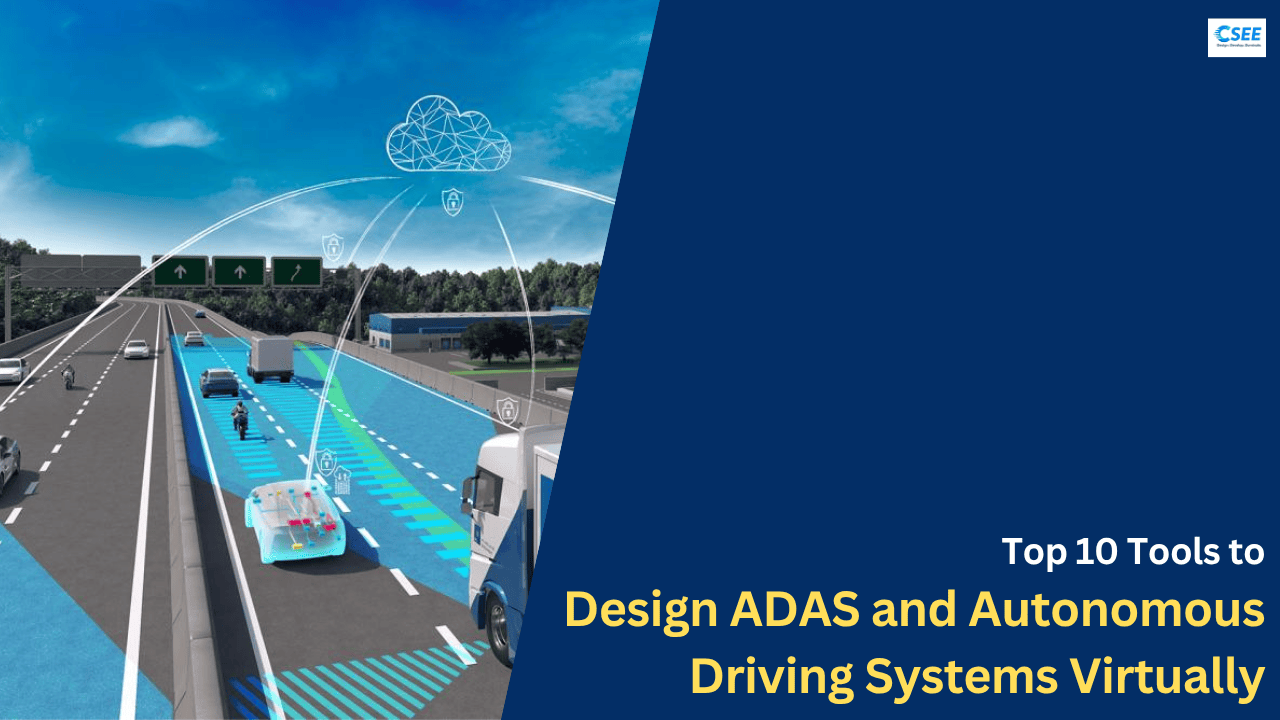
The automotive industry is rapidly moving toward software-defined vehicles, Advanced Driver Assistance Systems (ADAS), and autonomous driving. Modern vehicles are no longer developed only through physical prototypes and road testing. A significant part of development now happens virtually using simulation, digital twins, scenario generation, sensor modeling, Software-in-the-Loop (SIL), Model-in-the-Loop (MIL), Processor-in-the-Loop (PIL), and Hardware-in-the-Loop (HIL) testing.
ADAS functions such as Adaptive Cruise Control, Automatic Emergency Braking, Lane Keeping Assist, Lane Departure Warning, Traffic Sign Recognition, Blind Spot Detection, Parking Assist, and Highway Assist require extensive testing. A vehicle operating on a real road can encounter thousands of different combinations of traffic, weather, lighting, road geometry, pedestrians, vehicles, and sensor conditions. Testing every combination physically would require enormous amounts of time and money. Virtual simulation allows engineers to create these situations digitally and test ADAS algorithms repeatedly.
The most important tools used in this area include MATLAB and Simulink, IPG CarMaker, dSPACE AURELION and ASM, NVIDIA DRIVE Sim, CARLA, Siemens Simcenter Prescan, VIRES VTD, rFpro, Ansys AVxcelerate, and Vector DYNA4. Each platform has different strengths, and the right choice depends on whether the engineer is focusing on control systems, vehicle dynamics, perception, sensor simulation, AI, scenario generation, ECU testing, or complete autonomous-driving validation.
1. MATLAB and Simulink
MATLAB and Simulink are among the most widely used environments for automotive algorithm development and Model-Based Development. They are particularly useful for engineers developing ADAS functions, control algorithms, vehicle models, state machines, sensor-fusion algorithms, and embedded software.
The Automated Driving Toolbox extends the MATLAB and Simulink ecosystem toward autonomous-driving applications. Engineers can use it for scenario generation, sensor simulation, perception algorithms, tracking, sensor fusion, planning, and ADAS function development.
Important applications include:
- Adaptive Cruise Control
- Automatic Emergency Braking
- Lane Keeping Assist
- Lane Departure Warning
- Object detection
- Object tracking
- Sensor fusion
- Path planning
- Trajectory generation
- Parking systems
- Vehicle control
- Scenario-based testing
- Algorithm validation
One major advantage of MATLAB and Simulink is the connection between modeling and embedded implementation. Engineers can develop a control algorithm as a model, test it through simulation, generate production-oriented code, and subsequently validate it on target hardware.
A typical workflow can be:
- Model development
- MIL testing
- SIL testing
- PIL testing
- HIL testing
- ECU integration
- Vehicle testing
For engineers already working with MATLAB, Simulink, Stateflow, Embedded Coder, CAN, HIL and automotive embedded systems, this ecosystem provides a strong foundation for moving toward ADAS development.
2. IPG CarMaker
IPG CarMaker is a powerful virtual vehicle development and testing platform. It is particularly useful when engineers need to simulate not only an ADAS algorithm but also the behavior of the complete vehicle.
CarMaker can represent vehicle dynamics, road conditions, traffic participants, environmental conditions, driver behavior, and different test scenarios.
Important applications include:
- Vehicle dynamics simulation
- ADAS development
- Autonomous driving
- Powertrain simulation
- Chassis simulation
- Driver assistance
- Scenario testing
- ECU testing
- Virtual validation
- Vehicle control development
Consider an Automatic Emergency Braking system. The ADAS controller may generate a braking command, but engineers also need to understand how the vehicle physically reacts to that command.
The virtual workflow can be:
- ADAS algorithm
- Braking command
- Brake system model
- Tire forces
- Vehicle dynamics
- Vehicle deceleration
- Stopping distance
This makes vehicle simulation extremely important for ADAS engineers because software behavior and physical vehicle behavior need to be evaluated together.
CarMaker is particularly useful for engineers interested in the combination of:
- ADAS
- Vehicle dynamics
- Control systems
- Embedded software
- Virtual testing
3. dSPACE AURELION, ASM and VEOS
dSPACE provides a large ecosystem for automotive development, simulation, and testing. AURELION, ASM, and VEOS address different parts of virtual development and validation.
AURELION is focused on highly realistic virtual environments and sensor simulation. ASM provides simulation models for vehicles and environments, while VEOS supports virtual simulation of ECU and system software.
These technologies can be used to create a workflow involving:
- Virtual environment
- Vehicle model
- Sensor model
- ECU software
- ADAS algorithm
- Test automation
- Performance analysis
AURELION is particularly relevant for perception and sensor-related ADAS development because modern autonomous vehicles rely on multiple sensors.
Important sensors include:
- Camera
- Radar
- LiDAR
- Ultrasonic sensors
- GPS
- IMU
Each sensor has different characteristics, limitations, noise sources, and detection capabilities. Virtual sensor simulation allows engineers to test these characteristics without always requiring physical sensors and vehicles.
dSPACE technologies are also highly relevant for HIL development, making the platform useful for engineers who want to move from virtual simulation toward physical ECU validation.
4. NVIDIA DRIVE Sim and NVIDIA Simulation Technologies
Artificial intelligence and deep learning are becoming increasingly important in autonomous driving. As a result, GPU-based simulation and synthetic data generation are becoming important technologies for ADAS development.
NVIDIA provides simulation technologies designed for autonomous vehicle development, including DRIVE Sim and related simulation technologies.
These platforms can support:
- Autonomous-driving simulation
- Sensor simulation
- Synthetic data generation
- AI development
- Perception testing
- 3D environments
- Scenario generation
- Virtual validation
- GPU-accelerated workloads
Synthetic data is particularly important for AI-based perception systems. An autonomous vehicle may need to recognize pedestrians, vehicles, traffic signs, road markings, cyclists, and other objects.
Collecting and labeling millions of real-world images can be expensive and time-consuming. Virtual environments can generate large amounts of synthetic data with controlled variations.
For example:
- Change vehicle speed
- Change weather
- Change lighting
- Change pedestrian position
- Change traffic density
- Change camera position
- Add different road conditions
The resulting data can be used for training and validating perception algorithms.
NVIDIA’s ecosystem is particularly relevant for engineers interested in:
- ADAS
- AI
- Computer vision
- Deep learning
- GPU computing
- CUDA
- Autonomous systems
5. CARLA
CARLA is an open-source simulator designed specifically for autonomous-driving research and development. It is one of the most useful platforms for engineers, students, researchers, and developers who want practical experience with autonomous-driving simulation.
CARLA provides virtual environments containing:
- Vehicles
- Pedestrians
- Roads
- Traffic
- Traffic lights
- Buildings
- Cameras
- LiDAR
- GPS
- IMU
- Weather
- Environmental conditions
One of its major advantages is programmability. Engineers can use programming interfaces to control vehicles, create scenarios, configure sensors, and automate experiments.
For example, an engineer can create an Automatic Emergency Braking scenario:
- Vehicle travels at a defined speed
- Pedestrian enters the road
- Camera detects the pedestrian
- Perception algorithm estimates position
- Collision risk is calculated
- Braking command is generated
- Vehicle dynamics are simulated
- Stopping distance is measured
The same experiment can be repeated with different speeds, distances, weather conditions, pedestrian locations, and sensor configurations.
CARLA is especially useful for learning:
- Python
- C++
- Computer vision
- Sensor simulation
- Autonomous driving
- Deep learning
- Robotics
- Scenario testing
A strong learning combination is:
- CARLA
- Python
- OpenCV
- PyTorch
- C++
- ROS 2
6. Siemens Simcenter Prescan
Simcenter Prescan is a simulation platform focused strongly on ADAS and autonomous-driving applications.
One of its important areas is sensor simulation. Modern ADAS systems depend on multiple sensors, and engineers need to understand how these sensors behave in different environments.
Prescan can be used for:
- Camera simulation
- Radar simulation
- LiDAR simulation
- Vehicle simulation
- Environment simulation
- Traffic scenarios
- Sensor fusion
- ADAS testing
- Autonomous-driving validation
Different sensors provide different types of information.
Camera systems provide visual information.
Radar can provide range and relative velocity information.
LiDAR provides three-dimensional point-cloud information.
GPS and IMU can provide position and motion-related information.
A virtual environment can generate these sensor outputs and provide them to the ADAS algorithm.
A simplified workflow can be:
- Virtual road
- Virtual vehicle
- Virtual radar
- Object detection
- Target tracking
- Sensor fusion
- ACC controller
- Vehicle response
This makes Prescan particularly useful for engineers interested in sensor modeling and ADAS validation.
7. VIRES VTD
VIRES Virtual Test Drive, commonly known as VTD, is a platform used for virtual driving simulation and scenario-based testing.
VTD can represent:
- Road networks
- Traffic
- Vehicles
- Pedestrians
- Environment
- Weather
- Sensors
- Driving scenarios
Scenario generation is one of the most important aspects of autonomous-driving development.
For example, a Lane Keeping Assist system may need to be tested on:
- Straight roads
- Curved roads
- Narrow roads
- Wide roads
- Roads with good markings
- Roads with poor markings
- Wet roads
- Different traffic conditions
- Different vehicle speeds
- Different lighting conditions
Testing all these scenarios physically would be difficult.
Virtual scenario-generation tools allow engineers to create multiple variations and execute them automatically.
VTD can therefore form part of a broader virtual validation environment for ADAS and autonomous-driving systems.
8. rFpro
rFpro is focused on high-fidelity virtual testing for automotive development.
High-fidelity simulation becomes especially important when perception algorithms depend on realistic environmental information.
For example, a camera-based perception system needs to interpret:
- Road markings
- Vehicles
- Pedestrians
- Buildings
- Trees
- Traffic signs
- Shadows
- Lighting
- Road surfaces
- Weather conditions
If the virtual environment is too simple, it may not provide sufficiently realistic data for perception testing.
High-fidelity simulation aims to create virtual environments that better represent real-world conditions.
rFpro can therefore be useful for:
- ADAS development
- Autonomous driving
- Camera testing
- LiDAR-related workflows
- Sensor simulation
- Perception testing
- Virtual validation
- Scenario testing
This type of simulation becomes increasingly important as vehicles move toward more advanced autonomous-driving capabilities.
9. Ansys AVxcelerate
Ansys AVxcelerate is focused on virtual development and testing of autonomous vehicles and ADAS systems.
The platform addresses the interaction between the vehicle, environment, and sensors.
Important areas include:
- Camera simulation
- Radar simulation
- LiDAR simulation
- Vehicle simulation
- Environment simulation
- Sensor perception
- ADAS testing
- Autonomous-driving validation
Consider an autonomous vehicle approaching an intersection.
The virtual scenario can contain:
- Road geometry
- Traffic lights
- Other vehicles
- Pedestrians
- Environmental conditions
- Camera
- Radar
- LiDAR
The simulation can then evaluate the complete chain:
- Environment
- Sensor response
- Perception
- Object tracking
- Decision making
- Planning
- Control
- Vehicle response
This type of end-to-end simulation helps engineers test scenarios that may be difficult, expensive, or unsafe to reproduce repeatedly on real roads.
10. Vector DYNA4
Vector is widely known in automotive development and testing through tools used for CAN, ECU communication, diagnostics, measurement, and calibration.
DYNA4 extends this ecosystem toward vehicle simulation and virtual testing.
It can be used for:
- Vehicle dynamics
- ECU testing
- ADAS development
- Virtual testing
- Software-in-the-Loop
- Hardware-in-the-Loop
- Vehicle simulation
DYNA4 can be particularly useful for engineers who already work with automotive communication and ECU development.
A possible workflow is:
- Virtual vehicle model
- ECU software
- CAN or CAN FD communication
- ADAS function
- Vehicle response
- Test automation
This creates a bridge between traditional ECU development and virtual vehicle simulation.
For engineers working with CANoe, CANalyzer, CANape, ECU software, HIL, and automotive communication systems, understanding vehicle simulation can add another important capability to their skill set.
Important Skills Required for ADAS Simulation
Learning the software is only one part of becoming an ADAS engineer. Engineers also need to understand the technical concepts behind the tools.
Important vehicle-dynamics topics include:
- Longitudinal dynamics
- Lateral dynamics
- Tire forces
- Steering
- Braking
- Acceleration
- Yaw rate
- Vehicle mass
- Wheelbase
- Center of gravity
- Slip angle
- Road friction
Sensor knowledge is also extremely important.
Important sensor technologies include:
- Camera
- Radar
- LiDAR
- Ultrasonic
- GPS
- IMU
Engineers should understand what information each sensor provides and what its limitations are.
Computer Vision for ADAS
Camera-based ADAS systems require strong computer-vision knowledge.
Important areas include:
- Image processing
- Feature extraction
- Object detection
- Object tracking
- Lane detection
- Semantic segmentation
- Depth estimation
- Optical flow
- Image classification
Modern perception systems increasingly use deep learning.
Therefore, ADAS engineers interested in perception should also understand:
- Neural networks
- CNNs
- Object-detection models
- Segmentation models
- Model training
- Dataset preparation
- Model evaluation
- Inference optimization
Sensor Fusion
Autonomous vehicles rarely depend on a single sensor.
A camera may provide object classification, radar can provide range and relative velocity, and LiDAR can provide detailed three-dimensional information.
Sensor fusion combines these different sources.
Important sensor-fusion topics include:
- Kalman Filter
- Extended Kalman Filter
- Unscented Kalman Filter
- Bayesian estimation
- Object tracking
- Coordinate transformations
- Sensor calibration
- Time synchronization
- Data association
Sensor fusion is particularly important for advanced autonomous-driving systems because different sensors can complement each other’s limitations.
Planning and Decision Making
After perception and sensor fusion, the vehicle needs to decide what it should do.
Planning can include:
- Route planning
- Behavior planning
- Path planning
- Trajectory generation
- Obstacle avoidance
- Lane changes
- Parking
- Overtaking
- Intersection handling
A simplified workflow is:
- Detect object
- Estimate object behavior
- Determine risk
- Select driving behavior
- Generate trajectory
- Send trajectory to controller
Planning therefore connects perception with vehicle control.
Control Systems
Once the desired trajectory is generated, the vehicle needs to follow it.
Important control topics include:
- PID control
- State-space control
- Model Predictive Control
- Lateral control
- Longitudinal control
- Steering control
- Braking control
- Acceleration control
MATLAB and Simulink are particularly useful for developing and testing these controllers.
For example, a lane-keeping controller can calculate lateral error and steering corrections.
The workflow can be:
- Camera detects lane
- Lane model is generated
- Lateral error is calculated
- Controller calculates steering command
- Vehicle model responds
- Error is measured
Programming Skills for Autonomous Driving
Modern ADAS engineers benefit from having both modeling and programming skills.
Important languages include:
- C
- C++
- Python
- MATLAB
- CUDA
C is important for embedded automotive software.
C++ is widely used in high-performance automotive and robotics applications.
Python is extremely useful for simulation, data processing, machine learning, and automation.
MATLAB is valuable for algorithm development, mathematical modeling, simulation, and control systems.
CUDA becomes increasingly relevant when working with GPU acceleration and AI workloads.
A strong combination is:
- MATLAB
- Simulink
- C
- C++
- Python
- CUDA
ROS 2 for Autonomous Systems
ROS 2 is another useful technology for engineers moving toward autonomous systems and robotics.
It provides communication infrastructure between different software components.
A simplified autonomous-driving architecture can be:
- Camera node
- Perception node
- Object-tracking node
- Planning node
- Control node
- Vehicle-interface node
ROS 2 can therefore complement automotive simulation tools and help engineers understand distributed software architectures.
MIL, SIL, PIL and HIL
Understanding different testing levels is essential for automotive software engineers.
Model-in-the-Loop focuses on testing the algorithm at the model level.
A typical setup is:
- Simulink controller
- Virtual sensors
- Virtual vehicle
Software-in-the-Loop executes software implementation within a simulated environment.
Processor-in-the-Loop evaluates the algorithm on the target processor or a representative processing environment.
Hardware-in-the-Loop connects a real ECU to a simulated vehicle and environment.
A simplified HIL setup can be:
- Real ECU
- CAN/CAN FD
- HIL simulator
- Virtual sensors
- Virtual vehicle
- Test automation
This allows engineers to test real ECU hardware without physically driving the vehicle.
Scenario-Based Testing
Scenario-based testing is becoming increasingly important in ADAS and autonomous driving.
A single scenario can contain many variables:
- Vehicle speed
- Road curvature
- Weather
- Lighting
- Traffic density
- Pedestrian position
- Sensor noise
- Vehicle position
- Road friction
- Object velocity
When these variables are combined, the number of possible scenarios becomes enormous.
Virtual simulation allows engineers to generate variations automatically.
For example, one pedestrian-crossing scenario can be modified by changing:
- Vehicle speed
- Pedestrian speed
- Pedestrian distance
- Road conditions
- Lighting
- Weather
The same ADAS algorithm can then be evaluated against hundreds or thousands of variations.
Digital Twins for Automotive Development
Digital twins are becoming another important concept in automotive engineering.
A digital twin can represent a virtual version of a physical system.
An automotive digital twin can potentially contain:
- Vehicle model
- ECU behavior
- Sensors
- Environment
- Traffic
- Powertrain
- Chassis
- Software
- Communication networks
The objective is to create a sufficiently representative virtual system for development, testing, monitoring, or analysis.
This can reduce dependence on physical prototypes during certain stages of development.
Best Learning Path for Beginners
A beginner should not try to master all 10 tools simultaneously.
A practical learning path can be:
- MATLAB
- Simulink
- Python
- Computer vision
- CARLA
- OpenCV
- PyTorch
- Sensor fusion
- ROS 2
- C++
- NVIDIA simulation technologies
- CUDA
This combination provides exposure to automotive engineering, simulation, AI, perception, robotics, and embedded software.
Best Learning Path for MATLAB/Simulink Engineers
For engineers who already have experience with MATLAB, Simulink, Stateflow, Embedded C, CAN and HIL, the learning path can be more advanced.
A possible progression is:
- Advanced Simulink
- ADAS algorithm development
- Scenario generation
- CARLA
- Python
- Computer vision
- Sensor fusion
- ROS 2
- C++
- Deep learning
- GPU computing
- CUDA
- High-fidelity sensor simulation
This can help transition from traditional Model-Based Development toward ADAS, autonomous systems, and AI-based automotive development.
Project Idea: Automatic Emergency Braking
One practical project is to create a complete virtual Automatic Emergency Braking system.
The project can contain:
- Virtual road
- Virtual vehicle
- Virtual pedestrian
- Camera or radar
- Object detection
- Distance estimation
- Relative velocity estimation
- Time-to-collision calculation
- Braking decision
- Vehicle controller
- Vehicle dynamics
- Test automation
The system can be tested at different:
- Vehicle speeds
- Pedestrian distances
- Weather conditions
- Lighting conditions
- Road conditions
- Sensor-noise levels
The final metrics can include:
- Detection accuracy
- Detection latency
- False positives
- False negatives
- Reaction time
- Braking distance
- Collision avoidance
- System robustness
Project Idea: Lane Keeping Assist
Another excellent project is Lane Keeping Assist.
A simplified architecture can be:
- Camera
- Image processing
- Lane detection
- Lane modeling
- Lateral-error calculation
- Controller
- Steering command
- Vehicle dynamics
- Performance analysis
The system can be tested under:
- Straight roads
- Curved roads
- Different vehicle speeds
- Different lane widths
- Different road markings
- Poor lighting
- Rain
- Sensor noise
This project demonstrates knowledge of computer vision, control systems, vehicle dynamics, simulation, and ADAS testing.
Final Conclusion
Virtual simulation is becoming a fundamental part of modern ADAS and autonomous-driving development. Engineers can use simulation to design algorithms, model vehicles, generate scenarios, simulate sensors, test perception systems, validate controllers, evaluate edge cases, and perform large-scale testing before deploying software on physical vehicles.
The 10 important tools discussed in this article are:
- MATLAB and Simulink
- IPG CarMaker
- dSPACE AURELION, ASM and VEOS
- NVIDIA DRIVE Sim
- CARLA
- Siemens Simcenter Prescan
- VIRES VTD
- rFpro
- Ansys AVxcelerate
- Vector DYNA4
Each tool addresses different aspects of the ADAS development lifecycle. MATLAB and Simulink are highly useful for model-based development and control algorithms. CarMaker and DYNA4 are strong in vehicle simulation. dSPACE provides a broad virtual-to-HIL ecosystem. NVIDIA focuses heavily on GPU-based simulation and AI. CARLA provides an accessible open-source environment for autonomous-driving development. Prescan, AVxcelerate, AURELION and rFpro provide strong capabilities around sensor and environment simulation, while VTD is valuable for scenario-based virtual testing.
The most important point is that an ADAS engineer should not learn these tools in isolation. The real value comes from understanding the complete system:
Scenario → Environment → Sensors → Perception → Sensor Fusion → Decision Making → Planning → Control → Vehicle Dynamics → Validation
The future of automotive engineering will increasingly combine simulation, artificial intelligence, digital twins, synthetic data, GPU computing, automated testing, embedded systems, and real-world vehicle validation.
For engineers looking to build a strong career in ADAS and autonomous driving, a combination of MATLAB/Simulink, C/C++, Python, computer vision, sensor fusion, ROS 2, AI, simulation and GPU technologies can provide a strong technical foundation.
Also, read:
- “Mother of All Deals”: How The EU–India Free Trade Agreement Can Reshape India’s Economic Future
- 10 Free ADAS Projects With Source Code And Documentation – Learn & Build Today
- 10 Tips To Maintain Battery For Long Life, Battery Maintainance
- 10 Tips To Save Electricity Bills, Save Money By Saving Electricity
- 100 (AI) Artificial Intelligence Applications In The Automotive Industry
- 100 + Electrical Engineering Projects For Students, Engineers
- 100 GitHub Projects to Level Up Your Embedded Engineering Skills
- 100+ C Programming Projects With Source Code, Coding Projects Ideas