A working paper on brain-computer interfaces, neural decoding, and assistive speech technology
Neuralink VOICE: Speaking Without Moving Your Mouth
Somewhere in the brain of a man named Kenneth Shock, a thought forms. He is not moving his lips. He is not breathing out a syllable. He is not doing anything a camera, a microphone, or another human being sitting across from him could detect. And yet, a few hundred milliseconds later, a computer speaks his sentence out loud, in a voice that sounds unmistakably like his own — the same voice his family heard before amyotrophic lateral sclerosis, or ALS, took it away from him in 2024. This is not a magic trick. It is the result of a chain of engineering, each link built from a different field: neuroscience, microelectronics, signal processing, machine learning, and speech synthesis. This article walks through that entire chain, piece by piece, from the electrical noise of a single neuron to the sound waves reaching a listener’s ear.
This isn’t speculative. Neuralink’s VOICE trial — formally registered as an Early Feasibility Study titled “Precision Robot-Implanted Brain-Machine Interfaces for Communication Recovery” — is an active clinical program. As of early-to-mid 2026 it has enrolled multiple participants, several of whom have ALS and have lost the physical ability to speak. What follows is a detailed, plain-language technical explanation of how the system works: the implant, the electrodes, the decoding pipeline, and the voice-generation layer that turns a decoded sentence back into audible, personal speech.
ALS progressively disconnects the brain’s motor commands from the muscles that carry them out. Late in the disease, a person can be entirely “locked in” — fully conscious, fully capable of thought and language, with no reliable way to express either. Existing assistive tools, like eye-tracking spellers, are slow and depend on muscles that ALS eventually takes too. A system that reads speech intention directly from the brain sidesteps the muscles altogether.
1. What “speaking with your mind” actually means
It helps to separate three very different things that all get casually called “mind reading.” The first is reading thoughts in general — abstract ideas, memories, private opinions. Nothing in this technology does that, and nothing on the horizon does either. The second is reading attempted movement — the brain’s outgoing commands to muscles that no longer respond. The third, and the hardest, is reading imagined movement — a person picturing an action without any attempt to execute it. Neuralink’s VOICE system is built around the second and third categories, specifically as they apply to speech: the brain’s intent to move the lips, tongue, jaw, and larynx into the shapes and rhythms of language.
Speech is, from the brain’s point of view, a motor act, not a magical one. Long before air leaves your lungs and your vocal folds vibrate, your brain has already planned a rapid, highly coordinated sequence of muscle movements — sometimes 10 to 15 distinct articulator movements per second. The brain regions that plan this sequence are active whether or not the muscles ever receive the signal. In an ALS patient, the planning circuitry is often still healthy long after the motor neurons that would carry its output to the muscles have degenerated. That gap — a fully functioning “speech planner” with a severed connection to the body — is exactly the gap a brain implant is built to bridge.
Getting a decoding system to work reliably requires training it on a spectrum of effort, from full physical attempt down to pure imagination. Reporting on the trial describes a three-stage calibration protocol used with participants:
- Stage 1 — Overt speech
The participant speaks sample sentences out loud as normal. The implant records the neural activity that accompanies fully executed speech, giving the system a clean, high-confidence link between specific brain patterns and specific sounds.
- Stage 2 — Mimed / silent speech
The participant mouths the same words without vocalizing — moving the lips and jaw but producing no sound. This isolates the neural signal from the acoustic one and starts weaning the system off audio as a crutch.
- Stage 3 — Imagined / attempted speech
The participant simply intends to speak, without any observable movement at all. This is the mode the system ultimately needs to operate in for patients whose muscles no longer respond — and it is the hardest signal to decode, because it is quieter and more variable than the other two.
Each stage produces labeled training data — “here is the brain pattern, here is the word it corresponds to” — that a machine-learning model uses to build an internal map from neural activity to language. The progression from stage 1 to stage 3 is also a progression in difficulty for the decoder: overt speech gives strong, repeatable signals, while imagined speech is noisier and drifts more from session to session. Building a decoder that survives that drift is one of the central engineering problems in the whole field, and it’s discussed in more detail later in this article.
2. A short tour of the speech-planning brain
To place an implant usefully, you first have to know where to put it. Speech production recruits a network of regions, but the area most directly relevant here sits in the precentral gyrus, part of the primary motor cortex, in a strip sometimes informally called the “speech motor cortex.” This region contains a detailed, somewhat exaggerated map of the body’s articulators — the lips, jaw, tongue, and larynx each occupy a disproportionately large patch of cortical real estate, because fine motor control of speech requires an enormous amount of neural machinery per muscle compared with, say, the muscles of the back.
The four articulator zones targeted within the speech motor cortex
Placing electrode threads within or near this strip means the implant is listening to neurons that are, in effect, issuing the low-level motor commands for speech — not the higher-level linguistic planning of word choice or grammar, but the physical choreography of turning a chosen word into a sequence of mouth movements. This is a deliberate choice: motor commands are more consistent and more directly translatable into phonemes than the more abstract, distributed representations of language meaning found elsewhere in the brain. It’s also why the system decodes phonemes and words rather than “thoughts” in any broader sense — it is reading the brain’s articulation plan, not its inner monologue in some general sense.
3. The N1 implant: architecture and specifications
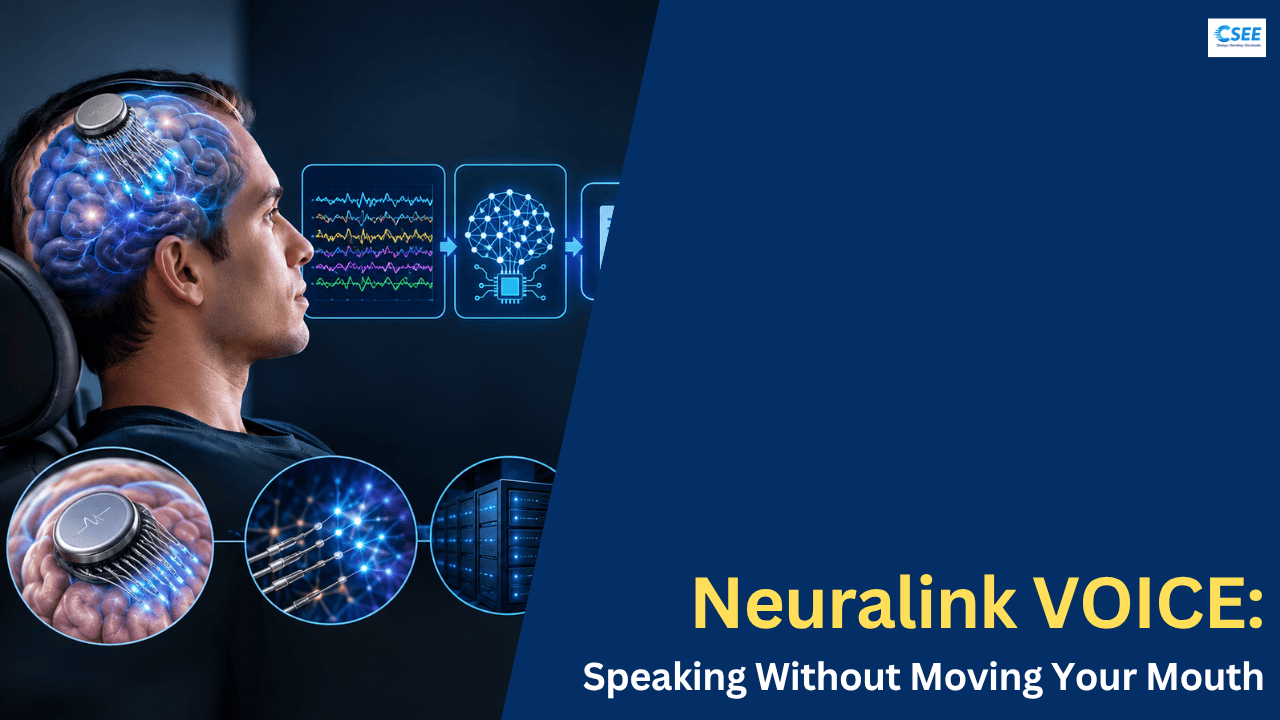
The hardware doing the listening is Neuralink’s N1 implant, a coin-sized device that sits within the skull, flush with the bone, with a bundle of ultra-thin polymer threads extending from it into the cortical surface. Each thread carries multiple electrode contacts along its length. Public disclosures around the VOICE trial describe implants with on the order of 1,024 individual electrode channels in earlier participants, with later participants receiving devices in the range of several thousand channels as the platform has matured — reflecting Neuralink’s stated trajectory of steadily increasing channel density with each hardware revision.
| Component | Function | Notable detail |
|---|---|---|
| Electrode threads | Make physical contact with cortical tissue and pick up electrical activity from nearby neurons | Ultra-flexible polymer, thinner than a human hair, inserted by robotic surgery |
| Electrode contacts | Individual sensing points distributed along each thread | Roughly 1,024 channels in early speech-trial devices; higher counts in newer revisions |
| Custom ASIC | Amplifies and digitizes the tiny voltage fluctuations picked up by each electrode | Processes signals from all channels in parallel, on-chip |
| Wireless radio | Streams processed neural data out of the skull without a wired connection | Bluetooth-class short-range link to an external receiver |
| Rechargeable battery | Powers the implant continuously | Charged wirelessly through the scalp, no external cable |
| Hermetic casing | Seals electronics from the body’s fluids | Sits flush with the skull, invisible externally |
| Surgical placement | Positions threads with sub-millimeter precision while avoiding surface blood vessels | Performed by Neuralink’s R1 surgical robot rather than by hand |
Two design decisions stand out. First, the threads are deliberately flexible rather than rigid — brain tissue shifts slightly with every heartbeat and breath, and a rigid electrode would slice through cells over months of micro-movement, while a flexible one moves with the tissue. Second, insertion is done by a purpose-built surgical robot, not a human hand, because the threads are both too fine and too numerous to place manually with the precision required, and because the robot can actively steer around visible surface blood vessels while inserting, reducing bleeding risk.
Simplified representation of an electrode channel array — each square is one independent sensing contact, sampling continuously
4. From a single neuron to a digital signal
Neurons communicate using brief electrical events called action potentials, or spikes — sudden, roughly one-millisecond voltage swings that travel down a neuron and trigger the release of chemical signals to its neighbors. An electrode sitting close enough to a neuron can detect the tiny voltage ripple this creates in the surrounding tissue. The catch is that any single electrode usually picks up a blend of activity from several nearby neurons at once, all superimposed on each other along with electrical noise from muscle activity, the implant’s own electronics, and the body generally.
Turning that raw, messy voltage trace into something useful requires several processing steps, most of which happen extremely fast, on the order of milliseconds:
The ASIC boosts the microvolt-scale signal and filters out slow drifts and high-frequency noise, isolating the frequency band where spikes live.
The system scans the cleaned signal for voltage crossings that match the shape of a genuine action potential, discarding noise artifacts.
Where multiple neurons share one electrode, their spike shapes are distinguished so individual neurons’ activity can be tracked separately over time.
Spiking rates and other signal features are computed in short time windows (often tens of milliseconds) across all channels, producing a compact numerical snapshot of brain state at each moment.
This compressed feature stream — not raw electrode voltages — is what actually gets radioed out of the implant, keeping bandwidth and power needs manageable.
This on-chip preprocessing is one of the least visible but most important parts of the whole system. A device with over a thousand channels sampled thousands of times per second generates far more raw data than any wireless link small enough to fit in the skull could transmit continuously. Compressing that firehose down to the meaningful features — while doing it in real time, with a power budget measured in milliwatts — is a serious engineering constraint that shapes almost every other design decision in the implant.
5. The AI speech-decoding pipeline
Once a stream of neural features is flowing out of the skull, the job shifts from electronics to machine learning. The receiving system’s task is to answer, dozens of times per second: given this pattern of brain activity, what sound, syllable, or word was the person intending to produce? This is fundamentally a sequence-decoding problem, structurally similar to speech recognition — except the “audio” is neural activity instead of sound.
Continuous, multi-channel numerical data representing firing patterns across the speech motor cortex.
A neural network — typically built from recurrent or transformer-style layers suited to time-series data — learns to map patterns of neural activity onto probable phonemes, the smallest distinguishable units of speech sound (roughly 40 in English).
Rather than committing to a single answer instantly, the model outputs a ranked likelihood over possible phonemes at each moment, acknowledging uncertainty in noisy signal.
A language model — the same kind of statistical or neural system that powers predictive text — stitches the phoneme stream into the most probable real words and grammatical sentences, correcting for ambiguous or noisy phoneme guesses using context.
The final output is ordinary written text — the sentence the system believes the person intended to say.
This two-layer structure — a low-level acoustic-style decoder feeding a higher-level language model — mirrors how modern voice-recognition software works, and for the same reason. Phoneme decoding alone is genuinely ambiguous; many phonemes look similar in neural (or acoustic) signal, and a language model’s knowledge of which word sequences are actually likely in English does a huge amount of error correction. This is why the system gets noticeably better the more it’s used: not only does the neural decoder adapt to a specific person’s brain patterns, but its output is filtered through increasingly well-tuned expectations about that person’s vocabulary and sentence habits.
Decoding speed remains one of the most actively worked-on problems. Early public demonstrations describe a process that could take on the order of minutes for some phrases, with the explicit goal of pushing toward real conversational latency — a delay so brief it feels like ordinary back-and-forth talk rather than a typed message being read aloud. Closing that gap requires improvements at every layer: faster on-chip preprocessing, decoder models that can commit to an answer with fewer neural samples, and language models tuned to resolve ambiguity in a single pass rather than through slow, iterative correction.
Why calibration and drift are hard problems
A brain is not a static input device. The exact firing pattern for the same intended word can shift slightly from one day to the next — because of fatigue, mood, medication, disease progression, or simply the natural turnover of which neurons an electrode happens to be closest to as tissue settles around it. A decoder trained once and left untouched will slowly degrade. In practice, this means the system needs periodic recalibration: short refresher sessions where the participant repeats known phrases, giving the model fresh labeled examples to correct its internal map. Managing that recalibration burden — making it brief and infrequent enough to be practical for someone who is often fatigued by their underlying condition — is as much a part of “the technology” as the electrodes themselves.
6. Turning decoded text into a human voice
Decoded text alone would already restore a form of communication — it could simply be displayed on a screen, the way many existing assistive-communication devices work. What makes this technology feel qualitatively different is the final layer: converting that text into spoken audio, and specifically into audio that sounds like the particular person speaking, rather than a generic computerized voice.
The sentence assembled by the language-model layer, ready to be spoken aloud.
The text-to-speech front end works out pronunciation, stress, and intended rhythm and intonation — the difference between a statement and a question, for instance.
A voice-synthesis model, trained in advance on recordings of the participant’s own pre-disease speech, generates audio in that person’s vocal identity rather than a generic voice.
The model renders an actual audio waveform — the sound pressure pattern that a speaker will reproduce as audible speech.
Sound is played through a speaker or connected device, completing the loop from silent intention to spoken word.
The personalization step is what has drawn the most public attention, and understandably so. In one widely covered case, engineers used recordings of the participant speaking years before his ALS diagnosis to train a voice model capable of reproducing his own vocal timbre, accent, and speech patterns — described by the team informally as his “original voice.” For a family, hearing that particular voice again, rather than a generic assistive-device monotone, is a fundamentally different experience, even though the words are arriving through an entirely different channel than they used to.
Voice-synthesis technology of this kind generally falls into two related approaches. Text-to-speech (TTS) systems generate speech directly from text using a model trained on a target voice. Voice conversion systems instead take speech-like input (which could come from a more generic synthesized voice) and transform its vocal characteristics to match a target speaker, while keeping the words unchanged. Modern personalized-voice pipelines often blend both ideas: a flexible TTS backbone that has been fine-tuned, or conditioned, on a smaller set of recordings from the specific individual, so that only a modest amount of pre-disease audio is needed to produce a convincing likeness — important, because most people never expect to need such a backup and only have whatever casual recordings already exist of them.
Reporting on later participants in the trial describes voice output being generated through xAI’s Grok Voice technology, suggesting the speech-synthesis layer of the pipeline is not necessarily built entirely in-house — it can draw on independently developed voice-generation systems, plugged in as the final stage of the chain described above.
7. The full system, end to end
Put every piece together, and the system reads as one continuous relay: an idea forms as a motor plan in the brain, is captured as electrical activity by implanted electrodes, is compressed and transmitted wirelessly, is decoded first into phonemes and then into words by machine-learning models, and is finally rendered back into audible, personalized sound. No single component is exotic in isolation — implantable electrodes, wireless telemetry, sequence models, and voice synthesis all exist elsewhere — but the achievement is in making the whole chain fast, reliable, and safe enough to run continuously in a living, moving human being.
The complete VOICE pipeline, condensed to seven stages
8. How this compares with older assistive-communication tools
People with ALS and similar conditions have long relied on assistive and augmentative communication (AAC) technology, and it’s worth being honest about how this new approach compares — including where it does not yet win.
| Approach | How it works | Typical limitation |
|---|---|---|
| Eye-tracking speller | User selects letters or words on a screen by gaze direction | Slow output rate; depends on reliable, sustained eye control, which can also decline in advanced disease |
| Switch scanning | A single reliable muscle movement (e.g., an eyebrow twitch) selects highlighted options as they cycle | Very slow; extremely limited words-per-minute |
| Partner-assisted scanning | A caregiver reads out letters or categories aloud, watching for a small, learned response | Requires a trained, present human partner at all times |
| Surface EMG / residual movement devices | Detects faint muscle electrical activity in areas not yet fully paralyzed | Only viable while some usable muscle activity remains |
| Neuralink VOICE (BCI-based) | Decodes speech intent directly from brain signals, bypassing muscles entirely | Currently early-stage: decoding latency, vocabulary breadth, and long-term reliability are still being refined |
The distinguishing promise of a brain-based approach is that it does not depend on any muscle at all — not eyes, not eyebrows, not residual limb twitches. That matters enormously for the later stages of ALS, when even the small, reliable movements other AAC systems depend on may no longer be available. It is also, at this stage, the newest and least mature option on the list, which is why it remains inside a formal clinical trial rather than an approved medical product.
9. Understanding ALS, and why the stakes are so high
ALS is a progressive neurodegenerative disease that destroys motor neurons — the nerve cells that carry commands from the brain and spinal cord to muscles throughout the body. As motor neurons die, the muscles they once controlled weaken and eventually stop responding altogether, while, critically, cognition, sensation, and language comprehension are typically preserved throughout. That combination — an unaffected mind trapped inside a body that can no longer execute its instructions — is what makes speech loss in ALS particularly devastating: it is not that the person has nothing to say, but that saying it has become physically impossible.
Speech is often one of the earliest and most keenly felt losses, because it strips away spontaneous, real-time participation in conversation long before it takes away broader independence. Restoring even a modest, imperfect capacity for spoken output — words appearing seconds after they are intended, in the person’s own remembered voice — represents a return of something disease had otherwise taken permanently and irreversibly.
10. Inside the VOICE clinical trial
| Detail | Description |
|---|---|
| Trial name | VOICE — an Early Feasibility Study |
| Formal title | Feasibility Study of Precision Robot-Implanted Brain-Machine Interfaces for Communication Recovery |
| Eligible conditions | Severe, irreversible speech impairment from causes including ALS, stroke, spinal cord injury, cerebral palsy, and multiple sclerosis |
| Implant used | N1 implant, surgically placed by the R1 robotic system |
| Regulatory status | FDA Breakthrough Device Designation granted; the device remains investigational and is not commercially approved |
| Broader program context | Runs alongside Neuralink’s earlier PRIME study (focused on cursor and device control); combined enrollment across programs has been reported at roughly 21 participants |
Breakthrough Device Designation is a regulatory pathway, not an approval — it signals that a regulator sees enough early evidence of meaningful benefit over existing options to justify a faster, more collaborative review process, while the underlying safety and effectiveness questions are still being answered through the trial itself. It’s an important distinction for setting expectations: participation is still an experimental, closely monitored medical procedure, not an off-the-shelf product.
11. Open challenges
None of this is finished technology, and it is worth being specific about what remains unresolved.
Latency. Early demonstrations describe decoding that can take substantially longer than natural conversational timing. Reaching a pace that feels like ordinary conversation — rather than a message being composed and then read aloud — is an explicit, unmet goal.
Vocabulary and generalization. Systems trained on a limited set of calibration sentences must still generalize to new, unrehearsed words and phrasings the person wants to say later, which is a much harder problem than recognizing a fixed, memorized phrase set.
Signal drift over time. As discussed earlier, both natural day-to-day variability and the underlying disease’s progression can shift the neural patterns a decoder relies on, requiring ongoing recalibration.
Surgical and biological durability. Any implanted electrode interacts with living tissue over years, not days; scar tissue formation, electrode degradation, and long-term biocompatibility all affect how well signal quality holds up over the long run.
Data privacy and security. A device that streams a continuous readout of neural activity out of the skull raises genuinely new questions about who can access that data, how it is stored, and what safeguards prevent misuse — questions that don’t have well-established answers yet, given how new this category of device is.
Equity of access. Early-stage implantable technology of this complexity is, realistically, available to a small number of trial participants; turning it into something broadly accessible to the ALS community at large is a manufacturing, regulatory, and cost problem layered on top of the underlying science.
12. Glossary
- Brain-computer interface (BCI)
- A system that reads signals directly from the brain (or, less commonly, writes signals into it) to create a communication channel that bypasses the usual nerves and muscles.
- N1 implant
- Neuralink’s implantable device, containing electrode threads and onboard electronics, placed within the skull.
- Electrode thread
- An ultra-thin, flexible strand carrying multiple electrical contacts, inserted into cortical tissue to sense neural activity.
- Action potential (spike)
- A brief electrical impulse generated by a neuron, the basic unit of neural signaling that electrodes are designed to detect.
- Phoneme
- The smallest distinguishable unit of speech sound — English has roughly 40 of them — used as an intermediate decoding target between raw signal and whole words.
- Decoder (in this context)
- A machine-learning model that translates a stream of neural features into a stream of likely phonemes or words.
- Language model
- A statistical or neural model of which word sequences are plausible in a language, used to resolve ambiguity in a raw decoded stream.
- Text-to-speech (TTS)
- Software that converts written text into audible spoken output.
- Voice cloning / personalized voice synthesis
- Techniques that train a speech-synthesis model to reproduce a specific individual’s vocal identity, typically from prior audio recordings of that person.
- Locked-in state
- A condition, sometimes reached in advanced ALS, in which a person retains full cognitive function but has lost nearly all voluntary muscle control, including speech.
- Breakthrough Device Designation
- An FDA regulatory pathway granted to devices showing early promise for serious conditions, accelerating review without constituting market approval.
13. Where this is heading
The trajectory implied by the VOICE trial is a familiar one in medical technology: a narrow, carefully supervised demonstration in a small number of participants, gradually expanding in channel count, decoding speed, and vocabulary breadth as engineering and clinical evidence accumulate. Each of the challenges above — latency, generalization, drift, durability, privacy, and access — represents a specific, ongoing body of work rather than a single unsolved mystery, which is generally a good sign for steady, incremental progress rather than a breakthrough that either arrives all at once or not at all.
What makes this particular application resonant, beyond the technical achievement, is the ordinariness of what it restores. Nobody in this trial is asking to control a robotic exoskeleton or fly a drone with their mind. They are asking to say good morning, to tell a joke, to correct someone’s pronunciation of their own name, to ask a question in a doctor’s office without a caregiver relaying it for them — the small, constant verbal texture of being a person among other people. A brain implant, a custom chip, a machine-learning decoder, and a voice-synthesis model are, in the end, being assembled for that: giving someone their voice back, in the most literal sense the phrase can carry.
This piece is a general technical explainer based on public reporting and disclosures about Neuralink’s VOICE trial as of 2026. Clinical trial technology changes quickly — specific figures such as electrode counts, participant numbers, and decoding speed are expected to keep evolving as the program progresses, and any individual’s outcome may differ from what has been publicly demonstrated.
Also, read:
- “Mother of All Deals”: How The EU–India Free Trade Agreement Can Reshape India’s Economic Future
- 10 Free ADAS Projects With Source Code And Documentation – Learn & Build Today
- 10 Tips To Maintain Battery For Long Life, Battery Maintainance
- 10 Tips To Save Electricity Bills, Save Money By Saving Electricity
- 100 (AI) Artificial Intelligence Applications In The Automotive Industry
- 100 + Electrical Engineering Projects For Students, Engineers
- 100 GitHub Projects to Level Up Your Embedded Engineering Skills
- 100+ C Programming Projects With Source Code, Coding Projects Ideas