Hello guys, welcome back to my blog. In this article, I will discuss the difference between an asynchronous counter and synchronous counter, what is an asynchronous counter, what is an asynchronous counter, applications of counters, etc.
If you need an article on some other topics then comment us below in the comment box. You can also catch me @ Instagram – Chetan Shidling.
Also, read:
- Difference Between Static RAM And Dynamic RAM, Definition, Applications.
- Difference Between Analog And Digital Integrated Circuits.
- Types Of Memories Used In Embedded System, Definition, Applications.
Asynchronous Counter And Synchronous Counter
Counters
Counters are sequential circuits used for counting the clock pulses. Since counters are sequential circuits they remember the number of input pulses applied at the input. Counters are combination of flip-flops, whose state change in response to clock pulses applied at the input.
Types Of Counters
01. Asynchronous counter
02. Synchronous counter
Asynchronous Counter Or Serial Counter

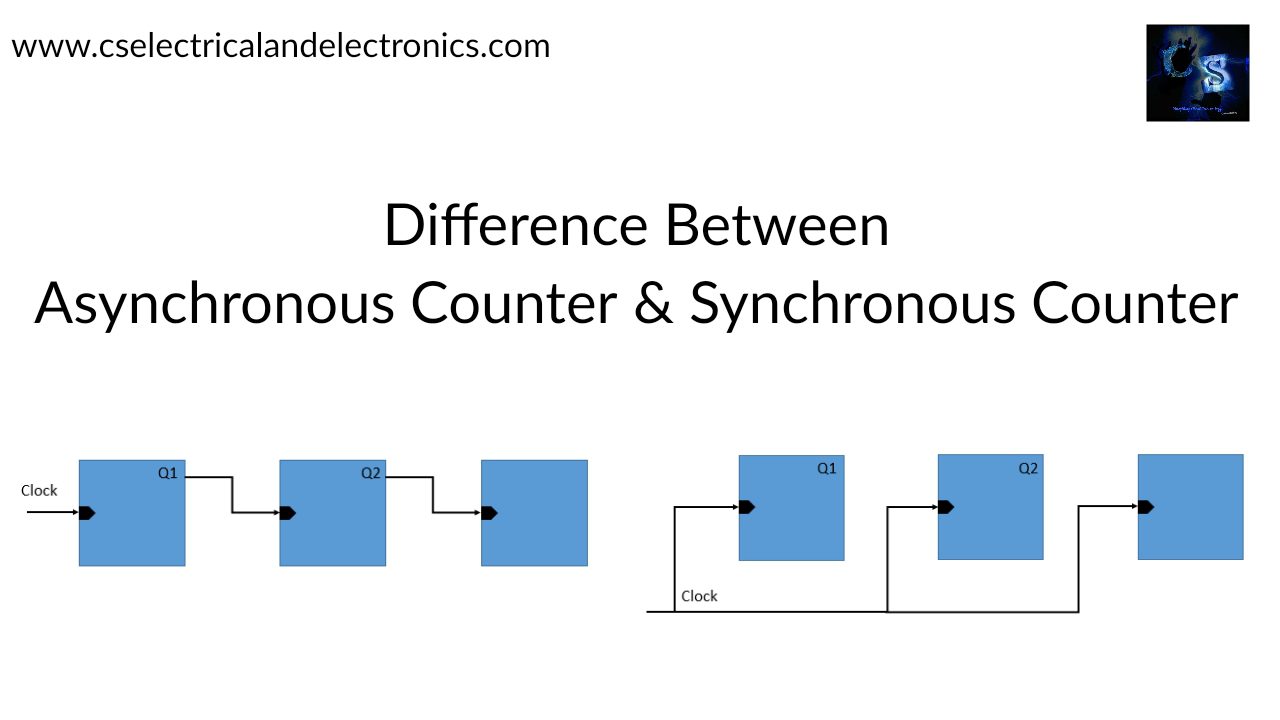
In the case of the asynchronous counter, all the flip-flops are not clocked simultaneously. The first flip-flop is triggered by the master clock pulse and other succeeding stages are triggered by the output of previous stages hence all the flip-flops are not in synchronism with the master clock. Therefore it is called asynchronous or serial counter. They are also called ripple-counters because each succeeding flip-flop is triggered by the previous flip-flop output just like ripples in water. The speed of operation is slow, circuits are simpler and require less hardware.
Synchronous Counter Or Parallel Counter

In the case of the synchronous counter, each and every flip-flop is triggered simultaneously. The master clock is applied to all the flip-flops that is all the flip-flops change state at the same time, therefore called a parallel counter. Since all flip-flop changes state at the same time, there is an increase in the speed of the serial counter. But requires more hardware.
Difference Between Asynchronous Counter And Synchronous Counter
| SI.No | Asynchronous Counter | Synchronous Counter |
| 01. | They are called serial or ripple counters. | They are called parallel counters. |
| 02. | In this flip-flops are connected in such a way that the output of the first flip-flop drives the clock for the next flip-flop. | In this type there is no connection between output of first flip-flop and clock of next flip-flop. |
| 03. | All flip-flops are not clocked simultaneously. | All flip-flops are clocked simultaneously. |
| 04. | A logic circuit is very simple even for more number of states. | A logic circuit is a complex as the number of states increases. |
| 05. | Hardware required is less. | Hardware required is more. |
| 06. | Less speed because the propagation delay is more. | High speed because the propagation delay is less. |
Applications Of Counters Or Applications Of Synchronous Counter And Asynchronous Counter
01. Digital clock which is a common example of counter application in time keeping.
02. Auto parking control. In this application, it uses up/down counter to solve the parking problem. This is a device with the means of monitoring at available space in 10 space parking garage and provides for indication of the full condition by illuminating the display sign and lowering the gate at the entrance.
03. Multiplexing i.e., parallel to serial data conversion.
04. Direct counting or event counting. This finds much application in many industrial processes counters will operate reliably where human counters fail. So because of fatigue or limitation of speed.
05. Frequency counter: It is an electronic circuit which can measure and display the frequency of electrical signal.
06. Measurement of distance.
07. Measurement of speed.
08. Digital counters.
09. Waveform generators.
I hope this article may help you all a lot. Thank you for reading. If you have any doubts related to this article “asynchronous counter and synchronous counter”, then comment below in the comment box.
Also, read:
- 10 Free ADAS Projects With Source Code And Documentation – Learn & Build Today
- 100 + Electrical Engineering Projects For Students, Engineers
- 100 GitHub Projects to Level Up Your Embedded Engineering Skills
- 100+ Indian Startups & What They Are Building
- 1000+ Automotive Interview Questions With Answers
- 1000+ Electronics Projects For Engineers, Diploma, MTech Students
- 1000+ MATLAB Simulink Projects For MTech, Engineering Students
- 20 Advanced Coursera Courses for Embedded Engineers That Can Lead to High-Paying Careers
- 2000+ Embedded Systems Interview Question Bank
- 2026 Hackathons That Can Change Your Tech Career Forever
- 25 AI & Embedded Technologies You Shouldn’t Miss
- 5 Amazing Websites to Learn Arduino Without Physical Hardware!
- 5 Budget-Friendly Boards to Start Your Embedded AI Journey
- 50 Advanced Level Interview Questions On CAPL Scripting
- 8051 Microcontroller Timers, TCON Register, TMOD Register
- 90% Of The World’s Most Advanced Chips Come from One Place — Why TSMC Quietly Runs the Modern World
- A Complete DSA Roadmap For Embedded Engineers
- A Complete Guide To FlexRay Automotive Protocol
- Accelerating Software-Defined Vehicles with Model-Based Design
- Active vs Passive ADAS: Which One is Driving The Future of Automotive Safety?