Most people don’t think about semiconductors when they unlock their phone, start their car, scroll social media, or ask an AI a question. Yet behind every one of these actions sits a tiny silicon chip—often smaller than your fingernail—that decides how fast, smart, and efficient our modern world can be.
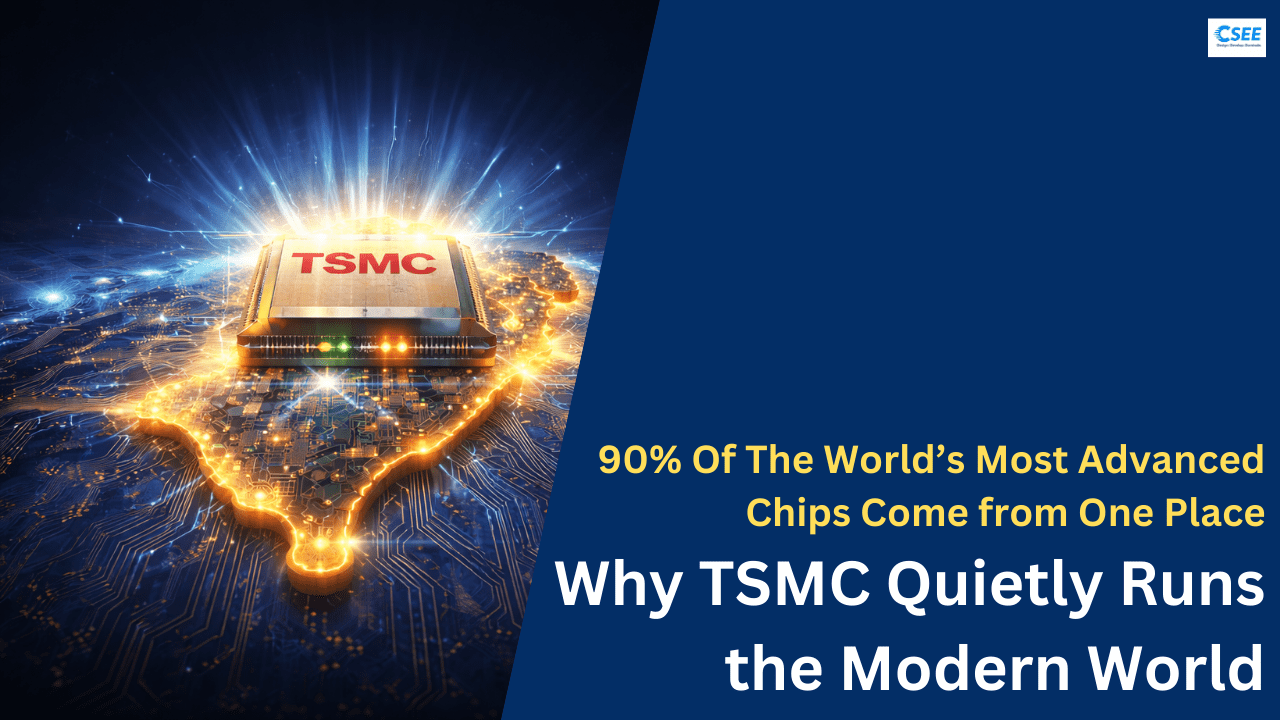
Here’s the surprising truth: nearly 90% of the world’s most advanced chips are manufactured by one company, in one place—TSMC in Taiwan.
This is not just a technology story. It’s a story about economics, geopolitics, national security, innovation, and the future of humanity. In this article, we’ll break it down in simple words—what TSMC is, why it matters so much, how it gained this dominance, what risks it creates, and what the future might look like.
1. What Are “Advanced Chips” and Why Do They Matter?
Before diving into TSMC, let’s first understand what advanced chips actually are.
1.1 What Is a Semiconductor Chip?
A semiconductor chip (or integrated circuit) is a tiny piece of silicon packed with billions of transistors. These transistors act like switches—on or off—that process information.
The more transistors you can fit:
- The faster the chip
- The more power-efficient it becomes
- The more complex tasks it can handle
This is why chips power:
- 📱 Smartphones
- 💻 Laptops and servers
- 🚗 Electric and autonomous vehicles
- 🤖 Artificial intelligence systems
- 🛰️ Satellites and defense systems
1.2 What Makes a Chip “Advanced”?
When people say advanced chips, they usually mean chips made using very small manufacturing processes, such as:
- 7nm
- 5nm
- 3nm
- (and soon 2nm)
“nm” stands for nanometer. Smaller numbers mean:
- More transistors
- Higher performance
- Lower power consumption
These chips are essential for:
- AI and machine learning
- High-end smartphones
- Data centers
- Advanced automotive systems
- Cutting-edge defense technology
And this is where TSMC dominates.
2. Meet TSMC: The Company Behind the World’s Chips
2.1 What Is TSMC?
TSMC (Taiwan Semiconductor Manufacturing Company) was founded in 1987 by Morris Chang.
Its business model was revolutionary at the time:
- TSMC would only manufacture chips
- It would not design its own products
- It would act as a neutral partner for everyone
This is known as a pure-play foundry model.
Before TSMC:
- Chip companies designed and manufactured chips
- Manufacturing was expensive and risky
- Innovation was slower
TSMC changed everything.
2.2 Who Uses TSMC?
Today, TSMC manufactures chips for:
- Apple (iPhones, MacBooks, iPads)
- NVIDIA (AI and GPUs)
- AMD (CPUs and GPUs)
- Qualcomm (mobile processors)
- MediaTek
- Tesla (automotive chips)
- Many defense and aerospace suppliers
If you use modern technology, you are already using TSMC chips—even if you’ve never heard the name.
3. The 90% Reality: How TSMC Dominates Advanced Manufacturing
3.1 The Numbers That Shock the World
As of today:
- TSMC produces ~90% of the world’s most advanced chips
- At 3nm and below, its dominance is even stronger
- Competitors like Samsung and Intel lag behind in yield, volume, or consistency
This level of concentration is unheard of in most industries.
3.2 Why Others Can’t Catch Up Easily
People often ask: Why can’t other companies just build similar factories?
The answer is simple—but brutal:
- Chip manufacturing is extremely complex
- Each advanced fab costs $15–25 billion
- It takes 10–20 years of experience to master yields
- One tiny mistake can destroy billions of dollars
TSMC has:
- Decades of process knowledge
- Strong relationships with equipment suppliers
- A trained workforce
- A culture focused only on manufacturing excellence
This isn’t something money alone can buy.
4. Why Taiwan Became the Center of the Chip World
4.1 Geography and Strategy
Taiwan made a strategic decision decades ago:
- Invest heavily in semiconductors
- Build talent pipelines
- Partner with global tech companies
- Stay politically neutral in business
The result?
- Taiwan became indispensable to the global economy
- Semiconductors became its “silicon shield”
4.2 The “Silicon Shield” Concept
The idea is simple:
- The world depends on Taiwan for chips
- Any conflict affecting Taiwan would disrupt global tech
- This dependence discourages aggression
Whether this shield is strong enough is debated—but its importance is undeniable.
5. Why the World Is Nervous About TSMC’s Concentration
5.1 Supply Chain Risk
The COVID-19 pandemic showed how fragile supply chains are:
- Car factories stopped due to chip shortages
- Electronics prices increased
- Production timelines collapsed
Now imagine:
- A natural disaster in Taiwan
- A geopolitical conflict
- A long-term disruption
The impact would be global and immediate.
5.2 National Security Concerns
Advanced chips are used in:
- Military systems
- Cybersecurity
- Space technology
- Intelligence infrastructure
This is why governments see chips as strategic assets, not just commercial products.
6. The Global Response: America, Europe, and Japan React
6.1 The United States: CHIPS Act
The US launched the CHIPS and Science Act, offering billions in incentives to:
- Build local fabs
- Reduce dependence on Taiwan
- Strengthen domestic manufacturing
TSMC is now building fabs in Arizona.
6.2 Europe: Semiconductor Independence
Europe aims to:
- Increase its share of global chip production
- Support companies like ASML
- Attract advanced fabs
But Europe still lacks leading-edge manufacturing capacity.
6.3 Japan: Strategic Partnerships
Japan is:
- Partnering with TSMC
- Investing in advanced materials
- Strengthening its semiconductor ecosystem
Yet even Japan relies on Taiwan for the most advanced nodes.
7. Can TSMC Be Replaced or Replicated?
7.1 The Hard Truth
Short answer: Not anytime soon.
Even with unlimited money:
- Talent takes decades to develop
- Process knowledge is not written in manuals
- Manufacturing culture matters
TSMC’s advantage is not just technology—it’s execution.
7.2 Competition Exists, But…
- Samsung competes but struggles with yield consistency
- Intel is rebuilding but years behind at advanced nodes
Competition may grow, but TSMC’s lead remains strong.
8. TSMC and the Rise of AI
8.1 AI Needs Advanced Chips
AI workloads require:
- Massive parallel processing
- Energy efficiency
- High-performance GPUs and accelerators
Most of these chips are:
- Designed by NVIDIA, AMD, Apple
- Manufactured by TSMC
8.2 AI Growth = More Power for TSMC
As AI adoption grows:
- Demand for advanced chips explodes
- TSMC’s role becomes even more critical
In many ways, AI’s future runs through Taiwan.
9. What Happens If Something Goes Wrong?
This is the question governments lose sleep over.
Possible consequences:
- Global tech slowdown
- Economic recession
- Defense vulnerabilities
- Innovation delays
This is why countries are racing to diversify—but doing so takes time.
10. The Future of Semiconductors
10.1 What’s Next for TSMC?
TSMC is already working on:
- 2nm technology
- Advanced packaging
- Energy-efficient processes
Its roadmap extends well into the next decade.
10.2 A More Balanced World?
In the long term:
- Manufacturing may spread across regions
- Supply chains may become more resilient
- But Taiwan will remain critical for years to come
Conclusion: Small Chips, Massive Power
It’s easy to overlook semiconductors because they’re invisible. But the reality is clear:
- 90% of the world’s most advanced chips come from one place
- That place is Taiwan
- That company is TSMC
This single fact influences:
- Global technology
- Economic stability
- Geopolitics
- The future of AI
Chips may be tiny—but the power they hold is enormous.
Thanks for reading.
Also, read:
- “Mother of All Deals”: How The EU–India Free Trade Agreement Can Reshape India’s Economic Future
- 10 Free ADAS Projects With Source Code And Documentation – Learn & Build Today
- 10 Tips To Maintain Battery For Long Life, Battery Maintainance
- 10 Tips To Save Electricity Bills, Save Money By Saving Electricity
- 100 (AI) Artificial Intelligence Applications In The Automotive Industry
- 100 + Electrical Engineering Projects For Students, Engineers
- 100 GitHub Projects to Level Up Your Embedded Engineering Skills
- 100+ C Programming Projects With Source Code, Coding Projects Ideas