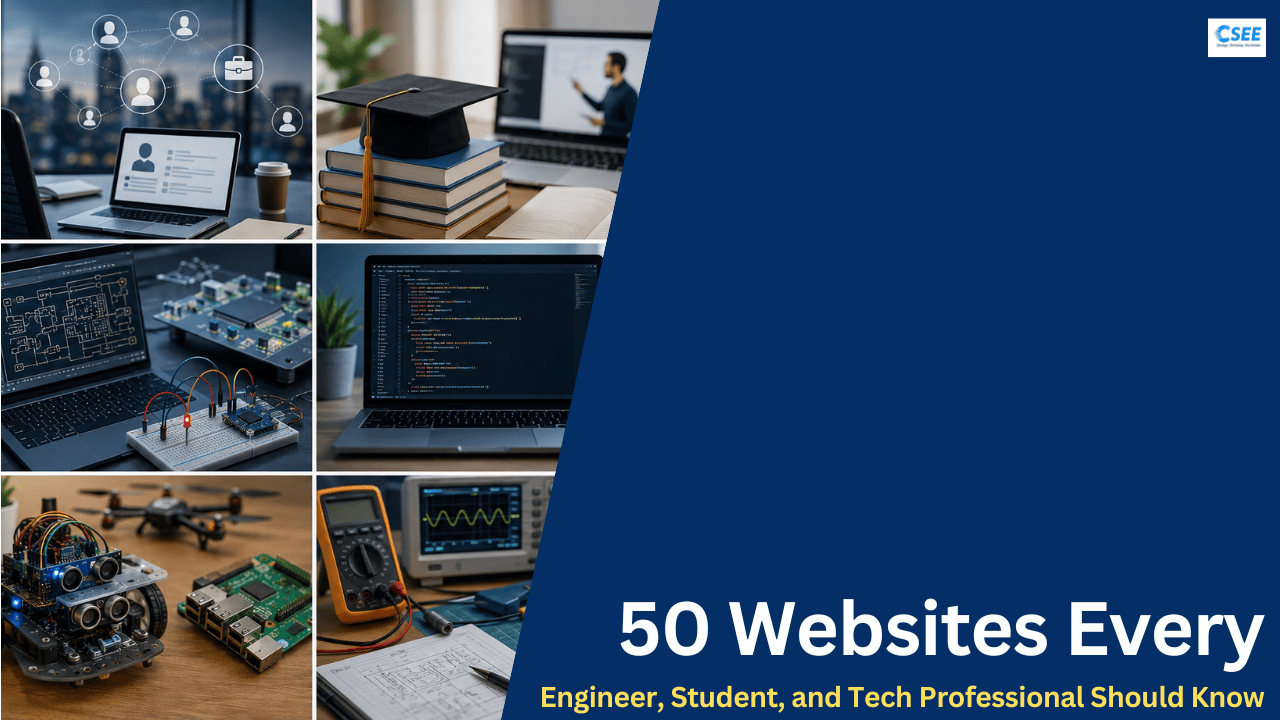
The internet has become one of the most powerful resources for engineers, students, developers, and technology professionals. Whether you are searching for a job, learning a new technology, exploring artificial intelligence, understanding automotive technology, designing circuits, improving your coding skills, building embedded projects, or finding useful engineering tools, the right websites can save you time and accelerate your learning.
The challenge is not finding information. There is simply too much of it. The real challenge is knowing which platforms are worth exploring.
This list brings together 50 useful websites across 10 categories: Jobs, Upskilling, AI, Visual AI Learning, Automotive Technology, Virtual Circuit Design, Coding & Programming, Tech & Engineering Knowledge, Embedded & Hardware Projects, and Engineering Tools & Resources.
You don’t need to use all 50 websites. Instead, choose the platforms that match your current goal and make them part of your regular learning, job-search, or engineering workflow.
💼 1. Jobs — 5 Websites
1. LinkedIn Jobs
LinkedIn Jobs is one of the most useful platforms for professionals looking for opportunities across industries. Engineers can search for positions based on job title, location, experience, skills, and company.
It is particularly useful because job searching and professional networking are combined on the same platform. You can follow companies, connect with recruiters, communicate with professionals, and discover opportunities through your network.
For engineers, searches can include roles such as Embedded Software Engineer, Automotive Engineer, MATLAB/Simulink Engineer, Hardware Engineer, AI Engineer, Verification Engineer, and many others.
2. Naukri
Naukri is one of the major job-search platforms for professionals in India. It covers opportunities across software, embedded systems, electronics, automotive, electrical engineering, manufacturing, IT, and many other domains.
A strong profile should clearly highlight your experience, technical skills, tools, programming languages, projects, and domain knowledge.
Regularly updating your profile and resume can help recruiters find you when they search for candidates with specific technical skills.
3. Indeed
Indeed provides job opportunities across different industries and countries. It can be useful for comparing roles and understanding the skills companies are currently requesting.
Instead of searching only for a job title, engineers can search using specific technologies. For example, an embedded engineer could search for Embedded C, AUTOSAR, CAN, MATLAB, Simulink, Python, Linux, or Automotive Software.
This can also help you identify which skills are frequently requested in the market.
4. Glassdoor
Glassdoor can be useful for both job searching and company research. Before applying for a position, candidates often want to understand company culture, interview processes, salaries, and employee experiences.
This information can help you prepare for interviews and salary discussions.
However, reviews and salary information should be treated as general guidance because experiences can vary between teams, locations, roles, and time periods.
5. Wellfound
Wellfound is useful for professionals interested in startups and technology companies.
Engineers interested in AI, robotics, EVs, automation, hardware, software, and emerging technologies can explore startup opportunities.
Startup roles can sometimes provide broader responsibilities, allowing engineers to work across development, testing, debugging, deployment, and product development.
📚 2. Upskilling — 5 Websites
1. Coursera
Coursera provides courses and professional learning programs covering programming, artificial intelligence, machine learning, data science, engineering, cloud computing, and many other areas.
It is useful for learners who prefer structured learning paths and courses from universities and organizations.
For example, an embedded engineer interested in AI can gradually learn Python, machine learning, deep learning, and edge AI.
2. Udemy
Udemy offers a huge collection of courses covering both technical and non-technical subjects.
Engineers can find courses on MATLAB, Simulink, Embedded C, AUTOSAR, Python, C++, PCB design, microcontrollers, Linux, AI, machine learning, and many other technologies.
It is particularly useful when you want to learn a specific tool or technology through practical tutorials.
Before choosing a course, check the curriculum, reviews, ratings, instructor background, and update date.
3. edX
edX provides courses covering computer science, engineering, artificial intelligence, mathematics, electronics, and many other subjects.
It can be particularly useful for people who want to strengthen their theoretical understanding while also developing practical skills.
A strong combination of theory and implementation can help engineers understand not just how to use a technology, but why it works.
4. Pluralsight
Pluralsight focuses strongly on technology and professional development.
Its learning resources cover software development, cloud technologies, cybersecurity, data, AI, and other technical areas.
Working professionals can use such platforms to identify skill gaps and create focused learning paths.
5. DataCamp
DataCamp focuses heavily on data-related technologies such as Python, SQL, statistics, data analysis, and machine learning.
These skills are becoming increasingly useful for engineers because modern engineering systems generate large amounts of data.
Vehicle logs, sensor data, test results, manufacturing data, and machine-learning datasets can all require data analysis skills.
🤖 3. AI — 5 Websites
1. NVIDIA Developer
NVIDIA Developer provides resources for artificial intelligence, GPU computing, computer vision, robotics, edge AI, and accelerated computing.
Engineers can explore AI frameworks, development tools, hardware acceleration, and deployment technologies.
For professionals working toward Embedded AI or Edge AI, understanding accelerated computing can be particularly valuable.
2. Google AI
Google provides a wide range of AI learning resources, research, tools, and educational material.
Engineers can explore machine learning concepts, generative AI, neural networks, computer vision, natural language processing, and other AI technologies.
It is useful for both beginners and professionals who want to understand current AI technologies.
3. Hugging Face
Hugging Face has become an important platform for the AI and machine-learning community.
It provides access to models, datasets, libraries, demos, and community projects.
Engineers can explore different AI models and experiment with applications involving natural language processing, computer vision, audio, and generative AI.
4. OpenAI
OpenAI provides resources around modern artificial intelligence, including generative AI and AI development.
For developers and engineers, AI platforms can be used to understand how modern AI systems can be integrated into applications and workflows.
AI knowledge is becoming increasingly relevant across software, embedded systems, robotics, automotive technology, and many other engineering fields.
5. Microsoft AI
Microsoft provides AI learning resources, development tools, services, and technical documentation.
Engineers can explore machine learning, generative AI, cloud AI, AI development, and enterprise applications.
For professionals already working with software or cloud technologies, AI resources can provide a pathway toward integrating intelligent capabilities into existing systems.
🎨 4. Learn AI Visually — 5 Websites
Sometimes reading technical documentation is not the easiest way to understand AI.
Visual explanations, interactive demonstrations, animations, and experiments can make difficult concepts much easier to understand.
1. 3Blue1Brown
3Blue1Brown is well known for visually explaining mathematical and technical concepts.
Its visual approach can be especially useful for understanding mathematics behind machine learning, neural networks, vectors, matrices, calculus, and other concepts.
If mathematical concepts feel difficult when presented only through equations, visual explanations can provide a completely different perspective.
2. StatQuest
StatQuest focuses on explaining statistics, machine learning, and data science concepts in a simple and visual way.
It is useful for understanding concepts such as regression, classification, decision trees, neural networks, statistics, and machine-learning algorithms.
The platform is particularly helpful for learners who want complicated concepts explained in a straightforward manner.
3. TensorFlow Playground
TensorFlow Playground provides an interactive way to experiment with neural networks.
Instead of simply reading about neural networks, users can change parameters and observe how the model behaves.
This makes it a useful educational tool for understanding concepts such as layers, neurons, training, decision boundaries, and model behavior.
4. Google Teachable Machine
Google Teachable Machine allows users to experiment with machine learning without requiring advanced programming knowledge.
You can train simple models using images, sounds, or poses and observe how machine learning can classify different inputs.
It is particularly useful for beginners who want to understand the basic idea of training an AI model through hands-on experimentation.
5. Machine Learning for Kids
Machine Learning for Kids provides an accessible way for beginners to experiment with machine learning.
It can help learners understand the basic concepts behind training models and using AI in simple projects.
Visual and interactive learning can be especially effective for students who are just beginning their AI journey.
🚗 5. Automotive Technology — 5 Websites
Automotive technology is rapidly changing. Modern vehicles are becoming software-defined, connected, electrified, and increasingly intelligent.
Engineers interested in automotive software, EVs, ADAS, autonomous driving, embedded systems, and vehicle architectures should regularly explore automotive technology resources.
1. AUTOSAR
AUTOSAR is highly relevant to automotive software engineers.
It provides standardized automotive software architecture concepts that help manufacturers and suppliers develop complex vehicle software systems.
Engineers working with automotive embedded systems can benefit from understanding concepts such as software components, basic software, runtime environments, communication, and standardized architectures.
2. MathWorks
MathWorks provides MATLAB and Simulink tools widely used in automotive engineering.
Engineers can use them for model-based development, control systems, simulation, algorithm development, testing, data analysis, and code generation.
Applications can include battery management systems, powertrain control, ADAS, vehicle dynamics, and other automotive systems.
3. ROS
ROS, or Robot Operating System, provides tools and frameworks used extensively in robotics and autonomous systems.
Many concepts used in robotics overlap with modern automotive technologies, including perception, sensors, localization, mapping, planning, and autonomous decision-making.
For engineers interested in autonomous vehicles and robotics, learning ROS can provide valuable practical experience.
4. NVIDIA Automotive
NVIDIA provides technologies for automotive AI, autonomous driving, simulation, and high-performance vehicle computing.
As vehicles increasingly depend on powerful computing platforms, AI acceleration and centralized vehicle computing are becoming important areas for automotive engineers.
Exploring automotive AI platforms can help engineers understand where vehicle technology is heading.
5. SAE International
SAE International provides standards, technical information, publications, and resources related to mobility and automotive engineering.
Engineers can use SAE resources to understand automotive standards, research, emerging technologies, and industry developments.
For professionals working in automotive engineering, understanding industry standards can be as important as learning specific tools.
🔌 6. Virtual Circuit Design — 5 Websites
Virtual circuit design platforms allow students and engineers to experiment with electronic circuits without immediately building them physically.
They can help reduce development time, improve understanding, and identify potential problems before hardware implementation.
1. Tinkercad Circuits
Tinkercad Circuits is a beginner-friendly platform for experimenting with circuits and microcontrollers.
Students can create virtual circuits, connect components, experiment with Arduino-based projects, and understand basic electronics.
It is a great starting point for people who are new to electronics.
2. CircuitLab
CircuitLab provides online schematic design and circuit simulation capabilities.
It can be useful for experimenting with electronic circuits and understanding how different components interact.
Virtual simulation can help engineers test ideas before moving to physical prototypes.
3. Falstad
Falstad is particularly useful for visualizing circuit behavior.
It can help learners understand concepts such as voltage, current, capacitors, inductors, oscillators, and filters.
The visual nature makes it useful for students trying to develop an intuitive understanding of electronics.
4. EasyEDA
EasyEDA combines schematic design, PCB design, and electronics development workflows.
It can be useful when moving from circuit concepts toward PCB implementation.
Engineers can create schematics and work toward board layouts as part of the hardware development process.
5. Multisim
Multisim is widely used for circuit simulation and electronics education.
It can be used to model and analyze analog, digital, and mixed electronic circuits before physical implementation.
Simulation can help students and engineers understand circuit behavior and identify design issues early.
🧑💻 7. Coding & Programming — 5 Websites
Programming is becoming important across almost every engineering discipline.
Even electrical, electronics, mechanical, and automotive engineers increasingly interact with software, data, automation, simulation, and AI.
1. GitHub
GitHub is one of the most important platforms for software development and open-source projects.
Engineers can use it to store code, collaborate, manage versions, contribute to open-source projects, and build technical portfolios.
A strong GitHub profile can demonstrate your practical skills through real projects.
2. LeetCode
LeetCode provides coding problems focused on algorithms, data structures, databases, and programming.
It is widely used by candidates preparing for technical interviews.
Regular practice can improve problem-solving ability, coding speed, and familiarity with common programming patterns.
3. HackerRank
HackerRank provides coding challenges and skill-based assessments.
It is useful for practicing programming languages and preparing for technical assessments.
Engineers moving into software-heavy roles can use it to strengthen their coding fundamentals.
4. Codewars
Codewars provides coding challenges with different difficulty levels.
It can make programming practice more engaging and encourage users to solve problems in different ways.
Regular coding practice helps improve logical thinking and debugging skills.
5. Replit
Replit provides an online environment for writing and running code.
It is convenient for beginners because they can start experimenting without setting up a complete development environment.
It can also be useful for quickly testing small programs and ideas.
📰 8. Tech & Engineering Knowledge — 5 Websites
Technology changes rapidly. Engineers who continuously follow technical developments can better understand emerging trends and identify new skills to learn.
1. IEEE Xplore
IEEE Xplore provides access to technical papers, journals, conference publications, and research.
It is especially valuable when you need deeper technical information rather than basic tutorials.
Engineers working on research, advanced development, academic projects, or emerging technologies can use it to explore technical literature.
2. Electronics Weekly
Electronics Weekly provides news and information related to the electronics industry.
Following industry publications can help engineers stay aware of semiconductor developments, new technologies, companies, components, and market trends.
3. Hackster.io
Hackster.io is a community focused on hardware and technology projects.
It provides project ideas, tutorials, demonstrations, and practical implementations involving development boards, sensors, AI, IoT, robotics, and more.
4. All About Circuits
All About Circuits provides educational content related to electronics and electrical engineering.
It covers areas such as analog electronics, digital electronics, circuits, semiconductors, power electronics, and embedded systems.
It can be useful for both beginners and experienced engineers who want to strengthen their fundamentals.
5. Electronics For You
Electronics For You covers electronics, embedded systems, technology news, projects, and industry developments.
It can provide a combination of practical engineering information and technology updates.
🛠️ 9. Embedded & Hardware Projects — 5 Websites
Learning embedded systems becomes much easier when you combine theory with practical projects.
The following platforms can help you explore development boards, sensors, microcontrollers, robotics, IoT, AI, and hardware implementation.
1. Arduino
Arduino is one of the most accessible ecosystems for learning microcontrollers and embedded development.
It is widely used for education, prototyping, automation, robotics, IoT, and sensor-based applications.
For beginners, Arduino provides a relatively simple entry point into embedded programming and electronics.
2. Raspberry Pi
Raspberry Pi provides compact computing platforms used for education, embedded development, robotics, IoT, automation, computer vision, and AI.
Unlike basic microcontrollers, Raspberry Pi boards can run operating systems and support more complex applications.
They are useful for engineers interested in Linux, Python, networking, computer vision, and edge AI.
3. Hackster.io
Hackster.io is also valuable for embedded and hardware projects because it provides a large collection of practical implementations.
You can find projects involving sensors, microcontrollers, cameras, AI, IoT, robotics, and automation.
Studying complete projects can help engineers understand how individual components are integrated into real systems.
4. Instructables
Instructables provides step-by-step project guides covering electronics, robotics, programming, DIY engineering, and hardware.
It can be useful for finding project ideas and learning practical implementation techniques.
Students can also use these projects as inspiration for creating their own unique portfolio projects.
5. Seeed Studio
Seeed Studio provides development boards, sensors, modules, embedded hardware, IoT resources, and AI-related platforms.
It is useful for engineers who want to experiment with sensors, microcontrollers, communication modules, edge AI, and rapid hardware prototyping.
🎨 10. Engineering Tools & Resources — 5 Websites
The right engineering tools can make everyday technical work faster and easier.
From mathematical calculations to component selection and software resources, these platforms can become useful parts of an engineer’s workflow.
1. Wolfram Alpha
Wolfram Alpha can be useful for mathematical calculations, equations, conversions, statistics, and technical exploration.
Engineers can use it as a quick supporting tool when checking calculations or exploring mathematical relationships.
It should complement engineering judgment rather than replace detailed engineering analysis.
2. MATLAB
MATLAB is widely used across engineering, mathematics, control systems, signal processing, data analysis, simulation, and AI.
Engineers can use MATLAB for algorithm development, mathematical modeling, data visualization, simulation, and analysis.
It is particularly valuable in automotive, electrical, electronics, control, and embedded engineering workflows.
3. GitHub
GitHub can also be considered an engineering resource because it contains thousands of open-source libraries, tools, reference implementations, datasets, examples, and projects.
Engineers can explore repositories to understand how technologies are implemented in real-world projects.
It can also help you discover tools that you may not find through traditional tutorials.
4. DigiKey
DigiKey is a major resource for electronic components and technical information.
Engineers can search for semiconductors, sensors, connectors, development boards, power components, and other electronic parts.
Component databases are useful not only for purchasing but also for comparing specifications, checking datasheets, and discovering alternative components.
5. Mouser
Mouser provides access to a wide range of electronic components and technical resources.
Engineers can explore semiconductors, sensors, connectors, embedded hardware, power components, development tools, and other products.
When selecting components, engineers need to consider parameters such as voltage, current, package, operating temperature, interface, tolerance, availability, and application requirements.
🚀 How to Use These 50 Websites
A list of 50 websites is useful only when you know how to use it.
You don’t need to visit every platform every day. Instead, choose websites based on your current goal.
If you are searching for a new job, focus on the five job platforms. Improve your resume, update your professional profile, identify target companies, and regularly search for roles matching your technical skills.
If your goal is upskilling, choose one technology and build a structured learning path. For example, an embedded engineer interested in AI could start with Python, then machine learning fundamentals, deep learning, computer vision, and finally Edge AI deployment.
If you want to learn AI, explore AI platforms and resources that allow you to understand both theory and practical implementation.
If AI concepts feel complicated, use visual learning platforms. Interactive demonstrations and animations can make concepts such as neural networks, statistics, optimization, and machine learning much easier to understand.
For automotive engineers, focus on technologies such as AUTOSAR, MATLAB/Simulink, automotive AI, robotics, vehicle computing, autonomous systems, and industry standards.
For electronics students and hardware engineers, virtual circuit simulation is a powerful way to experiment before purchasing components or manufacturing a PCB.
For programming, consistency is more important than solving hundreds of problems in a short period. Even 20–30 minutes of regular coding practice can gradually improve your programming ability.
For technical knowledge, develop the habit of reading. Follow engineering publications, research papers, technical tutorials, and industry news to stay updated.
For embedded systems, build projects. Instead of only watching tutorials, combine microcontrollers, sensors, communication protocols, displays, motors, cameras, and AI models to create practical systems.
Finally, use engineering tools to improve your daily workflow. Mathematical tools, component databases, simulation platforms, code repositories, and technical resources can save significant time during development.
Final Thoughts
The most valuable engineering skill is not knowing one specific software tool or programming language. It is knowing how to learn, research, build, test, troubleshoot, and continuously improve.
These 50 websites cover different stages of an engineer’s journey.
Use job platforms to discover opportunities.
Use upskilling platforms to learn new technologies.
Use AI platforms to explore artificial intelligence.
Use visual learning platforms to understand difficult concepts more easily.
Use automotive resources to explore modern vehicle technologies.
Use circuit simulators to experiment with electronics.
Use coding platforms to improve programming and problem-solving.
Use technical resources to stay updated with engineering developments.
Use embedded and hardware platforms to build real projects.
And use engineering tools to make your daily work more efficient.
You don’t have to master everything at once. Start with one category, explore the platforms, build a project, learn from your mistakes, and gradually expand your skills.
The goal is not to collect 50 bookmarks.
The goal is to turn these resources into practical knowledge.
Learn something. Build something. Test something. Share something. Keep improving.
That is how you turn online resources into a stronger engineering career.
Also, read:
- Top 10 Tools to Design ADAS and Autonomous Driving Systems Virtually
- What Is The Main Aim Of Semicon 2.0?
- 20 Advanced Coursera Courses for Embedded Engineers That Can Lead to High-Paying Careers
- E/E Architecture Is Changing: From Distributed ECUs to Zonal Architecture
- Embedded C vs C++: Which Should Embedded Engineers Learn?
- TSMC’s AI-Chip Demand Is Still Exploding: What It Means for AI Hardware and Embedded Engineers
- IndiaAI Crosses 45,000 GPUs: What It Means for India’s AI and Edge AI Future
- 30-Day DSA in C for Embedded Systems Engineers