Semiconductors · AI · Careers
Will AI replace chip designers? What GPT-Synopsys really changes
On 30 September 2026, OpenAI and Synopsys announced a model that can operate chip design tools by itself. Here is what it does, where it fits in the design flow, and what it means if you work in VLSI or plan to.
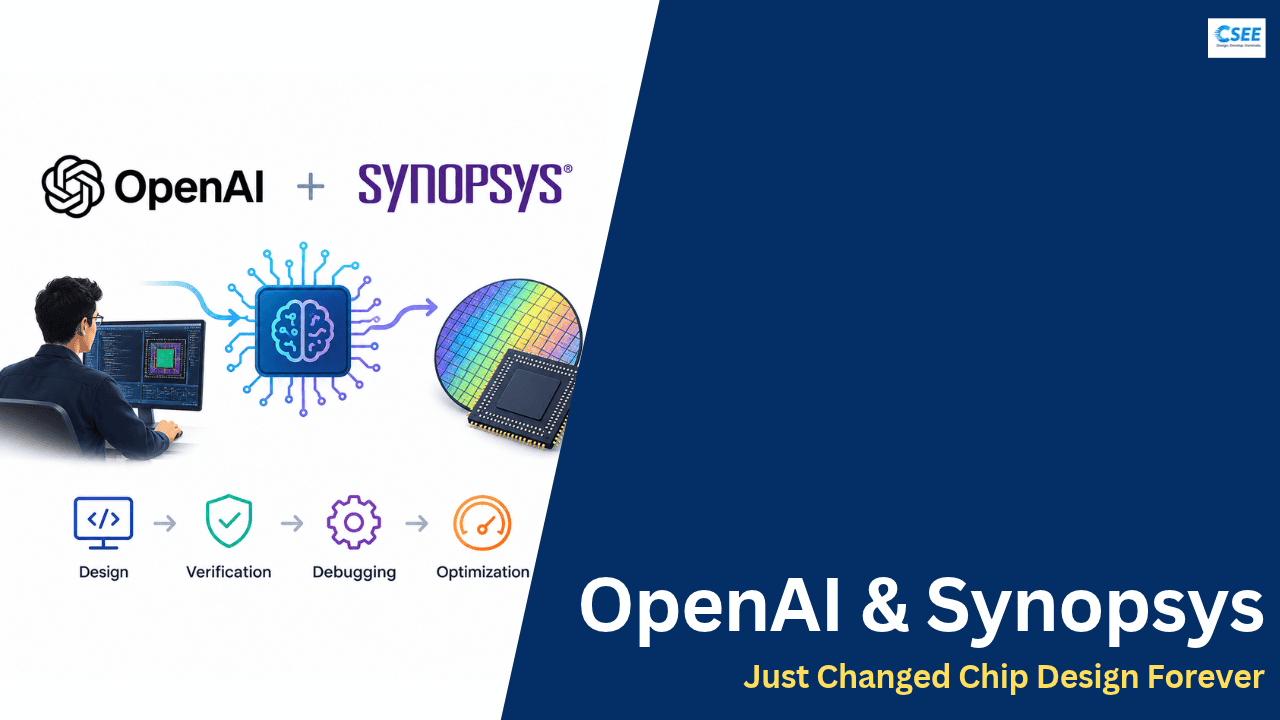
Guys, look at what just happened. On September 30, 2026, OpenAI and Synopsys announced GPT-Synopsys, and this could be a big deal for the semiconductor industry. Synopsys is one of the two companies whose software almost every chip in your phone, laptop and data centre passed through on its way to the factory. OpenAI is the company behind ChatGPT. Put them together and you get a specialised AI model that does not just talk about chip design. It is meant to sit at the controls of the actual design tools.
You know how difficult it is to design a chip. Engineers spend months on design, testing, debugging and optimisation. A modern processor holds billions of transistors, and every one of them has to meet timing, fit in the area budget and stay inside the power limit. Now imagine AI helping with these tasks and finding solutions much faster. That is exactly why this announcement is getting attention.
The obvious next question is the one every VLSI student and working engineer is asking in group chats right now: does this mean semiconductor engineers will lose their jobs? Honestly, I don’t think it’s that simple. Let’s break it down properly.
The newsWhat exactly was announced?
The two companies signed a multi-year agreement to work as preferred partners and jointly develop GPT-Synopsys, a model built specifically to operate Synopsys’ electronic design automation (EDA) tools across semiconductor design workflows. As part of the deal, OpenAI is licensing Synopsys’ EDA tools so it can train the model to use them.
The key difference from earlier AI helpers is control. Until now, agentic AI in chip design mostly meant connecting general-purpose models to EDA tools through plumbing. GPT-Synopsys is meant to be a native expert user of the tools. Synopsys describes the workflow like this: an engineer sets a design goal, such as optimising power, performance and area (PPA) or closing timing and verification. The agent then runs the tools, reads the results, applies changes, and keeps iterating until it reaches a verified result. The engineer reviews the final output.
| Item | What the companies said |
|---|---|
| Announced | 30 September 2026, San Francisco and Sunnyvale |
| Deal type | Multi-year strategic partnership, joint R&D and go-to-market, shared revenue framework |
| What it does | Reasons about chip design and verification and directly operates Synopsys tools |
| Where it runs | OpenAI-hosted infrastructure, integrated with Synopsys.ai and Synopsys Autopilot |
| Customer data | Not used for training; encrypted in transit and at rest, with retention, audit and permission controls |
| How it is sold | One bundle of compute, model access and EDA licences |
| Availability | Planned for end of 2026; early technical work with leading chip customers already under way |
| Benchmarks published | None yet for timing closure, verification closure or PPA |
The business model is interesting too. According to Synopsys CEO Sassine Ghazi, OpenAI first pays a training subscription so the model can learn the tools. Once Synopsys customers start using GPT-Synopsys, the two companies split revenue based on how much the model actually improves chip designs. In other words, the money depends on results, not hype.
The market liked it. Synopsys shares jumped as much as 7% during the day and closed up about 4.8%. At an investor event alongside the announcement, Synopsys also raised its fiscal 2027 revenue-growth expectation to 15%. OpenAI president Greg Brockman said the model could help engineers cut weeks or even months from design cycles.
- Synopsys shows autonomous EDA workflowsBuilt with Microsoft and used by AMD. Early tests of a fully autonomous debug-closure flow cut cycle time by 25% to 40%.
- Synopsys Autopilot and AgentEngineerA platform for long-horizon AI agents that plan and run engineering workflows.
- GPT-Synopsys announced with OpenAISame day, Synopsys also announced a separate engineering deal with Amazon.
- Target availabilityNo general availability date or pricing has been published.
BackgroundWhy chip design takes so long in the first place
To judge whether AI threatens jobs, you need to see where the work actually goes. A chip moves through a long chain of stages, and each stage has its own specialists and its own tools. Most of the calendar time is not spent having ideas. It is spent running tools, waiting for results, reading reports, fixing violations and running the tools again.
- 01SpecificationDefine what the chip must do, its power budget and target performance.
- 02ArchitectureChoose blocks, memory hierarchy, buses and trade-offs.
- 03RTL designWrite the logic in Verilog, SystemVerilog or VHDL.
- 04VerificationTestbenches, coverage, debugging failing tests. Often the biggest effort.AI loop target
- 05SynthesisConvert RTL into a gate-level netlist and tune for PPA.AI loop target
- 06Place and routePhysically place cells and wire them on silicon.AI loop target
- 07Timing closureFix setup and hold violations until every path meets its clock.AI loop target
- 08Sign-off and tape-outFinal checks, then the design goes to the foundry. Mistakes here cost millions.
Look at the highlighted stages. They share a pattern: run a tool, read thousands of lines of report, change something, run again. Timing closure on a large block can mean dozens of these iterations. Verification teams often outnumber design teams because proving a chip works is harder than writing it. This repetitive, tool-heavy loop is exactly what GPT-Synopsys is built to speed up.
How it worksThe loop the AI will run
Think of GPT-Synopsys as a very fast junior engineer who never gets tired of re-running jobs. You give it a target. It drives the tools, studies the output, makes a change, and tries again. The important part is that the EDA tools themselves remain the judge. The AI proposes and executes changes, but the measurements of timing, power and area still come from the same trusted tools engineers use today. Synopsys calls these the ground-truth engineering tools.
Notice where the humans are. They are at the start, choosing what “good” means for this chip, and at the end, deciding whether the result is safe to build. That framing matters a lot for the jobs question, and we’ll come back to it.
Where it sits in the software stack
GPT-Synopsys is one layer in a bigger system. It runs on OpenAI’s servers, plugs into Synopsys’ own agent platforms, and is designed to work with the agent systems that chip companies are already building internally.
The big questionSo, will semiconductor jobs be replaced?
Here is my honest take. Some tasks will get automated, and the way engineers work will definitely change. But “tasks get automated” is not the same as “jobs disappear”. A chip engineer’s job is a bundle of many tasks. Some of them are repetitive tool-driving. Others need deep judgment about trade-offs, risk and what the customer actually needs. AI is coming for the first kind much faster than the second.
It also helps to remember what the announcement does not claim. It does not say AI can now design a finished chip alone and send it to the factory. No published case yet shows a GPT-Synopsys design passing sign-off and going into mass production. There are no benchmark numbers for the model itself so far. The 25% to 40% speed-up figure people quote comes from Synopsys’ earlier July work on autonomous debug closure, not from GPT-Synopsys.
Below is a practical way to think about it. Plot each task by how repetitive and tool-driven it is, and by how much expert judgment and accountability it needs.
Look at the top-left box. If a big part of your day is babysitting tool runs, copying numbers out of timing reports and re-running the same fix with small variations, that part of your work is the most exposed. That is not a reason to panic. It is a reason to move up the grid, toward work where you decide what the tools should be doing and whether their answer is good enough.
| Role | What AI may take over | What stays human | Change |
|---|---|---|---|
| Physical design engineer | Iterative place-and-route runs, routine timing and congestion fixes | Floorplan strategy, sign-off judgment, handling unusual violations | High |
| Verification engineer | Regression triage, first-pass debug, coverage hole hunting | Test plans, deciding what “enough verification” means, corner cases | High |
| Synthesis / STA engineer | Constraint tuning loops, report analysis | Writing correct constraints, PPA trade-off calls | High |
| RTL designer | Boilerplate logic, lint fixes, small refactors | Micro-architecture, correctness, performance intent | Medium |
| CAD / flow engineer | Some routine scripting | Building and governing AI-driven flows, tool integration | Medium, growing demand |
| Architect | Faster what-if exploration | Product direction, system trade-offs, customer needs | Low |
| Post-silicon / bring-up | Log analysis help | Lab work, hardware debug, real-world failures | Low |
Why humans stayReliable chips still need engineering judgment
There is a reason chip design is one of the most careful engineering fields on the planet. When software has a bug, you push an update. When a chip has a bug after tape-out, you may need a new set of masks, months of delay and a huge bill. That is why Synopsys keeps stressing “first-time-right silicon” and why its own description of the workflow ends with an engineer reviewing the result.
Several things keep humans firmly in the loop:
Accountability. Someone has to sign off and stand behind a tape-out decision. Companies will not hand that responsibility to a model, at least not soon.
Defining the goal. The AI optimises toward targets that humans set. Choosing the right targets, knowing which corner cases matter for a car chip versus a phone chip, and deciding acceptable risk all require domain experience.
Spotting plausible nonsense. AI systems can produce answers that look convincing but are wrong. In chip design, only someone who understands timing, power and physics can tell when a “clean” report hides a real problem.
Data security and trust. Chip designs are among the most guarded secrets in tech. Synopsys says customer design data will not be used to train the model, but every company will still need people who decide what the AI is allowed to see and do.
For students and freshersShould you still enter the semiconductor industry?
Yes, but with open eyes. Global demand for chips, especially AI chips, keeps growing, and more companies want custom silicon. If tools like GPT-Synopsys let each team finish designs faster, the likely result is more chip projects, not fewer engineers overnight. Synopsys itself says one aim is to help more companies build advanced silicon.
What will change is the entry-level job. The classic fresher work of running tools, fixing simple violations and writing small scripts is exactly what agents are being built to do. So the bar for a new graduate goes up. You will be expected to understand why a fix works, not just how to apply it, and to supervise AI-driven flows from early in your career.
| Area | What to learn | Why it matters now |
|---|---|---|
| Fundamentals | Digital logic, CMOS, STA, low-power design, computer architecture | You cannot judge AI output without knowing the physics and theory |
| Core languages | Verilog / SystemVerilog, UVM basics | Still the language of design and verification |
| EDA tool flow | Synthesis, place and route, timing and verification tools end to end | Agents drive these tools; you must read and question their results |
| Scripting | Python and Tcl | Flows, automation and connecting AI agents to tools |
| AI literacy | How LLMs and agents work, prompting, their failure modes | Knowing when to trust and when to check the agent |
| Review skills | Reading reports critically, debugging, writing clear specs | Humans set goals and approve results in the new loop |
Four habits to start this month
1. Use AI tools on your own projects. Use assistants to explain timing reports, draft testbenches or review RTL. Then check every answer yourself. You learn both the subject and the AI’s weak spots.
2. Go deep on one stage. Pick physical design, verification or STA and understand it well enough to explain each step. Depth is what lets you supervise automation instead of being replaced by it.
3. Learn to automate flows. Python and Tcl skills turn you into the person who builds and governs AI-assisted flows. CAD and methodology roles are likely to grow as agents spread.
4. Follow what vendors actually ship. Watch Synopsys.ai, Autopilot and similar efforts from other EDA vendors. Many of these launches are still announcements with no published numbers. Learn to tell demos from proven results.
Bottom lineDon’t panic, but don’t ignore it
GPT-Synopsys is a serious signal. Two of the most important companies in AI and chip design are betting that AI agents will run a large share of EDA tool work, and they have tied their revenue to whether it actually improves chips. It also hasn’t proven itself yet: no public benchmarks, no announced production tape-out and no general release date beyond a target of late 2026.
Some tasks will get automated, and the way engineers work will definitely change. But designing reliable chips still requires deep technical knowledge and engineering judgment. So if you’re planning to enter the semiconductor industry, don’t panic, but don’t ignore AI either. Start learning these tools now, because the real competition could be between engineers who use AI and those who don’t.
Sources
- Synopsys press release: OpenAI and Synopsys Announce GPT-Synopsys
- Synopsys Korea press release (workflow description)
- eWEEK: GPT-Synopsys to let AI agents operate chip design tools
- R&D World: OpenAI and Synopsys plan a specialized model
- Let’s Data Science: guidance raise and share move
- Tiger Brokers: share price reaction and Brockman remarks
- INSIDE: revenue-sharing model explained by Sassine Ghazi
- XenoSpectrum: Autopilot vs GPT-Synopsys and what was not claimed
Role and task assessments in Fig. 5 and the roles table are editorial judgment, not survey data.