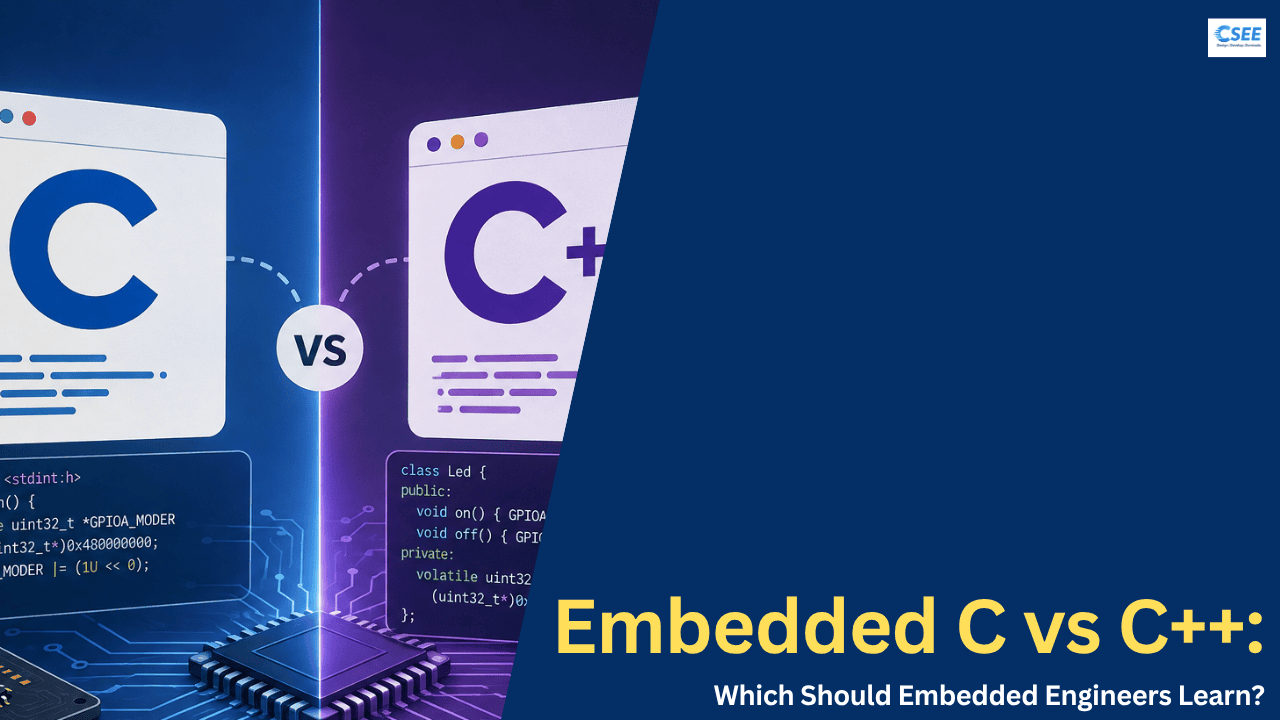
If you are planning a career in embedded systems, one question comes up again and again: Should you learn Embedded C or C++? Both languages are important, but they are used differently depending on the hardware, operating system, performance requirements, project architecture, and application.
For decades, C has been one of the most important programming languages in embedded development. It is widely used for microcontrollers, firmware, device drivers, bootloaders, RTOS applications, and low-level programming. Its predictable performance, small runtime requirements, and ability to interact directly with hardware make it extremely suitable for resource-constrained embedded devices.
At the same time, C++ has become increasingly important in modern embedded software development. Embedded products are becoming more sophisticated, with larger codebases, complex architectures, connectivity, graphical interfaces, artificial intelligence, robotics, industrial automation, and edge computing. C++ provides powerful software engineering features such as classes, encapsulation, templates, namespaces, RAII, and generic programming that can help developers manage this complexity.
The good news is that you don’t necessarily have to choose only one. For most aspiring embedded engineers, a strong approach is to learn C first and then add modern C++.
What Is Embedded C?
Embedded C refers to using the C programming language to develop software for embedded systems. The language is based on standard C, but embedded development introduces additional concepts related to hardware, memory, peripherals, interrupts, timers, communication interfaces, and real-time behavior.
Unlike desktop applications, an embedded program may run on a microcontroller with only a few kilobytes of RAM and limited flash storage. The software therefore needs to be efficient and carefully designed.
Embedded C allows developers to interact directly with hardware registers, memory addresses, GPIO pins, timers, ADCs, PWM modules, communication peripherals, and other microcontroller resources.
For example, an embedded developer may use C to configure a GPIO pin, read a sensor, control a motor, communicate through UART, or implement a CAN communication function.
This close relationship between C and hardware is one of the main reasons why C remains extremely popular in embedded systems.
Why Is C So Popular in Embedded Systems?
1. Direct Hardware Access
One of the biggest advantages of C is its ability to interact closely with hardware.
Developers can work with pointers, memory addresses, registers, and bitwise operators. This makes C highly suitable for microcontroller programming.
For example, if a developer needs to set or clear a particular bit in a hardware register, C provides straightforward mechanisms for doing this.
Understanding these concepts is extremely important for embedded engineers because hardware control is at the heart of firmware development.
2. Efficient Performance
Embedded systems often operate with limited CPU resources. A microcontroller may have limited processing power, RAM, and flash compared with a desktop or cloud server.
C allows developers to write efficient programs with relatively little runtime overhead. Developers also have significant control over memory and resource usage.
This becomes particularly important when developing applications involving high-frequency sensor processing, motor control, communication protocols, or real-time operations.
3. Small Memory Footprint
Many embedded devices operate under strict memory constraints.
A small microcontroller may have only a limited amount of RAM and flash memory. Therefore, developers need to carefully consider memory allocation and program size.
C can produce compact and efficient machine code and allows developers to have detailed control over memory usage.
4. Predictable Execution
Many embedded applications have real-time requirements.
For example, a motor-control system may need to process sensor information within a specific time period. A communication system may need to respond to incoming data quickly.
Embedded C allows developers to maintain significant control over execution and resource usage, which can be useful when deterministic behavior is important.
5. Huge Existing Codebase
C has been used in embedded systems for decades.
As a result, there are enormous numbers of existing firmware projects, libraries, device drivers, RTOS components, middleware systems, and development tools written in C.
An embedded engineer joining an established company may encounter a large C codebase that has been developed and maintained for many years.
Understanding C therefore remains highly valuable even when the project also uses C++.
Where Is Embedded C Used?
Embedded C is used across almost every major embedded domain.
Microcontrollers
C is extensively used with microcontrollers from companies such as STM32, NXP, Texas Instruments, Microchip, Renesas, and many others.
Developers use C to configure GPIO, timers, ADC, PWM, UART, SPI, I2C, CAN, USB, and other peripherals.
Firmware
Firmware is software that directly controls hardware. C is one of the most commonly used languages for firmware development.
Examples include firmware for sensors, smart appliances, industrial controllers, consumer electronics, networking equipment, and control systems.
Device Drivers
Device drivers provide software interfaces to hardware peripherals.
C is commonly used for low-level drivers because it provides direct access to registers, memory, interrupts, and hardware resources.
RTOS-Based Systems
Real-Time Operating Systems are widely used in embedded products.
C is commonly used to implement tasks, interrupt handlers, drivers, synchronization mechanisms, queues, and other system-level components.
Bootloaders
Bootloaders are responsible for initializing hardware and loading application software.
Because bootloaders operate at a low level and often have strict memory requirements, C is frequently used for their development.
What Is Embedded C++?
C++ is a general-purpose programming language that extends many of the capabilities of C with additional programming paradigms and software engineering features.
Modern C++ includes object-oriented programming, generic programming, templates, namespaces, RAII, standard libraries, and many other capabilities.
In embedded systems, C++ can provide a way to build larger and more maintainable software architectures while still allowing developers to work relatively close to hardware.
However, embedded C++ is not necessarily about using every feature of desktop C++.
Embedded developers often carefully select which C++ features are appropriate for their system based on memory, timing, compiler support, safety requirements, and performance constraints.
Why Is C++ Becoming Important in Embedded Systems?
1. Better Code Organization
As embedded applications become larger, organizing thousands or millions of lines of code becomes challenging.
C++ provides classes, namespaces, encapsulation, inheritance, and other features that can help developers organize complex software.
For example, instead of having many unrelated functions for controlling a sensor, a developer can create a class representing the sensor and encapsulate its state and functionality.
This can make the code easier to understand and maintain.
2. Object-Oriented Programming
Object-oriented programming can be useful when embedded software contains many interacting components.
For example, a system might contain:
- Sensor objects
- Communication objects
- Motor-control objects
- Display objects
- Storage objects
- Network objects
These components can be represented using classes and interfaces.
This approach can make large projects easier to structure.
3. Reusable Code
One of the major advantages of C++ is code reuse.
Templates, classes, inheritance, and generic programming can help developers create reusable components.
For example, a generic driver architecture can potentially be adapted for different hardware implementations without completely rewriting the application layer.
4. Abstraction
C++ provides abstraction mechanisms that allow developers to separate hardware-specific implementation from application logic.
For example, an application may interact with a generic Sensor interface while the underlying implementation communicates with an actual I2C or SPI sensor.
This separation can make software easier to test and maintain.
5. Modern Embedded Applications
Modern embedded systems are increasingly powerful.
Devices may contain multicore processors, large amounts of RAM, sophisticated operating systems, graphics processors, networking capabilities, and AI accelerators.
As hardware becomes more capable, software also becomes more complex.
C++ can be particularly useful for these larger embedded applications.
Where Is C++ Used in Embedded Systems?
C++ is used across many modern embedded domains.
Robotics
Robotics applications often require complex software architectures involving sensors, motors, navigation, perception, and communication.
C++ is widely used in robotics because it provides performance combined with powerful software abstraction features.
Automotive and ADAS
Modern vehicle software includes sophisticated systems for perception, control, infotainment, connectivity, and advanced driver assistance.
C++ is used in many higher-level automotive software components, while C remains extremely important for low-level ECU and microcontroller software.
Embedded Linux
Embedded Linux systems often use C and C++ together.
C may be used for kernel-level and low-level components, while C++ may be used for application-level software, middleware, graphical interfaces, and other complex components.
Industrial Automation
Industrial controllers, robotics systems, machine vision systems, and automation platforms can involve large software architectures where C++ can be useful.
IoT and Edge Computing
Connected embedded devices increasingly perform local data processing, networking, security, and analytics.
C and C++ are both commonly encountered in these systems.
Embedded C vs C++: Key Differences
| Feature | Embedded C | Embedded C++ |
|---|---|---|
| Hardware access | Excellent | Excellent |
| Memory control | Excellent | Excellent |
| Performance | Excellent | Excellent |
| Learning difficulty | Easier initially | More concepts |
| Object-oriented programming | No | Yes |
| Templates | No | Yes |
| Code abstraction | Limited | Strong |
| Large software architecture | More manual | Stronger support |
| Microcontroller firmware | Extremely common | Increasingly common |
| Legacy embedded projects | Very common | Common |
| Modern complex embedded software | Common | Increasingly important |
It is important to understand that C++ is not automatically slower than C.
A well-written C++ program can achieve performance comparable to C. The actual performance depends on how the language features are used, the compiler, optimization settings, architecture, and system requirements.
Should You Learn C or C++ First?
For someone completely new to embedded systems, C is usually the better starting point.
Start by learning:
- Variables and data types
- Operators
- Conditional statements
- Loops
- Functions
- Arrays
- Strings
- Pointers
- Structures
- Enumerations
- Bitwise operations
- Memory concepts
const,volatile, andstatic- Function pointers
- Header files
- Preprocessor directives
Once you are comfortable with C, start learning embedded concepts.
Learn how microcontrollers work, how memory is organized, and how peripherals communicate.
Then move toward:
- GPIO
- Timers
- Interrupts
- ADC
- PWM
- UART
- SPI
- I2C
- CAN
- DMA
- Watchdog timers
- Bootloaders
- RTOS concepts
After building this foundation, learning C++ becomes much easier.
What Should You Learn in C++ for Embedded Systems?
You don’t need to learn every advanced C++ feature before becoming productive.
Start with the fundamentals:
C++ Fundamentals
Learn:
- Classes and objects
- Constructors and destructors
- Encapsulation
- Inheritance
- Polymorphism
- References
- Namespaces
- Operator overloading
- Templates
- Exception concepts
- Smart pointers
- Standard containers
Then move toward modern C++ concepts such as:
- RAII
constexprautoenum class- Move semantics
- Lambda expressions
std::arraystd::optional- Generic programming
However, remember that not every C++ feature is appropriate for every embedded project.
A microcontroller project with extremely limited memory may have different requirements from a powerful embedded Linux platform.
What About Pointers?
Pointers are one of the most important topics for embedded engineers.
Whether you use C or C++, you should understand pointers extremely well.
You should be comfortable with:
- Pointer declaration
- Pointer arithmetic
- Arrays and pointers
- Pointers to structures
- Function pointers
- Pointers to hardware addresses
constpointers- Volatile pointers
- Memory addresses
Many embedded interview questions involve pointers because they are fundamental to low-level programming.
What About Memory Management?
Memory is another critical topic.
You should understand:
- Stack
- Heap
- Static memory
- Global memory
- Flash
- RAM
- Memory-mapped registers
- Dynamic allocation
- Fragmentation
- Memory leaks
- Alignment
- Buffer management
In resource-constrained embedded systems, inefficient memory usage can cause serious problems.
This is also an area where embedded C++ requires careful consideration. Features such as dynamic allocation and certain standard-library facilities may not always be appropriate for systems with strict memory or real-time constraints.
C and C++ Are Often Used Together
The real-world answer is not always C versus C++.
Many embedded projects use both.
For example, a system could have:
Hardware → C drivers → Middleware → C++ application → User interface
The low-level layer may use C because it needs direct hardware control and must work with existing vendor libraries.
The higher-level application may use C++ because the software contains more complex architectures and requires better abstraction and maintainability.
Embedded engineers who understand both languages can therefore work across more layers of a software stack.
What About AUTOSAR?
In automotive embedded development, C is especially important for low-level ECU software and AUTOSAR-related development.
However, C++ is also increasingly relevant in modern automotive software, particularly in higher-level applications and systems running on more powerful processors.
If your goal is automotive embedded development, learning C thoroughly is extremely valuable, followed by C++ depending on your target role.
What About RTOS?
If you want to become a strong embedded engineer, learning an RTOS is highly recommended.
You can start with concepts such as:
- Tasks
- Threads
- Scheduling
- Interrupts
- Semaphores
- Mutexes
- Queues
- Event groups
- Timers
- Priority inversion
- Context switching
You can then practice these concepts using an RTOS such as FreeRTOS.
Understanding how C interacts with an RTOS is particularly useful because many embedded applications rely on C-based RTOS APIs.
Free Resources to Learn C
You don’t necessarily need to spend a lot of money to learn programming.
Some useful free resources include:
Learn-C.org — Interactive lessons covering C fundamentals.
GeeksforGeeks C Programming — Useful explanations and examples for C concepts.
Programiz C Programming — Beginner-friendly tutorials covering the fundamentals.
You can also use YouTube to find complete C programming courses and embedded C tutorials.
The most important thing is not simply watching tutorials. Write code every day.
Free Resources to Learn C++
For C++, LearnCpp.com is one of the best free resources for learning modern C++ from beginner to advanced topics.
You can also use:
- Cppreference for detailed C++ language and library documentation
- GeeksforGeeks for examples and explanations
- Programiz for beginner-friendly C++ tutorials
- YouTube for embedded C++ courses and practical projects
Once you understand C++, try implementing small programs rather than only reading theory.
Free Resources for Embedded Systems
After learning C, start learning embedded systems using practical platforms and documentation.
Useful resources include:
STM32
STM32 development boards are popular for learning microcontroller programming.
You can practice GPIO, timers, UART, SPI, I2C, ADC, PWM, DMA, and interrupts.
Arduino
Arduino is beginner-friendly and can help you understand basic microcontroller concepts quickly.
However, don’t stop at Arduino abstractions. Once you understand the basics, learn how the underlying microcontroller registers and peripherals work.
ESP32
ESP32 boards are useful for learning embedded programming alongside Wi-Fi and Bluetooth connectivity.
FreeRTOS
FreeRTOS is an excellent platform for learning RTOS concepts.
You can practice tasks, queues, semaphores, mutexes, timers, and scheduling.
Datasheets and Reference Manuals
One of the most important skills for an embedded engineer is learning how to read technical documentation.
Don’t rely entirely on tutorials.
Learn to read:
- Datasheets
- Reference manuals
- Application notes
- Hardware schematics
- Register descriptions
- Technical specifications
A strong embedded engineer should be able to look at a microcontroller datasheet and understand how to configure a peripheral.
A Practical Learning Roadmap
If you’re starting from zero, follow this progression.
Step 1: Learn C
Spend time understanding C fundamentals and write small programs.
Step 2: Master Pointers and Memory
Don’t rush through pointers. Make sure you understand memory addresses, pointers, arrays, structures, and function pointers.
Step 3: Learn Microcontrollers
Choose one platform such as STM32, ESP32, or another popular microcontroller.
Step 4: Learn Peripherals
Practice GPIO, UART, SPI, I2C, ADC, PWM, timers, and interrupts.
Step 5: Learn Debugging
Learn how to use breakpoints, watch variables, inspect memory, analyze registers, and debug embedded applications.
Step 6: Learn RTOS
Start with FreeRTOS and understand tasks, scheduling, queues, semaphores, mutexes, and interrupts.
Step 7: Learn C++
Once your C and embedded fundamentals are strong, learn modern C++.
Step 8: Build Projects
Projects are where your knowledge becomes practical.
Build projects such as:
- Temperature monitoring system
- UART communication system
- Digital sensor interface
- Motor-control application
- CAN communication project
- RTOS-based sensor application
- IoT device
- Bootloader
- Embedded Linux application
Which Language Should You Put on Your Resume?
If you’re applying for embedded firmware positions, C should definitely be on your resume if you genuinely know it.
You can then add C++ based on your actual experience.
For example:
Programming: Embedded C, C++, Python
Embedded: Microcontrollers, ARM Cortex-M, RTOS, GPIO, UART, SPI, I2C, CAN
Debugging: JTAG, SWD, GDB, logic analyzer, oscilloscope
Don’t simply list technologies. Be prepared to explain them during interviews.
If you write “Embedded C” on your resume, you should be comfortable answering questions about pointers, memory, volatile, static, interrupts, bit manipulation, structures, function pointers, and embedded debugging.
What Do Companies Expect From Embedded Engineers?
Companies generally don’t expect an embedded engineer to simply know the syntax of C or C++.
They want engineers who understand how software interacts with hardware.
You should understand the complete chain:
Application → Firmware → Driver → Peripheral → Hardware
For example, if a sensor is connected through I2C, you should understand how your application request eventually results in I2C transactions at the hardware level.
That understanding is much more valuable than memorizing programming syntax.
Common Mistake: Learning Only Programming Syntax
One of the biggest mistakes beginners make is spending months learning programming syntax without actually building embedded systems.
Knowing how to write a for loop doesn’t make you an embedded engineer.
You need to understand what happens when an interrupt occurs, how a peripheral is configured, how memory is organized, how a task is scheduled, how communication protocols work, and how to debug hardware-software interactions.
That’s why practical projects are extremely important.
So, C or C++?
If you want a simple answer:
For traditional embedded firmware: C is essential.
For modern and complex embedded software: C++ is increasingly valuable.
For a long-term embedded career: Learn both.
A good learning sequence is:
C → Embedded C → Microcontrollers → Peripherals → RTOS → C++ → Modern C++ → Advanced Embedded Systems
This gives you a strong foundation while allowing you to move toward more advanced software architectures.
Final Thoughts
Embedded systems are evolving rapidly. Modern devices are no longer simple microcontrollers performing a few basic operations. They are becoming connected, intelligent, secure, and increasingly software-driven.
C remains extremely important because embedded systems still require efficient, predictable, low-level software that can interact directly with hardware.
At the same time, C++ is becoming more valuable as embedded software grows in size and complexity. Its abstraction, object-oriented programming, generic programming, and modern language features can help developers build maintainable and reusable systems.
Therefore, the best strategy is not to think of Embedded C vs C++ as a competition.
Think of them as complementary skills.
Master C first. Understand hardware deeply. Learn embedded programming. Then add modern C++ to your skill set.
If you can confidently work with both C and C++, understand microcontrollers, memory, peripherals, RTOS concepts, debugging, and communication protocols, you will have a much stronger foundation for a career in embedded systems.
Most importantly, don’t just learn these languages theoretically.
Write code. Build projects. Debug real hardware. Read datasheets. Break things. Fix them. Repeat.
That’s how you become a strong embedded engineer.
Also, read:
- Why Qualcomm Is Entering the Automotive Industry
- The Memory Problem Behind AI Chips
- Why EUV Lithography Took Decades to Develop
- How Intel Lost Its Semiconductor Dominance
- Want To Crack Top Embedded Companies? Build These LLM Projects
- Why The Entire AI Industry Needs ASML
- CPU vs GPU vs NPU: Who Handles What?
- From Beginner to NVIDIA Data Analyst: A 6-Month Roadmap