Quantum Computers and the Future of Cybersecurity
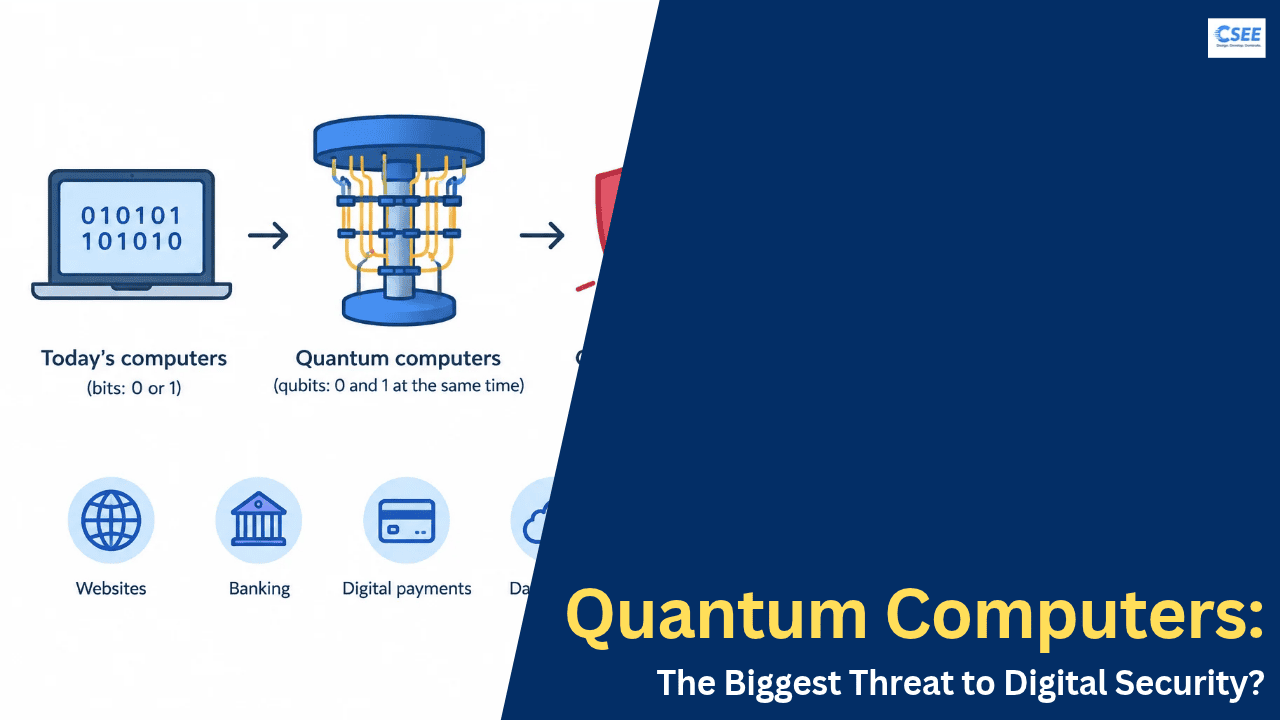
What if the machines we build to solve the world’s hardest problems could also break some of today’s strongest security systems? That is the central tension of quantum computing. It promises breakthroughs in medicine and materials, and it also threatens the mathematics that protects websites, banking and digital payments.
1. Bits and qubits
A classical computer stores information as bits. Each bit is either 0 or 1, like a switch that is off or on. Everything on your phone, from photos to bank apps, is a long sequence of these switches, and a processor flips them according to instructions.
A quantum computer uses qubits. A qubit can be built from a single atom, an ion, a tiny superconducting circuit or a particle of light. Until it is measured, a qubit is described by a mix of 0 and 1 called a superposition. Measuring it forces a single answer, 0 or 1, with probabilities set by that mix.
Three ideas that matter
- Superposition: a qubit holds a weighted blend of 0 and 1, described by numbers called amplitudes.
- Entanglement: qubits can be linked so that the state of the group cannot be described one qubit at a time.
- Interference: amplitudes can add or cancel. Quantum algorithms are designed so wrong answers cancel and right answers reinforce.
2. Why only some problems get easier
Quantum computers are not better at everything. Email, video, web browsing and spreadsheets gain nothing. They help on a narrow set of problems with hidden mathematical structure, such as simulating molecules, certain optimization tasks, and, critically for security, factoring and discrete logarithms.
| Feature | Classical computer | Quantum computer |
|---|---|---|
| Basic unit | Bit (0 or 1) | Qubit (blend of 0 and 1) |
| Reliability | Extremely stable | Fragile, error prone |
| Best at | General tasks | Specific structured problems |
| Operating conditions | Room temperature | Often near absolute zero or in vacuum |
| Scaling | Billions of transistors | Hundreds to thousands of noisy qubits today |
| Threat to RSA/ECC | None known at scale | Yes, via Shor’s algorithm |
3. How today’s encryption works
Most online security combines two kinds of cryptography. Symmetric encryption uses one shared secret key to scramble data quickly, as AES does. Public-key (asymmetric) cryptography solves a different problem: how two strangers agree on a secret over an open network, and how a website proves its identity.
Public-key systems rely on mathematical problems that are easy in one direction and extremely hard to reverse.
| System | Hard problem behind it | Used for |
|---|---|---|
| RSA | Factoring a huge number into two primes | Certificates, signatures, key exchange |
| Diffie-Hellman | Discrete logarithm | Key agreement |
| ECC (ECDH, ECDSA) | Elliptic-curve discrete logarithm | Mobile apps, TLS, cryptocurrencies |
| AES | Searching an enormous key space | Bulk data encryption |
An everyday example
Multiplying two 1,000-digit primes takes a laptop a blink. Starting from the product and recovering the primes is, for classical machines, beyond practical reach. A public key is the product. The private key depends on knowing the primes. That one-way street is what keeps a padlock icon in your browser meaningful.
4. Shor’s algorithm: the threat
In 1994 mathematician Peter Shor showed that a quantum computer could factor large numbers in a time that grows only polynomially with the size of the number, instead of the sub-exponential time of the best classical methods. The same method also solves discrete logarithms, which covers Diffie-Hellman and elliptic-curve systems.
How it works, without the heavy math
Factoring is turned into a pattern-finding problem. Pick a number a and look at the repeating cycle of ax mod n. The length of that cycle, called the period, leaks the factors of n through simple arithmetic. Finding periods is difficult classically but natural for a quantum computer, which uses a tool called the quantum Fourier transform to make the period stand out through interference.
What it breaks and what it does not
| Technology | Quantum effect | Status |
|---|---|---|
| RSA | Broken by Shor’s algorithm | Vulnerable |
| ECC / ECDSA / ECDH | Broken by Shor’s algorithm | Vulnerable |
| Diffie-Hellman | Broken by Shor’s algorithm | Vulnerable |
| AES-128 | Grover’s algorithm gives a square-root speedup; effective strength about 64 bits against ideal attacks | Weakened, use larger keys |
| AES-256 | Remains very strong after Grover | Considered safe |
| SHA-256 / SHA-3 | Grover reduces collision and preimage margins | Generally safe |
Grover’s algorithm is the other famous quantum algorithm. It speeds up unstructured search, but only quadratically. The practical response is simple: use 256-bit symmetric keys. Public-key cryptography faces the much bigger problem.
5. How far away is the threat?
Breaking RSA-2048 is not about having a few thousand physical qubits. Today’s physical qubits make mistakes constantly. To run Shor’s algorithm for hours without failure, machines need quantum error correction, which bundles many noisy physical qubits into one reliable logical qubit. Published resource estimates for breaking RSA-2048 have fallen over the years, and recent work suggests under a million noisy physical qubits running for days could be enough. Current devices are far below that, though progress in error correction is steady.
Why the gap is hard to close
- Noise: qubits lose their state from heat, vibration and stray radiation.
- Overhead: one logical qubit may need hundreds or thousands of physical qubits.
- Engineering: cooling, control wiring and fast classical decoding all scale poorly.
- Uncertainty: breakthroughs can arrive suddenly, so experts plan using ranges, not single dates.
6. “Harvest now, decrypt later”
You might think a distant threat can wait. It cannot, for one reason. An attacker can record encrypted traffic today and store it. When a capable quantum computer arrives, the stored data can be opened. Anything that must stay secret for 10, 20 or 30 years, such as health records, state secrets, industrial designs and legal archives, is already at risk.
7. Post-quantum cryptography
Post-quantum cryptography (PQC) uses new mathematical problems that are believed to be hard for both classical and quantum computers. Crucially, PQC runs on ordinary hardware. It is a software and standards upgrade, not a quantum device. In 2024 the US standards body NIST published its first finalized PQC standards, and further algorithms continue to be selected.
| Family | Hard problem | Examples | Trade-off |
|---|---|---|---|
| Lattice-based | Finding short vectors in high-dimensional grids | ML-KEM (Kyber), ML-DSA (Dilithium) | Fast; larger keys than ECC |
| Hash-based | Security of hash functions | SLH-DSA (SPHINCS+), XMSS | Conservative; big signatures |
| Code-based | Decoding random error-correcting codes | Classic McEliece, HQC | Very large public keys |
| Multivariate | Solving systems of polynomial equations | Rainbow-type schemes | Some designs have been broken |
| Isogeny-based | Maps between elliptic curves | SIKE (broken in 2022) | Shows why long public scrutiny matters |
A picture of a lattice problem
The practical impact: bigger keys and signatures
| Purpose | Classical choice | Approx. size | PQC choice | Approx. size |
|---|---|---|---|---|
| Key exchange public key | X25519 | 32 bytes | ML-KEM-768 | 1,184 bytes |
| Signature | ECDSA P-256 | 64 bytes | ML-DSA-44 | ~2,420 bytes |
| Signature (conservative) | RSA-2048 | 256 bytes | SLH-DSA-128s | ~7,856 bytes |
These sizes are a headache for small devices, certificate chains and network protocols designed around tiny keys. That is why migration is an engineering project and not a simple switch.
8. Quantum key distribution is a different thing
Quantum key distribution (QKD) uses the physics of photons to share keys, and any eavesdropping disturbs the signal. It is real and being trialed, but it needs special hardware and dedicated links, and it does not authenticate identities by itself. Most agencies favor PQC for broad deployment and see QKD as a niche addition.
| Post-quantum cryptography | Quantum key distribution | |
|---|---|---|
| Nature | Math algorithms in software | Physics-based photon exchange |
| Hardware | Existing computers and phones | Special optics and fiber or satellite links |
| Range | Global, over the normal internet | Limited distance without relays |
| Deployability | High | Low to moderate |
9. How organizations should prepare
Crypto-agility
The deepest lesson is not “switch to algorithm X.” It is to design systems so that algorithms can be replaced without rebuilding everything. History shows that cryptographic algorithms age, and some candidates fail unexpectedly. Hybrid approaches, which combine a classical and a post-quantum method so an attacker must break both, offer a safety net during the transition.
What individuals can do
- Keep browsers, phones and operating systems updated, since PQC support arrives through updates.
- Prefer services that announce post-quantum protections for connections.
- Use strong, unique passwords with a password manager. Quantum computers do not change this basic advice.
- Do not panic. Your accounts are not about to be opened by a quantum machine tomorrow.
10. Timeline at a glance
| Year | Milestone |
|---|---|
| 1981–82 | Feynman and others propose quantum simulation |
| 1994 | Shor publishes his factoring algorithm |
| 1996 | Grover publishes quantum search |
| 2016 | NIST opens its post-quantum standardization process |
| 2022 | Isogeny scheme SIKE broken by a classical attack |
| 2024 | First NIST PQC standards finalized |
| 2025 onward | Major browsers, cloud providers and messaging apps roll out hybrid PQC; governments publish migration deadlines in the 2030s |
11. Quantum also helps defenders
The same field offers positive tools. Quantum random number generators produce truly unpredictable randomness. Quantum sensors may detect tampering and improve navigation. Quantum-enhanced machine learning might one day assist threat detection. These are modest compared with the Shor threat, but they show that quantum technology is not purely an attacker’s tool.
12. Common questions
Can quantum computers break Bitcoin?
In principle, a large enough machine could forge ECDSA signatures and steal funds from exposed public keys. The networks would need to upgrade their signature schemes, and research on how to do so is active.
Is my password safe?
Passwords are usually protected by hashing and symmetric methods, which are much less affected. The channel that carries them is the part needing PQC.
Will quantum computers replace laptops?
No. They will be specialized accelerators, accessed mostly through the cloud, working alongside classical computers.
Is the threat overhyped?
The timing is uncertain, and honest experts disagree on it. But the preparation cost is manageable if started early and very high if started late, which is why governments and industry treat it as a planning priority.
Conclusion
Quantum computing is not just about faster computers. It forces a rethink of how digital trust is built. The machines that could unlock new medicines and materials could also undo the public-key systems that secure the internet. We do not have such machines yet, and we do have solutions in progress. The task now is steady, boring and important work: find where vulnerable cryptography lives, build the ability to swap it, and move to post-quantum standards before the clock runs out.