Why Are Solid-State Batteries So Difficult to Bring to Market?
They promise safer electric cars, longer range and faster charging. Yet making one in a lab is the easy part. Making millions of identical, affordable, reliable cells is the real challenge.
1. The promise in plain language
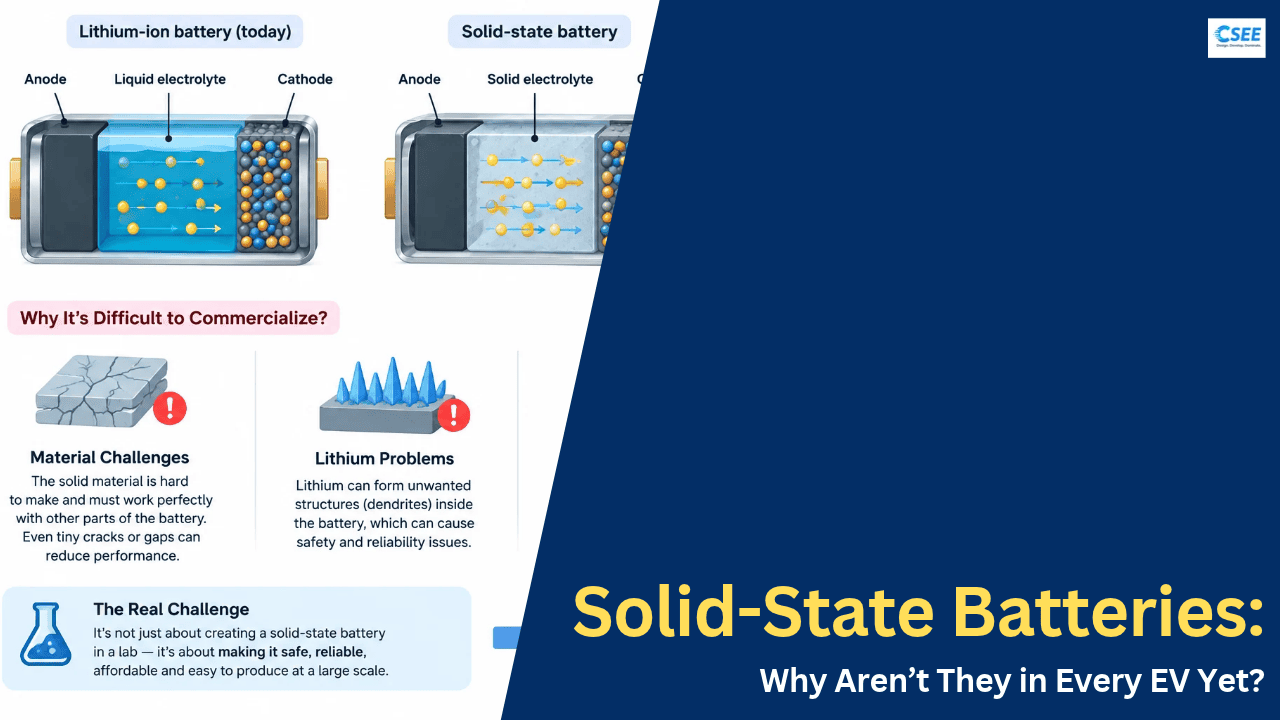
Every battery has the same basic parts: two electrodes (an anode and a cathode) and an electrolyte between them. When you charge or discharge, lithium ions travel through the electrolyte from one electrode to the other while electrons travel through the outside circuit and do the useful work.
In today’s lithium-ion cells the electrolyte is a liquid. It soaks into the electrodes, touches every surface and lets ions move easily. But it is also flammable, and it limits which materials can be used safely. A solid-state battery replaces that liquid with a solid material that still conducts lithium ions.
2. Liquid versus solid: what actually changes
| Feature | Liquid Li-ion | Solid-state (target) |
|---|---|---|
| Electrolyte | Flammable organic liquid | Ceramic, sulfide, polymer or hybrid solid |
| Safety | Can overheat and ignite if damaged | Generally less flammable |
| Energy density | Mature, improving slowly | Potentially higher, especially with lithium-metal anodes |
| Charging speed | Limited by heat and lithium plating | Potentially faster if interfaces stay healthy |
| Manufacturing | Highly refined, global supply chain | New processes, early-stage supply chain |
| Cost per kWh | Low and still falling | High today |
3. The material problem: no perfect solid exists yet
A good solid electrolyte must carry lithium ions as fast as a liquid, block electrons, stay chemically stable against both electrodes, survive high voltage, be mechanically tough, and be cheap to produce. No single material does everything well, so each family involves a compromise.
| Type | Strengths | Weaknesses |
|---|---|---|
| Oxide ceramics | Stable in air and against high voltage; very safe | Hard and brittle; need high-temperature processing; poor contact with electrodes |
| Sulfides | Excellent ion conductivity; softer and easier to press | React with moisture and can release toxic gas; need dry-room handling |
| Polymers | Flexible; easy to coat in rolls | Often need heating to conduct well; limited voltage window |
| Halides | Good conductivity and voltage stability | Costly raw materials; sensitive to some electrode materials |
| Hybrid / semi-solid | Easier path to production | Keeps some liquid, so gives up part of the benefit |
Sulfides illustrate the trade-off well. They conduct ions superbly and can be pressed into dense layers, which is why many developers favour them. But they are chemically reactive, so factories must control humidity very tightly, adding cost and complexity.
4. The interface problem: where batteries succeed or fail
Ions must hop from the electrolyte into the electrode across a boundary called the interface. With a liquid, that boundary is automatically complete. With a solid, any void, crack or loosely bonded patch is a spot where ions cannot cross. Current then squeezes through the remaining contact points, which raises resistance and heat.
Why interfaces degrade
- Volume change: electrodes swell and shrink as lithium moves in and out. A liquid adapts; a solid layer can separate or crack.
- Chemical reactions: some solids react with electrodes and form a resistive layer that grows over time.
- Pressure dependence: many designs need constant stack pressure to keep contact, which adds weight and engineering complexity.
Solid electrolytes were once expected to stop dendrites (needle-like lithium growths) simply by being hard. Research has shown that lithium can still creep along grain boundaries and tiny flaws in ceramics. So the electrolyte must be not only hard, but also defect-free and uniform.
5. The manufacturing problem: from lab cell to millions
A lab can hand-build a small cell, press it carefully and test it under ideal conditions. A gigafactory must produce millions of cells per year with nearly identical quality. Existing lithium-ion lines were built around slurry coating, liquid filling and winding, and many steps do not transfer to solid-state designs.
Specific production hurdles
- Thin, flawless layers: thinner electrolyte layers raise energy density, but they must be uniform across large areas with no pinholes.
- Tight environment control: sulfide materials need extremely dry conditions, which is expensive across a full factory.
- High pressure or heat: pressing or sintering can be slow and energy-intensive, and difficult to run continuously.
- Large-format cells: a method that works on a coin cell can behave differently on an automotive-size cell, where any flaw is amplified.
- Inspection: hidden internal voids are hard to find quickly, so quality control is slower than for conventional cells.
- New equipment: some lines must be designed or heavily modified, and that equipment itself is still maturing.
Why consistency matters so much
A car pack holds hundreds or thousands of cells wired together. One weak cell can limit the whole pack, so manufacturers need extremely high yield. If even a small share of cells fails inspection, the scrapped cost lands on the good ones. With early processes, yield tends to be low, and that directly drives price.
6. The cost problem
Cost comes from three places: expensive materials, slow or low-yield processes, and the lack of a supply chain at scale. Liquid lithium-ion benefits from decades of learning and enormous volume, which keeps pushing prices down. Solid-state must catch up while that target keeps moving.
| Cost driver | Why it is high | What could help |
|---|---|---|
| Raw materials | Specialty compounds, high purity requirements | Cheaper chemistries, local sourcing, bigger volumes |
| Process complexity | Pressing, sintering, dry rooms | Roll-to-roll methods, simpler assembly |
| Low yield | Invisible defects cause rejects | Better inspection and process control |
| Capital equipment | New machines, small production runs | Standardized tools, reuse of existing lines |
| Scale | No mass supply chain yet | Pilot lines growing into full factories |
7. The durability problem
Cars must work for ten years or more, in freezing winters and hot summers, through thousands of charge cycles and years of vibration. A prototype that performs well for a few dozen cycles tells us little about that. Solid-state cells must show that their interfaces stay intact through repeated swelling, temperature swings and fast charging.
| Stress in real life | Effect on a solid cell |
|---|---|
| Thousands of charge cycles | Repeated expansion can loosen contact |
| Cold weather | Ion movement slows; some materials suffer more |
| Hot weather | Speeds up unwanted reactions |
| Road vibration and impacts | Brittle layers can crack |
| Fast charging | High current exposes weak spots |
8. From lab to road: the long path
Automakers and battery companies have announced pilot lines, test vehicles and partnerships, and some semi-solid products already ship in limited volumes. Fully solid designs for mass-market cars are generally expected to arrive in small numbers first, likely in premium vehicles, before spreading as costs fall. Timelines have repeatedly slipped across the industry, so announcements are best read as targets, not guarantees.
9. Summary: the four big hurdles
| Hurdle | Core issue | What success looks like |
|---|---|---|
| Materials | No electrolyte is perfect on all fronts | Conductive, stable, tough and cheap solid |
| Interfaces | Gaps and cracks hurt performance | Contact that lasts thousands of cycles |
| Manufacturing | Lab methods don’t scale easily | Continuous, high-yield production |
| Cost | Expensive materials and low yield | Price competitive with advanced Li-ion |
10. Conclusion
Solid-state batteries are promising because they could make EVs safer, extend range and shorten charging time. But the real challenge is not inventing one in a lab. It is making the solid material work perfectly with every other component, keeping microscopic gaps away, producing millions of identical cells, and doing it all at a price people can afford.
That is why the technology looks so exciting and yet reaches the market slowly. Expect gradual progress: semi-solid and hybrid designs first, then premium fully solid cells, and finally broad adoption once reliability, yield and cost reach the level conventional batteries already offer.