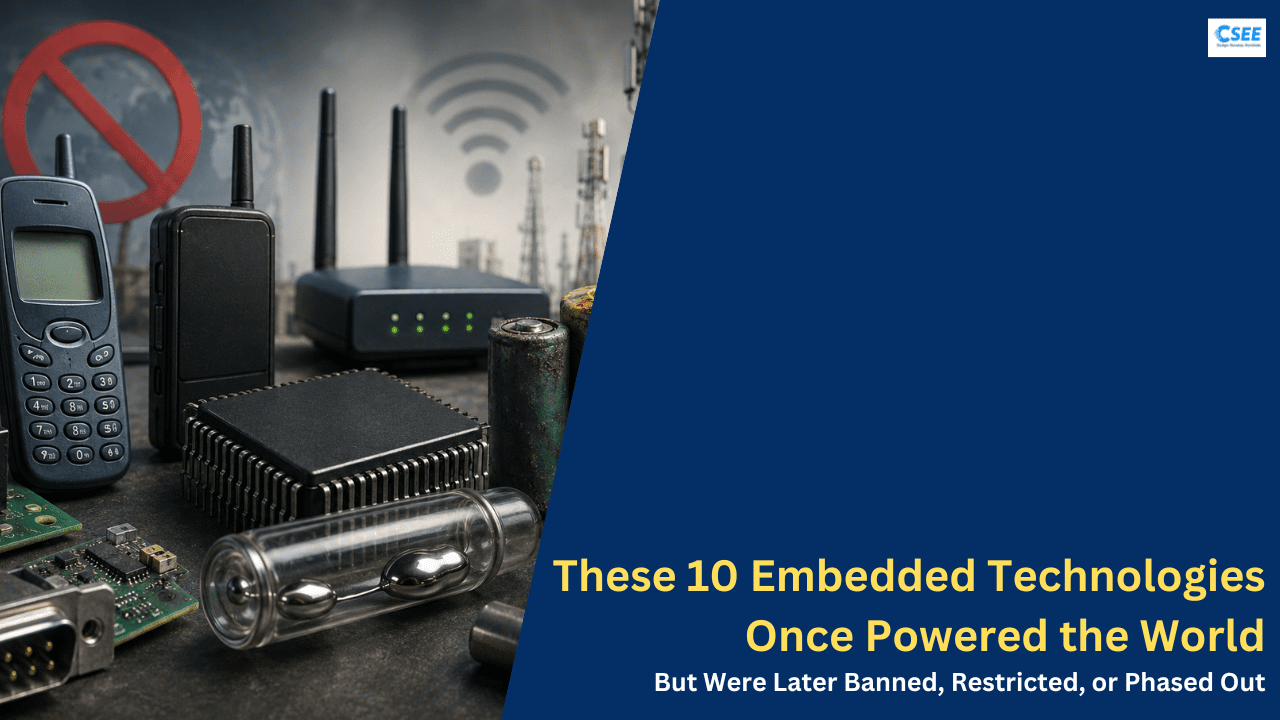
The history of embedded systems is filled with technologies that once seemed unstoppable. Engineers trusted them, industries standardized around them, and millions of products depended on them every day. From automotive ECUs and industrial controllers to telecommunications networks and consumer electronics, these technologies played a crucial role in building the connected world we live in today.
But technology never stands still. As computing power increased, security threats evolved, environmental regulations became stricter, and performance expectations grew, many of these once-essential technologies began to show their limitations. Some became vulnerable to cyberattacks. Others posed risks to human health and the environment. A few simply could not keep up with modern requirements.
As a result, many technologies that once represented the cutting edge of engineering were eventually banned, restricted, deprecated, or phased out.
What makes this story fascinating is that these technologies were not failures. In fact, they were incredibly successful. They helped shape entire industries and laid the foundation for the systems engineers design today.
Let’s explore ten embedded technologies that changed the world before eventually being replaced.
1. Mercury Switches
Before modern electronic sensors became affordable and reliable, mercury switches were considered one of the most elegant solutions for detecting movement, position, and tilt. These switches contained liquid mercury sealed inside a glass tube. When the switch was tilted, the mercury flowed to complete an electrical circuit.
Mercury switches were used extensively in automotive systems, industrial automation, aerospace equipment, thermostats, vending machines, security systems, and household appliances. Engineers appreciated their reliability because they contained very few moving parts and produced virtually no electrical contact bounce.
In automobiles, mercury switches commonly controlled hood lights, trunk lights, and tilt-sensitive functions. Industrial systems used them for orientation sensing and safety monitoring. Their simple design made them dependable in harsh environments.
Despite their advantages, mercury switches had one major problem: mercury is highly toxic. Even small quantities can contaminate water supplies and ecosystems. Exposure to mercury can also cause serious health problems.
As environmental regulations tightened worldwide, manufacturers were forced to find alternatives. Modern products now rely on Hall-effect sensors, accelerometers, MEMS sensors, reed switches, and solid-state electronic solutions.
Mercury switches helped automate countless systems, but environmental concerns ultimately ended their dominance.
2. DES Encryption
The Data Encryption Standard, commonly known as DES, was one of the most influential encryption algorithms ever created. Introduced in the 1970s, DES became the global standard for securing sensitive electronic information.
For decades, DES protected banking networks, government communications, embedded devices, payment terminals, ATMs, and secure industrial systems. It played a critical role in enabling secure digital transactions long before modern cybersecurity became mainstream.
At the time of its introduction, DES offered strong protection. However, technology advanced faster than expected. As processors became more powerful, security researchers realized that DES’s 56-bit encryption key was too small to withstand brute-force attacks.
In 1998, a specially designed machine demonstrated that DES could be cracked in a relatively short time. What was once considered secure had become vulnerable.
Organizations gradually migrated to stronger encryption standards such as Triple DES and eventually AES. Today, DES is considered obsolete and is prohibited in most security-critical applications.
Although it has been retired, DES remains one of the most important milestones in cybersecurity history.
3. WEP Wi-Fi Security
Wireless networking transformed the world, and WEP played a major role in making that transformation possible.
WEP, or Wired Equivalent Privacy, was introduced as the first major security protocol for Wi-Fi networks. Its goal was simple: provide wireless communications with security comparable to traditional wired networks.
For many years, WEP protected home routers, corporate wireless networks, industrial devices, embedded systems, and early IoT products. It enabled businesses and consumers to adopt Wi-Fi with confidence.
Unfortunately, researchers discovered significant flaws in WEP’s design. Attackers could capture wireless traffic and recover encryption keys in minutes. As hacking tools became widely available, WEP’s weaknesses became impossible to ignore.
The industry responded by developing WPA and later WPA2 and WPA3. Security organizations strongly discouraged the use of WEP, and manufacturers eventually removed support from new products.
Today, WEP is remembered as the technology that helped launch the Wi-Fi era, even though its security ultimately failed.
4. 2G GSM Modules
Long before the IoT boom, 2G GSM modules connected millions of machines to cellular networks.
These modules were used in vehicle tracking systems, vending machines, utility meters, industrial monitoring equipment, alarm systems, remote diagnostics platforms, and countless machine-to-machine applications.
For embedded engineers, 2G represented a breakthrough. Devices could transmit data from almost anywhere without requiring wired infrastructure. This capability opened the door to remote monitoring and automation on a massive scale.
However, cellular spectrum is limited. As demand for faster mobile internet increased, network operators needed additional bandwidth for newer technologies.
Around the world, telecom providers began shutting down 2G networks and reallocating spectrum to 4G and 5G services. As a result, countless legacy embedded products stopped functioning unless upgraded.
The retirement of 2G serves as a reminder that even highly successful technologies have finite lifespans.
5. 3G Cellular Modules
After 2G came 3G, bringing higher speeds and improved connectivity.
3G modules became the backbone of connected vehicles, industrial automation systems, telematics platforms, healthcare devices, smart meters, surveillance systems, and remote asset tracking solutions.
Many embedded products designed between 2005 and 2020 relied heavily on 3G infrastructure. Engineers viewed it as a future-proof solution capable of supporting growing data requirements.
However, history repeated itself.
As 4G LTE and later 5G technologies emerged, mobile operators began retiring 3G networks. The maintenance costs of older infrastructure could no longer be justified.
Organizations worldwide were forced to replace millions of deployed devices. Automotive manufacturers, utility companies, and industrial operators spent billions upgrading equipment that depended on 3G connectivity.
Although its lifespan was relatively short, 3G played a crucial role in the evolution of connected embedded systems.
6. SHA-1
SHA-1 was once considered one of the most trusted cryptographic algorithms in the world.
It was widely used for firmware authentication, software verification, SSL certificates, digital signatures, secure boot implementations, and embedded cybersecurity solutions.
For many years, SHA-1 protected software updates and helped ensure the integrity of critical systems. Manufacturers trusted it to verify that firmware had not been altered or tampered with.
Eventually, researchers discovered practical collision attacks. This meant attackers could potentially create two different files that generated the same hash value.
Such vulnerabilities undermined confidence in SHA-1’s security guarantees.
Technology companies, browser vendors, and security organizations began phasing out SHA-1 in favor of stronger algorithms such as SHA-256 and SHA-3.
Today, SHA-1 remains an important chapter in cryptography but is no longer considered secure for modern applications.
7. Telnet
Before SSH became standard, Telnet was one of the most common ways to remotely access embedded devices.
Engineers used Telnet to configure routers, switches, industrial controllers, Linux-based systems, and network equipment. It provided a simple and convenient method for remote administration.
The problem was that Telnet transmitted all information, including usernames and passwords, in plain text.
Anyone monitoring network traffic could potentially intercept credentials and gain unauthorized access.
As cybersecurity threats increased, organizations began replacing Telnet with Secure Shell (SSH), which encrypts communications and provides significantly stronger protection.
Today, many security standards prohibit Telnet usage in production environments, though it still appears occasionally in legacy systems.
8. RC4 Encryption
RC4 was once one of the most popular encryption algorithms in the world.
It was used in wireless networking, internet communications, SSL protocols, embedded systems, and secure data transmission applications.
RC4 became popular because it was simple, fast, and easy to implement on resource-constrained hardware. This made it particularly attractive for embedded devices with limited processing power.
Over time, researchers discovered statistical weaknesses that allowed attackers to recover sensitive information under certain conditions.
As evidence mounted, major technology companies began abandoning RC4. Security organizations recommended its removal from secure systems, and browser vendors disabled support.
The algorithm that once protected billions of communications became another example of how cybersecurity must constantly evolve.
9. Nickel-Cadmium Batteries
Before lithium-ion batteries became dominant, nickel-cadmium batteries powered a wide range of electronic and embedded products.
They were commonly found in cordless tools, emergency systems, industrial equipment, medical devices, aviation systems, and portable electronics.
Engineers valued NiCd batteries because they were durable, capable of delivering high current, and performed well under extreme temperatures.
However, cadmium is a toxic heavy metal that poses significant environmental risks.
Growing concerns about pollution and disposal led many countries to restrict the use of cadmium-containing batteries. Manufacturers gradually transitioned toward nickel-metal hydride and lithium-ion technologies.
Although they have largely disappeared from consumer products, nickel-cadmium batteries helped power the early portable electronics revolution.
10. Lead-Based Solder
Perhaps no material has had a greater impact on electronics manufacturing than lead-based solder.
For decades, nearly every electronic product—from televisions and computers to automotive ECUs and industrial controllers—used tin-lead solder to create reliable electrical connections.
Engineers preferred lead-based solder because it melted at lower temperatures, formed strong joints, and provided excellent long-term reliability.
However, lead exposure poses serious health and environmental risks.
The introduction of RoHS regulations dramatically changed the electronics industry. Manufacturers were required to reduce or eliminate hazardous substances, including lead.
This triggered one of the largest manufacturing transitions in history as companies redesigned processes to support lead-free solder technologies.
Today, lead-free manufacturing is the global standard, though leaded solder still survives in some specialized aerospace, military, and high-reliability applications.
Conclusion
The story of these ten technologies highlights an important lesson for every embedded engineer: success does not guarantee permanence. Mercury switches, DES encryption, WEP security, 2G and 3G modules, SHA-1, Telnet, RC4, nickel-cadmium batteries, and lead-based solder were all groundbreaking innovations in their time. They solved real engineering problems and enabled industries to grow.
Yet advances in cybersecurity, telecommunications, environmental science, and manufacturing eventually revealed their limitations.
Today’s cutting-edge technologies may face the same fate in the future. As engineers, our responsibility is not only to innovate but also to continuously evaluate whether existing solutions remain secure, efficient, reliable, and sustainable.
The technologies on this list may be gone from modern designs, but their influence remains embedded in nearly every system we build today. They are reminders that engineering is a constant process of evolution—and that every generation stands on the foundation built by the technologies that came before it.
Thanks for reading.
Also, read:
- How Does An EV Know It Has 50% Battery Left? 🔋
- Why AI Agents Could Become The Digital Workforce
- Press Accelerator → What Happens Inside the Car?
- What Does TOPS Mean In AI Chips?
- The Future of Communication: Neuralink VOICE
- Top 10 Tools to Design ADAS and Autonomous Driving Systems Virtually
- What Is The Main Aim Of Semicon 2.0?
- 20 Advanced Coursera Courses for Embedded Engineers That Can Lead to High-Paying Careers