Project Brief · AI Systems Architecture
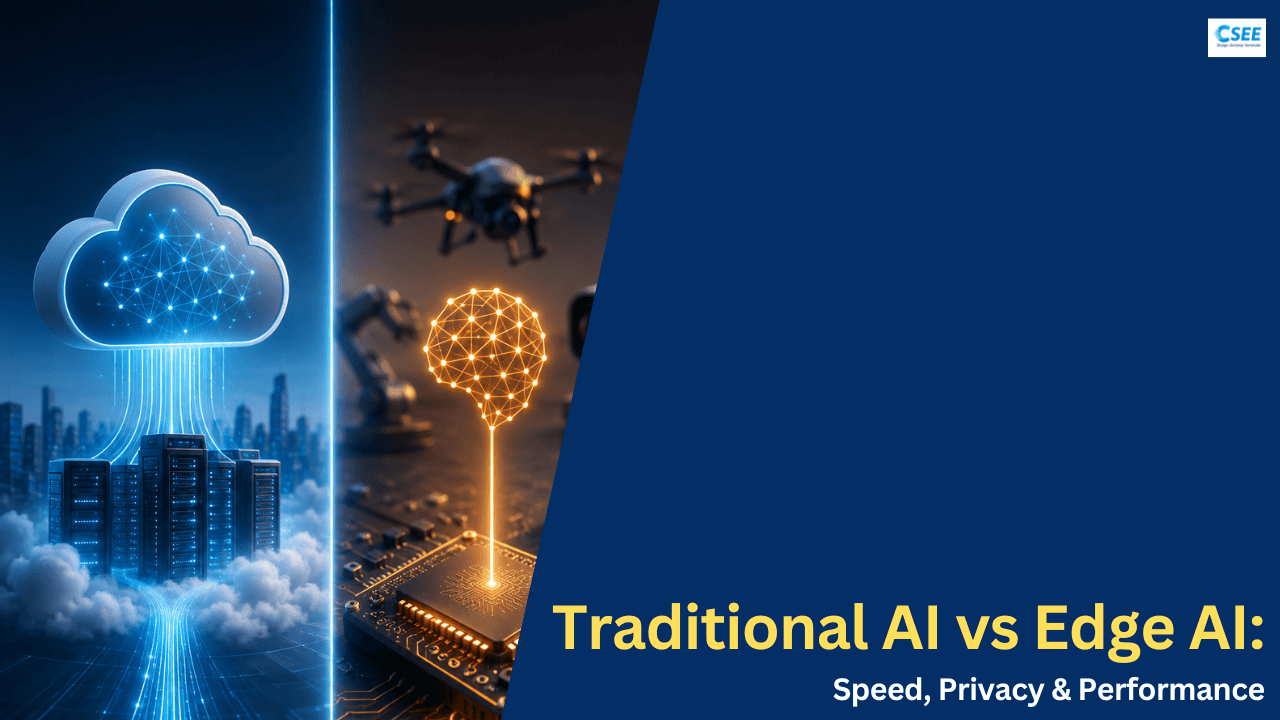
Traditional AI vs Edge AI:
Which One Will Power the Future?
A detailed, diagram-led comparison of centralized cloud intelligence and on-device intelligence — how they work, what they cost, where each one wins, and why the future almost certainly belongs to both.
What this article covers
- AI foundations in one page
- How Traditional AI works
- How Edge AI works
- Architecture side by side
- The data-flow difference
- Latency & bandwidth
- The master comparison table
- Cost economics compared
- Privacy & security
- Edge hardware landscape
- Shrinking models for the edge
- Industry use cases
- Energy & sustainability
- Reliability & failure modes
- 5G & the network
- Building & maintaining each
- The hybrid future
- Honest challenges
- Who powers the future?
- Glossary
- FAQ
- The project & its cost
01 Foundations
Artificial intelligence in a single page
Before comparing where AI runs, it helps to agree on what is running. At its core, a modern AI system is a mathematical function with millions or billions of adjustable numbers, called parameters or weights. During training, the system is shown vast amounts of example data and its parameters are nudged, over and over, until its outputs match the desired answers. Training is enormously compute-hungry: it can involve thousands of specialized processors working for days or weeks, consuming as much electricity as a small town over the course of a single large run.
Once trained, the model is frozen and used to make predictions on new data. This second phase is called inference. Inference is far cheaper than training per request, but it happens constantly — every photo you unlock your phone with, every voice command, every fraud check on a card swipe is an inference. Multiply a tiny per-request cost by billions of requests a day and inference becomes the dominant, recurring expense of running AI at scale.
Training decides how smart a model is. Inference decides how much it costs to keep being smart. The Traditional-vs-Edge debate is almost entirely a debate about where inference should happen.
Almost nobody trains large foundation models on a phone; the heavy lifting of training will remain in data centers for the foreseeable future. The real battleground is inference — the moment of using the model. Traditional AI keeps inference in the cloud. Edge AI pushes inference down onto the device. Everything that follows flows from that one distinction.
How we ended up with two paradigms
The split between cloud and edge intelligence was not planned; it emerged from the collision of two trends moving in opposite directions. On one side, models grew larger and hungrier, which pulled computation toward the cloud, the only place with enough concentrated power to train and run them. For years this was the whole story: intelligence meant sending your data somewhere powerful and waiting for wisdom to come back. The cloud was where the brains lived, and devices were merely windows onto that intelligence.
On the other side, the chips inside everyday devices were quietly becoming astonishingly capable. The same relentless improvement that turned phones into pocket supercomputers also gave them dedicated circuitry for the specific math that neural networks need. Suddenly a device could run a respectable model on its own, without asking permission from a server. The moment that became true, the questions of latency, privacy, connectivity, and cost that had always been swept under the rug of “just use the cloud” became live design choices again. Edge AI is what happened when devices grew smart enough to keep some of the thinking for themselves.
So the field did not replace one paradigm with another; it gained a second option and, with it, a genuine architectural decision. Every AI-powered product now faces a question that did not meaningfully exist a decade ago: for each intelligent feature, should the thinking happen here, or there? The rest of this document is a structured way of answering that question well.
A quick vocabulary
- Latency — the delay between asking and answering, usually measured in milliseconds.
- Bandwidth — how much data you can move across the network per second.
- Throughput — how many requests a system can handle per second.
- Model size — how much memory the parameters occupy, from a few megabytes to hundreds of gigabytes.
- Accelerator — specialized hardware (GPU, TPU, NPU) that runs the math of a model far faster than a general CPU.
02 Traditional AI
How Traditional (cloud) AI works
Traditional AI — often simply called cloud AI — is the architecture most people picture when they think of “artificial intelligence.” The intelligence lives on powerful servers in centralized data centers. A user’s device, whether a phone, a browser, a camera, or a car, acts mainly as a collector and messenger: it captures input, ships that input across the internet to the server, waits for the model to process it, and then displays whatever answer comes back.
This is the model behind most large language model chat interfaces, cloud vision APIs, recommendation engines, and the smart features of countless apps. When you dictate a message and it turns into text, or you ask a chat assistant a question and receive a paragraph in return, the odds are high that your words traveled hundreds or thousands of kilometers to a data center and back.
Why the cloud became the default
The cloud became the natural home for AI for several compounding reasons. First, raw power: data centers can house racks of accelerators with more compute than any handheld device could dream of, letting them run the largest, most capable models. Second, elasticity: cloud platforms can spin thousands of machines up or down within minutes, absorbing spikes in demand that would crush a fixed local setup. Third, central control: when the model lives in one place, improving it is a matter of updating a single deployment, and every user instantly benefits without touching their device. Fourth, data gravity: organizations already stored oceans of data in the cloud, so it was efficient to bring the computation to where the data already lived.
The lifecycle of one cloud AI request
- A device captures input — an image, a sentence, a sensor reading.
- The input is packaged, often compressed and encrypted, and sent over the network.
- A load balancer routes the request to an available server with a free accelerator.
- The model performs inference, sometimes calling other services (databases, other models) along the way.
- The result is packaged and returned across the network to the device.
- The device renders the answer to the user.
Each of those steps adds a little time and consumes a little bandwidth. On a fast connection this whole loop can feel instant. On a slow, congested, or intermittent connection, it can feel sluggish — or fail entirely. That fragility is the seed from which Edge AI grew.
Inside the data center
It is worth appreciating just how much sits behind that single word “cloud.” A modern AI data center is a purpose-built industrial facility: rows upon rows of servers, each packed with specialized accelerators, connected by extremely fast internal networking so that many chips can cooperate on one enormous model. Surrounding all that computation is an equally serious support system — massive cooling to carry away the heat, redundant power feeds and backup generators, layered physical and digital security, and monitoring that watches every component around the clock. This machinery is why the cloud can offer capability no device can match, and also why every cloud inference carries overhead the raw math alone would not suggest.
Orchestration software ties it all together, deciding which request runs on which chip, spinning capacity up when demand surges and releasing it when demand falls. This elasticity is one of the cloud’s quiet superpowers: a service can serve a handful of users at breakfast and millions at lunchtime without anyone provisioning hardware in advance. The user never sees any of this. They send a request and receive an answer, unaware of the vast, humming apparatus that produced it. That invisibility is precisely the point — and precisely why the network dependency and recurring cost are so easy to forget until they bite.
Strength in one line: Traditional AI offers the most raw intelligence per request and the easiest central updates, at the price of a network round trip and continuous server cost.
03 Edge AI
How Edge AI works
Edge AI flips the geography. Instead of sending data to a distant model, it brings a (usually smaller) model down to the device — to the “edge” of the network, where data is actually born. The “edge” is a deliberately broad term. It can mean a smartphone, a smartwatch, a security camera, an industrial sensor, a car’s onboard computer, a drone, a hearing aid, or a small gateway box sitting in a factory that serves dozens of nearby machines. What unites them is that inference happens locally, without a mandatory trip to the cloud.
When your phone recognizes your face to unlock in a fraction of a second, transcribes your voice while in airplane mode, or blurs your background on a video call, that is Edge AI at work. The model is already on the chip. The data never has to leave.
Why push intelligence to the edge?
Four pressures drove the rise of Edge AI. First, latency: some decisions simply cannot wait for a network round trip. A car deciding whether to brake, a machine deciding whether to halt a spinning blade, or a hearing aid adjusting to a noisy room needs an answer in milliseconds, reliably, every time. Second, privacy: keeping sensitive data — faces, voices, medical readings, keystrokes — on the device sidesteps a whole category of risk that comes from transmitting and storing it elsewhere. Third, connectivity: billions of devices operate where networks are weak, metered, or absent, from rural farms to ships to underground mines. Fourth, cost at scale: once a model runs on a device the user already owns, each inference is essentially free to the provider, whereas every cloud inference is a metered expense.
Traditional AI asks, “how do we bring the data to the intelligence?” Edge AI asks, “how do we bring the intelligence to the data?”
The lifecycle of one edge AI inference
- A device captures input — the same starting point as before.
- A compact model already stored on the device runs inference directly on the local processor or a dedicated neural chip.
- The result is produced on the device, typically within milliseconds.
- Only if needed — for logging, aggregate analytics, or a harder follow-up question — is a small summary sent to the cloud.
Notice what is missing: the mandatory network round trip. The device can produce an answer even with the antenna switched off. That single structural change is why Edge AI feels instant, works offline, and keeps raw data private by default.
What makes a task a good fit for the edge
Not every problem belongs on the edge, and recognizing the pattern of a good candidate saves a great deal of wasted effort. Tasks that thrive locally tend to share a few traits. They are well-defined and repetitive — recognizing a wake word, detecting a face, classifying a defect — rather than open-ended. They are latency-sensitive, where a fast, predictable answer matters more than a marginally smarter one. They are privacy-sensitive, involving data a user would prefer never left their possession. And they are high-volume, repeated so often that paying for each one in the cloud would be wasteful. When several of these traits line up, the edge is almost always the right home.
Conversely, tasks that are rare, wildly varied, dependent on huge and constantly changing knowledge, or that demand the absolute peak of reasoning capability still point toward the cloud. The skill in designing modern AI products is learning to look at each feature and quickly place it on this spectrum, rather than reflexively sending everything to one destination. Much of the elegance of a well-built system comes from making these placements correctly, so that the fast things are fast, the private things stay private, and the genuinely hard things get the full power they need.
Strength in one line: Edge AI offers near-instant, offline-capable, private inference at near-zero marginal cost, at the price of running within tight hardware limits and being harder to update.
04 Architecture
The two architectures, side by side
The clearest way to feel the difference is to look at where the “brain” sits in each design. In the diagrams below, the blue path is Traditional AI, where the model lives far away in the cloud. The teal path is Edge AI, where the model lives right on the device. Both diagrams scale to fit whatever screen you are reading on.
The visual contrast tells the whole story. In Figure 1, the intelligence and the data are separated by the internet, and every answer must cross that gap twice. In Figure 2, the intelligence sits next to the data, and the gap is optional. Everything that distinguishes these two approaches — speed, privacy, offline capability, cost structure, update strategy — is a downstream consequence of that single relocation.
05 Data Flow
Following the data through both systems
Architecture diagrams show where things live. Data-flow diagrams show what happens over time. The sequence below traces a single request through each paradigm so you can see exactly where the seconds and the risks accumulate.
Reading these two columns together makes the trade-off tangible. The cloud path has more moving parts, and several of them — upload, queue, routing, download — depend entirely on network conditions the application cannot control. The edge path collapses those steps because the model is already sitting a few millimeters from the sensor. When people say Edge AI “feels instant,” this collapsed timeline is precisely what they mean.
It is worth being fair to the cloud, though. That extra machinery buys something real: the ability to run a far larger, more capable model, to consult huge databases, and to combine multiple services into one answer. For a complex research question, the cloud’s richer path is a feature, not a bug. For a reflex decision, it is pure overhead.
06 Latency & Bandwidth
Why milliseconds and megabytes matter
Latency is the single most intuitive advantage of Edge AI, so it deserves a careful look. Human perception has thresholds. Below about 100 milliseconds, an interaction feels instantaneous. Between 100 milliseconds and a second, it feels responsive but noticeable. Beyond a second, attention starts to drift and the experience feels laggy. A cloud round trip, even under good conditions, spends a meaningful chunk of that budget just moving data back and forth before the model has done any thinking at all.
The chart captures a subtle but crucial point: Edge AI’s latency is predictable. It barely moves whether the signal is strong, weak, or absent, because the network is not in the loop. Cloud latency, by contrast, is at the mercy of conditions the user cannot see — a congested cell tower, a busy server, a long physical distance to the nearest data center. For an app where the occasional slow response is fine, that variability is tolerable. For a safety system, an unpredictable delay is unacceptable. This is why braking systems, industrial safety cutoffs, and medical monitors overwhelmingly favor the edge.
Bandwidth is the quiet cost
Latency gets the attention, but bandwidth is where cloud AI quietly runs up a bill. Consider a network of a thousand cameras streaming high-resolution video to the cloud for analysis. That is a torrent of data to upload continuously, and someone pays for every gigabyte, both in network fees and in the cloud compute needed to process it. Edge AI reverses this: each camera analyzes its own footage locally and only sends up a tiny result — “person detected at 14:03” — a few bytes instead of a video stream. For large fleets of devices, this bandwidth reduction is often the single biggest cost saving, dwarfing even the latency benefits.
Rule of thumb: if a decision must be fast, private, or made offline, lean edge. If a decision must be as smart as possible and can tolerate a network trip, lean cloud.
07 The Comparison
Traditional AI vs Edge AI: the master table
Everything discussed so far can be distilled into a single reference table. Scroll it sideways on a narrow screen — it is built to stay readable on a phone.
| Dimension | Traditional (Cloud) AI | Edge AI |
|---|---|---|
| Where inference runs | Remote data center | On the device itself |
| Typical latency | 100–800 ms (variable) | 1–50 ms (stable) |
| Works offline? | No — needs a connection | Yes — fully local |
| Model size possible | Very large (billions+ of params) | Small to medium (compressed) |
| Raw capability ceiling | Highest available | Good, improving fast |
| Marginal cost per request | Metered server cost | Near zero |
| Bandwidth use | High (data leaves device) | Low (results only) |
| Raw data privacy | Data transmitted & stored remotely | Data can stay on device |
| Updating the model | Instant & central | Requires pushing updates to devices |
| Scaling to many devices | Server cost grows with usage | Cost grows with device count, not usage |
| Reliability dependency | Network + data center uptime | Device only |
| Energy per inference | High per query (big model) | Low (efficient chips) |
| Best-fit workloads | Complex reasoning, huge context, analytics | Reflex decisions, sensing, privacy-critical |
No column is a clean winner. Traditional AI dominates the top of the capability curve and the ease of central control. Edge AI dominates speed, privacy, offline resilience, and marginal cost. The correct reading of this table is not “pick the better one” but “match each requirement to the column that satisfies it,” which for most real products means using both.
08 Economics
The economics: two very different cost shapes
The financial profiles of these two approaches are almost mirror images, and understanding that shape difference is often more important than any single number. Traditional AI has low upfront cost and high ongoing cost. You can call a cloud model with a few lines of code and no hardware investment, but you then pay for every single inference, forever, and that bill scales directly with success. The more users you win, the more you pay.
Edge AI has the opposite shape: higher upfront cost and low ongoing cost. You must engineer a model to fit on-device, possibly select or design capable hardware, and manage deployment to a fleet — real work. But once that model is running on devices your users already own, each additional inference costs you essentially nothing. Your marginal cost per prediction approaches zero even as usage explodes.
Figure 5 shows why the right answer depends heavily on scale and usage intensity. Below the break-even point — a prototype, a low-traffic app, an experiment — cloud AI is almost always cheaper and faster to ship because there is nothing to build. Above the break-even point — a popular consumer app, a million-device sensor fleet, a high-frequency vision system — edge economics win decisively, because the cloud bill would otherwise grow without limit. Many mature products deliberately start in the cloud to move fast, then migrate their hottest, most repetitive inferences to the edge as volume grows and the recurring bill becomes painful.
| Cost factor | Cloud AI | Edge AI |
|---|---|---|
| Upfront engineering | Low | Higher (model + hardware work) |
| Hardware investment | None for you | Capable device / chip needed |
| Per-inference cost | Pay every time | ~Zero after deployment |
| Bandwidth cost | High & recurring | Minimal |
| Cost at 10× growth | ~10× the bill | Roughly flat per device |
| Financial risk | Runaway usage bills | Fixed, predictable |
09 Privacy & Security
Privacy, security, and regulation
Where data physically travels is a privacy decision as much as a technical one. In the traditional model, raw data — which may include faces, voices, health readings, location trails, or private messages — must leave the device and traverse networks to reach the model. Even with strong encryption in transit and at rest, this creates a larger “attack surface”: more places where data exists, more systems that could be breached, and more parties who could, in principle, access it. It also raises hard questions about jurisdiction: data crossing borders can fall under multiple, sometimes conflicting, legal regimes.
Edge AI offers a structurally different privacy posture. When inference happens on-device and the raw data never leaves, an entire category of risk simply does not arise. A smart doorbell that recognizes a family member on its own chip, sending only “known person” to the cloud, exposes far less than one that streams every visitor’s face to a server. This property, sometimes called privacy by design, is increasingly valued not just by cautious users but by regulators.
The most private data is the data that never leaves the device. Edge AI turns that principle into an architecture.
Data-protection laws around the world increasingly favor data minimization — collecting and moving as little personal data as possible. Keeping processing local aligns naturally with that direction and can dramatically simplify compliance. For sectors like healthcare, finance, and anything involving children or biometrics, the ability to say “the raw data never left the device” is a powerful and sometimes decisive advantage.
Where the cloud can be more secure
The story is not one-sided. A well-run data center has security resources no consumer device can match: physical guards, dedicated security teams, rapid patching, intrusion detection, and redundant backups. A device, by contrast, can be lost, stolen, or tampered with physically. If a model itself is valuable intellectual property, shipping it to millions of devices exposes it to reverse-engineering in a way that keeping it locked in the cloud does not. Edge deployments must therefore invest in secure boot, encrypted model storage, and hardware protections. The right framing is not “edge is private, cloud is not,” but “each shifts the risk to a different place, and you must secure whichever place you choose.”
| Aspect | Cloud AI | Edge AI |
|---|---|---|
| Raw data location | Leaves device, stored remotely | Can stay entirely on device |
| Attack surface | Larger (network + servers) | Smaller for data; device-local |
| Regulatory alignment | Complex across borders | Eases data-minimization rules |
| Central security ops | Strong, professional | Depends on device hardening |
| Model IP exposure | Protected in cloud | Shipped to devices; needs protection |
| Physical theft risk | Low (data not on device) | Device loss is a factor |
10 Hardware
The hardware that makes the edge possible
Edge AI would be a nice idea and nothing more without a decade of relentless progress in efficient silicon. The reason a phone can now run models that once required a server rack is a family of specialized chips designed to do one thing extremely well: the matrix multiplications at the heart of neural networks, using as little power as possible.
The key players inside a device
- CPU (central processing unit) — the general-purpose brain. It can run any AI model but does so relatively slowly and inefficiently for large neural nets.
- GPU (graphics processing unit) — originally for graphics, its ability to do many calculations in parallel makes it well suited to neural networks. Present in phones and many edge boards.
- NPU (neural processing unit) — a chip built specifically for AI inference. Modern phones, laptops, and many cameras now include an NPU that runs models fast while sipping power. This is the workhorse of consumer Edge AI.
- TPU / dedicated AI accelerators — purpose-built inference silicon, from tiny modules for microcontrollers to larger units in gateways and cars.
- Microcontrollers (MCUs) — extremely small, cheap, low-power chips. A whole discipline, sometimes called TinyML, squeezes useful models onto devices with only kilobytes of memory, running for months on a coin cell.
The important insight from Figure 6 is that “edge” is not one thing. A temperature sensor detecting an anomaly with a few kilobytes of model is edge. A self-driving car running perception on a rack of accelerators bolted into the trunk is also edge. What they share is locality: the compute sits where the data is, not in a distant cloud. As NPUs grow more powerful each year, the ceiling on what can run locally keeps rising, steadily shifting workloads that once required the cloud down onto the device.
11 Optimization
Shrinking big models to fit small devices
A model that runs happily on a data-center accelerator might be far too large and power-hungry for a phone, let alone a coin-cell sensor. Making Edge AI practical therefore depends on a toolbox of techniques for making models smaller and faster while keeping them accurate enough. These techniques are where much of the field’s cleverness now lives.
Quantization
Models normally store their parameters as high-precision numbers. Quantization reduces that precision — for example from 32-bit down to 8-bit or even lower — so each number takes far less memory and can be processed faster by efficient hardware. Done carefully, the accuracy loss is small while the size and speed gains are large. Quantization is often the first and highest-impact optimization applied to an edge model.
Pruning
Trained networks are frequently over-provisioned; many connections contribute little to the final answer. Pruning removes these low-value connections, producing a leaner network that computes the same result with fewer operations. It is like editing a draft down to only the words that carry meaning.
Knowledge distillation
Here a large, capable “teacher” model trains a small “student” model to imitate its behavior. The student ends up far smaller than the teacher yet captures much of its skill on the target task. Distillation is a favorite route to getting near-cloud quality into an edge-sized package.
Efficient architectures
Rather than shrinking a big model after the fact, researchers also design architectures that are efficient from the start, specifically shaped for mobile and embedded hardware. These purpose-built designs squeeze maximum capability out of every operation, and they underpin a large share of the vision and audio models running on phones today.
| Technique | What it does | Main benefit | Trade-off |
|---|---|---|---|
| Quantization | Lowers numeric precision of weights | Big size & speed gain | Small accuracy risk |
| Pruning | Removes low-value connections | Fewer computations | Needs careful tuning |
| Distillation | Small model imitates a large one | Near-teacher quality, tiny size | Extra training step |
| Efficient architecture | Model designed lean from the start | Best fit for edge hardware | May cap peak capability |
In practice these techniques are stacked. A team might distill a large model into a smaller architecture, prune the redundant parts, and quantize the result — arriving at something a hundred times smaller than the original that still performs its narrow job well. This compounding is why the gap between what the cloud can do and what the edge can do keeps narrowing year after year.
12 In the Wild
Where each approach wins in practice
Abstract trade-offs become concrete when mapped onto real industries. The pattern that emerges is consistent: reflex, privacy, and offline needs pull toward the edge; deep reasoning, huge context, and rapid iteration pull toward the cloud. Many of the best products blend both.
Automotive
A car cannot ask a distant server whether to brake for a child who just stepped into the road. Perception and split-second driving decisions must run on the edge, on hardware inside the vehicle, with total reliability and no dependence on signal. Meanwhile, the cloud handles fleet-wide learning, map updates, and long-term analysis of aggregated, anonymized driving data. Edge for the reflex, cloud for the wisdom.
Healthcare
Wearables and bedside monitors increasingly run models on-device to detect irregular heart rhythms, falls, or oxygen problems instantly and privately, even without connectivity. Sensitive raw signals stay on the device. Harder diagnostic questions, and the training of the underlying models on large research datasets, remain in the cloud where the compute and the data live.
Manufacturing & industry
On a fast production line, a defect must be caught in the moment the part passes the camera, and a dangerous vibration must trigger a shutdown immediately. Edge AI on the factory floor delivers this millisecond response and keeps working during network outages. The cloud aggregates data across many machines and plants to spot broader trends and schedule maintenance.
Smart homes & consumer devices
Wake-word detection, face unlock, on-device transcription, and background blur all run at the edge for speed and privacy. When you ask a complex question that needs deep reasoning or fresh information, the request may still travel to the cloud. The hand-off between the two, ideally invisible to the user, is the modern design pattern.
Retail & cities
Stores and cities deploy fleets of cameras and sensors. Streaming all that video to the cloud is expensive and privacy-fraught, so increasingly each device analyzes its own feed locally — counting footfall, detecting incidents, managing traffic — and sends only compact insights upstream. This is the bandwidth argument from earlier, playing out at city scale.
Agriculture & remote operations
Farms, mines, ships, pipelines, and remote research stations share a defining constraint: connectivity is weak, intermittent, or absent, and often expensive when available. A crop-monitoring drone or a soil sensor that depended on a live cloud connection would be useless in the middle of a field. Edge AI lets these systems classify pests, detect leaks, monitor equipment, and guide machinery entirely on their own, syncing summaries to the cloud only when a connection happens to be available. For anyone operating far from reliable infrastructure, the edge is not a preference — it is the only workable option.
Drones & robotics
A drone dodging a tree branch or a warehouse robot avoiding a person cannot outsource that decision to a server; the round trip would arrive after the collision. Real-time navigation, obstacle avoidance, and stabilization must run on the machine itself with guaranteed, predictable timing. The cloud still plays a role — planning routes, coordinating fleets, and learning from the data many robots gather — but the moment-to-moment control loop belongs firmly to the edge.
Finance & fraud
Finance shows how the two layers split by task even within one domain. A card terminal or phone may run lightweight on-device checks for instant, private verification, while the deep, cross-account fraud models that weigh thousands of signals against enormous historical datasets live in the cloud, where the data and compute are concentrated. Speed and privacy at the point of contact; depth and breadth in the center.
Education & accessibility
On-device language and vision models increasingly power live captioning, real-time translation, reading assistance, and accessibility features that must work instantly and privately, including offline. A student in a low-connectivity area, or a user who needs their personal data to stay on their own device, benefits directly from intelligence that runs locally. Richer tutoring or content generation may still reach out to a larger cloud model when a connection is present, again illustrating the hybrid pattern.
| Industry | Edge does | Cloud does |
|---|---|---|
| Automotive | Perception, braking, driving reflexes | Fleet learning, maps, analytics |
| Healthcare | Instant, private on-body monitoring | Diagnosis, model training on datasets |
| Manufacturing | Defect & safety detection in real time | Cross-plant trends, planning |
| Smart home | Wake words, face unlock, transcription | Complex questions, fresh knowledge |
| Retail / cities | Local video analysis, counting | Aggregated insight, dashboards |
| Agriculture / remote | Offline monitoring & control | Occasional sync & trends |
| Drones / robotics | Real-time navigation & safety | Route planning, fleet learning |
| Finance | Instant on-device checks | Deep cross-account fraud models |
| Education / access | Live captions, translation, offline | Rich tutoring, content generation |
13 Energy & Sustainability
The energy question nobody can ignore
Every inference costs energy somewhere. As AI weaves itself into billions of daily interactions, the total energy footprint of “the machine thinking” becomes a first-order concern — for cost, for the planet, and for the practicality of battery-powered devices. The Traditional-versus-Edge decision has a large and often underappreciated effect on that footprint, and the effect cuts in surprising directions depending on how you measure it.
Consider a single cloud inference on a very large model. The model itself is huge, so running it lights up a rack of power-hungry accelerators for a fraction of a second. On top of that raw compute sits the overhead of the data center: cooling systems, power conversion losses, networking equipment, and redundancy. Then add the energy spent moving your data across the network — every router and radio between your device and the data center draws power too. A cloud inference therefore carries a long tail of hidden energy costs beyond the model’s own arithmetic.
An edge inference tells a different story. The model is small and the chip running it is engineered specifically for efficiency, so it performs the task using a tiny amount of energy — often measured in millijoules rather than joules. There is no data-center cooling overhead, and crucially, there is no network transmission energy because the data never travels. For workloads that repeat constantly, this efficiency compounds enormously. A sensor that classifies its own readings a thousand times a day on a coin cell would be absurd to power by streaming those readings to a data center and back a thousand times.
Moving a byte of data across the internet can cost more energy than the actual computation that byte was collected for. Edge AI’s biggest green advantage is often the transmission it avoids.
But the picture is genuinely nuanced
It would be too simple to declare the edge universally greener. There are important counterweights. Data centers can be sited where clean energy is abundant and can run at very high utilization, extracting the most work from every watt. A billion always-on edge devices, each idling and occasionally computing, can collectively consume a great deal of standby power. Manufacturing all that specialized silicon has its own environmental cost. And for the largest models, the sheer capability difference means the cloud may accomplish in one efficient pass what a weaker edge model could never do at all.
The honest synthesis is this: for small, frequent, repetitive tasks, the edge is usually far more energy-efficient, primarily because it eliminates transmission and data-center overhead. For rare, enormous computations that demand the biggest models, the cloud’s ability to concentrate work on highly optimized, clean-powered infrastructure can be the more efficient choice. A well-designed hybrid system minimizes total energy by keeping the common case local and reserving the cloud for the genuinely heavy exceptions.
| Energy factor | Cloud AI | Edge AI |
|---|---|---|
| Per-inference compute | High (large model) | Low (compact model) |
| Data-center overhead | Cooling, power loss, redundancy | None |
| Transmission energy | Paid on every request | Avoided (local) |
| Clean-energy siting | Possible at scale | Tied to device location |
| Idle / standby draw | Amortized across many users | Adds up across huge fleets |
| Best energy fit | Rare, very large computations | Frequent, small computations |
14 Reliability
Reliability, resilience, and failure modes
An intelligent system is only as trustworthy as its behavior on a bad day. When comparing the two paradigms, it is essential to ask not just how they perform when everything works, but how they degrade when things go wrong. Their failure modes are almost opposites, and understanding them is central to choosing correctly for anything important.
How cloud AI fails
Traditional AI has a long dependency chain, and a break anywhere in that chain stops the whole thing. If the device loses connectivity, the feature dies. If the network is congested, responses crawl. If the data center has an outage, or the service is overwhelmed by demand, or a regional link goes down, every user relying on it is affected simultaneously. This is the double edge of centralization: fixing a problem once fixes it for everyone, but a single failure can also take everyone down at once. Cloud providers invest heavily in redundancy to make such failures rare, yet the structural reality remains — a cloud-dependent feature has multiple external points of failure entirely outside the user’s control.
How edge AI fails
Edge AI has a short dependency chain: essentially just the device. If the device works, the feature works, regardless of the network, the servers, or the rest of the world. This makes edge systems remarkably resilient for the individual user — a phone still unlocks with your face in a tunnel with no signal, a car still perceives the road when the cellular network is dead. The flip side is that when something does go wrong with the on-device model, it is harder to fix quickly, because you cannot simply patch one central server; you must reach the affected devices. And a flawed model update, if pushed carelessly, could degrade many devices at once.
Cloud failures are wide but centrally fixable. Edge failures are narrow but locally stubborn. Resilient design chooses the failure mode it can best tolerate.
Graceful degradation
The most robust systems plan for failure explicitly. A hybrid design can offer graceful degradation: when the cloud is unreachable, the device falls back to its on-device model, delivering a slightly less capable but still functional experience rather than failing outright. A navigation app that keeps routing you with on-device intelligence when you drive out of coverage, then re-enriches with live traffic when signal returns, is a small everyday example of this principle. Designing for the degraded path, not just the happy path, is a hallmark of serious engineering, and the edge’s independence is what makes graceful degradation possible in the first place.
| Question | Cloud AI | Edge AI |
|---|---|---|
| Dependency chain | Device + network + servers | Device only |
| Effect of no signal | Feature stops | Feature keeps working |
| Blast radius of a fault | Can affect all users at once | Usually one device at a time |
| Speed of a fix | Instant, central patch | Must reach the fleet |
| Graceful degradation | Needs a local fallback | Naturally standalone |
15 Networking
The role of 5G, Wi-Fi, and the network in between
It is tempting to assume that ever-faster networks will eventually make the whole edge-versus-cloud debate moot — that once connectivity is fast enough, everything can simply run in the cloud. This assumption deserves scrutiny, because it is both partly true and importantly wrong.
Modern networks are genuinely transformative. High-bandwidth, low-latency wireless technology narrows the gap between a local response and a cloud response, making cloud AI feel snappier and enabling new categories of connected application. Faster networks also make hybrid designs smoother, because escalating a hard case to the cloud becomes quicker and cheaper. In that sense, better connectivity helps the cloud side of the ledger and lubricates the hand-off in hybrid systems.
Why faster networks do not erase the edge
Yet three stubborn realities keep the edge indispensable no matter how fast networks become. First, physics sets a floor on latency. Even at the speed of light, a signal takes real time to travel to a distant data center and back, and that irreducible delay, however small, is still larger and less predictable than a computation performed on the spot. For the fastest reflexes, local will always beat remote. Second, coverage is never universal. Tunnels, remote regions, moving vehicles, dense crowds, buildings with poor reception, and outright outages mean connectivity can never be assumed everywhere at all times, and anything safety-critical cannot depend on a network being present. Third, the privacy and cost arguments are untouched by speed. A faster network still transmits raw data off the device and still meters every gigabyte and every cloud inference. No amount of bandwidth makes transmitted data private or free.
A faster network makes the cloud a better option. It never makes the edge a worse one. Speed cannot overturn physics, coverage gaps, privacy, or marginal cost.
The realistic effect of improving networks is therefore not the disappearance of the edge but the flourishing of hybrid systems. As the pipe between edge and cloud gets fatter and quicker, the two layers cooperate more fluidly: the edge handles what must be local, the cloud handles what must be large, and the improved network makes their collaboration nearly seamless. Better connectivity is an accelerant for the hybrid future, not a solvent that dissolves the edge.
16 Building & Maintaining
What it is actually like to build and maintain each
Beyond how they perform, the two paradigms feel very different to build and to live with over a product’s lifetime. Teams choosing between them are also choosing a development workflow, a maintenance burden, and a set of ongoing responsibilities.
Building for the cloud
Cloud AI is, for most teams, the faster path from idea to working prototype. You can integrate a capable model with a modest amount of code and no hardware to procure, and you can iterate on the model centrally without touching users’ devices. When you improve the model, everyone gets the improvement immediately. Monitoring is straightforward because all the inference happens in infrastructure you control and can instrument. The trade-off arrives later, in the form of the recurring bill, the dependency on connectivity, and the responsibility for handling and protecting all the data flowing through your servers.
Building for the edge
Edge AI asks more of a team upfront. You must fit the model within the target device’s memory, compute, and power budget, which pulls in the optimization techniques discussed earlier and often several rounds of testing across different hardware. You need a strategy for delivering the model to devices and for updating it safely later — a discipline sometimes called on-device model management. You have to think about how the model behaves when it encounters inputs it was not trained for, since there is no easy central fallback. In return, once deployed, the system is cheap to run, resilient, private, and fast. The effort is concentrated at the start; the payoff accrues over the long, high-volume life of the product.
The maintenance mindset
A useful way to frame the difference: a cloud model is like a single restaurant kitchen you can walk into and re-arrange at any time, instantly changing what every customer is served. An edge deployment is like having shipped a fully stocked kitchen to every customer’s home — wonderful for them because it always works and keeps their ingredients private, but changing the recipe now means updating every kitchen. Neither is better in the abstract. The right one depends on how often you need to change the recipe, how many kitchens there are, how fast the food must arrive, and how private the ingredients need to stay.
| Stage | Cloud AI | Edge AI |
|---|---|---|
| Time to first prototype | Fast | Slower (fit + hardware) |
| Model iteration | Central, instant | Requires fleet updates |
| Hardware concerns | None for the team | Central to the design |
| Monitoring | Straightforward, centralized | Harder, distributed |
| Long-run running cost | Recurring, scales with use | Low after deployment |
| Effort profile | Cost paid over time | Cost paid upfront |
17 The Hybrid Model
The future is not either / or
By now a theme has surfaced repeatedly: the strongest real-world systems do not choose between cloud and edge — they orchestrate both. This hybrid pattern lets each layer do what it is best at. The edge handles the fast, private, always-available reflexes. The cloud handles the heavy, deep, occasionally-needed reasoning and the fleet-wide learning. A thin, intelligent hand-off connects them.
A concrete example: a voice assistant detects its wake word entirely on-device (edge — instant, private, always listening without streaming audio), handles simple commands like “set a timer” locally, and only escalates a genuinely complex request to a large cloud model. The user never sees the seam. They just experience something that is fast when it can be and smart when it needs to be. This is the design most sophisticated products are converging on, and it is why framing the future as “cloud versus edge” is ultimately a false choice.
The winning architecture is not cloud or edge. It is cloud and edge, each doing the job it is uniquely good at.
18 Reality Check
Honest challenges on both sides
No architecture is free of friction. A fair comparison names the hard parts.
Challenges for Edge AI
- Constrained resources. Devices have limited memory, compute, and battery. Fitting a useful model into that budget is real engineering, and there is a ceiling on how capable an on-device model can be at any given moment.
- Fragmented hardware. The edge spans a bewildering variety of chips and devices. A model that runs well on one may need re-tuning for another, complicating development and testing.
- Updating the fleet. When a model lives on millions of devices, improving it means safely delivering updates to all of them — a logistics and reliability problem the cloud simply does not have.
- Model protection. Shipping a model to devices exposes it to potential extraction, so valuable models need on-device security measures.
Challenges for Traditional AI
- Connectivity dependence. No network, no answer. For anything mission-critical or mobile, that is a serious limitation.
- Recurring cost. Every inference is billable, and costs scale with success, which can turn a hit product into a financial strain.
- Latency variability. Response time is hostage to network and server conditions the application cannot control.
- Privacy & compliance load. Moving and storing raw personal data invites regulatory scrutiny and breach risk.
Takeaway: the challenges are complementary. Edge struggles with capability limits and fleet management; cloud struggles with connectivity, cost, and privacy. A hybrid design lets each layer cover the other’s weakness.
19 The Verdict
So which one powers the future?
If the question demands a single word, the most honest answer is: both — but the balance is shifting toward the edge for a growing share of everyday intelligence. Here is the reasoning.
The largest, most capable models will keep living in the cloud, because training them and running them at the frontier of capability requires more compute than any device can hold. When you need the deepest reasoning, the freshest knowledge, or the biggest context, the cloud will remain the answer. That is not going away.
At the same time, three forces are steadily moving the center of gravity toward the edge. First, hardware: on-device AI chips get more capable and more efficient every year, so the ceiling on what runs locally keeps rising. Second, optimization: quantization, pruning, distillation, and efficient architectures keep making capable models smaller. Third, the non-negotiables: latency, privacy, offline resilience, and marginal cost are not preferences a faster network can erase — they are structural advantages of putting intelligence next to the data. As long as people want fast, private, always-available intelligence, there will be strong pressure to run it on the edge.
Traditional AI will keep powering the deepest thinking. Edge AI will increasingly power the everyday thinking. The future runs on the seam between them.
The most useful mental model is layered. Picture intelligence distributed across a gradient: tiny reflexes on sensors and microcontrollers, richer perception on phones and cameras, heavier reasoning on nearby edge servers, and the deepest capability in the cloud. A request flows to whichever layer can satisfy it fastest and most appropriately. For the person using it, the machinery disappears; they simply experience technology that is quick, private, reliable, and smart. That layered, hybrid world — not a victory of one paradigm over the other — is what will genuinely power the future.
There is also a broader historical rhythm worth naming. Computing has swung between centralization and decentralization for decades — from shared mainframes, to personal computers, back to centralized cloud, and now, with the edge, partway back toward the device again. Each swing does not erase the last; it rebalances. The current movement toward the edge is not a rejection of the cloud but a correction of an over-centralization that made sense only while devices were too weak to help. As the silicon in our hands and our surroundings keeps getting smarter, intelligence naturally redistributes itself to wherever it can do the most good with the least cost, delay, and exposure. The endpoint is not a single winning location but a fluid, sensible distribution of thinking across every layer.
For anyone building today, the practical implication is liberating rather than limiting. You are not forced to bet a whole product on one paradigm and hope. You can place each capability where it belongs, start simple, and evolve the balance as your scale, your costs, and your users’ expectations grow. The teams that internalize this — that treat “where should this run?” as a routine, per-feature design question rather than a one-time ideological choice — will build products that feel fast, respect privacy, keep working when the network does not, and remain affordable at scale. That combination is exactly what the future rewards.
A short decision guide
- Need an answer in milliseconds, every time? Edge.
- Must it work with no connection? Edge.
- Is the raw data sensitive and best kept private? Edge.
- Running billions of the same cheap inference? Edge (after break-even).
- Need the largest, smartest, most current model? Cloud.
- Prototyping fast with no hardware work? Cloud.
- Want the best of both? Hybrid — and that is where most of the future lives.
20 Glossary
Plain-language glossary of key terms
This explainer has used a number of technical terms. Here they are gathered in one place, defined simply, so the whole document can stand on its own without any external references.
| Term | Plain-language meaning |
|---|---|
| Artificial intelligence | Software that learns patterns from examples to make useful predictions or decisions. |
| Model | The trained mathematical function that does the “thinking”; a set of learned numbers plus the recipe for using them. |
| Parameters / weights | The adjustable numbers inside a model that get tuned during training; more can mean more capability but a bigger model. |
| Training | The compute-heavy process of teaching a model by showing it huge amounts of example data. Usually done in the cloud. |
| Inference | Using an already-trained model to get an answer for new input. This is the moment the edge-versus-cloud choice governs. |
| Traditional / cloud AI | An approach where inference happens on remote servers and devices send data to them. |
| Edge AI | An approach where inference happens on the device itself, close to where data is created. |
| Latency | The delay between asking and receiving an answer, usually in milliseconds. |
| Bandwidth | How much data a network can carry per second. |
| NPU | Neural processing unit — a chip built to run AI efficiently, common in modern phones and cameras. |
| Quantization | Storing a model’s numbers at lower precision to make it smaller and faster. |
| Pruning | Removing a model’s low-value connections to make it leaner. |
| Distillation | Training a small model to imitate a large one, capturing much of its skill in a fraction of the size. |
| TinyML | The practice of running tiny models on very small, low-power microcontrollers. |
| Hybrid AI | A system that combines edge and cloud, using each for what it does best. |
| Graceful degradation | Designing a system so that when part of it fails, it keeps working in a reduced but useful way. |
21 FAQ
Frequently asked questions
Is Edge AI going to replace cloud AI entirely?
No. The two solve different problems. Edge AI is taking over fast, private, offline, high-volume inference, while the cloud keeps the largest models and the training. The realistic future is a partnership, not a replacement.
Can large language models run on the edge?
Increasingly, smaller and optimized versions can run on capable phones and laptops for many tasks, thanks to quantization and distillation. The very largest frontier models still live in the cloud, but the size of model that fits on a device rises every year.
Is Edge AI always cheaper?
No. It has higher upfront cost and lower ongoing cost, so it wins economically only above a break-even point of usage or device count. For a small prototype, the cloud is usually cheaper and faster to ship.
Does Edge AI mean my data is fully private?
It can dramatically improve privacy because raw data need not leave the device, but it is not automatic. On-device models and any summaries they do send still need proper security. Privacy by design is a strong default, not a guarantee.
What is a hybrid AI system?
One that uses the edge for instant, local decisions and the cloud for heavy reasoning and fleet-wide learning, handing off between them invisibly. It is the pattern most advanced products are adopting.
Which should a new project start with?
Often the cloud, to validate the idea quickly with no hardware investment, then migrate the hottest, most repetitive, or most latency- and privacy-sensitive inferences to the edge as the product scales. Match each requirement to the layer that satisfies it best.
Will faster networks make Edge AI unnecessary?
No. Better connectivity helps the cloud and smooths hybrid designs, but it cannot beat the physics of a local computation, cannot guarantee coverage everywhere, and cannot make transmitted data private or free. Those structural advantages keep the edge essential regardless of network speed.
Is Edge AI more energy-efficient than cloud AI?
For small, frequent tasks it usually is, largely because it avoids the energy of transmitting data and the overhead of data-center cooling and redundancy. For rare, very large computations, the cloud’s ability to run highly optimized, cleanly powered infrastructure at high utilization can be more efficient. A hybrid system aims to minimize total energy across both.
What happens to an edge device if its model is wrong?
Because there is no automatic central fallback, robust edge products are designed to recognize inputs they are unsure about and, where possible, escalate them to a cloud model or defer to a safe default. Fixing the on-device model itself requires safely delivering an update to the affected devices, which is why disciplined update management is a core part of edge engineering.
Do I have to choose one paradigm for my whole product?
Rarely. Most mature products assign different features to different layers: reflexes and privacy-sensitive work to the edge, deep reasoning and fleet-wide learning to the cloud. Thinking feature-by-feature rather than product-wide almost always yields a better design than committing everything to a single paradigm.
22 The Project
Project title, purpose, and a realistic cost
Project title: “Traditional AI vs Edge AI: Which One Will Power the Future?” — a comparative technical study and reference explainer.
The goal of this project is deceptively simple to state and surprisingly hard to answer well: given the same intelligent capability — recognizing a face, translating a sentence, spotting a defect on a production line, predicting when a motor is about to fail — where should the computation actually happen? Should the “thinking” take place in a distant data center packed with powerful accelerators, or right there on the small chip inside the device holding the data? That single architectural choice ripples outward into latency, cost, privacy, reliability, energy use, and even whether a product is legally allowed to operate in a given market.
This explainer treats that question as an engineering decision rather than a slogan. It walks through both paradigms from first principles, visualizes their internal machinery with device-friendly diagrams, lays their trade-offs out in scannable tables, and ends with a defensible view of the future. It is written to be readable on a phone on the train and equally useful on a desktop during a design review.
What the project actually delivers
- A conceptual model of Traditional (cloud) AI and Edge AI that a non-specialist can follow, and a specialist can trust.
- Architecture and data-flow diagrams that render crisply on any screen size because they are drawn as scalable vector graphics rather than fixed-size images.
- Decision tables covering latency, cost, privacy, reliability, and maintenance so a team can map their own requirements onto the right approach.
- A cost breakdown for building this very explainer as a deliverable, so the document is honest about its own economics.
Cost of the project
Because the deliverable here is a self-contained, single-file explainer (research, writing, custom diagrams, responsive engineering, and review), the cost is dominated by skilled time rather than infrastructure. The table below breaks down a realistic budget for producing a polished, production-ready version of this project as a freelance or small-studio engagement. Figures are indicative and expressed in US dollars; local rates will vary.
| Work item | What it involves | Effort | Cost (USD) |
|---|---|---|---|
| Research & scoping | Gathering current facts on both paradigms, verifying claims, defining structure | 6–8 hrs | $300 – $520 |
| Technical writing | Drafting the full 10,000+ word explainer in plain, accurate language | 16–22 hrs | $800 – $1,430 |
| Custom diagrams | Hand-built responsive SVG architecture & data-flow visuals | 8–12 hrs | $480 – $900 |
| Front-end build | Responsive layout, tables, accessibility, cross-device testing | 6–10 hrs | $360 – $750 |
| Editing & review | Fact-check, copy edit, consistency pass, mobile QA | 4–6 hrs | $220 – $450 |
| Project management | Coordination, revisions, handover | 3–4 hrs | $150 – $300 |
| Total | 43–62 hrs | $2,310 – $4,350 |
Note on hosting: the finished artifact is a single HTML file with no external dependencies, so ongoing hosting cost is effectively zero to a few dollars a month on static hosting. That is deliberate — the same “keep it local, keep it lean” philosophy that makes Edge AI attractive also makes this document cheap to run.