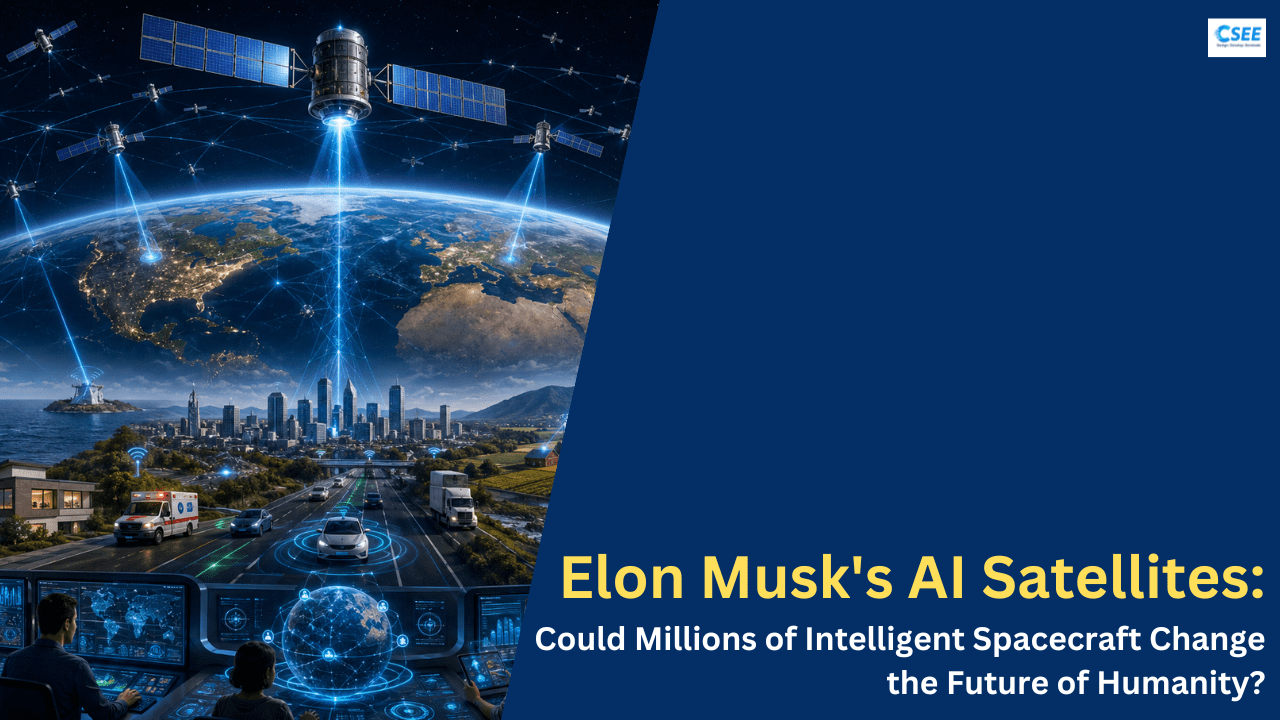
Imagine opening ChatGPT and receiving an answer powered not by a massive data center on Earth but by a network of intelligent satellites orbiting thousands of kilometers above your head. It sounds like science fiction, but the rapid growth of artificial intelligence, satellite communications, and space technology is making such possibilities increasingly realistic. Over the last few decades, technology has advanced at a pace that few could have predicted. Smartphones replaced many devices we once carried separately. Artificial intelligence can now generate images, write code, and answer complex questions in seconds. Reusable rockets have dramatically reduced the cost of reaching space. What seemed impossible only a generation ago is becoming reality. This raises an exciting question: what if the next major technological revolution happens not on Earth but in space?
Many people associate Elon Musk with ambitious projects that push the boundaries of what is possible. From electric vehicles to reusable rockets and satellite internet, his companies have consistently challenged conventional thinking. Through SpaceX, thousands of satellites have already been launched into orbit as part of the Starlink network. The purpose is simple but ambitious: provide internet access to every corner of the world. Yet internet connectivity may only be the beginning. As artificial intelligence continues to evolve, many experts believe that future satellite networks could become far more intelligent, creating a space-based infrastructure capable of processing information, making decisions, and supporting advanced AI applications across the globe.
The Evolution of Satellite Technology
To understand the potential of AI satellites, it is important to understand how satellites operate today. Most satellites perform specialized functions. Communication satellites relay signals between locations. Weather satellites monitor atmospheric conditions. Navigation satellites help people find their way. Earth observation satellites capture images and collect scientific data.
Although these systems are incredibly advanced, most of them follow a similar pattern. They collect information and send it back to Earth, where powerful computers analyze it. This process works well, but it also creates limitations. Large amounts of data must travel long distances before useful insights can be generated. In situations where time is critical, even small delays can matter.
Artificial intelligence has the potential to change this model completely. Instead of acting as passive data collectors, satellites could become intelligent systems capable of processing information directly in orbit. This would allow them to identify patterns, make predictions, and generate insights without waiting for instructions from Earth.
What Are AI Satellites?
AI satellites are spacecraft equipped with advanced computing hardware and artificial intelligence software. These systems could analyze information onboard, making decisions in real time.
Imagine a satellite monitoring a forest. Instead of capturing thousands of images and transmitting them back to Earth for analysis, it could use AI algorithms to detect signs of a wildfire immediately. It could estimate the fire’s size, predict its likely path, and alert emergency responders within seconds.
Similarly, satellites could monitor hurricanes, floods, droughts, and earthquakes. Rather than sending raw data to scientists who then process it, AI systems in orbit could analyze conditions instantly and provide actionable information.
This capability could transform how humanity responds to emergencies. Faster information means faster decisions. Faster decisions can save lives.
Why Space Is Becoming the Next Computing Platform
Traditionally, most computing happens inside data centers. These facilities contain thousands of servers that process information for websites, applications, and AI systems. However, the demand for computing power continues to grow rapidly.
Artificial intelligence models require enormous computational resources. As billions of people use AI tools every day, the need for processing capacity increases dramatically. Some experts believe future systems may require entirely new approaches to computing infrastructure.
Space offers unique advantages. Satellites can observe the entire planet, communicate across vast distances, and operate continuously. By adding advanced processing capabilities to these platforms, humanity could create a distributed computing network that extends far beyond the surface of Earth.
Rather than relying solely on centralized facilities, future AI workloads could potentially be shared across large networks of intelligent satellites. This vision remains ambitious, but technological progress continues to move in that direction.
Why Would Millions of Satellites Be Needed?
The idea of millions of satellites may sound excessive at first. However, there are practical reasons why extremely large networks could be beneficial.
Earth is a massive planet. A single satellite can only cover a limited area at any given moment. To provide uninterrupted service everywhere, multiple satellites must work together. As demand for connectivity grows, more satellites become necessary to maintain performance and reliability.
Think of satellites as roads in a transportation network. A small town may function with a few roads, but a major city requires highways, intersections, and multiple routes to support millions of people. Similarly, a global AI and communications network serving billions of users would require enormous capacity.
Additional satellites could reduce latency, increase bandwidth, improve reliability, and provide redundancy if individual satellites fail. Large constellations could ensure continuous coverage across oceans, deserts, mountains, and remote regions.
While one million satellites remains a speculative figure, the broader concept highlights the scale of infrastructure that future technologies may require.
Transforming Global Internet Access
One of the most immediate benefits of advanced satellite networks is improved internet access.
Despite significant progress, billions of people still lack reliable high-speed connectivity. Geographic challenges, economic limitations, and infrastructure costs make it difficult to extend traditional networks to every location.
Satellite-based systems can overcome many of these barriers. Because they operate from orbit, they can provide coverage across vast regions without requiring extensive ground infrastructure.
Imagine a student in a remote village gaining access to the same educational resources available in major cities. Imagine entrepreneurs in underserved communities connecting with global customers. Imagine healthcare professionals consulting specialists from anywhere in the world.
By expanding access to information and digital services, advanced satellite networks could create new opportunities for economic growth, education, and innovation.
AI-Powered Disaster Response
Natural disasters remain one of humanity’s greatest challenges. Wildfires, hurricanes, floods, earthquakes, and tsunamis can cause enormous damage within a matter of hours.
AI satellites could significantly improve disaster response capabilities.
By analyzing environmental conditions continuously, intelligent satellites could identify warning signs earlier than traditional systems. They could monitor changes in temperature, vegetation, ocean conditions, and atmospheric patterns to detect potential threats.
When disasters occur, satellites could provide real-time updates to emergency responders. They could track the movement of storms, assess damage, identify safe evacuation routes, and coordinate rescue operations.
The ability to process information directly in orbit would reduce delays and improve decision-making during critical moments.
Supporting Autonomous Vehicles and Smart Cities
Future transportation systems will depend heavily on real-time information.
Self-driving vehicles require accurate navigation, environmental awareness, and constant updates. AI-powered satellite networks could provide valuable support by delivering precise positioning data and monitoring traffic conditions across large regions.
Smart cities could also benefit. Urban infrastructure generates enormous amounts of data related to transportation, energy consumption, environmental conditions, and public services. Satellite-based AI systems could help analyze this information and improve operational efficiency.
Traffic congestion could be reduced. Energy systems could become more efficient. Emergency services could respond faster. Urban planning decisions could be informed by comprehensive real-time data.
Climate Monitoring and Scientific Research
Climate change represents one of the most significant challenges facing humanity. Understanding environmental trends requires continuous monitoring of Earth’s systems.
AI satellites could provide unprecedented insights into climate conditions.
They could track deforestation, glacier movement, ocean temperatures, carbon emissions, agricultural activity, and biodiversity changes with remarkable precision. By analyzing information directly in space, these systems could identify patterns and trends much faster than traditional methods.
Scientists could gain access to richer datasets, enabling more accurate predictions and better-informed policy decisions.
This capability could play a crucial role in addressing environmental challenges and promoting sustainable development.
The Challenges Ahead
While the vision of AI satellites is exciting, it also raises important concerns.
One major issue is space debris. As more satellites enter orbit, the risk of collisions increases. Even a small collision can create thousands of fragments traveling at extremely high speeds. These fragments can threaten other spacecraft and create long-term hazards.
Cybersecurity is another concern. Satellite networks supporting critical infrastructure would become attractive targets for cyberattacks. Protecting these systems would require advanced security measures and continuous monitoring.
Privacy concerns also deserve attention. Satellites capable of collecting and analyzing large amounts of data raise questions about surveillance, data ownership, and personal privacy.
Additionally, international regulations will need to evolve. Questions regarding governance, responsibility, and access must be addressed to ensure that future technologies benefit humanity as a whole.
The Future of AI Beyond Earth
Human civilization has always expanded its capabilities by exploring new frontiers. The oceans opened global trade routes. Aviation connected continents. The internet connected billions of people. Space may become the next great platform for technological advancement.
The combination of artificial intelligence, satellite communications, and advanced computing has the potential to transform nearly every aspect of modern life. From global internet access and disaster response to scientific research and smart infrastructure, intelligent satellite networks could reshape how humanity interacts with technology.
Whether the future ultimately involves thousands, hundreds of thousands, or millions of satellites, one thing is becoming increasingly clear: space is no longer just a destination for exploration. It is becoming a platform for innovation.
The idea of ChatGPT running from space may sound futuristic today. Yet many technologies that once seemed impossible are now part of everyday life. Reusable rockets, satellite internet, and advanced artificial intelligence were all considered unrealistic by many people not long ago.
The future has a habit of arriving faster than expected.
If intelligent satellite networks continue to evolve, the next revolution in AI may not happen inside a building on Earth. It may happen above our heads, orbiting silently around the planet, helping billions of people connect, learn, work, and solve problems in ways we can barely imagine today.
Thank you for reading.
Also, read:
- How Does An EV Know It Has 50% Battery Left? 🔋
- Why AI Agents Could Become The Digital Workforce
- Press Accelerator → What Happens Inside the Car?
- What Does TOPS Mean In AI Chips?
- The Future of Communication: Neuralink VOICE
- Top 10 Tools to Design ADAS and Autonomous Driving Systems Virtually
- What Is The Main Aim Of Semicon 2.0?
- 20 Advanced Coursera Courses for Embedded Engineers That Can Lead to High-Paying Careers