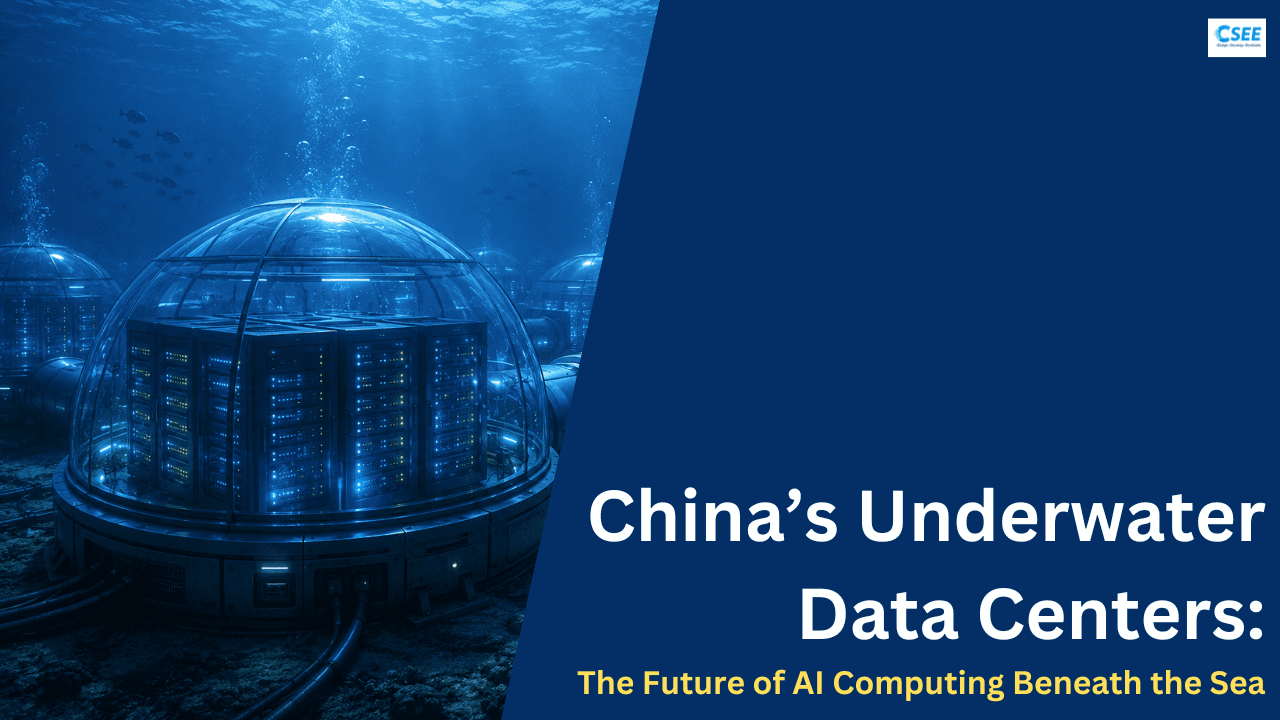
China has taken a bold step in the world of computing by deploying large-scale underwater data center modules off its coastline. Instead of building massive facilities on land, thousands of AI servers are now placed inside sealed capsules on the seabed, where the ocean itself helps keep them cool. This unusual approach is designed to solve one of the biggest problems in modern computing: the rising cost and energy demand of cooling high-performance servers used for artificial intelligence and cloud services.
As AI workloads grow rapidly, traditional data centers are struggling with heat, electricity consumption, and space limitations. China’s underwater deployment represents a new direction in infrastructure design, where natural environments are used to improve efficiency and reduce cost.
What Exactly Is an Underwater Data Center?
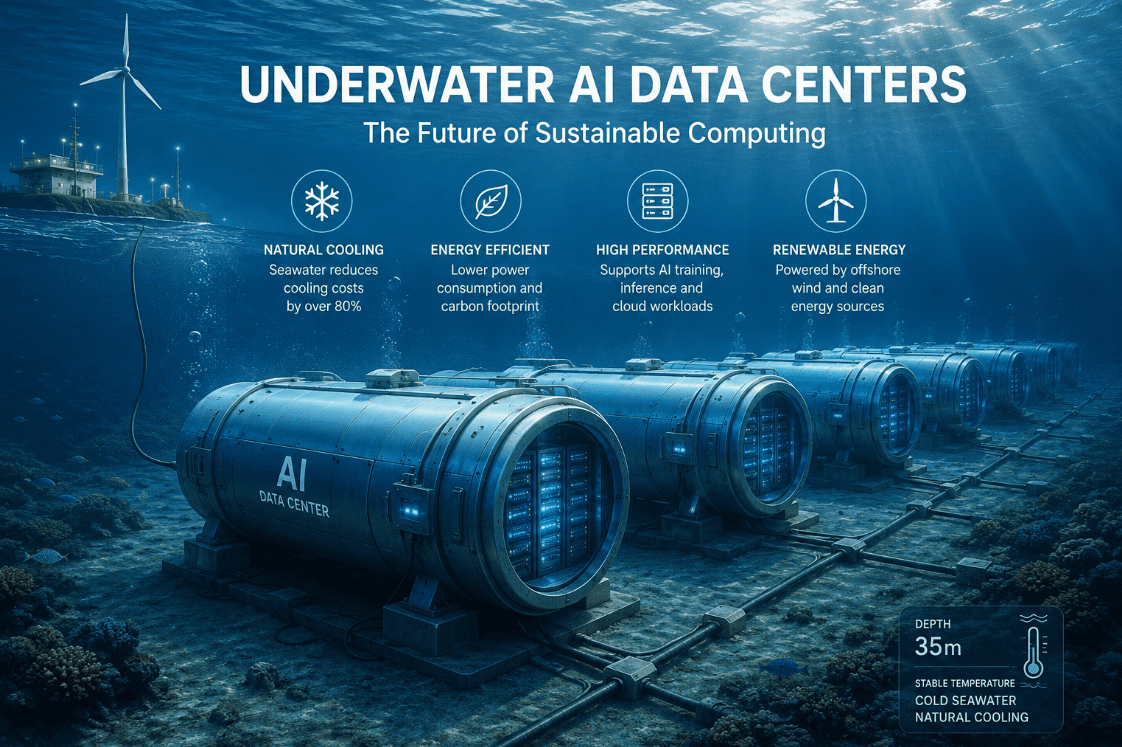
An underwater data center is a system where computing servers are sealed inside pressure-resistant, waterproof capsules and placed on the ocean floor. These capsules contain everything needed to run a small data center, including servers, networking equipment, and cooling systems.
In China’s case, the system has been deployed at a depth of around 35 meters near coastal waters. These modules are connected to offshore power sources and communication networks through underwater cables. Once installed, they operate continuously without human presence, performing tasks such as AI processing, cloud computing, and data storage.
Unlike traditional data centers, these systems do not rely on air conditioning. Instead, they use the surrounding cold seawater to naturally absorb and dissipate heat.
Why Cooling Is a Big Problem in Data Centers
Modern data centers generate enormous heat because thousands of servers run continuously at high speed. These servers are required for services like artificial intelligence, video streaming, cloud storage, and online applications.
To prevent overheating, conventional data centers use large cooling systems such as air conditioning units, liquid cooling systems, and ventilation structures. In many cases, cooling alone can account for nearly 30% to 40% of the total energy consumption of a data center.
This creates three major challenges:
- High electricity costs
- Large carbon footprint
- Complex infrastructure requirements
As AI systems become more powerful, these problems are expected to grow even further. This is where underwater data centers offer a different approach.
How China’s Underwater System Works
China’s underwater data center modules are designed like sealed industrial pods. Each pod contains racks of servers that operate in a controlled environment. The capsules are engineered to withstand underwater pressure, corrosion, and long-term exposure to seawater.
Here’s how the system functions:
First, the servers are placed inside a sealed structure that prevents any water from entering. Then, the capsules are lowered to the seabed using specialized marine equipment. Once installed, they are connected to offshore power sources, including wind energy systems in some setups.
The key innovation is heat management. Instead of using mechanical cooling systems, the heat generated by servers is transferred to the capsule walls and then absorbed by the surrounding seawater. Because seawater has a high heat capacity and remains relatively stable in temperature, it acts as a natural cooling medium.
This reduces or even eliminates the need for traditional air-conditioning systems.
Energy Efficiency and Cost Benefits
One of the biggest advantages of underwater data centers is energy efficiency. Cooling is one of the most expensive parts of operating a data center, especially in hot climates or regions with high electricity costs.
By using seawater as a natural cooling system, underwater data centers can reduce cooling energy consumption by more than 80% in some estimates. This leads to significant cost savings over time.
Other benefits include:
- Reduced land usage, since the infrastructure is offshore
- Lower environmental impact compared to large land-based facilities
- Potential integration with renewable energy sources like offshore wind
For countries investing heavily in AI infrastructure, these savings can be strategically important.
Role of Artificial Intelligence and Cloud Computing
AI systems require massive computing power to train models, process data, and run applications. Traditional cloud computing infrastructure is reaching its physical and economic limits due to heat and energy constraints.
China’s underwater data centers are designed to support these AI workloads more efficiently. By placing high-density computing clusters in a stable thermal environment, they can potentially improve performance consistency while reducing energy waste.
This makes them suitable for:
- AI model training
- Big data analytics
- Cloud service operations
- Real-time processing applications
As AI demand continues to grow, such alternative infrastructures may become more common.
Microsoft’s Earlier Experiment: Project Natick
Interestingly, China is not the first to explore this concept. Microsoft conducted a pioneering experiment called Project Natick, where a fully sealed underwater data center was deployed and tested for years.
Microsoft’s experiment showed several surprising results:
- The system was highly reliable
- Hardware failure rates were lower than expected
- Cooling efficiency was significantly improved
However, despite its success, Microsoft chose not to scale the project commercially. The company focused instead on optimizing traditional data centers and other emerging technologies.
China’s approach differs because it is actively exploring deployment at a larger scale to support national AI infrastructure needs.
Engineering Challenges and Risks
While underwater data centers are promising, they are not without challenges.
One of the biggest issues is maintenance. Once a capsule is placed on the seabed, accessing or repairing it is extremely difficult and expensive. Any hardware failure may require retrieving the entire module.
Other challenges include:
- Corrosion from long-term exposure to saltwater
- High initial installation costs
- Environmental impact on marine ecosystems
- Limited flexibility for upgrades
These limitations mean underwater data centers are not likely to replace traditional facilities completely, but rather complement them in specific use cases.
Environmental Impact
From an environmental perspective, underwater data centers can be both beneficial and concerning.
On the positive side, they reduce energy consumption for cooling and can integrate with renewable offshore energy sources. This may help lower overall carbon emissions compared to traditional data centers.
However, there are concerns about:
- Heat discharge into marine environments
- Disruption to underwater ecosystems
- Long-term ecological effects of large-scale deployment
Environmental monitoring is therefore a critical part of such projects.
The Future of Data Centers
The development of underwater data centers reflects a broader shift in computing infrastructure. As demand for AI and cloud computing continues to increase, companies and governments are exploring unconventional solutions to manage energy consumption and scalability.
Possible future directions include:
- Hybrid data centers combining land and underwater systems
- Integration with offshore wind farms and renewable energy grids
- Modular, autonomous computing pods deployed in different environments
- Advanced cooling technologies inspired by natural systems
While underwater data centers are still in the experimental or early deployment stage, they represent a clear sign that computing infrastructure is evolving beyond traditional boundaries.
Conclusion
China’s underwater data center initiative marks a significant step in rethinking how large-scale computing systems are built and operated. By moving servers beneath the ocean, the project directly addresses one of the biggest challenges in modern technology: heat and energy consumption.
Although still facing technical and environmental challenges, this approach demonstrates how natural environments can be used to support digital infrastructure. Combined with earlier experiments like Microsoft’s Project Natick, it is clear that underwater computing is no longer just a concept—it is becoming a real-world experiment in the future of AI infrastructure.
The idea that data centers could one day operate beneath the ocean highlights a simple but powerful shift: the future of computing may not just be faster and smarter, but also more deeply integrated with the natural world.
Also, read:
- “Mother of All Deals”: How The EU–India Free Trade Agreement Can Reshape India’s Economic Future
- 10 Free ADAS Projects With Source Code And Documentation – Learn & Build Today
- 10 Tips To Maintain Battery For Long Life, Battery Maintainance
- 10 Tips To Save Electricity Bills, Save Money By Saving Electricity
- 100 (AI) Artificial Intelligence Applications In The Automotive Industry
- 100 + Electrical Engineering Projects For Students, Engineers
- 100 GitHub Projects to Level Up Your Embedded Engineering Skills
- 100+ C Programming Projects With Source Code, Coding Projects Ideas