Working in the automotive domain for the past four years, I have had the opportunity to work across embedded systems, diagnostics, and Model-Based Development (MBD). During this time, I have witnessed a major transformation in the industry. Automotive engineering is no longer limited to mechanical systems; it has evolved into a highly software-driven, electronics-intensive, and data-centric ecosystem.
The rise of electric vehicles, advanced driver assistance systems, connected mobility, and software-defined vehicles has significantly changed the skill requirements. Companies are now looking for engineers who can work across domains—combining software, electronics, and system-level thinking. As a result, certain roles have emerged as not only in-demand but also highly paid due to their complexity and impact.
This article provides a deep dive into the most high-paying automotive roles, including their responsibilities, required skills, tools, career paths, and reasons behind their high compensation.
EV Powertrain Engineer
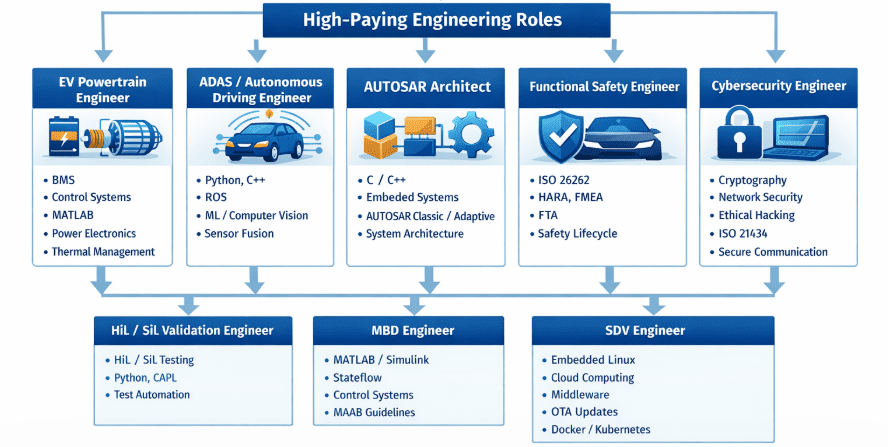
The EV Powertrain Engineer plays a central role in the development of electric vehicles. Unlike traditional internal combustion engine systems, EV powertrains involve complex integration of battery packs, electric motors, inverters, and control units. These engineers are responsible for optimizing energy efficiency, performance, and safety.
They work on designing Battery Management Systems (BMS), which monitor and control battery health, temperature, and charging cycles. Additionally, they develop control algorithms that manage power distribution between components. Thermal management is another critical area, as battery performance is highly sensitive to temperature variations.
- Skills: Battery Management Systems, control systems, MATLAB/Simulink, power electronics, thermal management
- Tools: Simulink, dSPACE, ETAS, Python
- Why high paying: EV adoption is growing rapidly, and there is a shortage of engineers with deep expertise in electrification
Beyond technical skills, EV Powertrain Engineers must understand system-level integration. For example, optimizing a battery for range may impact thermal constraints, which in turn affects charging speed. This interconnected nature of EV systems makes the role both challenging and rewarding.
From a career perspective, engineers typically start with component-level design and gradually move toward system architecture roles. With experience, they can become EV system architects or technical leads, contributing to next-generation vehicle platforms.
ADAS / Autonomous Driving Engineer
ADAS and autonomous driving represent one of the most advanced areas in automotive engineering. Engineers in this field develop systems that enable vehicles to perceive their environment, make decisions, and execute actions with minimal or no human intervention.
The work involves processing data from multiple sensors such as cameras, radar, and LiDAR. Engineers develop perception algorithms to detect objects, lane markings, and obstacles. These inputs are then used in decision-making systems that determine vehicle behavior. Finally, control systems execute actions like braking or steering.
- Skills: Python, C++, ROS, computer vision, machine learning, sensor fusion
- Tools: OpenCV, TensorFlow, PyTorch, CARLA simulator
- Why high paying: High complexity, massive R&D investment, and global demand for autonomous solutions
One of the key challenges in this role is ensuring reliability under all driving conditions. Engineers must account for varying lighting, weather, and road scenarios. This requires extensive testing, simulation, and validation.
Career growth in this domain is rapid due to the pace of innovation. Engineers can specialize in perception, planning, or control, and eventually move into system architecture roles. Given the global push toward autonomy, this role offers opportunities across international markets.
AUTOSAR Architect
AUTOSAR (Automotive Open System Architecture) has become a standard for developing scalable and reusable automotive software. An AUTOSAR Architect is responsible for designing the overall software architecture of vehicle systems, ensuring that different components communicate effectively.
This role involves defining software layers, configuring basic software modules, and ensuring compliance with AUTOSAR standards. Architects must also manage integration challenges, especially when working with multiple suppliers and platforms.
- Skills: C, C++, embedded systems, AUTOSAR Classic and Adaptive platforms
- Tools: Vector DaVinci, EB Tresos, CANoe
- Why high paying: High complexity, system-level responsibility, and widespread adoption across OEMs
AUTOSAR Architects need a deep understanding of both software and hardware interactions. They must ensure that software components meet real-time constraints while maintaining scalability and maintainability.
Career progression typically involves moving from developer roles to senior engineering positions and eventually into architecture. Experienced architects are highly valued due to their ability to design robust and future-ready systems.
Functional Safety Engineer
Functional safety is a critical requirement in modern vehicles, especially as systems become more autonomous. Functional Safety Engineers ensure that systems operate safely even in the presence of faults, following standards such as ISO 26262.
Their work begins with hazard analysis and risk assessment (HARA), where potential risks are identified and classified. Based on this analysis, safety requirements are defined and implemented throughout the development lifecycle. Engineers also perform validation to ensure compliance.
- Skills: ISO 26262, HARA, FMEA, fault tree analysis, safety lifecycle
- Tools: Medini Analyze, safety analysis tools
- Why high paying: High responsibility, regulatory requirements, and limited expertise
The importance of this role cannot be overstated, as failures in safety-critical systems can have serious consequences. This responsibility, combined with the need for specialized knowledge, drives high compensation.
Functional Safety Engineers often collaborate with multiple teams, including software, hardware, and validation teams. With experience, they can move into safety management or consultancy roles, further increasing their earning potential.
Automotive Cybersecurity Engineer
As vehicles become connected, they are increasingly vulnerable to cyber threats. Automotive Cybersecurity Engineers are responsible for protecting vehicle systems from unauthorized access and ensuring secure communication.
They design secure architectures, implement encryption mechanisms, and perform threat analysis. Engineers must also ensure compliance with standards such as ISO 21434. This involves identifying potential vulnerabilities and implementing countermeasures.
- Skills: cryptography, network security, ISO 21434, ethical hacking
- Tools: Wireshark, Kali Linux, CAN security tools
- Why high paying: Growing threat landscape and shortage of skilled professionals
Cybersecurity in automotive is still an evolving field, which makes it both challenging and lucrative. Engineers must stay updated with the latest threats and technologies to effectively protect systems.
Career growth includes roles such as security architect or consultant. As regulations become stricter, the demand for cybersecurity professionals will continue to rise.
HiL / SiL Validation Engineer
Validation engineers ensure that automotive systems perform as expected before they are deployed in real vehicles. HiL (Hardware-in-the-Loop) and SiL (Software-in-the-Loop) testing allow engineers to simulate real-world conditions in a controlled environment.
These engineers develop test cases, automate testing processes, and analyze system behavior under various scenarios. This helps identify issues early in the development cycle, reducing costs and risks.
- Skills: HiL, SiL, test automation, Python, CAPL
- Tools: dSPACE, Vector CANoe, NI LabVIEW
- Why high paying: Critical role in ensuring system reliability and reducing development risks
Validation engineers must have a strong understanding of both system functionality and testing methodologies. Their work directly impacts product quality and customer safety.
With experience, engineers can move into validation leadership roles or specialize in areas such as ADAS validation or EV testing.
Model-Based Development (MBD) Engineer
Model-Based Development has become a standard approach in automotive engineering. MBD Engineers use simulation models to design, test, and validate systems before implementation.
They create models using tools like Simulink and Stateflow, allowing for early validation and automatic code generation. This approach improves efficiency and reduces errors compared to traditional development methods.
- Skills: MATLAB/Simulink, Stateflow, control systems, MAAB guidelines
- Tools: Simulink, TargetLink
- Why high paying: Widely adopted methodology and high demand across OEMs
MBD Engineers must have strong analytical skills and a deep understanding of system behavior. Their work enables faster development cycles and higher-quality outputs.
Career growth includes moving into system design or architecture roles. As MBD adoption increases, demand for skilled engineers continues to rise.
Software-Defined Vehicle (SDV) Engineer
Software-Defined Vehicles represent the future of the automotive industry, where software controls most functionalities. SDV Engineers work on integrating software platforms, cloud services, and vehicle systems.
They develop middleware, manage over-the-air updates, and ensure seamless communication between different components. This role requires a combination of embedded systems knowledge and modern software practices.
- Skills: Embedded Linux, cloud computing, middleware, OTA updates
- Tools: Docker, Kubernetes, QNX
- Why high paying: Future-focused role with increasing adoption
SDV Engineers must think beyond traditional automotive boundaries, incorporating concepts from cloud computing and software engineering. This makes the role both challenging and highly rewarding.
Why These Roles Are High Paying
Several factors contribute to the high salaries associated with these roles. First, there is a significant skill gap, as the industry transformation is happening faster than the availability of trained professionals. Second, these roles involve high complexity and require deep technical expertise. Third, many of these positions directly impact vehicle safety, performance, and innovation.
Additionally, global demand plays a major role. Automotive companies across regions are competing for the same talent pool, driving up compensation. The shift toward electrification and autonomy is also attracting investments, further increasing the demand for skilled engineers.
How to Transition into These Roles
For professionals looking to move into these high-paying roles, the key is to build a strong foundation and then specialize. Start by strengthening core skills in programming, control systems, or embedded systems. Then, choose a domain such as EV, ADAS, or cybersecurity and focus on gaining hands-on experience.
Practical exposure is critical. Working on projects, simulations, and real-world applications helps build confidence and expertise. Certifications and continuous learning also play an important role in staying relevant.
Networking and industry exposure can further accelerate career growth. Engaging with professionals, attending conferences, and contributing to open-source projects can open new opportunities.
Conclusion
The automotive industry is undergoing a major transformation, creating opportunities for engineers who are willing to adapt and learn. High-paying roles are no longer limited to traditional domains but are now centered around advanced technologies such as electrification, autonomy, and software-defined systems.
By focusing on the right skills and continuously upgrading knowledge, professionals can position themselves for these roles and achieve significant career growth. The future of automotive engineering is dynamic, and those who embrace change will be at the forefront of innovation and success.
Also, read:
- Why Qualcomm Is Entering the Automotive Industry
- The Memory Problem Behind AI Chips
- Why EUV Lithography Took Decades to Develop
- How Intel Lost Its Semiconductor Dominance
- Want To Crack Top Embedded Companies? Build These LLM Projects
- Why The Entire AI Industry Needs ASML
- CPU vs GPU vs NPU: Who Handles What?
- From Beginner to NVIDIA Data Analyst: A 6-Month Roadmap