Why Is India Building Its Own Semiconductor Ecosystem?
Chips power smartphones, cars, EVs, AI systems, data centres, defence electronics and telecom networks. Whoever controls their design and manufacture holds a strategic advantage, and India now wants a seat at that table.
1. Why semiconductors are strategic
A semiconductor is a material that can switch between conducting and insulating electricity. Etched into silicon by the billions, these switches become transistors, and transistors become processors, memory and sensors. Almost every modern product depends on them.
| Sector | How chips are used | Why it matters to India |
|---|---|---|
| Smartphones & electronics | Processors, memory, power and RF chips | Large consumer market and growing assembly base |
| Automotive & EVs | Power electronics, sensors, microcontrollers | Chip shortages have halted car lines before |
| AI & data centres | GPUs, accelerators, high-bandwidth memory | Compute is becoming a national capability |
| Telecom (5G/6G) | Base-station and network silicon | Secure networks need trusted components |
| Defence & space | Radar, guidance, secure communications | Reliable supply cannot depend on others |
2. Where India stands today
India has long been strong in chip design and software. A large share of the world’s chip design engineers work in Indian centres of global firms. But fabrication, advanced packaging and equipment are concentrated in a few places, notably Taiwan, South Korea, Japan, the US, China and the Netherlands.
Bars are a qualitative illustration of relative strength, not measured data.
3. The chip value chain
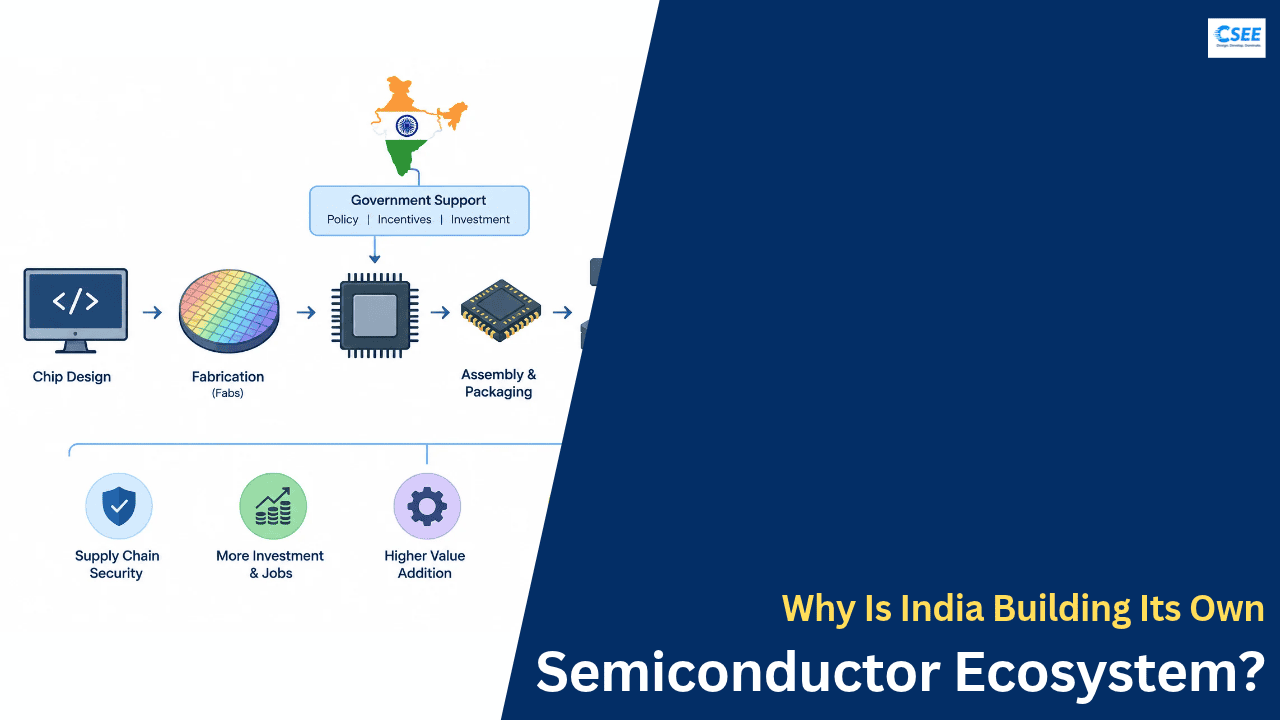
Making a chip is a long relay race. India aims to participate at every leg, not just one.
Supporting layers
Beneath this chain sit chemicals, specialty gases, silicon wafers, photomasks and the tools that deposit, etch and inspect. These are called equipment and materials, and they are hard to build because a few global firms dominate them.
4. The Semiconductor Mission
The programme has an approved outlay of ₹76,000 crore and covers several schemes under one umbrella.
| Component | What it supports |
|---|---|
| Fab support | Financial backing for setting up semiconductor fabrication plants |
| Packaging & testing | Support for assembly, test, marking and packaging units |
| Design incentives | Help for chip design start-ups and companies |
| Infrastructure | Industrial parks, utilities and ecosystem clusters |
| R&D | Research institutions and technology development |
| Skills | Training engineers and technicians for fabs and design |
5. Why it matters: five payoffs
| Benefit | Explanation |
|---|---|
| Supply-chain resilience | Fewer shocks from distant disruptions or geopolitical tension |
| Investment | Global firms look for diversified manufacturing locations |
| Jobs | High-skill roles in engineering, operations and R&D |
| Value addition | More of an electronic product’s worth is created at home |
| Strategic sectors | Automotive, AI, telecom and defence gain reliable supply |
6. The four pillars
Technology
Process know-how is the hardest part to acquire, so partnerships with experienced global firms are central.
Manufacturing
Fabs and packaging plants need clean rooms, stable power, ultra-pure water and a dense supplier base.
Talent
India’s design workforce is an advantage; the task is adding process, equipment and fab operations skills.
Supply chain
Local suppliers of materials, gases and components make plants cheaper and more dependable.
7. Challenges
| Challenge | Why it is hard |
|---|---|
| Capital intensity | Fabs cost billions and take years to build |
| Technology access | Advanced nodes are tightly held and export-controlled |
| Utilities | Fabs need uninterrupted power and vast clean water |
| Talent depth | Skilled fab technicians are scarce globally |
| Competition | Other nations also offer large subsidies |
8. A rough path ahead
Mission approved; schemes for fabs, packaging and design launched.
Packaging, testing and fab projects are set up with industry partners.
Suppliers, equipment makers and design firms cluster around plants.
Domestic chips feed into automotive, telecom, AI and defence products.
Conclusion
The semiconductor race is about technology, manufacturing, talent and supply-chain capability. India is investing in all four, aiming not merely to make chips but to anchor a complete, resilient ecosystem. Success will be measured over years, in plants running, engineers trained and products shipped.