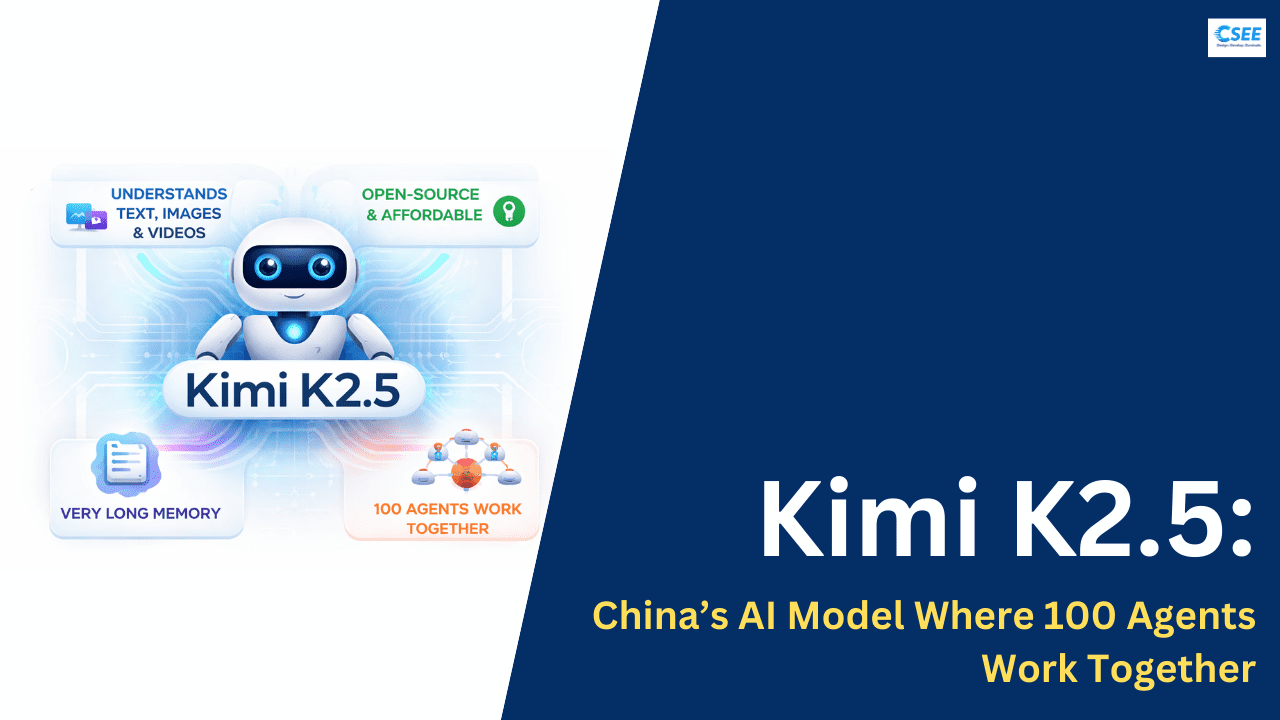
Artificial Intelligence is moving very fast. Every few months, a new model appears that promises to be faster, smarter, cheaper, or more useful than the previous one. For a long time, most of the attention was on US-based models like GPT from OpenAI or Claude from Anthropic. But now, China is entering the global AI race in a serious way. One of the strongest examples of this is Kimi K2.5, developed by Moonshot AI. What makes Kimi K2.5 special is not just that it understands text, images, and videos together, but that it can make up to 100 AI agents work together at the same time to solve complex problems. This article explains Kimi K2.5 in simple language, how it works, why it matters, and how it compares with other popular AI models.
What is Kimi K2.5?
Kimi K2.5 is a large language model created by Chinese AI company Moonshot AI. Like other modern AI models, it can read text, answer questions, write code, summarize documents, and help with research. But Kimi K2.5 goes beyond normal chatbots. It is a multimodal AI, which means it can understand text, images, and videos together. For example, you can show it a screenshot of code, a chart, or a document image, and it can analyze it and respond intelligently.
Another important feature is its very large memory, also called a large context window. This allows Kimi K2.5 to read extremely long documents without forgetting earlier parts. This is very useful for legal documents, research papers, technical manuals, and large codebases.
The Big Hook: 100 AI Agents Working Together
The most exciting feature of Kimi K2.5 is its 100-agent system. Normally, when you ask a question to an AI model, one model processes everything step by step. Kimi K2.5 can do something different. It can split a big task into many smaller tasks and assign them to different AI agents. These agents work in parallel, just like a team of engineers working on different parts of a project at the same time.
For example:
- One agent can read a long document
- Another agent can summarize it
- Another agent can check facts
- Another agent can write code
- Another agent can prepare a final answer
All of this happens together, making the process faster and more organized. This is why people say Kimi K2.5 is built for real work, not just casual chatting.
Why the 100-Agent System Matters
The idea of multiple agents working together is very important for the future of AI. Real-world problems are complex. They are not solved by a single step or a single thought. They require planning, checking, revising, and sometimes trying different approaches. The 100-agent system allows Kimi K2.5 to behave more like a team than a single assistant.
This helps in:
- Complex problem solving
- Large-scale automation
- Enterprise-level tasks
- Research and development
- Software engineering workflows
Instead of waiting for one long response, users get better structured and more reliable results.
Multimodal Intelligence: Text, Image, and Video
Kimi K2.5 is designed to understand different types of data together. This is called multimodal intelligence. Many older AI models only understand text. Kimi K2.5 can:
- Read documents and PDFs
- Understand images like charts, screenshots, and diagrams
- Analyze video frames and visual content
- Combine visual and text information into one response
For example, you can upload an image of a circuit diagram and ask Kimi K2.5 to explain how it works. Or you can show it a screenshot of an error message and ask it to fix the code.
Large Context Window: Remembering More
One common problem with AI models is memory. If a document or conversation is too long, the model forgets earlier information. Kimi K2.5 solves this by offering a very large context window, which means it can remember and understand much more content at once.
This is extremely useful for:
- Reading full research papers
- Reviewing large code projects
- Legal and compliance documents
- Long conversations with detailed instructions
This makes Kimi K2.5 suitable for professional and enterprise use.
Open-Source Advantage
One of the biggest reasons Kimi K2.5 is getting attention is that it is open-source (or open-weight). This means developers can:
- Study how it works
- Customize it
- Deploy it on their own servers
- Reduce dependency on closed platforms
In contrast, many popular models like GPT and Claude are closed-source. Users can only access them through APIs and must follow strict usage rules. Open-source models give more freedom, especially for startups, researchers, and companies that care about data privacy.
Cost and Accessibility
Another strong point of Kimi K2.5 is cost. Running advanced AI models is expensive. Closed models often charge high fees for API usage. Kimi K2.5 is designed to be more affordable, especially for large-scale use.
Lower cost means:
- More experimentation
- Faster innovation
- Easier adoption for small teams
- Better access for researchers and students
This makes Kimi K2.5 attractive in markets where cost matters a lot.
Use Cases of Kimi K2.5
Kimi K2.5 is not just a demo model. It is designed for practical use. Some real-world use cases include:
1. Software Development
- Writing and debugging code
- Reviewing pull requests
- Understanding large codebases
- Generating documentation
2. Research and Education
- Reading and summarizing papers
- Explaining complex concepts
- Assisting with experiments and analysis
3. Business and Enterprise
- Document analysis
- Report generation
- Workflow automation
- Customer support tools
4. Design and Media
- Image and video analysis
- Content creation
- Visual explanations
Comparison with GPT Models (OpenAI)
GPT models from OpenAI are among the most popular AI systems today. They are known for:
- Strong reasoning
- High-quality writing
- Polished user experience
However, GPT models are:
- Closed-source
- Expensive at scale
- Limited in user control
Compared to GPT, Kimi K2.5 offers:
- Open-source flexibility
- Lower cost
- Built-in 100-agent collaboration
GPT models may feel smoother for general users, but Kimi K2.5 is better suited for developers and teams that want control and scalability.
Comparison with Claude (Anthropic)
Claude models focus heavily on safety, clarity, and reliability. They are excellent for:
- Clean writing
- Long-form analysis
- Ethical and safe responses
But Claude models:
- Are closed-source
- Have limited multimodal features
- Do not emphasize agent-based workflows
Kimi K2.5, with its 100-agent system and multimodal design, is more suitable for automation and technical tasks.
Comparison with DeepSeek
DeepSeek is another Chinese AI model that is popular for:
- Strong math skills
- Good coding performance
Some DeepSeek models are open-source, which is a plus. However, compared to DeepSeek, Kimi K2.5 offers:
- Better multimodal understanding
- Larger context window
- Advanced multi-agent collaboration
This gives Kimi K2.5 a more balanced profile.
Why Kimi K2.5 Matters Globally
Kimi K2.5 is not just another AI model. It represents a shift in the AI world. It shows that:
- Advanced AI is no longer limited to one country
- Open-source models can compete with closed systems
- Multi-agent AI is becoming practical
This increases competition, which is good for innovation and users.
Challenges and Limitations
Like any AI model, Kimi K2.5 is not perfect. Some challenges include:
- Language quality may vary compared to GPT
- Ecosystem and tools are still growing
- Global adoption is still limited
However, these are normal growing pains for a new model.
The Future of Multi-Agent AI
The idea of 100 AI agents working together points to the future of AI. Instead of one assistant doing everything, we will see AI teams that plan, execute, review, and improve tasks together. Kimi K2.5 is one of the early models to make this idea practical.
In the future, we can expect:
- More intelligent agent coordination
- Better task planning
- Fully autonomous workflows
Impact on Developers and Startups
For developers and startups, Kimi K2.5 is exciting because it lowers barriers. Teams can build powerful AI tools without spending huge amounts of money or depending on closed platforms. The open-source nature encourages learning and innovation.
Impact on Education and Research
Students and researchers benefit from models that can read long documents, explain complex ideas, and assist with experiments. Kimi K2.5’s large memory and multimodal skills make it a strong educational tool.
Security and Data Privacy
Because Kimi K2.5 can be deployed locally, organizations can keep sensitive data on their own servers. This is a major advantage over cloud-only models, especially in regulated industries.
Final Thoughts
Kimi K2.5 is a strong signal that the AI world is changing. With 100 AI agents working together, multimodal intelligence, a large memory, and open-source access, it is built for real-world use, not just demos. While GPT and Claude remain strong leaders in polish and reliability, Kimi K2.5 offers something different: freedom, scalability, and teamwork at the AI level.
As multi-agent systems become more common, models like Kimi K2.5 may shape the next phase of artificial intelligence. For developers, researchers, and businesses looking for open, affordable, and powerful AI, Kimi K2.5 is a model worth watching closely.
Thank you for reading.
Also, read:
- “Mother of All Deals”: How The EU–India Free Trade Agreement Can Reshape India’s Economic Future
- 10 Free ADAS Projects With Source Code And Documentation – Learn & Build Today
- 10 Tips To Maintain Battery For Long Life, Battery Maintainance
- 10 Tips To Save Electricity Bills, Save Money By Saving Electricity
- 100 (AI) Artificial Intelligence Applications In The Automotive Industry
- 100 + Electrical Engineering Projects For Students, Engineers
- 100+ C Programming Projects With Source Code, Coding Projects Ideas
- 100+ Indian Startups & What They Are Building