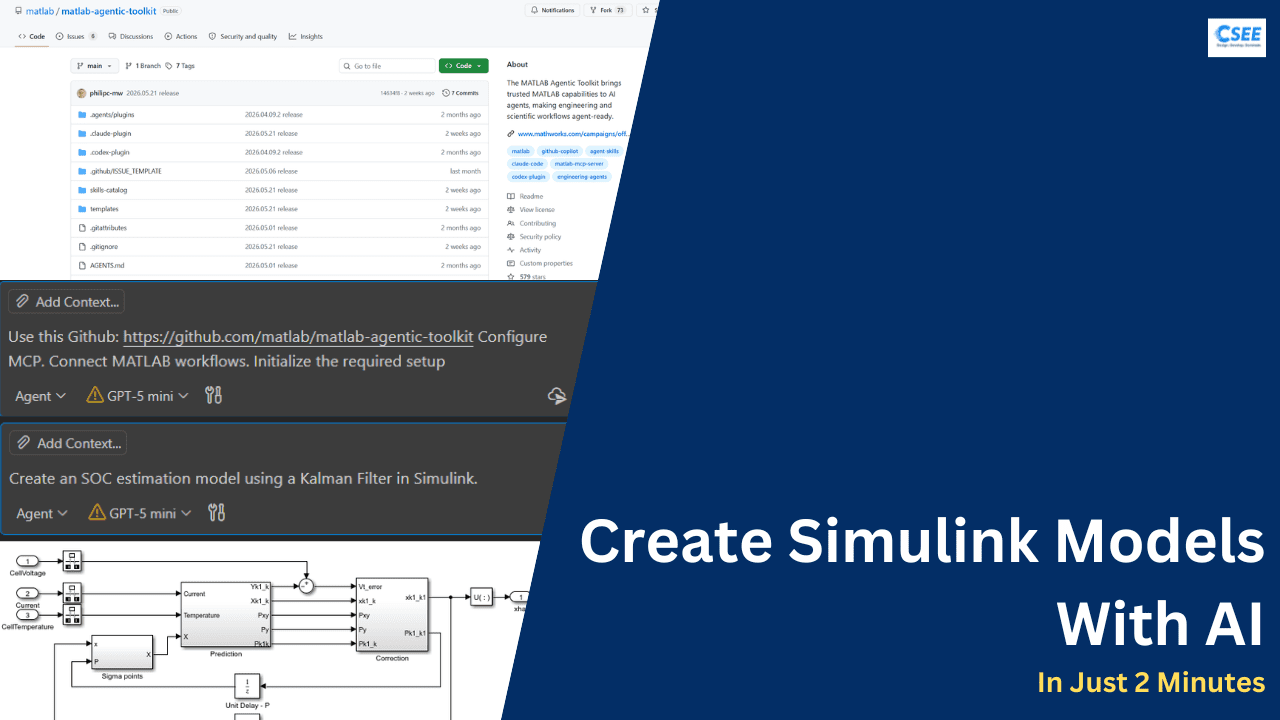
The pace of change in engineering has accelerated dramatically over the last few years. Tasks that once required weeks of manual effort can now be completed in minutes with the help of AI-powered development tools. One of the most striking examples I recently experienced was building a Battery State of Charge (SOC) Estimation model using a Kalman Filter in Simulink.
A few years ago, developing such a model was a time-consuming engineering activity involving multiple stages of design, implementation, debugging, and validation. Today, with the help of the MATLAB Agentic Toolkit, GitHub Copilot, and MCP integration inside Visual Studio Code, I was able to generate a working SOC estimation Simulink model in almost two minutes.
This experience highlighted how AI is transforming Model-Based Development workflows and changing the way engineers interact with tools like MATLAB and Simulink.
Traditional Development Process for SOC Estimation
Battery State of Charge estimation is one of the most important functions in Battery Management Systems (BMS). Accurate SOC estimation is critical for electric vehicles because it directly impacts battery safety, performance, range prediction, and charging efficiency.
One of the commonly used methods for SOC estimation is the Kalman Filter. The Kalman Filter is widely adopted because it can estimate internal battery states even when measurements contain noise and uncertainties.
Developing an SOC estimation model traditionally involves several engineering activities:
Requirement Analysis
The first step is understanding the battery system and estimation requirements. Engineers need to define:
- Battery chemistry
- Input signals
- Measurement parameters
- Sampling time
- Accuracy targets
- System constraints
This stage itself can consume significant engineering time.
Battery Modeling
Before implementing the Kalman Filter, the battery must be mathematically modeled. This usually includes:
- Open Circuit Voltage (OCV) modeling
- Internal resistance modeling
- Equivalent circuit representation
- Dynamic system equations
Creating an accurate battery model requires domain expertise and repeated validation.
Kalman Filter Design
The Kalman Filter algorithm must then be designed and tuned carefully. Engineers work on:
- State equations
- Prediction equations
- Covariance matrices
- Noise modeling
- Gain calculations
Improper tuning often leads to unstable or inaccurate SOC estimation.
Simulink Architecture Development
Once the mathematical foundation is ready, the implementation begins in Simulink. Engineers manually:
- Add blocks
- Connect signals
- Configure subsystems
- Create data flow
- Set parameters
- Design interfaces
Large models become increasingly complex and difficult to manage.
Testing and Validation
After model implementation, extensive testing is required:
- Signal verification
- Noise analysis
- Error checking
- Simulation validation
- Edge case testing
Debugging alone can consume several days.
Because of these activities, building a production-quality SOC estimation model typically takes anywhere between two to four weeks depending on complexity.
The Shift Introduced by AI
Recently, I experimented with the MATLAB Agentic Toolkit and experienced a completely different workflow.
Instead of manually creating the architecture block by block, I used the official GitHub repository:
MATLAB Agentic Toolkit GitHub Repository
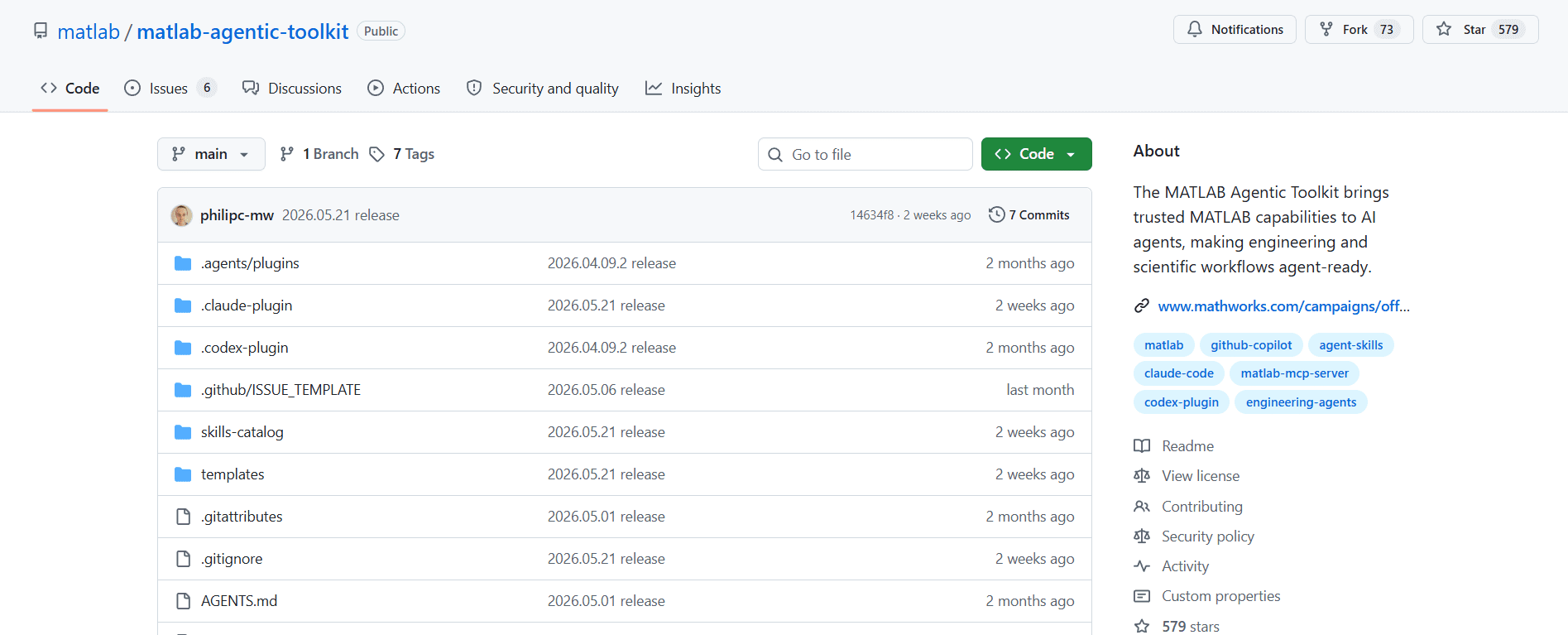
I cloned the repository and instructed GitHub Copilot inside Visual Studio Code to set up MCP for MATLAB.
The process was surprisingly straightforward.
Basic Setup Process
The initial setup involved cloning the repository:
git clone https://github.com/matlab/matlab-agentic-toolkit.gitcd matlab-agentic-toolkit
After this, I simply instructed Copilot to:
- Configure MCP
- Connect MATLAB workflows
- Initialize the required setup
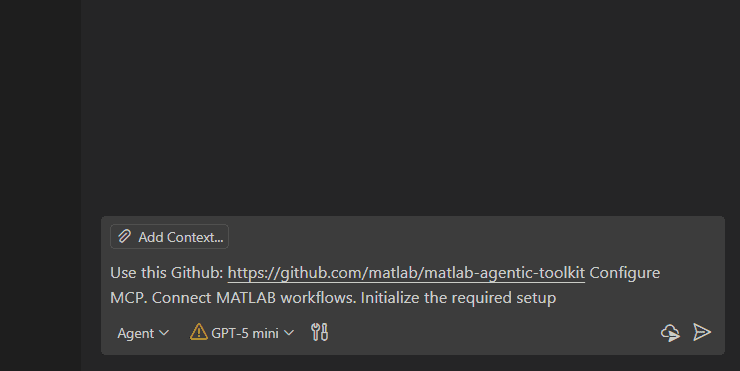
Once configured, the AI assistant gained the ability to interact with MATLAB workflows intelligently.
This was the key difference compared to traditional development.
What MCP Enables
MCP, or Model Context Protocol, enables AI agents to interact directly with engineering tools and workflows. Instead of functioning as a generic chatbot, the AI becomes context-aware about the development environment.
Through the MATLAB Agentic Toolkit, the AI assistant can:
- Understand MATLAB commands
- Generate MATLAB scripts
- Build Simulink logic
- Interact with model structures
- Assist in debugging
- Execute workflows
- Analyze outputs
This creates an entirely new engineering experience.
Instead of manually building every subsystem, the engineer can define requirements and guide the AI toward implementation.
Building the SOC Estimation Model
After configuring the toolkit, I provided instructions to create an SOC estimation model using a Kalman Filter in Simulink.
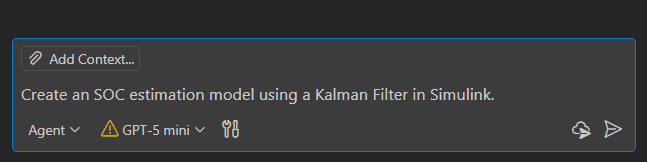
Within minutes:
- Simulink blocks were generated
- Model structure was organized
- Signal flow was created
- Basic architecture was prepared
- Initial implementation logic was available
The time reduction was extraordinary.
A workflow that traditionally required weeks of engineering effort was compressed into approximately two minutes.
Of course, this does not mean the final production-ready system is completed instantly. Validation, tuning, and engineering review are still required. However, the initial development effort was drastically reduced.
This is where AI demonstrates its true value in engineering.
AI Is Accelerating Engineering, Not Replacing It
There is a common concern that AI will replace engineers. After practical experience with these tools, I believe the situation is very different.
AI is not replacing engineering knowledge.
AI is reducing repetitive manual effort.
Engineering still requires:
- System understanding
- Domain expertise
- Safety awareness
- Validation capability
- Decision-making
- Optimization skills
AI cannot replace engineering judgment.
However, AI can significantly accelerate repetitive implementation tasks.
For example:
- Creating repetitive Simulink connections
- Generating boilerplate scripts
- Organizing architecture
- Building initial model structures
- Performing repetitive validations
This allows engineers to focus on higher-value activities.
Instead of spending hours wiring blocks manually, engineers can spend more time:
- Improving algorithms
- Optimizing performance
- Validating safety
- Innovating new solutions
- Exploring advanced architectures
This is a major shift in productivity.
Impact on Model-Based Development
Model-Based Development has already transformed industries like automotive, aerospace, and embedded systems by enabling simulation-driven design.
Now AI is introducing another major transformation:
AI-Assisted Model-Based Development.
This new workflow combines:
- AI-powered automation
- Engineering intelligence
- Simulation-driven development
- Rapid architecture generation
The impact is significant.
Areas AI Can Improve
AI-assisted workflows can help with:
- Simulink model generation
- MATLAB scripting
- Stateflow logic creation
- Plant model development
- Automated testing
- Signal tracing
- Requirement mapping
- Documentation generation
The productivity gains are substantial.
Why This Matters for the Automotive Industry
The automotive industry is rapidly evolving toward:
- Electric Vehicles (EVs)
- Software Defined Vehicles (SDVs)
- Autonomous systems
- Intelligent Battery Management Systems
These systems require increasingly complex software architectures.
Traditional development methods alone may not scale efficiently for future complexity.
AI-assisted engineering can help accelerate:
- BMS algorithm development
- Control system implementation
- Simulation workflows
- Validation cycles
- Embedded software generation
For companies developing advanced automotive systems, this can reduce development time significantly.
The Role of GitHub Copilot and VS Code
One of the most impressive aspects of this experience was how naturally GitHub Copilot integrated into the workflow.
Instead of manually reading documentation for hours, I simply instructed Copilot to:
- Set up MCP
- Configure the toolkit
- Initialize workflows
The AI assistant handled much of the setup automatically.
This demonstrates another important trend:
Engineering tools are becoming conversational.
Engineers are gradually shifting from purely manual implementation toward intent-driven development.
Instead of manually performing every step, engineers can define objectives while AI assists with execution.
This fundamentally changes productivity.
The New Skill Engineers Must Develop
As AI becomes integrated into engineering workflows, a new skill is becoming increasingly important:
The ability to collaborate effectively with AI systems.
Future engineers will still require:
- Strong fundamentals
- System-level thinking
- Domain expertise
- Mathematical understanding
- Safety awareness
However, they will also need:
- AI interaction skills
- Prompt engineering capability
- Workflow orchestration understanding
- AI validation techniques
The engineers who combine deep technical expertise with effective AI collaboration will likely achieve the highest productivity gains.
Limitations and Realistic Expectations
Although AI-assisted development is powerful, it is important to maintain realistic expectations.
AI-generated models still require:
- Human review
- Verification
- Validation
- Performance tuning
- Safety analysis
In automotive systems especially, functional safety standards such as ISO 26262 remain critical.
AI can accelerate development, but engineering accountability still belongs to human engineers.
Therefore, AI should be viewed as:
- An accelerator
- A productivity tool
- An intelligent assistant
Not as a replacement for engineering responsibility.
The Future of Engineering Workflows
The experience of generating an SOC estimation model within minutes strongly suggests where engineering workflows are heading.
In the near future, we may see:
- AI-generated system architectures
- Automated Simulink model generation
- Intelligent debugging systems
- AI-assisted requirement tracing
- Automatic test generation
- Real-time optimization suggestions
Engineering workflows may become significantly faster and more iterative.
This could reduce development cycles dramatically across industries.
Conclusion
The transition from spending two to four weeks building a Simulink SOC estimation model to generating one in approximately two minutes represents more than just a productivity improvement.
It represents a fundamental shift in engineering workflows.
By combining:
- MATLAB
- Simulink
- GitHub Copilot
- MCP integration
- AI-assisted tooling
Engineers can now accelerate development at an unprecedented scale.
The most important takeaway is not that AI replaces engineering knowledge.
The real transformation is that AI amplifies engineering capability.
Engineers can move faster, prototype quicker, validate earlier, and focus more on innovation instead of repetitive implementation tasks.
For professionals working in:
- Automotive engineering
- Embedded systems
- Battery Management Systems
- Control systems
- Model-Based Development
This shift will likely become one of the most important technological changes of the coming decade.
The future of engineering is not only about writing code or connecting blocks manually.
It is increasingly about combining human expertise with intelligent AI-assisted workflows.
And this transformation has already begun.
- Why Quantum Computers Could Break Today’s Cybersecurity
- Solid-State Batteries: Why Aren’t They in Every EV Yet?
- Why Qualcomm Is Entering the Automotive Industry
- The Memory Problem Behind AI Chips
- Why EUV Lithography Took Decades to Develop
- How Intel Lost Its Semiconductor Dominance
- Want To Crack Top Embedded Companies? Build These LLM Projects
- Why The Entire AI Industry Needs ASML