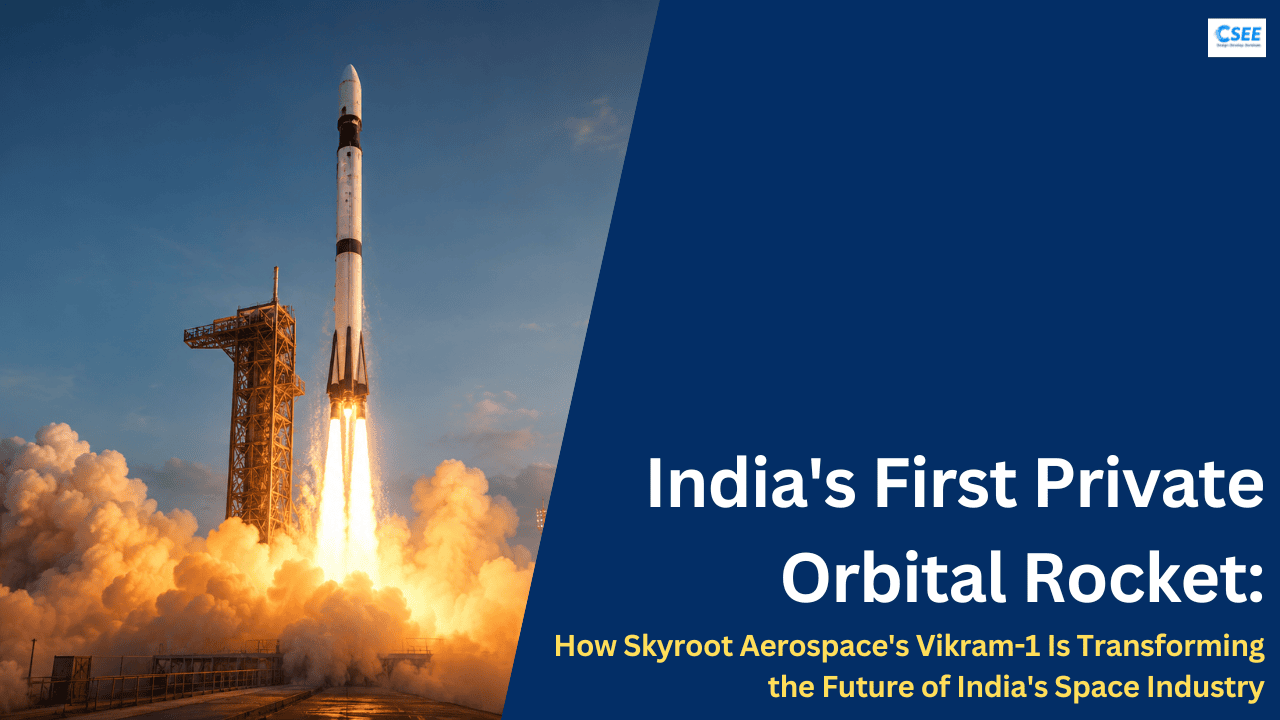
On 18 July 2026, India achieved a historic milestone in its space journey with the successful launch of Vikram-1, the country’s first privately developed orbital launch vehicle. Developed by Skyroot Aerospace, the rocket successfully placed its payloads into Low Earth Orbit (LEO), marking a new era where private Indian companies are not just supporting space missions but leading them. This achievement places India among a select group of nations capable of developing and operating private orbital launch vehicles, signaling a major shift in the country’s space ecosystem.
For decades, India’s space story has been synonymous with the Indian Space Research Organisation (ISRO). ISRO has earned global recognition through missions such as Chandrayaan, Mangalyaan, Aditya-L1, and numerous commercial satellite launches. However, the successful flight of Vikram-1 demonstrates that India’s space ambitions have expanded beyond government agencies. The country’s private sector is now capable of designing, manufacturing, testing, and launching sophisticated orbital rockets, opening exciting opportunities for innovation, investment, and international collaboration.
A Historic Moment for Indian Space Exploration
The launch of Vikram-1 is much more than a successful rocket mission. It represents the beginning of a new chapter in Indian aerospace engineering. Private companies have long contributed components and manufacturing support to ISRO, but Vikram-1 is the first orbital launch vehicle completely developed by an Indian private startup.
This accomplishment reflects years of engineering excellence, extensive testing, regulatory support, and collaboration between government agencies and private industry. It demonstrates that Indian startups are now capable of competing in one of the world’s most technologically demanding sectors.
The success also validates the government’s decision to liberalize the Indian space sector, allowing private companies to participate in launch vehicle development, satellite manufacturing, and commercial space services.
The Journey of Skyroot Aerospace
Skyroot Aerospace was founded by former ISRO scientists who envisioned making space launches more affordable, accessible, and frequent. Their goal was to create launch vehicles specifically designed for the growing small satellite market.
The company attracted significant investments from venture capital firms, strategic investors, and technology partners. Instead of competing directly with heavy-lift launch vehicles, Skyroot focused on creating flexible, cost-effective rockets capable of launching small satellites into precise orbits.
Before Vikram-1, Skyroot successfully demonstrated its technological capabilities through the launch of Vikram-S in 2022, India’s first privately developed suborbital rocket. That mission proved critical technologies, flight software, avionics, propulsion systems, and launch operations. Vikram-1 built upon those achievements to become India’s first successful private orbital mission.
Understanding Vikram-1
Vikram-1 is a three-stage launch vehicle designed primarily for deploying small satellites into Low Earth Orbit.
The rocket incorporates several advanced technologies that improve efficiency while reducing manufacturing costs. One of its standout innovations is the extensive use of 3D-printed engine components, allowing rapid production and lower complexity compared to conventional manufacturing methods.
The launch vehicle is also designed with modular architecture, enabling greater flexibility for different mission requirements. Depending on customer needs, the rocket can deploy multiple satellites during a single mission.
Its approximate payload capacity of around 350 kilograms to Low Earth Orbit makes it ideal for modern Earth observation satellites, communication satellites, scientific payloads, and technology demonstrations.
Why Private Rockets Matter
Historically, launching satellites required government-operated launch services. While agencies such as ISRO, NASA, ESA, Roscosmos, and JAXA continue to play major roles, the global space industry has increasingly shifted toward commercial participation.
Companies including SpaceX, Rocket Lab, Firefly Aerospace, and others have shown that private organizations can dramatically reduce launch costs while increasing launch frequency.
India’s successful private orbital launch indicates that the country is joining this global transformation.
Private launch providers offer:
- Faster mission scheduling
- Lower launch costs
- Customized missions
- Greater innovation
- Increased competition
- Better commercial opportunities
These advantages benefit universities, startups, research organizations, defense agencies, and international satellite operators.
India’s Space Sector Reforms
A major catalyst behind Vikram-1’s success was India’s space sector reform initiated in 2020.
These reforms opened multiple areas of space activities to private companies while creating regulatory frameworks through organizations such as IN-SPACe.
The reforms encouraged startups to access ISRO facilities, testing infrastructure, launch pads, and technical expertise while retaining commercial independence.
As a result, dozens of Indian space startups emerged, working in satellite manufacturing, propulsion, launch systems, communication technologies, Earth observation, AI-powered space analytics, and reusable launch systems.
Vikram-1 is perhaps the strongest validation of these reforms so far.
Engineering Innovations Behind Vikram-1
Modern rockets require expertise across numerous engineering disciplines.
Vikram-1 integrates advanced systems including:
- High-performance propulsion
- Lightweight composite structures
- Precision navigation
- Autonomous flight computers
- Real-time telemetry
- Fault-tolerant avionics
- Stage separation systems
- Flight safety mechanisms
The use of additive manufacturing (3D printing) significantly reduces production time while improving component optimization.
Digital simulation, computational fluid dynamics, finite element analysis, and advanced software verification also played major roles in ensuring mission success.
Launch Sequence
Every orbital launch follows a carefully planned sequence.
The Vikram-1 mission involved:
- Final countdown
- Engine ignition
- Lift-off
- First-stage separation
- Second-stage ignition
- Fairing separation
- Third-stage ignition
- Orbital insertion
- Payload deployment
Each phase requires millisecond-level precision because even tiny deviations can affect orbital accuracy.
The successful completion of all these stages demonstrated the maturity of Skyroot’s engineering capabilities.
Importance for India’s Economy
The global space economy is projected to exceed one trillion dollars over the coming decades.
Satellite communication, navigation, remote sensing, climate monitoring, defense, precision agriculture, disaster management, autonomous transportation, and IoT all depend heavily on satellite infrastructure.
India has enormous potential to become a major commercial launch provider because of its highly skilled engineering workforce, competitive manufacturing costs, and growing startup ecosystem.
Successful private launches attract:
- Foreign investments
- International customers
- High-value employment
- Technology exports
- Research collaborations
- Manufacturing opportunities
This creates significant economic benefits beyond the aerospace sector.
Opportunities for Engineers
The success of Vikram-1 creates exciting career opportunities.
Demand will increase for professionals in:
- Aerospace Engineering
- Mechanical Engineering
- Electronics Engineering
- Embedded Systems
- Guidance, Navigation and Control (GNC)
- Artificial Intelligence
- Machine Learning
- Computer Vision
- Functional Safety
- Avionics
- MATLAB/Simulink
- Embedded C
- FPGA Development
- Software Verification and Validation
- RF Communication
- Cybersecurity
Students interested in space technology now have many more career paths beyond government organizations.
Impact on Startups
India’s startup ecosystem has already transformed industries such as fintech, healthcare, education, and e-commerce.
Space technology is rapidly becoming another high-growth sector.
Following Skyroot’s success, more startups are expected to focus on:
- Satellite platforms
- Launch vehicles
- In-space propulsion
- Space robotics
- Space manufacturing
- Lunar technologies
- Space AI
- Deep-space communications
- Space situational awareness
This diversification will strengthen India’s technological leadership.
International Significance
The success of Vikram-1 also enhances India’s global reputation.
Many countries seek affordable and reliable launch providers for their satellites.
India’s combination of engineering excellence, cost competitiveness, and increasing launch capability positions it as an attractive destination for international space customers.
Private launch companies can complement ISRO’s missions while expanding India’s commercial presence worldwide.
Challenges Ahead
Although Vikram-1 marks an extraordinary achievement, sustaining success will require overcoming several challenges.
Future priorities include:
- Increasing launch frequency
- Improving payload capacity
- Developing reusable rockets
- Reducing launch costs further
- Expanding international customer base
- Building robust supply chains
- Enhancing manufacturing scalability
- Ensuring consistent mission reliability
Addressing these challenges will determine India’s long-term competitiveness in the global launch market.
The Future of Indian Private Space
The coming decade could witness multiple Indian private launch providers operating alongside ISRO.
Reusable rockets, satellite constellations, lunar exploration missions, space stations, on-orbit servicing, and interplanetary technologies may increasingly involve Indian private companies.
Collaboration between government agencies, academia, startups, and established industries will accelerate innovation and create a vibrant commercial space ecosystem.
Conclusion
The successful launch of Vikram-1 is more than just another rocket launch—it is a defining moment in India’s technological evolution. It demonstrates that Indian startups can achieve world-class engineering excellence and compete on the global stage. By combining innovation, entrepreneurial spirit, supportive government policies, and technical expertise, India has opened a new chapter in commercial space exploration.
As the demand for satellite launches continues to rise worldwide, India’s private space industry is well-positioned to become a major player. Vikram-1 is not merely the country’s first private orbital rocket; it is a symbol of India’s transition from being a participant in the global space economy to becoming one of its future leaders. The success of this mission will inspire entrepreneurs, engineers, researchers, and students to dream bigger and contribute to the next generation of space technologies, ensuring that India’s journey into space continues to reach new heights.