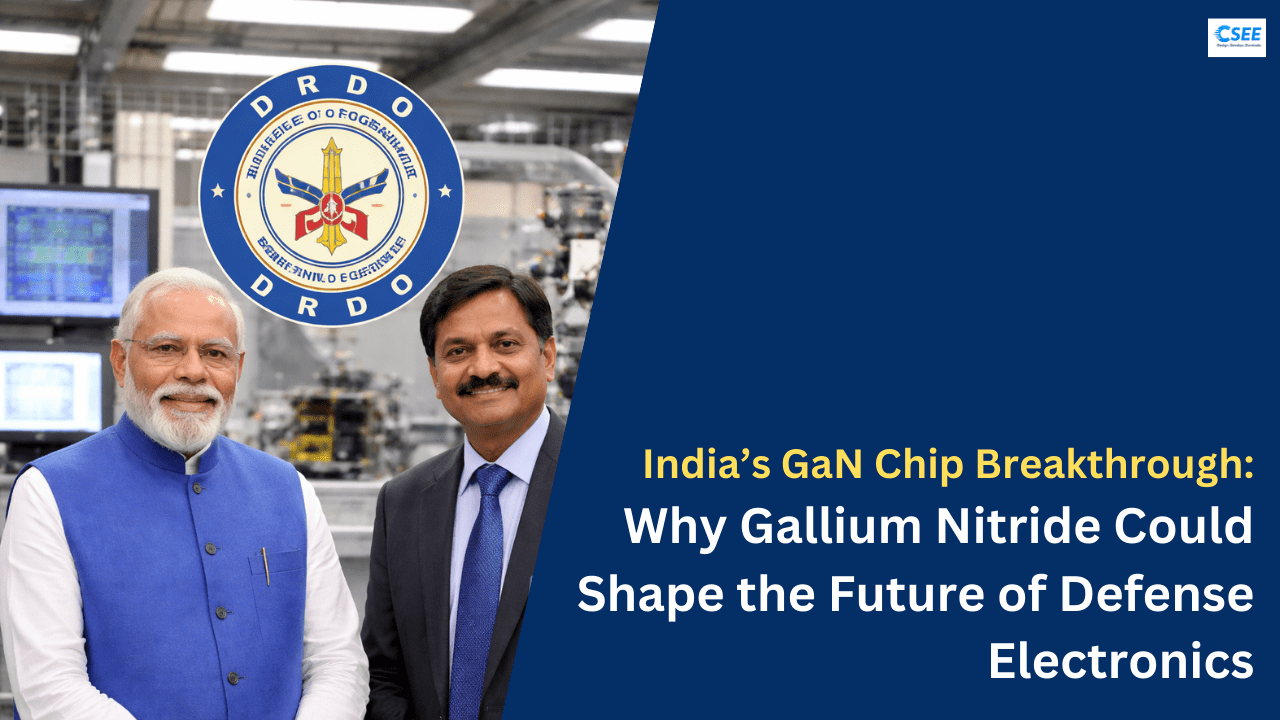
In 2016, the Defence Research and Development Organisation (DRDO) was given a major task — develop India’s own Gallium Nitride (GaN) semiconductor technology. At that time, the global semiconductor industry was already exploring new materials that could go beyond the limits of traditional silicon-based chips.
For decades, silicon had been the backbone of the electronics revolution. From smartphones and laptops to automotive systems and satellites, silicon chips powered nearly everything. But as electronic systems demanded higher power, faster speeds, better efficiency, and extreme temperature tolerance, engineers began looking for alternatives.
This is where GaN (Gallium Nitride) entered the picture.
Developing GaN technology is not easy. It requires deep expertise in materials science, semiconductor physics, fabrication processes, and device engineering. Despite these challenges, DRDO scientists and engineers worked for seven years, conducting experiments, building prototypes, refining fabrication processes, and testing high-performance devices.
After years of research and development, India successfully demonstrated indigenous GaN semiconductor technology. This achievement is not just a scientific milestone. It represents a strategic technological capability that can impact defense systems, communications infrastructure, electric vehicles, renewable energy systems, and many other industries.
But the big question remains:
If GaN is so powerful, does it mean silicon is becoming outdated?
To understand that, we need to explore the science behind semiconductors, the limits of silicon, and the advantages that GaN brings to modern electronics.
Understanding Semiconductor Materials
What Is a Semiconductor?
A semiconductor is a material whose electrical conductivity lies between that of a conductor (like copper) and an insulator (like glass). This unique property allows engineers to precisely control the flow of electricity.
Semiconductors are used to create electronic components such as:
- Transistors
- Diodes
- Integrated circuits
- Power devices
- RF amplifiers
These components form the foundation of modern electronic systems.
The performance of these devices depends heavily on the material used to build them.
The Rise of Silicon
Silicon became the dominant semiconductor material for several reasons:
- Abundant availability – Silicon is one of the most common elements on Earth.
- Stable properties – It behaves predictably in electronic circuits.
- Mature manufacturing processes – Decades of research have optimized silicon fabrication.
- Cost efficiency – Silicon wafers are relatively cheap to produce.
Because of these advantages, silicon has powered the electronics revolution for more than 50 years.
However, as technology advanced, new challenges emerged.
The Limitations of Silicon
Silicon works extremely well for most electronics, but it has certain physical limits.
When engineers try to design systems that operate at very high voltages, high frequencies, or extreme temperatures, silicon devices begin to struggle.
Some key limitations include:
1. Heat Generation
High-power electronic systems generate a lot of heat. Silicon devices can degrade or fail when temperatures become too high.
2. Switching Losses
Power electronics rely on switching devices on and off rapidly. Silicon devices generate energy losses during switching, which reduces efficiency.
3. Voltage Handling Limits
For high-power applications such as electric vehicles or power grids, silicon devices require larger structures to handle high voltages. This increases size and reduces efficiency.
4. Frequency Constraints
High-frequency applications like radar and 5G communication demand extremely fast switching speeds. Silicon struggles to maintain efficiency at these frequencies.
These limitations led researchers to explore wide bandgap semiconductor materials.
Wide Bandgap Semiconductors
Wide bandgap materials have a larger energy bandgap compared to silicon. This gives them several advantages:
- Higher voltage tolerance
- Higher temperature operation
- Faster switching speeds
- Lower energy losses
Two of the most promising wide bandgap materials are:
- Silicon Carbide (SiC)
- Gallium Nitride (GaN)
Among these, GaN has become particularly important for high-frequency and high-power electronics.
What Is Gallium Nitride (GaN)?
Gallium Nitride is a compound semiconductor made from gallium and nitrogen atoms.
Unlike silicon, which is a single element semiconductor, GaN is a compound material with unique electrical properties.
These properties allow GaN devices to outperform silicon in several critical areas.
Key Advantages of GaN Technology
1. Higher Power Density
GaN devices can handle significantly higher power levels in smaller sizes. This enables compact and efficient electronic systems.
2. Faster Switching Speed
GaN transistors switch much faster than silicon transistors. Faster switching reduces power losses and improves system efficiency.
3. High Temperature Operation
GaN can operate at higher temperatures without performance degradation. This reduces cooling requirements in many systems.
4. High Frequency Performance
GaN performs exceptionally well in radio frequency (RF) applications, making it ideal for radar and wireless communication systems.
5. Improved Energy Efficiency
Because GaN devices generate less energy loss, systems using GaN can achieve higher overall efficiency.
Applications of GaN Technology
GaN is transforming many industries.
01. Radar Systems
Modern radar systems require high-power RF amplifiers that operate at high frequencies. GaN technology significantly improves radar performance.
Defense systems benefit from:
- Longer detection ranges
- Higher signal power
- Better reliability
02. 5G Communication Infrastructure
5G networks require base stations that operate at extremely high frequencies. GaN amplifiers enable stronger signals and improved network performance.
03. Electric Vehicles
Electric vehicles rely on efficient power electronics to manage battery energy.
GaN power devices can improve:
- Charging speed
- Energy efficiency
- Thermal performance
04. Satellite Communication
Space systems require electronics that can operate in extreme environments. GaN devices provide reliability and high power performance for satellite communication systems.
05. Renewable Energy Systems
Solar and wind energy systems require efficient power converters. GaN devices can increase efficiency and reduce energy losses.
DRDO’s Role in Developing GaN Technology
The Defence Research and Development Organisation plays a crucial role in strengthening India’s defense technology capabilities.
Recognizing the importance of GaN technology, DRDO launched a mission in 2016 to develop indigenous GaN semiconductor devices.
This involved:
- Researching GaN materials
- Developing fabrication techniques
- Designing high-frequency devices
- Testing performance under extreme conditions
After seven years of research, DRDO scientists successfully developed GaN-based semiconductor technology.
This breakthrough allows India to build advanced electronic systems domestically.
Strategic Importance for India
Developing semiconductor technology is not just a scientific achievement. It has strategic importance.
Countries that control semiconductor technology control the future of modern electronics.
GaN technology is particularly important for:
- Defense systems
- Radar technology
- Communication infrastructure
- Space technology
By developing indigenous GaN capability, India reduces dependence on foreign suppliers.
This strengthens national security and technological independence.
Global Race in GaN Technology
Several countries are investing heavily in GaN research.
Major technology leaders include:
- United States
- Japan
- South Korea
- Taiwan
- China
These countries are using GaN technology for both commercial and defense applications.
India entering this field is an important step toward building a strong semiconductor ecosystem.
Is Silicon Becoming Outdated?
Despite the excitement around GaN, silicon is not going away.
Silicon still dominates most electronic devices because:
- It is cost effective
- Manufacturing infrastructure already exists
- It works well for many applications
Instead of replacing silicon, GaN is complementing it.
Different materials serve different purposes.
For example:
- Silicon – consumer electronics and general computing
- GaN – high power and high frequency systems
- SiC – power electronics and electric vehicles
The future of electronics will likely involve multiple semiconductor materials working together.
The Future of GaN Technology
GaN technology is still evolving.
Researchers are exploring ways to improve:
- Device reliability
- Manufacturing efficiency
- Integration with silicon processes
As production scales up, GaN devices are expected to become more affordable and widely used.
Future applications may include:
- Ultra-fast chargers
- Advanced AI hardware
- High-efficiency data centers
- Next-generation communication systems
India’s Semiconductor Vision
India has recently launched several initiatives to strengthen its semiconductor industry.
The government is encouraging investments in:
- Semiconductor fabrication plants
- Chip design companies
- Research institutions
India is also attracting global semiconductor companies to establish manufacturing facilities.
These efforts aim to position India as an important player in the global semiconductor supply chain.
Challenges in Semiconductor Development
Despite progress, semiconductor development remains extremely challenging.
Key challenges include:
01. High Investment Costs
Building semiconductor fabrication facilities requires billions of dollars.
02. Skilled Workforce
Developing advanced chips requires highly trained engineers and scientists.
03. Complex Supply Chains
Semiconductor manufacturing depends on specialized equipment and materials.
04. Rapid Technological Evolution
The semiconductor industry evolves rapidly, requiring constant innovation.
India will need sustained investment and long-term planning to overcome these challenges.
The Road Ahead
India’s GaN breakthrough represents more than a technological achievement.
It shows that Indian scientists and engineers can compete in one of the most complex technological fields in the world.
The next steps include:
- Scaling production
- Integrating GaN devices into real systems
- Expanding research into new semiconductor materials
If these efforts continue, India could become a major contributor to the global semiconductor ecosystem.
Conclusion
The successful development of Gallium Nitride semiconductor technology by the Defence Research and Development Organisation marks a significant milestone in India’s technological journey.
GaN offers major advantages over silicon in areas such as high power, high frequency, and high temperature electronics. This makes it ideal for applications in defense systems, communication infrastructure, electric vehicles, and space technology.
However, this does not mean silicon is becoming obsolete. Instead, the semiconductor industry is evolving toward a multi-material future, where silicon, GaN, and other materials each play important roles.
India’s progress in GaN technology demonstrates the country’s growing capabilities in advanced semiconductor research. With continued investment, innovation, and collaboration, India has the potential to become an important player in the global semiconductor landscape.
The development of indigenous GaN technology is not just about building better chips. It is about building technological independence, economic growth, and a stronger future for India’s electronics ecosystem. 🚀🇮🇳
Thanks for reading.
Also, read:
- “Mother of All Deals”: How The EU–India Free Trade Agreement Can Reshape India’s Economic Future
- 10 Free ADAS Projects With Source Code And Documentation – Learn & Build Today
- 10 Tips To Maintain Battery For Long Life, Battery Maintainance
- 10 Tips To Save Electricity Bills, Save Money By Saving Electricity
- 100 (AI) Artificial Intelligence Applications In The Automotive Industry
- 100 + Electrical Engineering Projects For Students, Engineers
- 100 GitHub Projects to Level Up Your Embedded Engineering Skills
- 100+ C Programming Projects With Source Code, Coding Projects Ideas