Hello, everyone. Welcome back to our blog. In this article, I will discuss will AI replace automotive engineering jobs? let’s deep dive into MBD, HiL, diagnostics, software testing and beyond.
Ask questions if you have any electrical, electronics, or computer science doubts. You can also catch me on Instagram – CS Electrical & Electronics
- Why There Is No Competitor For MATLAB Simulink In The Automotive Industry
- The Ultimate Roadmap To Become A Part of the Software-Defined Vehicle (SDV) Revolution
- Computer Vision In ADAS: From Lane Keeping To Collision Avoidance
Will AI Replace Automotive Engineering Jobs?
Artificial Intelligence (AI) is no longer a buzzword — it is an integral part of modern industries, and the automotive sector is no exception. As car manufacturers and suppliers push for smarter, safer, and more efficient vehicles, AI is reshaping everything from manufacturing lines to advanced driver-assistance systems (ADAS). With this shift comes a fundamental question: Which jobs will be replaced, transformed, or newly created in the automotive domain due to AI?
This comprehensive article explores how AI is influencing key areas in automotive engineering such as Model-Based Design (MBD), Hardware-in-the-Loop (HiL) testing, automotive diagnostics, software development, embedded systems, and more. We will identify roles at risk, the new skillsets required, and the future opportunities AI brings.
01. The Role of AI in the Automotive Industry
AI in automotive is not just about self-driving cars. It’s involved in:
- Predictive maintenance
- Automated design and simulation
- Intelligent manufacturing
- Quality control using computer vision
- Natural language customer service
- Connected car features and OTA (Over-The-Air) updates
- Cybersecurity
Companies like Tesla, Bosch, Continental, Valeo, and Aptiv are heavily investing in AI to enhance efficiency, reduce costs, and improve safety.
02. Model-Based Design (MBD): Will AI Replace Engineers?
Model-based design is the backbone of control system development. Engineers use tools like MATLAB/Simulink to model, simulate, and auto-generate code.
AI Impact:
- AI can automate model generation from specifications or sensor data.
- Generative AI is beginning to create draft Simulink models based on system descriptions.
- Auto-tuning of parameters, real-time validation, and anomaly detection are becoming AI-driven.
Jobs at Risk:
- Entry-level MBD engineers focusing on routine modeling tasks
- Manual code conversion and documentation roles
New Opportunities:
- AI model trainers for automotive control systems
- Integration experts who can merge AI-generated models with real vehicle requirements
- Engineers specializing in validating AI-generated control logic
03. Hardware-in-the-Loop (HiL) Testing: Automation on the Rise
HiL systems allow testing of ECU software in a simulated environment before real vehicle trials. Tools like dSPACE, NI, and Vector VT Systems dominate this space.
AI Impact:
- Test case generation using AI based on previous bugs and functional coverage
- Intelligent fault injection and analysis
- AI-driven report summarization and visualization
Jobs at Risk:
- Manual test case developers
- Report writers and data analysts
New Opportunities:
- AI automation engineers for HiL setups
- Data scientists focused on test result prediction and root-cause analysis
- HiL engineers skilled in AI integration and maintenance
04. Automotive Diagnostics: Smarter Fault Detection
Diagnostics involve reading and interpreting Diagnostic Trouble Codes (DTCs), running UDS services, and analyzing logs.
AI Impact:
- Predictive diagnostics using AI to detect failures before they occur
- Natural Language Processing (NLP) is used to explain DTCs to non-technical users
- Pattern recognition to detect hidden issues in massive vehicle logs
Jobs at Risk:
- Manual log reviewers
- Basic diagnostic tool operators
New Opportunities:
- AI diagnostics analysts
- Vehicle health data modelers
- Engineers who train AI models to detect specific failures
05. Automotive Software Development: Shifting Paradigms
From AUTOSAR-based embedded software to adaptive platforms and SDVs (Software Defined Vehicles), software is key to modern automotive systems.
AI Impact:
- Code completion and error correction using tools like GitHub Copilot or AI4Code
- Automated documentation and unit test generation
- Intelligent bug prediction and resolution assistance
Jobs at Risk:
- Junior developers working on repetitive code
- Manual testing and integration engineers
New Opportunities:
- AI-augmented developers
- Experts in safety validation for AI-generated code
- Continuous integration (CI/CD) specialists for AI-driven pipelines
06. Embedded Systems and ECU Development: Precision Meets Intelligence
AI is influencing microcontroller selection, power optimization, and real-time task scheduling in embedded systems.
AI Impact:
- AI for automatic hardware-software partitioning
- Optimized firmware generation based on use case
- Predictive resource management
Jobs at Risk:
- Repetitive low-level programming tasks
- Manual memory optimization roles
New Opportunities:
- Embedded AI engineers
- Specialists in neural network inference on microcontrollers
- Real-time schedulers for AI-augmented ECUs
07. Electric Powertrain, Battery Management, and Energy Systems
AI is now used to monitor battery health, predict range, and manage thermal conditions.
AI Impact:
- AI models that learn driver behavior and adjust power use
- Predictive maintenance for electric drive units
- AI-based SOC/SOH estimation
Jobs at Risk:
- Manual data collection and analysis roles in BMS
- Standard calibration engineers
New Opportunities:
- Data engineers for powertrain analytics
- AI-powered calibration engineers
- Cloud-AI engineers for EV platforms
08. Vehicle Testing, Validation, and Verification
Testing processes, both on-road and simulated, are evolving with AI assistance.
AI Impact:
- Simulation of rare edge cases using AI-generated scenarios
- Automated test result categorization and prioritization
- Enhanced virtual testing environments
Jobs at Risk:
- Manual scenario creation and data labeling roles
- Physical-only test drivers (especially for early validation)
New Opportunities:
- Scenario designers for AI-driven simulators (e.g., CARLA, IPG CarMaker)
- Human-in-the-loop test engineers
- Test validation reviewers using AI feedback
09. Other Roles at Risk or in Transition
- Technical Writers: AI can now draft documentation, installation guides, and release notes
- Support Engineers: AI chatbots can handle basic customer service, troubleshooting, and updates
- Project Coordinators: AI can assist in scheduling, tracking progress, and managing resources
10. The Human Element: Why AI Won’t Replace Everyone
Despite all the automation, the automotive domain is safety-critical. Human validation, ethical decisions, compliance with ISO 26262, ASPICE, and regulatory understanding still require deep human involvement.
Even when AI is used, engineers must:
- Define correct system behavior
- Validate model predictions
- Ensure safety and legal compliance
Creativity, judgment, empathy, and domain experience remain irreplaceable.
11. How to Future-Proof Your Automotive Career
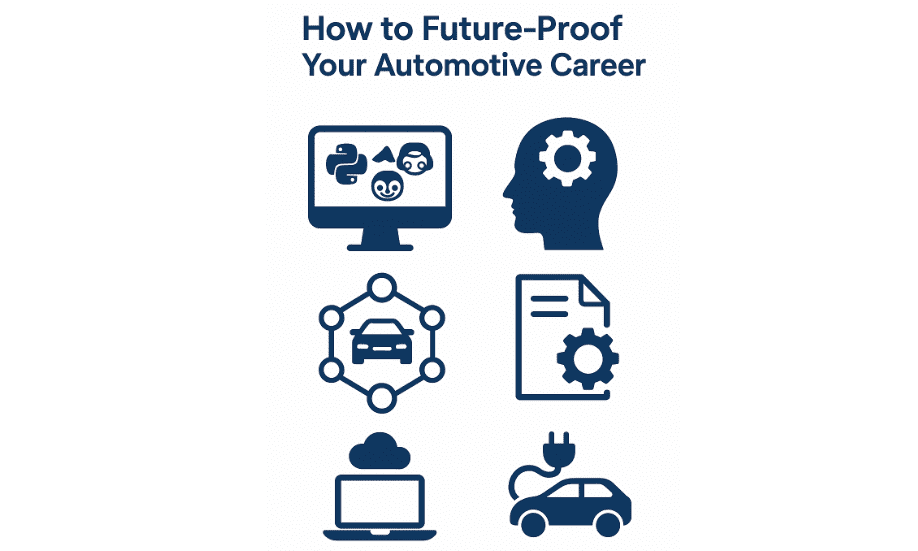
- Upskill Continuously: Learn about AI, data science, and automation tools.
- Focus on Integration: Become a bridge between AI tools and vehicle systems.
- Develop Soft Skills: Communication, collaboration, and critical thinking are key.
- Work on AI-Augmented Projects: Gain hands-on experience in projects that blend AI and automotive engineering.
- Certifications: Look into programs in automotive cybersecurity, machine learning, and functional safety.
Conclusion
AI is transforming the automotive industry rapidly. While it will replace some roles, especially those involving repetitive tasks, it will also create a wave of new opportunities. Engineers who adapt, learn, and grow with AI will not only survive but thrive in this new age of mobility.
So, will AI replace your job in the automotive sector? Not if you’re willing to evolve. The future is not about man or machine — it’s about man with machine.
Stay curious. Stay skilled. Stay future-ready.
This was about “Will AI Replace Automotive Engineering Jobs?“. Thank you for reading.
Also, read:
- “Mother of All Deals”: How The EU–India Free Trade Agreement Can Reshape India’s Economic Future
- 10 Free ADAS Projects With Source Code And Documentation – Learn & Build Today
- 100 (AI) Artificial Intelligence Applications In The Automotive Industry
- 100 GitHub Projects to Level Up Your Embedded Engineering Skills
- 1000+ Automotive Interview Questions With Answers
- 20 Advanced Coursera Courses for Embedded Engineers That Can Lead to High-Paying Careers
- 2000+ Embedded Systems Interview Question Bank
- 2024 Is About To End, Let’s Recall Electric Vehicles Launched In 2024