Hello guys, welcome back to my blog!
Today, we’re diving into a game-changing topic for defence engineers, electronics enthusiasts, and technology professionals — The Role of Gallium Nitride (GaN) in Next-Generation Defence Electronics. As modern defence systems become more advanced, faster, and software-driven, understanding the technologies that power them is more important than ever.
In this article, I’ll break down how GaN is transforming defence electronics, enabling smarter, more powerful, and more reliable systems. We’ll explore real-world applications such as advanced radars, electronic warfare, secure military communications, directed energy weapons, and satellite systems. You’ll also learn about the technical advantages that make GaN an essential material for high-frequency, high-power, and high-efficiency applications in harsh environments.
Whether you’re working in defence technology, aerospace, electronics engineering, or strategic research, this guide will give you practical insights into why GaN is becoming the backbone of next-generation military electronics. By the end, you’ll have a clear understanding of its role, applications, and the future potential of this revolutionary material.
Ask questions if you have any electrical, electronics, or computer science doubts. You can also catch me on Instagram – CS Electrical & Electronics.
- Adaptive AUTOSAR Service-Oriented Architecture – Real-Life Working Examples
- Top Automotive Diagnostic Tools Like DTS Monaco
- How PVA And Liquid Metal Are Revolutionizing PCB Prototyping And E-Waste Management
Role of Gallium Nitride (GaN) in Next-Gen Defence Electronics
In the era of modern warfare, electronics have become the backbone of every defence strategy. From advanced radar systems and secure communications to electronic warfare and directed energy weapons, the success of a nation’s armed forces often depends on how powerful, efficient, and reliable their electronic systems are. To meet these demanding requirements, the defence industry is turning to new semiconductor technologies that can go beyond the limitations of traditional silicon.
One such breakthrough is Gallium Nitride (GaN), a wide-bandgap semiconductor material that has revolutionized high-power and high-frequency applications. GaN is not just an incremental improvement over silicon; it is a strategic enabler of next-generation defence electronics. By offering high power density, efficiency, thermal stability, and ruggedness, it is reshaping the way military systems are designed and deployed.
This article explores the role of Gallium Nitride in modern defence electronics, its technical advantages, applications, global adoption, challenges, and future outlook.
What is Gallium Nitride (GaN)?
Gallium Nitride is a wide-bandgap semiconductor material composed of gallium and nitrogen. Unlike traditional silicon, which has been the standard in electronics for decades, GaN offers a wider bandgap of about 3.4 eV compared to silicon’s 1.1 eV. This larger bandgap allows devices made from GaN to operate at:
- Higher voltages – enabling more power in smaller systems.
- Higher frequencies – crucial for radar and communications.
- Higher temperatures – reducing cooling requirements.
Another major advantage is GaN’s ability to achieve higher electron mobility, which allows faster switching and improved efficiency. Compared to Gallium Arsenide (GaAs), another compound semiconductor, GaN provides better power handling and thermal stability, making it ideal for defence systems that must operate in extreme conditions.
Why Defence Needs GaN
Modern defence systems demand electronics that are:
- High Power and High Frequency: Radar and communication systems require devices that can transmit large amounts of power at GHz frequencies.
- Compact and Lightweight: Military platforms like fighter jets, UAVs, and naval vessels need systems that are powerful yet compact to save space and reduce weight.
- Energy Efficient: Mobile and remote systems benefit from reduced power consumption, which translates into longer mission life and lower operational costs.
- Reliable in Harsh Environments: Defence electronics must function reliably in extreme heat, cold, radiation, and battlefield conditions.
GaN uniquely satisfies all these requirements. Its ability to deliver high performance in compact, energy-efficient packages makes it indispensable for the next generation of defence electronics.
Applications of GaN in Defence Electronics
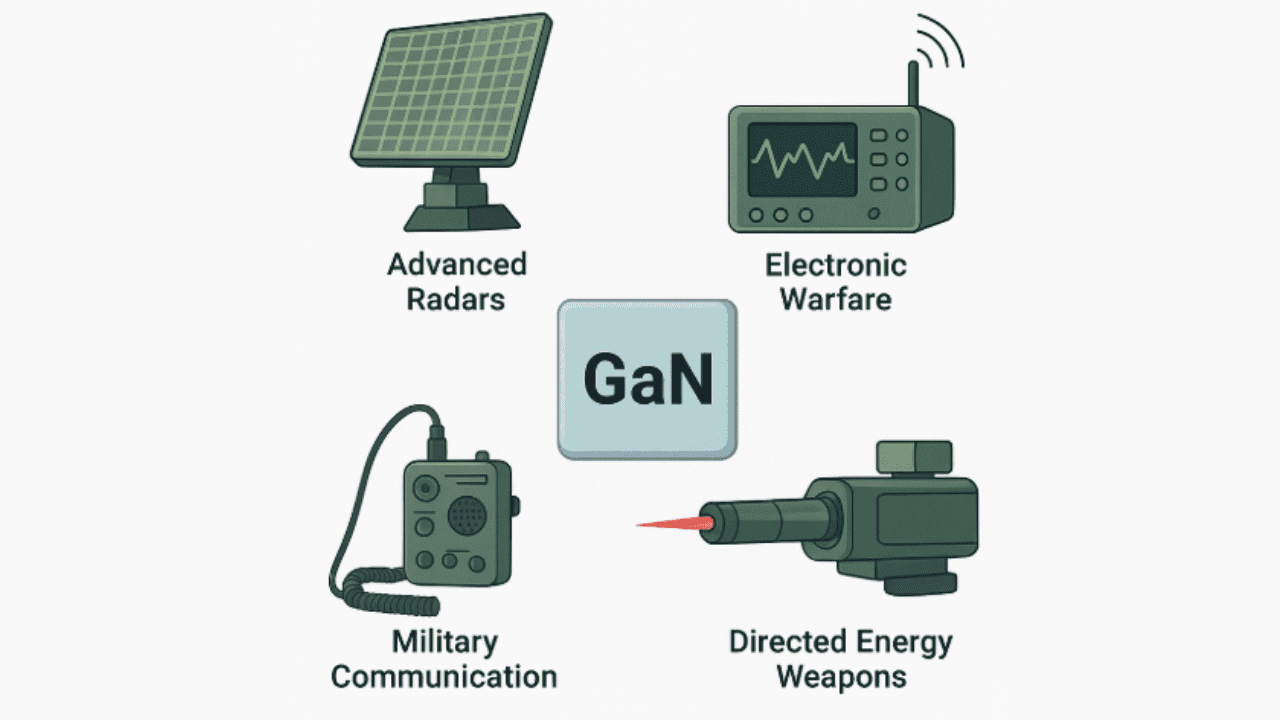
1. Advanced Radars
One of the most important applications of GaN is in Active Electronically Scanned Array (AESA) radars. These radars rely on thousands of transmit/receive modules to detect, track, and engage multiple targets simultaneously.
GaN-based modules provide:
- Longer detection range – crucial for spotting threats early.
- Higher resolution – for distinguishing between multiple objects.
- Reduced size and weight – ideal for integration into fighter jets, ships, and land-based platforms.
For instance, the F-35 Lightning II fighter jet uses GaN technology in its radar systems to achieve superior situational awareness. Similarly, naval warships are increasingly adopting GaN-powered radars for air and missile defence.
2. Electronic Warfare Systems
Electronic warfare (EW) is a critical domain where GaN plays a transformative role. EW systems involve both offensive and defensive measures, such as jamming enemy communications, disrupting radar, and protecting friendly signals.
GaN amplifiers provide:
- High power output – ensuring stronger jamming signals.
- Wideband agility – covering multiple frequencies for faster response.
- Compact design – making them suitable for mobile and airborne EW pods.
This gives armed forces the ability to react swiftly and effectively against enemy threats, enhancing both offensive capabilities and defensive protection.
3. Secure Communication Systems
Reliable communication is the lifeline of any military operation. Secure, long-range, and interference-resistant communication systems are essential for coordination across land, sea, air, and space.
GaN enables:
- High-frequency communication links – for long distances.
- Greater efficiency – reducing power consumption.
- Compact devices – suitable for portable or vehicle-mounted systems.
By enhancing communication reliability and security, GaN strengthens coordination among troops, ships, and aircraft in complex battlefields.
4. Directed Energy Weapons (DEWs)
Directed energy weapons are no longer science fiction. These systems use concentrated energy, such as high-powered microwaves or lasers, to disable enemy drones, missiles, or electronic equipment.
GaN provides the high power density and efficiency required for DEWs to be practical and mobile. Microwave-based weapons, in particular, benefit from GaN’s ability to deliver high-frequency, high-power signals in compact systems.
This makes it possible to field weapons that can neutralize multiple threats at once, without relying on traditional ammunition.
5. Space and Satellite Systems
Space has become a critical domain for defence operations, with satellites playing a key role in surveillance, communication, navigation, and missile detection.
GaN’s advantages in this area include:
- Radiation tolerance – critical for survival in space.
- High efficiency – reducing satellite power needs.
- Thermal stability – essential in the extreme temperature swings of orbit.
As nations expand their satellite constellations for defence purposes, GaN devices will ensure more reliable and longer-lasting systems in orbit.
Technical Advantages of GaN in Military Applications
The success of GaN in defence electronics can be traced to several key technical advantages:
- High Power Density – Delivers more power per unit area than silicon.
- High Efficiency – Reduces energy losses and lowers system power consumption.
- Thermal Stability – Operates at high temperatures without degradation.
- Frequency Agility – Performs well at microwave and millimeter-wave frequencies.
- Size and Weight Reduction – Enables smaller, lighter defence systems.
These factors collectively allow militaries to build compact, mobile, and more powerful electronic systems for diverse applications.
Global Defence Programs Using GaN
United States
The U.S. Department of Defense, through DARPA (Defense Advanced Research Projects Agency), has been heavily investing in GaN research since the early 2000s. Defence contractors such as Raytheon, Northrop Grumman, and Lockheed Martin use GaN in radars, electronic warfare, and communication systems.
Europe
European defence companies like Thales and Airbus Defence are integrating GaN into their radar and communication platforms. NATO has also recognized GaN as a critical technology for future defence operations.
India
The Defence Research and Development Organisation (DRDO) in India has been working on indigenous GaN technology to power radars and communication systems. Efforts are being made to establish a domestic supply chain for GaN to reduce dependence on imports.
China and Russia
Both countries have accelerated their GaN programs to enhance radar, communication, and electronic warfare capabilities. This reflects a global recognition of GaN’s strategic importance in defence.
Challenges and Limitations of GaN
Despite its advantages, GaN adoption faces challenges:
- High Manufacturing Costs: Producing GaN devices is more expensive compared to silicon.
- Reliability Concerns: While improving, GaN still faces long-term reliability issues in some applications.
- Supply Chain Risks: Gallium and other raw materials are limited and subject to geopolitical risks.
- Competition with Silicon Carbide (SiC): Another wide-bandgap material, SiC, is also gaining ground in defence and aerospace applications.
Addressing these challenges is essential for GaN to achieve full-scale adoption.
Future Outlook of GaN in Defence Electronics
The future of GaN in defence is promising, with several key trends emerging:
- GaN-on-Diamond Technology: Combining GaN with diamond substrates offers unmatched thermal conductivity, allowing even higher power density.
- Integration with AI: GaN-based systems combined with artificial intelligence will enable adaptive radars and smarter electronic warfare systems.
- Hypersonic Missile Defence: GaN’s high-frequency performance will be crucial for detecting and countering hypersonic threats.
- 6G Military Communication: Future communication systems will rely on GaN to provide secure, high-speed links across multiple domains.
These advancements highlight GaN’s long-term role as a foundational technology for defence electronics.
Conclusion
Gallium Nitride is far more than a replacement for silicon; it is a strategic enabler of modern defence electronics. Its ability to handle high power, high frequencies, and extreme environments makes it indispensable in applications such as radars, electronic warfare, communication systems, directed energy weapons, and satellites.
As nations continue to modernize their defence capabilities, GaN will remain at the core of innovation. While challenges such as cost and supply chain issues remain, the global defence industry is rapidly investing in solutions to overcome them.
The future battlefield will be shaped not only by weapons and strategies but also by the materials that power the underlying electronics. In this context, Gallium Nitride is positioned to redefine the way defence forces operate, making systems more efficient, reliable, and powerful than ever before.
FAQs
Q1. Why is Gallium Nitride better than silicon for defence applications?
GaN offers higher power density, efficiency, frequency capability, and thermal stability compared to silicon, making it ideal for demanding defence environments.
Q2. Which defence applications benefit the most from GaN?
Radars, electronic warfare systems, secure communications, directed energy weapons, and satellites benefit significantly from GaN technology.
Q3. What are the challenges in adopting GaN in defence electronics?
The main challenges are high manufacturing costs, long-term reliability, supply chain risks, and competition from alternative materials like silicon carbide.
Q4. What is the future of GaN in defence?
Future advancements include GaN-on-diamond for better heat management, integration with AI for smarter systems, and expanded use in hypersonic defence and 6G military communications.
This was about “Role of Gallium Nitride (GaN) in Next-Gen Defence Electronics“. Thank you for reading.
Also, read:
- 10 Free ADAS Projects With Source Code And Documentation – Learn & Build Today
- 100 + Electrical Engineering Projects For Students, Engineers
- 100+ Indian Startups & What They Are Building
- 1000+ Automotive Interview Questions With Answers
- 1000+ Electronics Projects For Engineers, Diploma, MTech Students
- 1000+ MATLAB Simulink Projects For MTech, Engineering Students
- 2026 Hackathons That Can Change Your Tech Career Forever
- 50 Advanced Level Interview Questions On CAPL Scripting