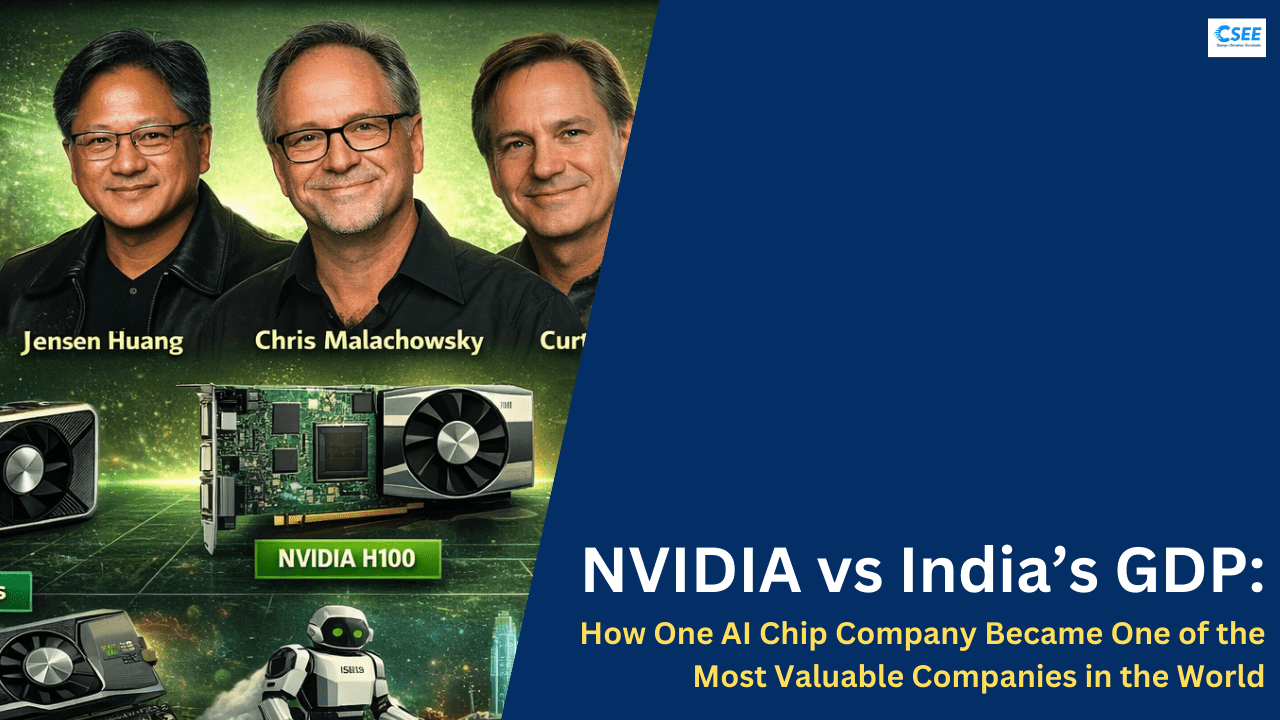
India’s GDP per year is around 4 trillion dollars, making it one of the largest economies in the world. But surprisingly, a single technology company has reached a valuation close to this level. That company is NVIDIA.
Just a few decades ago, NVIDIA was a relatively small semiconductor company working mainly on graphics chips for gaming computers. Today, it has become one of the most influential technology companies in the world. Its hardware powers the modern artificial intelligence revolution, supports the largest cloud computing platforms, and enables breakthroughs in robotics, self-driving vehicles, and scientific research.
Many of the most advanced technologies being built today rely heavily on NVIDIA’s computing platforms. From training large language models such as ChatGPT to powering data centers used by global tech giants like Microsoft, Google, and Amazon, NVIDIA has positioned itself at the center of the AI-driven technological revolution.
This article explores how NVIDIA grew from a gaming GPU company into the backbone of global AI infrastructure. We will examine its history, products, technology ecosystem, market strategy, competitors, and future opportunities.
The Origins of NVIDIA
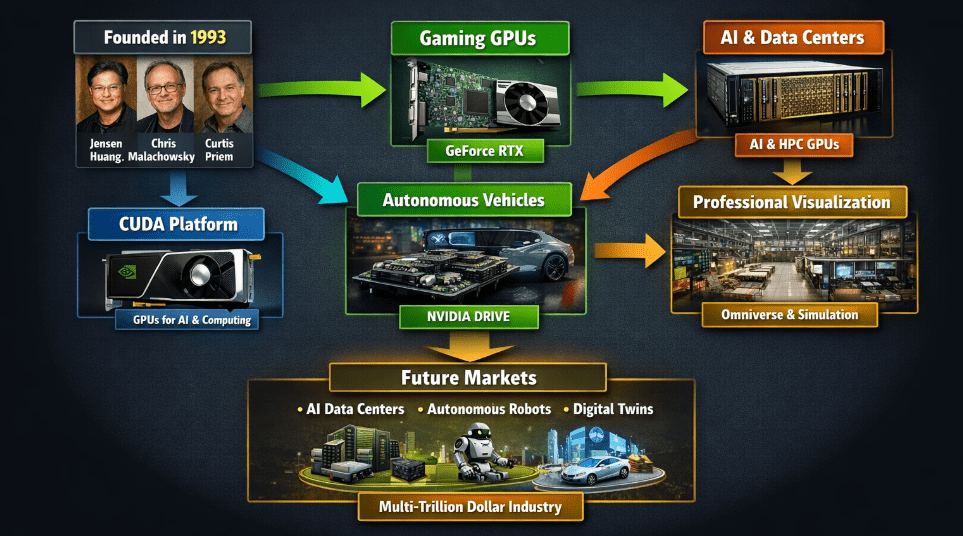
NVIDIA was founded in 1993 by three engineers: Jensen Huang, Chris Malachowsky, and Curtis Priem. At the time, personal computers were becoming increasingly powerful, but their graphics capabilities were still limited.
The founders believed that graphics processing would soon become a critical component of computing. They envisioned a specialized processor that could handle complex graphics operations much faster than traditional central processing units (CPUs).
This vision led to the creation of the Graphics Processing Unit (GPU). In 1999, NVIDIA introduced the GeForce 256, which the company described as the world’s first GPU. The chip was designed specifically to accelerate graphics rendering for video games and visual applications.
The introduction of the GPU revolutionized computer graphics. Games became more realistic, animations became smoother, and developers gained powerful tools to create immersive digital environments.
Although gaming was the initial focus, the GPU architecture had a much broader potential. The ability to process thousands of calculations simultaneously made GPUs ideal for other types of complex computing workloads.
Understanding GPUs and Parallel Computing
To understand why NVIDIA became so important, it is necessary to understand the difference between CPUs and GPUs.
A CPU is designed for general-purpose computing tasks. It handles many types of operations but usually processes them sequentially. CPUs are excellent for tasks requiring flexibility and complex decision-making.
GPUs, on the other hand, are designed for parallel processing. Instead of performing one operation at a time, GPUs can perform thousands of operations simultaneously. This makes them extremely efficient for tasks that involve large amounts of data being processed in parallel.
Originally, this parallel processing capability was used for rendering images and graphics in video games. However, researchers soon discovered that the same architecture could accelerate scientific computing, simulations, and machine learning.
This discovery eventually transformed GPUs into the primary hardware used for artificial intelligence.
NVIDIA’s Role in the Gaming Industry
For many years, NVIDIA was best known for its gaming graphics cards. Its GeForce series of GPUs became extremely popular among gamers who wanted high-performance graphics.
Gaming GPUs enable features such as realistic lighting, advanced shading, and high frame rates. Over time, NVIDIA introduced technologies like ray tracing, which simulates how light behaves in the real world, producing highly realistic graphics.
Another important innovation was Deep Learning Super Sampling (DLSS). This technology uses artificial intelligence to upscale images and improve game performance without sacrificing visual quality.
These innovations helped NVIDIA dominate the gaming GPU market. Even today, gaming remains an important part of NVIDIA’s business, generating billions of dollars in annual revenue.
However, the company’s biggest growth has come from a different sector: artificial intelligence and data centers.
The AI Revolution and NVIDIA’s Transformation
The rise of artificial intelligence dramatically increased the demand for high-performance computing. Training AI models requires enormous computational resources because neural networks must process massive datasets and perform billions of calculations.
Researchers discovered that GPUs were much better suited for these workloads than traditional CPUs. GPUs could train neural networks much faster by performing multiple mathematical operations in parallel.
Recognizing this opportunity early, NVIDIA invested heavily in AI computing platforms. It developed specialized GPUs designed specifically for machine learning and deep learning workloads.
These GPUs are now widely used in AI research, natural language processing, computer vision, and many other fields.
Many advanced AI systems, including large language models, are trained using clusters of NVIDIA GPUs.
The Importance of CUDA
One of the most important reasons for NVIDIA’s dominance is its software ecosystem, particularly CUDA (Compute Unified Device Architecture).
CUDA is a programming platform that allows developers to use GPUs for general-purpose computing tasks. Before CUDA, GPUs were mainly used for graphics. CUDA allowed developers to harness GPU power for scientific and technical computing.
Using CUDA, programmers can write applications that run directly on NVIDIA GPUs. These applications can accelerate tasks such as:
• Machine learning
• Image processing
• Financial modeling
• Scientific simulations
• Data analytics
Over time, millions of developers adopted CUDA, creating a large ecosystem of GPU-accelerated software. This ecosystem became a major competitive advantage for NVIDIA because many AI frameworks and research tools were optimized for CUDA.
As a result, companies that build AI systems often rely on NVIDIA hardware because their software is already optimized for it.
NVIDIA Data Center Business
Today, NVIDIA’s data center business is its fastest-growing and most profitable segment.
Modern artificial intelligence models require extremely powerful computing infrastructure. Training a large AI model can require thousands of GPUs working together in massive clusters.
Technology companies such as Microsoft, Amazon, Google, and Meta Platforms operate enormous data centers that host cloud computing services.
These data centers increasingly rely on NVIDIA GPUs to provide the computational power required for AI training and inference.
NVIDIA has developed specialized GPUs for this market, including the A100 and H100 processors. These chips are designed specifically for high-performance computing and AI workloads.
Each GPU can cost tens of thousands of dollars, and large AI clusters can cost hundreds of millions of dollars. As AI adoption increases, demand for these systems continues to grow.
Autonomous Vehicles and AI Computing
Another area where NVIDIA is making significant investments is autonomous vehicle technology.
Self-driving cars rely heavily on artificial intelligence to interpret sensor data, make decisions, and control vehicle movements. These tasks require powerful computing systems capable of processing data from cameras, radar, and lidar sensors in real time.
NVIDIA developed the NVIDIA Drive platform, which provides the hardware and software necessary to power autonomous driving systems.
Automotive companies such as Mercedes-Benz and Volvo Cars are working with NVIDIA to integrate AI-based computing systems into their vehicles.
Although fully autonomous vehicles are still under development, many modern cars already use AI-powered driver assistance systems based on similar technologies.
NVIDIA Omniverse and Digital Twins
NVIDIA is also investing in simulation platforms such as NVIDIA Omniverse.
Omniverse is a platform designed to simulate real-world environments using advanced graphics and AI technologies. It allows engineers and designers to create digital replicas of physical systems, often called digital twins.
These simulations can be used to test and optimize complex systems before building them in the real world.
Industries that can benefit from digital twins include manufacturing, logistics, city planning, and robotics. Engineers can simulate factories, warehouses, and transportation networks to identify inefficiencies and improve performance.
By combining advanced graphics with AI simulation, Omniverse aims to transform how industries design and operate complex systems.
Robotics and Edge AI
NVIDIA is also developing platforms for robotics and edge computing. These platforms enable intelligent machines to process data locally rather than relying entirely on cloud servers.
One example is the NVIDIA Jetson platform, which provides compact AI computing modules for embedded systems. These modules are used in robots, drones, smart cameras, and industrial automation systems.
Robotics is expected to become one of the fastest-growing technology sectors in the coming decades. AI-powered robots could transform industries such as manufacturing, logistics, healthcare, and agriculture.
NVIDIA aims to become the primary computing platform for these machines.
NVIDIA’s Competitive Landscape
Despite its success, NVIDIA faces competition from several major technology companies.
One key competitor is Advanced Micro Devices, which produces GPUs for gaming and data center applications. Another competitor is Intel, which has also entered the GPU and AI accelerator market.
Some large technology companies are designing their own specialized AI chips. For example, Google has developed Tensor Processing Units (TPUs) for machine learning workloads, while Amazon has introduced its own AI chips for cloud computing.
Despite these efforts, NVIDIA continues to maintain a strong lead due to its mature hardware architecture, software ecosystem, and developer community.
Why NVIDIA Became So Valuable
NVIDIA’s massive valuation can be explained by several key factors.
First, artificial intelligence is becoming one of the most important technologies of the modern era. Almost every industry is exploring ways to integrate AI into its operations.
Second, NVIDIA provides the hardware infrastructure required to build and train AI systems. Without powerful GPUs, many advanced AI applications would not be possible.
Third, the company has built a strong software ecosystem around its hardware. Tools like CUDA have created a large community of developers who rely on NVIDIA platforms.
Finally, NVIDIA operates in markets that are expected to grow rapidly over the next decade, including AI, cloud computing, robotics, and autonomous vehicles.
Skills Required to Work at NVIDIA
For engineers and students interested in working at NVIDIA, several technical skills are particularly valuable.
Programming skills are essential, especially in languages such as C, C++, and Python. Knowledge of parallel programming and GPU computing can also be extremely helpful.
Hardware engineering skills such as VLSI design, computer architecture, and chip verification are important for roles related to semiconductor development.
Understanding artificial intelligence and machine learning frameworks is another advantage. Engineers who can combine hardware knowledge with AI expertise are especially valuable.
NVIDIA also hires engineers specializing in embedded systems, robotics, and high-performance computing.
The Future of NVIDIA
The future of NVIDIA is closely tied to the growth of artificial intelligence.
AI is expected to transform industries such as healthcare, transportation, finance, manufacturing, and education. As AI models become more complex, the demand for high-performance computing will continue to increase.
NVIDIA is investing heavily in next-generation GPU architectures, advanced data center platforms, and AI software tools.
The company is also exploring emerging technologies such as quantum computing, digital simulation, and advanced robotics.
If AI continues to expand as rapidly as many experts predict, NVIDIA could remain one of the most influential technology companies in the world for decades.
Understanding What NVIDIA Actually Does
Before preparing for a company like NVIDIA, it is important to understand its core business areas.
NVIDIA operates in multiple advanced technology sectors including:
• Graphics Processing Units (GPUs)
• Artificial Intelligence Infrastructure
• High Performance Computing
• Autonomous Vehicles
• Robotics and Edge AI
• Cloud Data Centers
• Simulation and Digital Twins
The company builds both hardware and software platforms. Some of its most important technologies include:
• GeForce GPUs for gaming
• Data center GPUs like H100 and A100
• CUDA programming platform
• NVIDIA Omniverse simulation platform
• NVIDIA Drive autonomous vehicle platform
Because of this wide technology stack, NVIDIA hires engineers from multiple backgrounds.
Understanding which role matches your interests is the first step in your preparation journey.
Major Roles Available at NVIDIA
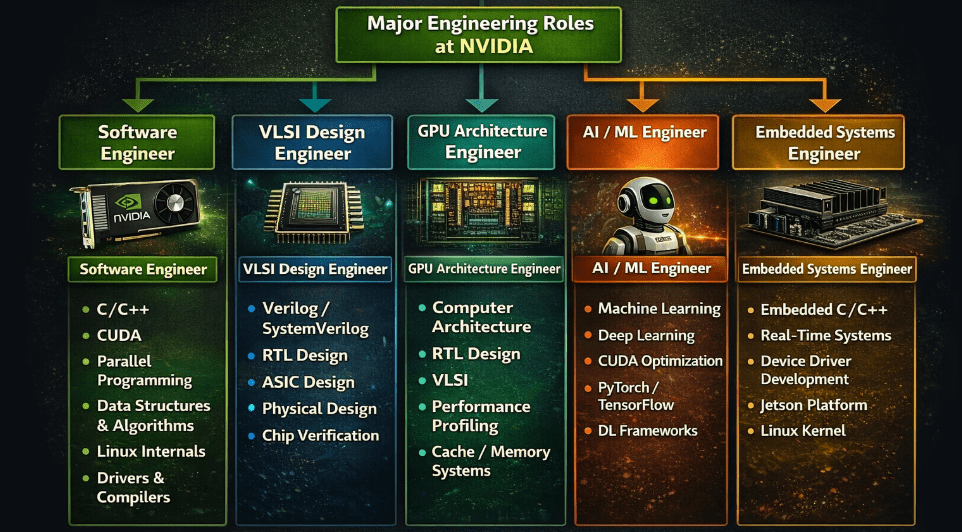
NVIDIA hires engineers in several technical domains.
Some of the most common roles include:
Software Engineer
Software engineers work on:
• GPU drivers
• AI frameworks
• CUDA libraries
• Operating systems
• Performance optimization
• Data center infrastructure
Languages commonly used include C, C++, Python, and sometimes Rust or Go.
GPU Architecture Engineer
These engineers design the internal architecture of GPUs.
They work on:
• parallel processing units
• memory systems
• instruction pipelines
• scheduling algorithms
This role requires deep knowledge of computer architecture and hardware design.
VLSI Design Engineer
These engineers work on semiconductor chip design.
They focus on:
• RTL design
• ASIC development
• chip verification
• digital logic design
• physical design
Skills such as Verilog, SystemVerilog, and VLSI tools are essential.
AI / Machine Learning Engineer
AI engineers work on developing machine learning frameworks and optimization tools.
They often work with technologies such as:
• PyTorch
• TensorFlow
• CUDA kernels
• GPU acceleration
They help optimize AI algorithms to run efficiently on GPUs.
Embedded Systems Engineer
Embedded engineers build software for NVIDIA hardware platforms such as Jetson modules and automotive platforms.
Their responsibilities include:
• device driver development
• Linux kernel development
• real-time systems
• robotics software
Step 1: Choose the Right Educational Background
Although NVIDIA hires people from many backgrounds, certain degrees are more common.
Popular degrees include:
• Computer Science
• Electronics and Communication Engineering
• Electrical Engineering
• Computer Engineering
• Artificial Intelligence
• Robotics
Students with strong fundamentals in data structures, operating systems, and computer architecture have an advantage.
However, a degree alone is not enough. NVIDIA mainly looks for problem-solving ability and technical depth.
Step 2: Master Programming Languages
Programming is one of the most important skills required to work at NVIDIA.
The most important languages include:
C
C is widely used in system programming and embedded development.
Important concepts to master include:
• pointers
• memory management
• bit manipulation
• data structures
• low-level debugging
C++
C++ is heavily used at NVIDIA because it allows high-performance system development.
Important concepts include:
• object-oriented programming
• templates
• memory management
• multithreading
• performance optimization
Advanced knowledge of C++ is extremely valuable.
Python
Python is widely used in AI development and automation.
Important areas include:
• NumPy
• PyTorch
• TensorFlow
• data processing
• machine learning workflows
Step 3: Learn Data Structures and Algorithms
Almost every engineering interview at NVIDIA includes questions related to Data Structures and Algorithms (DSA).
Important topics include:
• arrays and strings
• linked lists
• stacks and queues
• trees and binary trees
• graphs
• recursion
• dynamic programming
• sorting algorithms
• searching algorithms
You should practice coding problems regularly on platforms like:
• LeetCode
• HackerRank
• Codeforces
Solving hundreds of problems helps build a strong problem-solving ability.
Step 4: Understand Computer Architecture
Computer architecture is extremely important for NVIDIA roles because GPUs are complex computing systems.
Important concepts include:
• CPU architecture
• pipelining
• cache memory
• memory hierarchy
• instruction-level parallelism
• multi-core processing
• SIMD architecture
Understanding how processors work internally helps engineers optimize software for better performance.
Step 5: Learn GPU Computing
Since NVIDIA specializes in GPU computing, understanding GPU architecture is highly beneficial.
Important topics include:
• parallel programming
• thread blocks and grids
• memory hierarchy in GPUs
• shared memory
• warp scheduling
Learning **CUDA programming is especially valuable.
CUDA allows developers to write programs that run directly on NVIDIA GPUs.
Key CUDA concepts include:
• kernels
• thread synchronization
• memory transfers
• performance optimization
Developers who understand CUDA have a strong advantage when applying to NVIDIA.
Step 6: Build Strong System Programming Skills
System programming is critical for many NVIDIA roles.
Important topics include:
• operating systems
• process management
• thread synchronization
• memory management
• file systems
Knowledge of Linux internals is particularly valuable.
You should also learn:
• Linux kernel basics
• device driver development
• debugging tools
System-level understanding makes engineers much more effective at solving real-world problems.
Step 7: Learn Artificial Intelligence and Machine Learning
AI is one of NVIDIA’s biggest business areas.
Learning machine learning concepts can significantly improve your chances of getting hired.
Important topics include:
• neural networks
• deep learning
• computer vision
• natural language processing
• reinforcement learning
Frameworks to learn include:
• PyTorch
• TensorFlow
• ONNX
Understanding how AI models run on GPUs is extremely valuable.
Step 8: Work on Real Projects
Projects are one of the best ways to demonstrate your technical ability.
Examples of good projects include:
• CUDA-based matrix multiplication optimization
• GPU-accelerated image processing
• deep learning object detection system
• robotics simulation using NVIDIA Omniverse
• embedded AI system using Jetson modules
Projects show that you can apply your knowledge to real-world problems.
Employers value hands-on experience much more than theoretical knowledge alone.
Step 9: Learn High Performance Computing
High Performance Computing (HPC) is another key domain at NVIDIA.
Important topics include:
• parallel computing
• distributed systems
• cluster computing
• MPI programming
• GPU acceleration
HPC knowledge helps engineers build scalable systems that process massive datasets.
Step 10: Contribute to Open Source
Open-source contributions are highly respected in the technology industry.
You can contribute to projects related to:
• machine learning frameworks
• GPU libraries
• Linux kernel modules
• AI tools
Open-source contributions demonstrate your ability to collaborate with other developers and write production-quality code.
Step 11: Build a Strong Resume
Your resume should highlight the most relevant technical skills.
Important sections include:
• programming languages
• projects
• internships
• research work
• open-source contributions
Focus on measurable achievements such as:
• optimized algorithm performance
• reduced computation time
• built scalable systems
A well-structured resume increases your chances of getting shortlisted.
Step 12: Prepare for NVIDIA Interviews
NVIDIA interviews are known for being technically challenging.
They typically include multiple rounds.
Online Assessment
The first stage may include coding tests involving:
• algorithms
• debugging problems
• system design questions
Technical Interviews
Technical interviews focus on:
• data structures and algorithms
• computer architecture
• operating systems
• C/C++ programming
• parallel computing
Interviewers often ask deep questions to test your understanding.
System Design Interviews
For experienced engineers, system design questions may involve:
• designing distributed systems
• optimizing GPU workloads
• building scalable AI infrastructure
Behavioral Interviews
Behavioral interviews evaluate:
• teamwork
• communication
• problem-solving approach
Companies like NVIDIA look for engineers who can collaborate effectively in complex projects.
Step 13: Apply Through Multiple Channels
You can apply to NVIDIA through several methods.
Common channels include:
• company career website
• LinkedIn job listings
• employee referrals
• campus placements
Referrals often increase your chances of getting an interview.
Networking with engineers working in the industry can also help.
Step 14: Keep Learning Emerging Technologies
Technology evolves rapidly, especially in fields like AI and computing.
To stay competitive, engineers should continuously learn new technologies.
Emerging areas relevant to NVIDIA include:
• AI accelerators
• robotics
• digital twins
• quantum computing
• edge AI systems
Engineers who stay updated with new trends have better long-term career prospects.
Common Mistakes to Avoid
Many candidates fail interviews because of avoidable mistakes.
Common mistakes include:
• weak programming fundamentals
• poor understanding of computer architecture
• lack of hands-on projects
• memorizing answers instead of understanding concepts
Focusing on deep technical knowledge rather than shortcuts is the best strategy.
Timeline to Prepare for NVIDIA
A typical preparation roadmap might look like this:
Year 1
Learn programming and basic data structures.
Year 2
Study algorithms, operating systems, and computer architecture.
Year 3
Work on projects involving GPUs, AI, and system programming.
Year 4
Practice interview problems and apply for internships or full-time roles.
This timeline can vary depending on your background and experience.
Final Thoughts
Getting a job at NVIDIA requires dedication, technical depth, and continuous learning. The company works on some of the most advanced technologies in the world, including AI infrastructure, high-performance computing, robotics, and autonomous vehicles.
Engineers who master programming, computer architecture, parallel computing, and AI technologies have a strong chance of building successful careers at NVIDIA.
The most important thing is to build strong fundamentals, real-world projects, and deep technical understanding.
If you follow this roadmap consistently, you can position yourself among the engineers shaping the future of computing.
Conclusion
NVIDIA’s journey from a small graphics chip startup to one of the most valuable companies in the world is a remarkable example of technological vision and strategic innovation.
By recognizing the potential of GPUs beyond gaming and investing early in artificial intelligence computing, NVIDIA positioned itself at the center of the AI revolution.
Today, its hardware powers some of the most advanced technologies in the world, from large language models to autonomous vehicles and robotic systems.
As artificial intelligence becomes increasingly integrated into everyday life, NVIDIA’s role in the global technology ecosystem is likely to grow even further.
For engineers, researchers, and students, understanding the technologies developed by NVIDIA provides valuable insight into the future of computing and the opportunities that lie ahead.
Thank you for reading.
Also, read:
- “Mother of All Deals”: How The EU–India Free Trade Agreement Can Reshape India’s Economic Future
- 10 Free ADAS Projects With Source Code And Documentation – Learn & Build Today
- 10 Tips To Maintain Battery For Long Life, Battery Maintainance
- 10 Tips To Save Electricity Bills, Save Money By Saving Electricity
- 100 (AI) Artificial Intelligence Applications In The Automotive Industry
- 100 + Electrical Engineering Projects For Students, Engineers
- 100+ C Programming Projects With Source Code, Coding Projects Ideas
- 100+ Indian Startups & What They Are Building