Cities across the world are struggling with the same problems: air pollution, traffic congestion, rising fuel costs, and climate change. Public transport is one of the strongest tools to fight these challenges. Electric buses have become a key solution, replacing diesel buses that pollute cities every day.
Most countries have adopted battery electric buses as the standard solution. These buses run on large lithium-ion batteries and charge for several hours. China, however, has taken a different and more system-oriented approach. Instead of relying only on batteries, China has invested heavily in supercapacitor-based electric buses and opportunity charging transit systems.
This article explains what supercapacitors are, how they work in public transport, how they compare with battery electric buses, and why China’s approach gives it a strategic advantage. This is not just about a new vehicle technology—it is about how technology, infrastructure, energy, and policy work together as one system.
Understanding Supercapacitors in Simple Words
A supercapacitor is an energy storage device. It is different from a battery.
- A battery stores energy using chemical reactions
- A supercapacitor stores energy using electric fields
Because there are no chemical reactions, supercapacitors can charge and discharge extremely fast and do not degrade easily.
Key Properties of Supercapacitors
- Charging time: 30 seconds to 2 minutes
- Discharge time: almost instant
- Life cycle: hundreds of thousands to millions of cycles
- Energy storage: lower than batteries
- Power output: very high
Supercapacitors cannot store as much energy as batteries, so they are not ideal for long-distance travel. But they are perfect for short routes with frequent stops, such as city buses.
What Is a Supercapacitor Electric Bus?
A supercapacitor electric bus does not rely on a large battery pack. Instead, it uses:
- A small battery or none at all
- One or more supercapacitor modules
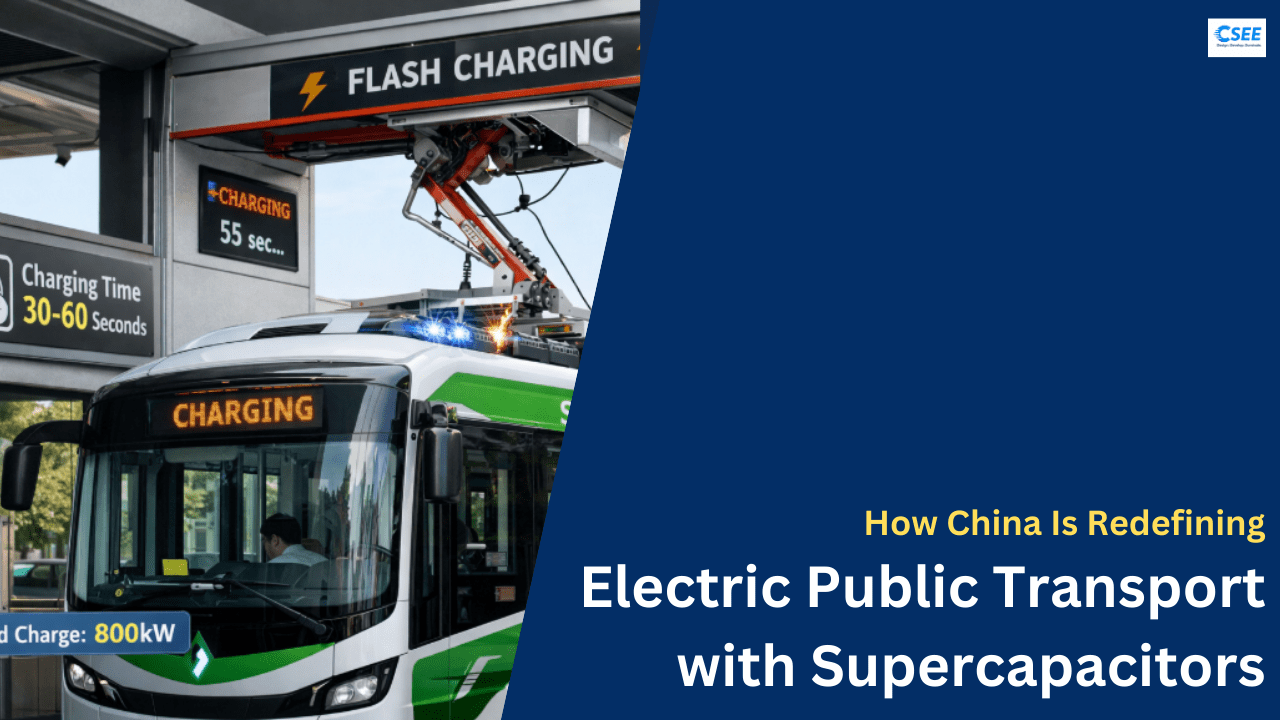
- Ultra-fast chargers installed at bus stops or terminals
How It Works
- The bus arrives at a stop
- It connects to a high-power charger
- It charges in 30–60 seconds
- It drives to the next stop or few stops
- The process repeats all day
This is called opportunity charging—charging whenever the opportunity exists.
Battery Electric Buses: The Traditional Model
Battery electric buses (BEBs) dominate global markets outside China.
Typical Battery Bus Characteristics
- Charging time: 3–6 hours (slow) or 30–90 minutes (fast)
- Energy stored: high
- Range: 200–350 km
- Battery weight: very heavy
- Battery degradation: noticeable after 5–8 years
Problems at Scale
When hundreds or thousands of buses charge at the same time:
- Power grid stress increases
- Transformer upgrades are required
- Peak electricity demand rises
- Charging stations become bottlenecks
This makes large-scale deployment expensive and complex.
Supercapacitor vs Battery: Clear Comparison
| Feature | Supercapacitor Bus | Battery Electric Bus |
|---|---|---|
| Charging time | 30–60 seconds | 3–6 hours |
| Energy storage | Low | High |
| Weight | Light | Heavy |
| Cycle life | Very high | Limited |
| Grid impact | Distributed | Concentrated |
| Downtime | Almost none | Significant |
| Maintenance | Lower | Higher |
Supercapacitor buses trade range for speed, reliability, and system efficiency.
Why China Chose Supercapacitors
China’s cities are dense, busy, and high-frequency. Buses stop often and run on fixed routes. This environment is perfect for supercapacitors.
Key Reasons
- High passenger volume
- Short distances between stops
- Strong urban planning control
- Centralized policy execution
- Manufacturing strength
China does not think in isolated vehicles. It thinks in systems.
Systems-Level Thinking: The Core Advantage
China’s success is not about supercapacitors alone. It is about how everything connects.
The System Includes
- Bus routes
- Charging stations
- Power grid
- Manufacturing
- Urban planning
- Government policy
Each part is designed together, not separately.
Charging Infrastructure: Distributed and Smart
Instead of building massive depots:
- Chargers are placed at terminals and stops
- Power is drawn in short bursts
- Energy demand is spread across time and space
This avoids grid overload and reduces infrastructure cost.
Impact on the Power Grid
Battery buses create large power peaks during charging.
Supercapacitor buses create small, frequent, manageable loads.
Benefits
- Less grid reinforcement
- Better load balancing
- Easier renewable integration
- Improved grid stability
This is critical for megacities.
Durability and Lifecycle Advantage
Batteries degrade with every charge.
Supercapacitors barely degrade.
Lifecycle Comparison
- Battery life: 5–8 years
- Supercapacitor life: 15–20 years
This reduces replacement cost and waste.
Material and Supply Chain Strategy
Lithium batteries depend on:
- Lithium
- Cobalt
- Nickel
These materials have geopolitical risks.
Supercapacitors mainly use:
- Carbon
- Aluminum
- Common electrolytes
China has strong control over these materials and manufacturing processes.
Environmental Impact
Supercapacitor systems:
- Use fewer rare minerals
- Generate less hazardous waste
- Support longer vehicle life
They are not perfect, but they reduce environmental pressure in key areas.
Operational Efficiency for Transit Agencies
Benefits
- No long charging breaks
- Higher vehicle utilization
- Fewer spare buses needed
- Predictable schedules
Buses stay on the road instead of in depots.
Economic Considerations
Initial Cost
- Infrastructure cost is high
- Vehicle cost can be lower due to smaller batteries
Long-Term Cost
- Lower maintenance
- Longer lifespan
- Lower energy losses
Over time, total cost of ownership can be lower.
Challenges of Supercapacitor Transit
Supercapacitor systems are not perfect.
Limitations
- Short driving range
- High-power charging hardware needed
- Route planning must be precise
This is why the model works best in planned urban environments, not random routes.
Why Other Countries Haven’t Adopted It Widely
- Cities are less centralized
- Infrastructure planning is slower
- Policy coordination is weaker
- Focus remains on vehicle-first thinking
China designs the ecosystem first, vehicle second.
Hybrid Systems: The Future Direction
China is now combining:
- Small batteries
- Supercapacitors
- Regenerative braking
This creates flexible and efficient systems.
Lessons for the World
Other countries can learn:
- Think in systems, not products
- Design infrastructure and vehicles together
- Reduce dependence on single technologies
- Match technology to city needs
Conclusion
China’s supercapacitor transit strategy shows that the future of electric mobility is not one-size-fits-all. Battery electric buses are useful, but they are not the only answer. By using supercapacitors, China has built a public transport system that charges in seconds, runs continuously, and works in harmony with the power grid.
This approach is fast, resilient, and deeply integrated. It proves that real innovation happens not just in devices, but in how systems are designed. The pulse of the dragon is not just electric—it is strategic.
Thanks for reading.
Also, read:
- “Mother of All Deals”: How The EU–India Free Trade Agreement Can Reshape India’s Economic Future
- 10 Free ADAS Projects With Source Code And Documentation – Learn & Build Today
- 10 Tips To Maintain Battery For Long Life, Battery Maintainance
- 10 Tips To Save Electricity Bills, Save Money By Saving Electricity
- 100 (AI) Artificial Intelligence Applications In The Automotive Industry
- 100 + Electrical Engineering Projects For Students, Engineers
- 100+ C Programming Projects With Source Code, Coding Projects Ideas
- 100+ Indian Startups & What They Are Building