Wind energy has played a key role in the global shift toward clean and renewable power. From large wind farms on land to massive offshore turbines in the sea, wind has proven to be reliable, scalable, and increasingly affordable. But traditional wind turbines have one major limitation: they are stuck close to the ground.
Even the tallest wind turbines today reach only a few hundred meters high. At those heights, wind speed and consistency are limited by terrain, buildings, weather patterns, and surface friction. Scientists and engineers have long known a powerful truth: the higher you go, the better the wind gets.
China’s recent success in testing a megawatt-scale airborne wind power system, flying at more than 6,500 feet above the ground and connected directly to the electricity grid, marks a historic milestone. This is not just an experiment or a small prototype. It is a real, grid-connected demonstration of high-altitude wind energy.
This article explains what airborne wind power is, how China’s system works, why high-altitude winds matter, how electricity is sent back to the grid, and what this breakthrough could mean for the future of clean energy worldwide.
The Limits of Traditional Wind Turbines
Why Wind Turbines Keep Getting Taller
Traditional wind turbines work by capturing wind near the Earth’s surface. Over time, turbine towers have grown taller because:
- Wind speeds increase with height
- Wind becomes less turbulent higher up
- More consistent wind improves energy output
Modern turbines can exceed 150 meters in height, with blade tips reaching even higher. However, increasing height comes with serious challenges:
- Higher construction costs
- Stronger materials required
- Transportation difficulties
- Visual and environmental concerns
At some point, building taller towers becomes inefficient and impractical.
The Wind Resource Above Us
Above 500 meters, wind conditions change dramatically:
- Winds are stronger
- Winds are more stable
- Winds blow more consistently throughout the day and year
Studies show that high-altitude winds could provide several times more energy than all current global electricity demand. The problem has never been the wind itself — it has been how to access it.
What Is Airborne Wind Power?
Airborne Wind Power (AWP) is a technology that generates electricity using flying systems instead of fixed towers. These systems operate hundreds or even thousands of meters above the ground, where wind conditions are far superior.
Instead of spinning large blades on a tower, airborne systems use:
- Aircraft-like drones
- Kites
- Gliders
- Flying turbines
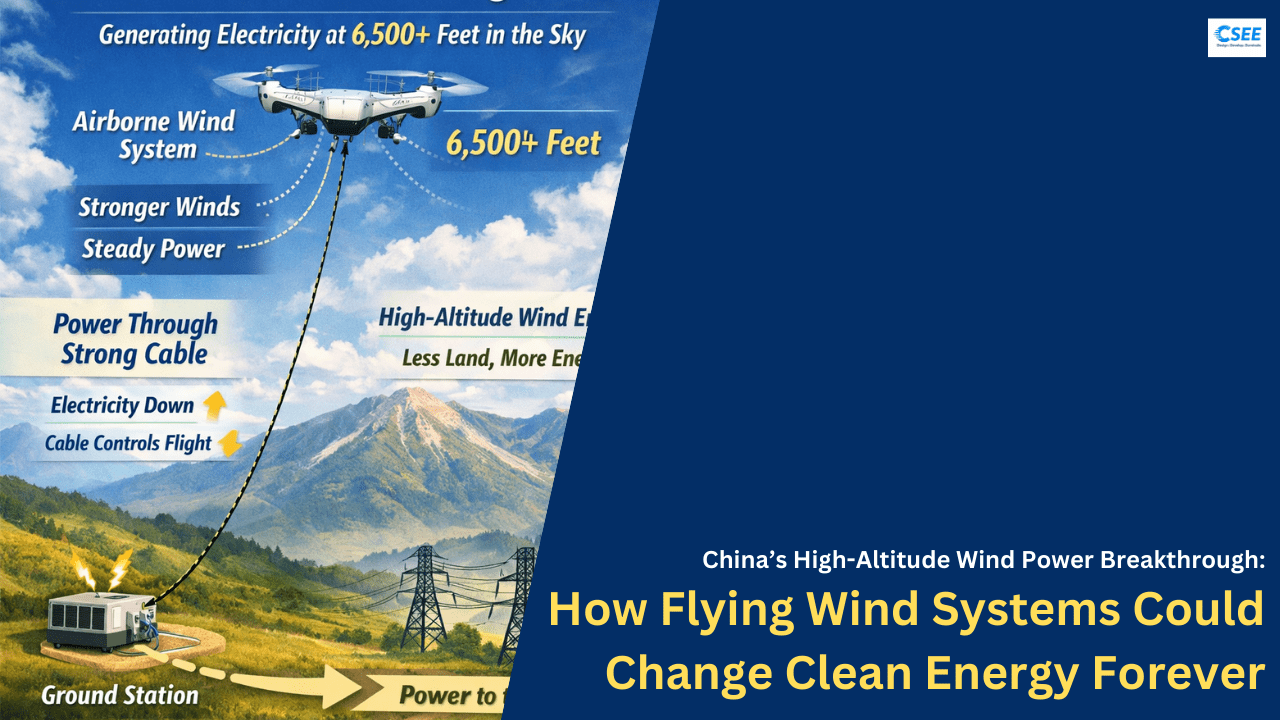
They remain connected to the ground using a strong connecting cable, which both controls the flight and transfers electricity.
China’s Megawatt-Scale Flying Wind System
What Makes This Test Special
China’s test stands out for several reasons:
- Megawatt-scale power output
This is not a lab prototype. Megawatt capacity means real power generation. - High operating altitude
The system flew at over 6,500 feet (≈2,000 meters). - Grid-connected operation
Electricity was sent directly into the power grid. - Stable and controlled flight
Sustained operation proves the system is not just theoretical.
This combination marks a transition from research to real-world energy infrastructure.
How the System Works (Simple Explanation)
Step 1: Flying Into Strong Winds
The airborne system is launched from a ground station and climbs to high altitude. Once there, it flies in controlled paths where wind speeds are higher and steadier than near the ground.
Step 2: Generating Electricity in the Air
There are two main design approaches for airborne wind power. China’s system falls into the onboard generation category:
- Wind spins rotors or turbines mounted on the flying platform
- Electricity is generated directly in the air
This avoids mechanical losses and allows continuous power generation.
Step 3: Sending Power Back to the Grid
Electricity generated in the air travels down through a strong connecting cable.
This cable:
- Holds and stabilizes the aircraft
- Sends electricity to the ground
- Transfers control signals
At the ground station:
- Power is converted to grid-compatible voltage
- Frequency is stabilized
- Electricity is fed into the grid like normal wind power
Flying system → cable → ground station → grid
Why High-Altitude Wind Is a Game Changer
More Energy From the Same Wind
Wind power increases dramatically with speed. A small increase in wind speed leads to a large increase in power. High-altitude winds can be:
- 2–3 times faster than surface winds
- Available for longer periods
- Less affected by terrain and obstacles
This means:
- Higher capacity factors
- More predictable energy output
- Better reliability
Less Land and Material Use
Traditional wind farms require:
- Large land areas
- Massive towers
- Heavy foundations
Airborne systems need:
- Small ground stations
- No tall towers
- Far less steel and concrete
This reduces:
- Environmental impact
- Construction cost
- Land-use conflicts
Comparison: Airborne Wind vs Traditional Wind Turbines
| Feature | Traditional Wind | Airborne Wind |
|---|---|---|
| Height | Up to ~200 m | 1,000–3,000 m |
| Wind quality | Moderate | Strong & stable |
| Land use | High | Low |
| Materials | Steel, concrete | Lightweight composites |
| Installation | Heavy construction | Flexible deployment |
| Grid connection | Direct | Direct via cable |
China’s test proves airborne wind can now match traditional systems in grid integration, which was one of the biggest missing pieces.
Why Grid Connection Is So Important
Many experimental energy technologies fail to move beyond testing because they cannot:
- Deliver stable electricity
- Match grid requirements
- Operate continuously
China’s grid-connected flight shows:
- Voltage control works
- Frequency stability is manageable
- Power electronics are mature enough
This is the step that turns a concept into real infrastructure.
Engineering Challenges and How China Addressed Them
Flight Stability
Maintaining stable flight at high altitude requires:
- Advanced control algorithms
- Real-time wind sensing
- Fast response systems
China’s success shows progress in autonomous flight control and AI-based stabilization.
Cable Strength and Safety
The connecting cable must:
- Carry mechanical loads
- Conduct electricity
- Resist weather and fatigue
Modern materials like high-strength composites and advanced insulation make this possible.
Weather and Airspace
Operating in high altitude raises concerns:
- Storms
- Lightning
- Aviation safety
Careful site selection, controlled airspace, and automated safety systems are critical.
Why China Is Leading This Area
China has several advantages:
- Strong government support for renewable energy
- Massive manufacturing capability
- Experience scaling new technologies quickly
- Integrated power grid development
This test aligns with China’s long-term goals:
- Carbon neutrality
- Energy security
- Technological leadership
Global Context: Who Else Is Working on Airborne Wind?
Several countries and startups have explored airborne wind power:
- Europe (kite-based systems)
- United States (drone-based concepts)
- Japan (offshore airborne wind)
However, most efforts remain:
- Small scale
- Off-grid
- Experimental
China’s megawatt-scale, grid-connected test puts it ahead of most global efforts.
Potential Applications in the Future
Remote and Offshore Power
Airborne wind systems could provide power to:
- Remote regions
- Islands
- Offshore platforms
- Disaster zones
Without needing heavy infrastructure.
Complement to Solar and Wind Farms
High-altitude wind can:
- Produce power at night
- Balance seasonal gaps
- Improve grid stability
This makes it a strong complement to solar energy.
Environmental Impact
Lower Footprint
Compared to traditional wind farms:
- Less land disturbance
- Fewer foundations
- Reduced material use
Wildlife and Noise
Flying systems:
- Operate at higher altitudes
- Avoid ground-level noise
- Reduce bird collision risks near habitats
Environmental impact studies will still be needed, but early signs are promising.
Challenges Ahead
Despite the success, challenges remain:
- Long-term reliability
- Maintenance at scale
- Airspace regulations
- Public acceptance
China’s test does not mean mass deployment tomorrow — but it opens the door.
What This Means for the Future of Energy
China’s airborne wind test signals a shift in thinking:
- Energy is no longer limited to ground-based infrastructure
- The sky itself becomes a power resource
- Renewable energy can scale in new dimensions
Just as offshore wind changed the energy map, high-altitude wind could be the next leap.
Conclusion: A New Era Above Our Heads
China’s successful megawatt-scale, grid-connected airborne wind power test is more than a technical achievement. It is proof that clean energy can go higher, smarter, and more efficient.
By generating electricity at over 6,500 feet and sending it back to the grid through a strong connecting cable, China has shown that high-altitude wind energy is no longer science fiction.
If developed and scaled responsibly, airborne wind power could:
- Reduce land pressure
- Increase renewable output
- Support global decarbonization
The future of wind energy may not be on taller towers —
it may be flying above us.
Thanks for reading.
Also, read:
- “Mother of All Deals”: How The EU–India Free Trade Agreement Can Reshape India’s Economic Future
- 10 Free ADAS Projects With Source Code And Documentation – Learn & Build Today
- 10 Tips To Maintain Battery For Long Life, Battery Maintainance
- 10 Tips To Save Electricity Bills, Save Money By Saving Electricity
- 100 (AI) Artificial Intelligence Applications In The Automotive Industry
- 100 + Electrical Engineering Projects For Students, Engineers
- 100+ C Programming Projects With Source Code, Coding Projects Ideas
- 100+ Indian Startups & What They Are Building