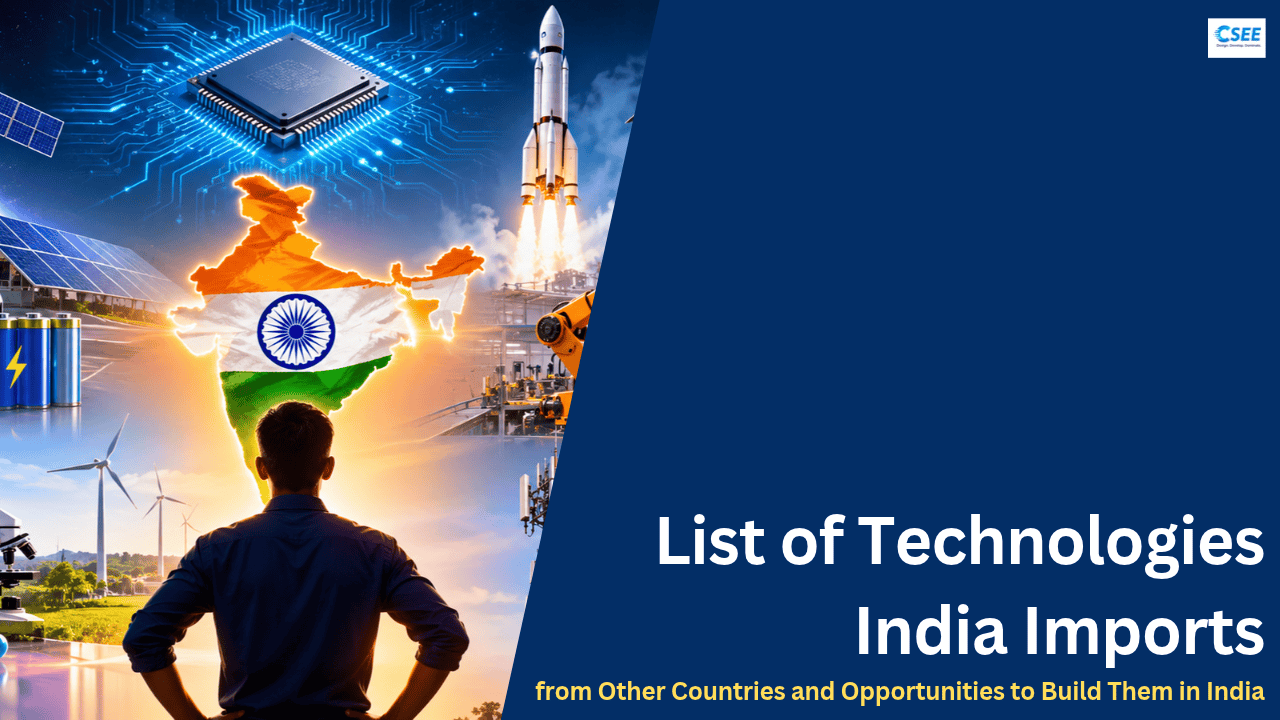
India is one of the world’s fastest-growing economies, with a strong engineering workforce, a rapidly expanding manufacturing sector and a growing technology ecosystem. From developing space launch vehicles to manufacturing automobiles, smartphones, defence equipment and advanced software, India has made remarkable progress in several technological fields.
However, there is another side to this progress. India still depends on other countries for many critical technologies, electronic components, raw materials, manufacturing equipment and specialised products. We import advanced semiconductor chips, lithium-ion battery cells, high-performance computing processors, rare-earth magnets, aircraft engines, precision sensors, medical imaging equipment and several other technologies.
This dependence is not necessarily a weakness in every situation. International trade and technology partnerships are normal parts of a global economy. However, excessive dependence on a limited number of countries for strategically important technologies can create challenges related to supply-chain disruptions, pricing, national security and technological independence.
This creates a massive opportunity for Indian engineers, researchers, entrepreneurs, startups and technology companies. Instead of looking at imports only as a dependency, we should look at them as a list of problems that Indian innovators can solve.
The objective should not be to manufacture everything immediately. It should be to gradually develop domestic capabilities, starting with individual components, subsystems, materials, software, intellectual property and eventually complete products.
Let’s explore the major technology areas where India depends on foreign suppliers and, more importantly, what we can start building in India.
1. Semiconductor Technology: The Foundation of Modern Electronics
Semiconductors are among the most important technologies in the modern world. Almost every electronic product, including smartphones, computers, electric vehicles, aircraft, medical equipment, industrial robots and communication systems, depends on semiconductor chips.
India has a strong semiconductor design ecosystem, with many engineers working on chip design, verification, embedded software and semiconductor research. However, India has historically depended heavily on other countries for semiconductor manufacturing, advanced integrated circuits, memory chips and manufacturing equipment.
Taiwan, South Korea, Japan, the USA and the Netherlands are important players in different parts of the semiconductor supply chain.
According to NITI Aayog’s 2025 Trade Watch analysis, India imported approximately $23.8 billion worth of integrated circuits in 2024. India also imports a substantial proportion of its semiconductor and electronic component requirements.
Technologies India can start developing:
- Semiconductor chip design and verification.
- Automotive-grade microcontrollers.
- System-on-Chip (SoC) development.
- AI processors and GPU architecture.
- Memory chips such as DRAM and NAND.
- Power semiconductor devices.
- Silicon carbide (SiC) and gallium nitride (GaN) chips.
- Semiconductor packaging and testing equipment.
- Electronic Design Automation (EDA) tools.
- Semiconductor manufacturing equipment.
Opportunities: Engineers can start with semiconductor IP design, FPGA development, RTL design using Verilog or SystemVerilog, chip verification, embedded systems and semiconductor testing. Startups can focus on specialised chip design, packaging, testing equipment and indigenous electronic components.
2. Electric Vehicle Battery Technology
Electric vehicles are becoming an important part of India’s transportation industry. Companies are developing electric cars, buses, two-wheelers, commercial vehicles and energy storage systems.
However, one of the biggest challenges is battery technology.
Lithium-ion batteries are widely used in electric vehicles because of their high energy density and rechargeable characteristics. India depends on international supply chains for lithium compounds, battery materials, cells and advanced manufacturing processes.
China is particularly important in battery material processing and manufacturing. Australia, Chile and Argentina are also important sources of lithium resources.
Technologies India can start developing:
- Lithium-ion battery cell manufacturing.
- Sodium-ion battery technology.
- Solid-state batteries.
- Lithium iron phosphate (LFP) batteries.
- Nickel manganese cobalt (NMC) battery technology.
- Battery Management Systems (BMS).
- Battery thermal management systems.
- Battery recycling and material recovery.
- Fast-charging technology.
- Battery State of Health (SoH) estimation algorithms.
- Battery State of Charge (SoC) estimation algorithms.
Opportunities: Embedded engineers can develop BMS controllers, battery monitoring circuits, cell balancing algorithms and thermal management solutions. Researchers can work on alternative battery chemistries, while startups can develop battery recycling technologies and locally manufactured battery components.
3. Rare-Earth Materials and Permanent Magnets
Rare-earth elements are essential for manufacturing electric motors, wind turbines, smartphones, speakers, defence equipment and several advanced electronic products.
For example, permanent magnets made using neodymium, iron and boron are widely used in high-performance electric motors.
India has rare-earth mineral resources, but extracting, separating, refining and converting these materials into high-performance magnets requires specialised industrial capabilities.
China is a major global supplier of rare-earth processing and permanent magnets.
Technologies India can start developing:
- Rare-earth extraction and refining.
- Neodymium permanent magnets.
- High-temperature permanent magnets.
- Electric motor magnet technology.
- Rare-earth recycling.
- Advanced magnetic materials.
- High-efficiency electric motor manufacturing.
Opportunities: Material scientists, mechanical engineers, chemical engineers and electrical engineers can work on magnet manufacturing, motor design, material processing and recycling technologies.
4. Aircraft Engines and Aerospace Technology
India has made significant progress in aerospace and defence manufacturing. Organisations such as ISRO, HAL, DRDO and several private companies are developing launch vehicles, satellites, aircraft systems and defence technologies.
However, developing a high-performance jet engine remains a major technological challenge.
Modern aircraft engines require extremely advanced engineering involving high-temperature materials, precision manufacturing, turbine blade cooling, combustion systems and sophisticated control electronics.
India has developed and manufactured several aircraft systems, but it continues to face important challenges in indigenous high-performance fighter jet engine technology and advanced engine manufacturing.
Technologies India can start developing:
- Turbofan engine technology.
- Turboshaft engines.
- Gas turbine technology.
- High-temperature alloys.
- Ceramic matrix composites.
- Aircraft engine control systems.
- FADEC (Full Authority Digital Engine Control).
- Advanced turbine blade manufacturing.
- Aerospace sensors and avionics.
- Predictive maintenance systems.
Opportunities: Mechanical, aerospace, electronics and embedded engineers can work on engine simulation, control algorithms, embedded controllers, sensor systems, thermal analysis, computational fluid dynamics and advanced manufacturing.
5. Artificial Intelligence Hardware and High-Performance Computing
Artificial intelligence is transforming industries such as healthcare, automotive, banking, manufacturing, robotics and education.
India has a strong software development ecosystem and a growing AI startup community. However, developing large-scale AI models requires powerful computing infrastructure.
High-performance GPUs, AI accelerators, high-bandwidth memory and advanced server processors are largely supplied by international companies.
The USA dominates several AI chip design and computing platform segments, while Taiwan and South Korea play critical roles in manufacturing and memory supply chains.
Technologies India can start developing:
- AI accelerator chips.
- GPU architecture.
- Neural Processing Units (NPUs).
- Edge AI processors.
- High-bandwidth memory technologies.
- High-performance computing systems.
- AI inference hardware.
- Low-power AI chips.
- Indigenous AI computing platforms.
- AI compiler and optimisation technologies.
Opportunities: Engineers can develop edge AI devices, FPGA-based AI accelerators, AI inference systems, embedded machine learning solutions and specialised processors for automotive, industrial and healthcare applications.
6. Medical Equipment and Healthcare Technology
India has a large pharmaceutical industry and a strong healthcare services sector. However, advanced medical equipment manufacturing remains an important area where foreign suppliers play a major role.
Many hospitals depend on imported MRI scanners, CT scanners, PET scanners, advanced ultrasound systems, radiation therapy equipment and specialised diagnostic instruments.
Countries such as the USA, Germany, Japan and the Netherlands are important suppliers of advanced medical technology.
Technologies India can start developing:
- MRI systems.
- CT scanners.
- PET scanners.
- Portable ultrasound devices.
- Digital X-ray systems.
- Cancer radiotherapy equipment.
- Patient monitoring systems.
- Medical imaging processors.
- Wearable health monitoring devices.
- AI-powered diagnostic systems.
Opportunities: Electronics engineers, biomedical engineers, embedded developers and AI researchers can develop medical sensors, imaging systems, patient monitoring devices, diagnostic software and affordable medical equipment.
7. Solar Energy Manufacturing Technology
India is rapidly expanding its renewable energy capacity, particularly solar power. However, installing solar panels and manufacturing the underlying technology are two different things.
The solar manufacturing supply chain includes polysilicon, silicon ingots, wafers, solar cells and solar modules.
China dominates several upstream stages of this global supply chain. India’s domestic capabilities in upstream solar manufacturing are still developing.
Technologies India can start developing:
- Solar-grade polysilicon manufacturing.
- Silicon wafer manufacturing.
- High-efficiency solar cells.
- TOPCon solar cell technology.
- Heterojunction solar cells.
- Perovskite solar cells.
- Solar inverters.
- Solar energy storage systems.
- Solar tracking systems.
- Solar panel recycling.
Opportunities: Electrical engineers, material scientists, electronics engineers and manufacturing startups can work on solar cell research, inverter development, energy management, storage technology and solar manufacturing equipment.
8. Pharmaceutical Ingredients and Drug Manufacturing
India is one of the world’s major pharmaceutical manufacturing hubs and is often called the pharmacy of the world. It exports generic medicines to many countries.
However, a significant portion of the raw materials used in pharmaceutical manufacturing comes from other countries.
Active Pharmaceutical Ingredients (APIs), Key Starting Materials (KSMs) and drug intermediates are essential for manufacturing medicines.
According to the Department of Pharmaceuticals, India imported approximately $4.35 billion worth of APIs, bulk drugs and drug intermediates in FY 2024–25. China accounted for approximately 73.7% of these imports.
Technologies India can start developing:
- API manufacturing technology.
- Advanced chemical synthesis.
- Pharmaceutical fermentation.
- Biopharmaceutical manufacturing.
- Continuous pharmaceutical processing.
- Drug discovery platforms.
- Biotechnology-based production.
- Pharmaceutical automation.
- Advanced analytical testing equipment.
Opportunities: Chemical engineers, biotechnology researchers, pharmaceutical scientists and automation engineers can develop domestic manufacturing processes, production equipment, fermentation systems and quality-control technologies.
9. Advanced Industrial Machinery and CNC Technology
Manufacturing is the backbone of any industrial economy. Producing automobiles, aircraft, semiconductor components, medical equipment and defence systems requires highly precise manufacturing machines.
Computer Numerical Control (CNC) machines are used to manufacture complex components with extremely high accuracy. Advanced five-axis machining centres, precision grinding machines, industrial metrology systems and specialised machine tools are essential for modern manufacturing.
India has a domestic machine-tool industry, but it still imports a significant proportion of its requirements.
Technologies India can start developing:
- Five-axis CNC machines.
- High-precision machining systems.
- CNC controllers.
- Industrial servo drives.
- Precision measurement systems.
- Laser cutting machines.
- Additive manufacturing equipment.
- Advanced industrial sensors.
- Manufacturing automation software.
- Digital twin technology.
Opportunities: Mechanical engineers, electronics engineers, control-system developers and robotics specialists can develop CNC controllers, motion-control systems, industrial automation platforms and precision manufacturing equipment.
10. Robotics and Industrial Automation
Robotics is transforming automobile manufacturing, electronics production, logistics, healthcare, agriculture and industrial operations.
Countries such as Japan, Germany, China and South Korea have established strong industrial robotics ecosystems.
India has started adopting industrial robots, but there is considerable scope to develop indigenous robot hardware, controllers, actuators, sensors and automation platforms.
Technologies India can start developing:
- Industrial robotic arms.
- Collaborative robots (Cobots).
- Autonomous Mobile Robots (AMRs).
- Robotic actuators.
- Servo motors and drives.
- Robot Operating System (ROS) platforms.
- Machine vision systems.
- Robotic grippers.
- Autonomous navigation systems.
- Industrial automation controllers.
Opportunities: Embedded engineers can develop robot controllers, motor-control algorithms, real-time operating systems and communication interfaces. AI developers can work on machine vision, object detection and autonomous navigation. Mechanical engineers can develop robotic arms, actuators and mechanical systems.
11. Automotive Electronics and Advanced Vehicle Technology
Modern vehicles are becoming computers on wheels. Traditional vehicles relied heavily on mechanical systems, but modern vehicles contain hundreds of electronic components and multiple Electronic Control Units (ECUs).
Electric vehicles, Advanced Driver Assistance Systems (ADAS), autonomous driving and Software-Defined Vehicles (SDVs) are increasing the demand for advanced automotive electronics.
India has a strong automotive engineering and software development ecosystem. However, several high-value components, including advanced automotive semiconductor chips, radar sensors, specialised processors and certain precision sensors, are sourced from international suppliers.
Japan, Germany, the USA, Taiwan and South Korea are important players in the automotive electronics supply chain.
Technologies India can start developing:
- Automotive-grade microcontrollers.
- Battery Management Systems.
- Automotive radar sensors.
- LiDAR systems.
- ADAS processors.
- Automotive Ethernet controllers.
- Vehicle communication gateways.
- Electric motor controllers.
- Automotive power electronics.
- Functional safety platforms.
- Vehicle cybersecurity solutions.
- Automotive-grade sensors.
Opportunities: Embedded C/C++ developers, MATLAB/Simulink engineers, electronics engineers and AI researchers can develop BMS algorithms, motor-control software, radar signal processing, ADAS perception algorithms, ECU hardware and automotive communication solutions.
For example, a startup could develop an indigenous BMS controller for Indian electric two-wheelers, including cell monitoring, voltage measurement, temperature monitoring, cell balancing and battery health estimation algorithms.
Another company could develop an automotive radar processing platform for Indian vehicle manufacturers.
These are practical opportunities where Indian engineering talent can contribute to reducing dependence on imported components.
12. Display Technology and Advanced Electronic Components
Displays are used in smartphones, televisions, laptops, vehicle dashboards, medical equipment, industrial machines and wearable devices.
India has made progress in smartphone and consumer electronics assembly. However, the manufacturing of advanced display panels and several underlying components remains concentrated in countries such as China, South Korea and Japan.
OLED panels, LCD panels, display driver ICs and specialised display manufacturing equipment are important parts of this ecosystem.
Technologies India can start developing:
- OLED display manufacturing.
- MicroLED technology.
- LCD panel manufacturing.
- Flexible display technology.
- Display driver integrated circuits.
- Touchscreen controllers.
- Display manufacturing equipment.
- Automotive display systems.
- Microdisplay technology.
Opportunities: Electronics engineers, semiconductor designers, material scientists and manufacturing specialists can develop display controllers, driver ICs, flexible electronics and display manufacturing processes.
13. Printed Circuit Boards and Electronic Components
Almost every electronic product contains a Printed Circuit Board (PCB). Smartphones, computers, electric vehicles, industrial controllers, medical devices and communication equipment all depend on PCBs and electronic components.
India has PCB manufacturing capabilities, but it still imports several advanced PCB types, specialised materials and electronic components. High-density interconnect (HDI) boards, advanced multilayer PCBs, flexible PCBs and specialised substrates are important areas for further development.
Technologies India can start developing:
- Multilayer PCB manufacturing.
- High-Density Interconnect (HDI) PCBs.
- Flexible and rigid-flex PCBs.
- Advanced PCB substrates.
- Semiconductor packaging substrates.
- Electronic connectors.
- Capacitors and inductors.
- High-frequency circuit materials.
- Surface Mount Technology (SMT) equipment.
- Automated PCB inspection systems.
Opportunities: Electronics engineers can develop PCB design tools, automated inspection systems, advanced PCB manufacturing processes and locally manufactured electronic components. Startups can focus on specialised PCBs for automotive, defence, medical and industrial applications.
14. Telecom and 5G/6G Communication Technology
Telecommunication infrastructure is essential for connecting people, industries, vehicles, businesses and smart devices.
India has developed its own 4G and 5G network capabilities, including indigenous telecom equipment initiatives. However, several advanced network components, semiconductor chips, optical communication components and specialised testing equipment continue to come from international suppliers.
The USA, China, Sweden, Finland, Japan and South Korea have strong telecom technology ecosystems.
Technologies India can start developing:
- 5G and 6G baseband processors.
- Radio Frequency (RF) semiconductor chips.
- Massive MIMO antenna systems.
- Optical communication transceivers.
- Network processors.
- Telecom network equipment.
- Open Radio Access Network (Open RAN) technology.
- Satellite communication terminals.
- Advanced communication protocols.
- Network security hardware.
Opportunities: Electronics and communication engineers can develop RF systems, antenna technology, embedded communication software, optical networking equipment and indigenous telecom hardware.
15. Precision Sensors and Measurement Technology
Sensors are essential for measuring physical parameters such as temperature, pressure, acceleration, vibration, current, voltage, position and speed.
They are used in automobiles, aircraft, industrial machines, medical equipment, robotics, defence systems and consumer electronics.
India has sensor manufacturing and research capabilities, but several high-performance sensors and specialised measurement technologies are imported.
Japan, Germany, the USA and Switzerland are important suppliers of advanced sensor technologies.
Technologies India can start developing:
- MEMS accelerometers.
- MEMS gyroscopes.
- Automotive pressure sensors.
- High-precision temperature sensors.
- LiDAR sensors.
- Radar sensors.
- Industrial vibration sensors.
- Magnetic position sensors.
- Current and voltage sensors.
- Optical measurement systems.
Opportunities: Electronics engineers, embedded developers and instrumentation specialists can develop sensor interfaces, signal-conditioning circuits, sensor fusion algorithms and indigenous measurement devices.
For example, developing an automotive-grade pressure sensor or a high-accuracy battery current measurement module could address a specific requirement in the Indian automotive industry.
16. Semiconductor Manufacturing Equipment
Developing semiconductor chips is only one part of the semiconductor industry. Manufacturing those chips requires highly specialised machines and equipment.
Advanced semiconductor fabrication facilities use lithography systems, deposition machines, etching equipment, wafer inspection systems and precision measurement instruments.
The Netherlands, Japan, the USA and Germany are important suppliers of semiconductor manufacturing equipment.
Technologies India can start developing:
- Wafer inspection systems.
- Semiconductor testing equipment.
- Plasma etching equipment.
- Thin-film deposition systems.
- Wafer cleaning equipment.
- Lithography-related subsystems.
- Precision vacuum systems.
- Semiconductor packaging equipment.
- Automated wafer handling systems.
- Cleanroom monitoring systems.
Opportunities: Mechanical engineers, electronics engineers, robotics specialists and material scientists can work on semiconductor equipment, precision automation, vacuum technology, machine vision and equipment control systems.
India does not need to start by developing the world’s most advanced lithography machine. Developing specialised equipment and supporting subsystems is also a valuable opportunity.
17. Advanced Optical and Photonics Technology
Optical technology is becoming increasingly important in telecommunications, defence, medical imaging, industrial automation and autonomous vehicles.
Optical communication allows high-speed data transmission through fibre-optic networks. Photonics technology also enables laser-based measurement, sensing and imaging.
Germany, Japan, the USA and the Netherlands have established capabilities in advanced optical and photonics technologies.
Technologies India can start developing:
- Fibre-optic communication components.
- Optical transceivers.
- Photonic Integrated Circuits (PICs).
- Laser systems.
- LiDAR optical components.
- Infrared imaging systems.
- Optical sensors.
- Precision lenses.
- Fibre-optic gyroscopes.
- Silicon photonics.
Opportunities: Electronics engineers, optical engineers, physicists and embedded developers can develop optical sensors, communication modules, laser systems and photonic devices.
18. High-End Computer Processors and Memory Technology
Computers, smartphones, servers, automotive ECUs and AI systems require processors and memory devices.
India has a strong software industry and significant semiconductor design talent. However, advanced processor manufacturing and memory fabrication remain concentrated in other countries.
The USA, Taiwan and South Korea are particularly important in processor design, fabrication and memory manufacturing.
Technologies India can start developing:
- General-purpose microprocessors.
- RISC-V processors.
- Automotive microcontrollers.
- DRAM and NAND memory.
- Embedded processors.
- AI inference processors.
- High-performance computing platforms.
- Chiplet architectures.
- Processor verification platforms.
- Memory controllers.
Opportunities: Engineers can work on processor architecture, RTL design, FPGA prototyping, verification, compiler development and embedded software.
19. Defence Electronics and Electronic Warfare Systems
Modern defence systems rely heavily on advanced electronics, communication, sensors, radar, navigation and computing systems.
India manufactures several defence platforms and electronic systems domestically, but certain advanced components and technologies continue to come from foreign suppliers.
The USA, France, Israel, Russia and Germany are important defence technology partners.
Technologies India can start developing:
- Active Electronically Scanned Array (AESA) radar.
- Electronic warfare systems.
- Advanced signal processing.
- Secure military communication.
- Software-defined radios.
- Inertial navigation systems.
- Military-grade embedded processors.
- Electro-optical surveillance systems.
- High-performance defence sensors.
- Autonomous defence platforms.
Opportunities: Electronics engineers, embedded developers, RF specialists, signal-processing engineers and AI researchers can work on radar algorithms, communication systems, navigation electronics and indigenous defence subsystems.
20. Advanced Materials and Specialised Chemicals
Many advanced technologies depend on specialised materials that cannot be manufactured using ordinary industrial processes.
These materials are used in aerospace, semiconductor manufacturing, EV batteries, defence systems, medical devices and renewable energy.
India has chemical and materials manufacturing capabilities, but several specialised materials and processing technologies still rely on international supply chains.
Technologies India can start developing:
- Semiconductor-grade silicon.
- Advanced ceramic materials.
- High-temperature alloys.
- Carbon fibre composites.
- Ceramic matrix composites.
- Battery-grade graphite.
- High-purity chemical materials.
- Advanced polymers.
- Specialised semiconductor gases.
- High-performance thermal management materials.
Opportunities: Chemical engineers, material scientists, mechanical engineers and research institutions can work on material development, industrial processing, testing and specialised manufacturing.
21. Which Countries Dominate Which Technologies?
Understanding which countries dominate specific technologies helps Indian engineers and entrepreneurs identify areas where domestic alternatives could be developed.
| Country | Major technology strengths |
|---|---|
| USA | AI chips, GPUs, aerospace, cloud computing, advanced defence and software |
| China | Batteries, electronics components, rare-earth processing, solar manufacturing and industrial equipment |
| Taiwan | Advanced semiconductor fabrication and chip manufacturing |
| South Korea | Memory chips, OLED displays, batteries and consumer electronics |
| Japan | Automotive sensors, semiconductor materials, precision machinery and robotics |
| Germany | Automotive engineering, industrial automation, CNC machines and precision equipment |
| Netherlands | Advanced semiconductor lithography equipment |
| France | Aircraft engines, aerospace and defence systems |
| UK | Aerospace engines, semiconductor IP and advanced engineering |
| Switzerland | Precision machinery, measurement systems and specialised industrial equipment |
These countries do not necessarily dominate every product in their respective categories. Most technologies have international supply chains involving multiple countries.
22. The Biggest Opportunities for Indian Engineers and Startups
India does not need to develop every technology from scratch. There are several ways to enter these industries, even with limited resources.
Here are some practical opportunities.
| Technology area | Possible startup or engineering project |
|---|---|
| Semiconductors | Indigenous RISC-V microcontroller |
| EV batteries | Low-cost BMS development platform |
| AI hardware | Edge AI accelerator |
| Automotive | Indigenous automotive radar module |
| Robotics | Low-cost industrial robotic arm |
| Medical electronics | Affordable portable diagnostic equipment |
| Solar energy | High-efficiency solar inverter |
| Sensors | Automotive-grade pressure sensor |
| Industrial automation | Indigenous CNC controller |
| Telecom | 5G/6G RF components |
| Rare earths | Magnet recycling technology |
| Defence | Indigenous radar signal-processing system |
| Photonics | Optical communication transceiver |
| Semiconductor equipment | Automated wafer inspection system |
| Advanced materials | Battery-grade material processing |
The important point is that you do not need to establish a massive manufacturing facility to contribute to technological independence.
You can start with research, product development, prototyping, software, component design, testing equipment or specialised subsystems.
For example, a small engineering startup could begin by developing a BMS evaluation board. Another startup could develop an indigenous industrial sensor. A semiconductor startup could design a specialised chip using an established fabrication partner.
Over time, these companies can expand into larger products and manufacturing capabilities.
23. How Can You Start Working on These Technologies?
If you are an engineering student, working professional, researcher or entrepreneur, you can start contributing to these areas by following a structured approach.
Step 1: Identify a technology gap
Study which components India imports and understand why domestic alternatives are limited. Look at government reports, import statistics, industry requirements and existing Indian manufacturers.
Step 2: Select one specialised area
Do not try to develop everything. Select one area based on your education, technical skills, available resources and market demand.
For example:
- Electronics engineers: semiconductor design, PCB development and sensors.
- Electrical engineers: EV power electronics, motor controllers and renewable energy.
- Mechanical engineers: CNC machines, robotics and advanced manufacturing.
- Computer engineers: AI hardware, embedded software and cybersecurity.
- Chemical engineers: battery materials, APIs and specialised chemicals.
- Aerospace engineers: propulsion systems, avionics and advanced materials.
Step 3: Develop practical skills
Learn the tools, technologies and engineering fundamentals required for your selected domain. Build small projects, develop prototypes and understand the complete product development lifecycle.
Step 4: Build a prototype
Start with a small, working solution. Test it, measure its performance and compare it with existing international products.
Step 5: Collaborate with Indian industries
Connect with research institutions, universities, startups, manufacturers and government-supported innovation programmes. Work with companies that could eventually adopt your technology.
Step 6: Convert your solution into a product
A successful prototype is only the beginning. Focus on reliability, cost, quality, scalability, certifications and manufacturing.
24. Government Initiatives Supporting Indigenous Technology Development
India already has several initiatives to strengthen domestic manufacturing and technology development.
Some important initiatives include:
1. India Semiconductor Mission: Supports the development of semiconductor manufacturing, display fabrication and semiconductor ecosystems in India.
2. Make in India: Encourages domestic manufacturing, investment and technology development.
3. Production Linked Incentive (PLI) Schemes: Supports manufacturing in selected sectors, including electronics, automobiles, batteries and solar modules.
4. Startup India: Provides support for eligible startups through various government programmes and initiatives.
5. Atal Innovation Mission: Promotes innovation, entrepreneurship and technology development.
6. iDEX (Innovations for Defence Excellence): Encourages startups and innovators to develop indigenous defence technologies.
7. National Green Hydrogen Mission: Supports the development of domestic green hydrogen production and associated technologies.
8. Technology Development Board: Supports the commercialisation of indigenous technologies.
9. R&D and innovation programmes: Various government departments and research institutions support indigenous research, product development and industrial innovation.
These initiatives provide opportunities for innovators to access funding, incubation, research infrastructure and industry partnerships, subject to their respective eligibility conditions.
25. Conclusion: The Next Big Indian Technology Company Could Start With You
India has a tremendous opportunity to become a global technology development and manufacturing powerhouse.
We have talented engineers, research institutions, entrepreneurs, a large domestic market and growing demand for advanced technologies.
However, becoming technologically independent requires more than assembling imported components or manufacturing products using foreign technology. It requires developing the underlying intellectual property, core components, manufacturing processes, materials, equipment and engineering capabilities.
Whether it is semiconductor chips, EV batteries, AI processors, aircraft engines, medical equipment, industrial robots, automotive electronics or advanced sensors, there are countless opportunities for Indian engineers and entrepreneurs.
You do not need to wait for a large company to solve these problems. You can start by identifying one technology gap, learning the fundamentals, building a prototype and developing a practical solution.
The next generation of Indian technology companies should not just assemble products developed elsewhere. They should design, develop and manufacture technologies that the rest of the world wants to use.
India’s technological future will depend on what we build today. The opportunity is here. The question is: which technology are you going to work on?