Why Qualcomm, the Smartphone Chip Giant, Is Going Deeper Into Cars
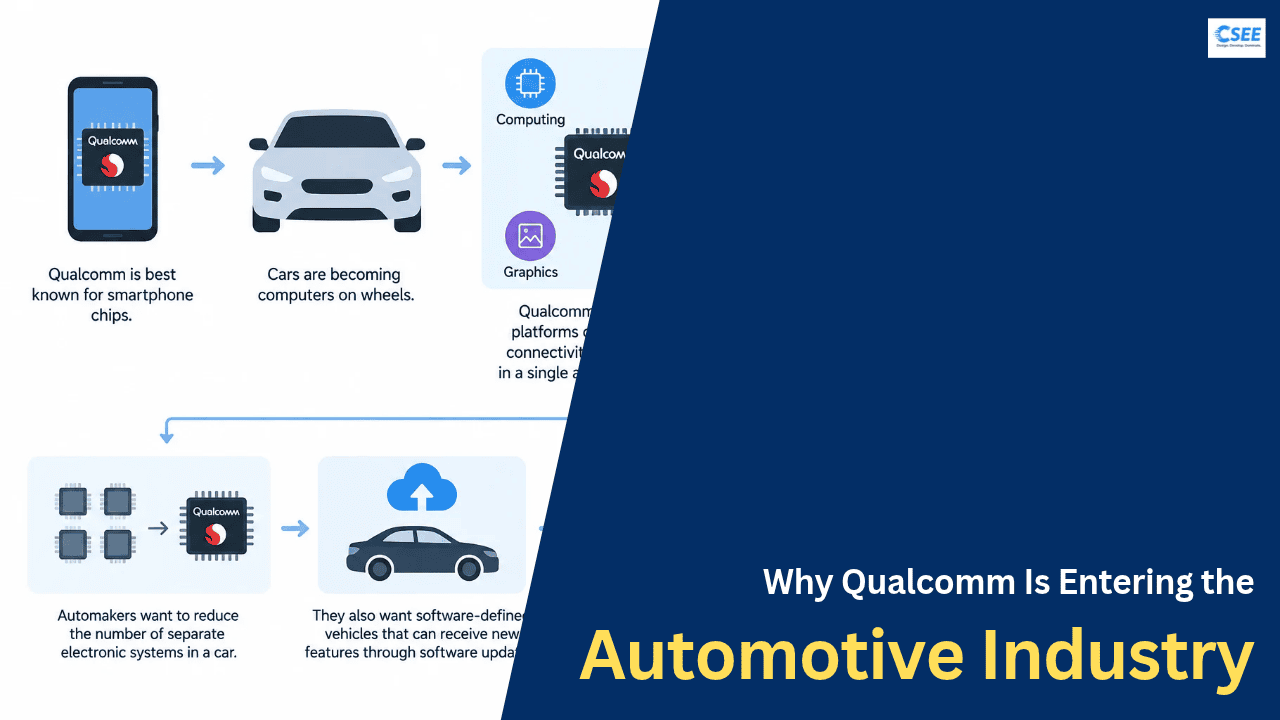
Cars are turning into computers on wheels. The company that taught the world’s phones to compute, connect and run AI efficiently now wants to do the same for vehicles.
1. The car becomes a computer
For a century, a car’s value came from its engine, chassis and build quality. Electronics were supporting actors: a radio, a few sensors, an engine controller. Today the balance has flipped. Screens, voice assistants, navigation, safety cameras, radar, battery management and over-the-air features define how a car feels and how it ages.
That shift creates a new customer need: lots of efficient, reliable computing inside a very small power and thermal budget. This is exactly the problem Qualcomm has solved for over a decade in smartphones, where a chip must run graphics, video, AI, cellular and Wi-Fi without overheating or draining a battery.
2. From many boxes to a few computers
Traditionally a car held dozens, sometimes well over a hundred, small electronic control units (ECUs), each from a different supplier with its own software. This is costly, heavy, hard to update and hard to secure. Automakers now consolidate functions into a handful of powerful domain or zonal computers.
| Aspect | Traditional car | Software-defined car |
|---|---|---|
| Electronics | Many single-purpose ECUs | Few high-performance computers |
| Software | Fixed at the factory | Updated over the air |
| Features | Bought with the car | Added, improved or subscribed later |
| Supplier model | Box-by-box sourcing | Platform plus software ecosystem |
| Value over time | Declines with age | Can improve with updates |
3. What Qualcomm brings to the table
Qualcomm’s advantage is that one family of silicon can span the major compute needs of a vehicle. Its automotive offering is branded the Snapdragon Digital Chassis, a set of platforms that work together or independently.
| Pillar | What it does | Why it matters |
|---|---|---|
| Cockpit | Runs infotainment, instrument cluster, voice and passenger screens | Smooth, phone-like experiences and on-device AI assistants |
| Ride | Processes camera, radar and other sensor data for driver assistance | Safety features and a path toward more automation |
| Auto Connectivity | Cellular, Wi-Fi, Bluetooth, satellite and precise positioning | Always-connected cars and reliable data links |
| Car-to-Cloud | Supports remote updates, activation of features and diagnostics | New revenue and lifetime improvement for automakers |
Why phone DNA transfers well
- Power efficiency: mobile chips are designed to do heavy work on tight energy budgets, helpful for electric vehicle range.
- Integrated modem: Qualcomm is a leader in cellular technology, a natural fit for connected cars.
- AI on device: neural processing units run voice, vision and driver monitoring locally, with low latency.
- Graphics: high-resolution, multi-screen cockpits depend on strong GPUs.
- Fast cadence: consumers expect car screens to feel as fresh as their phones.
4. The software-defined vehicle loop
A software-defined vehicle (SDV) is one where features are largely controlled by software that can change after sale. Powerful, centralized silicon makes this possible, because new code needs spare compute and a connected pipeline to arrive.
5. Why automakers want this
Most automakers cannot build advanced chips themselves, and few want to depend on one rigid supplier stack. A chip platform paired with open tools lets them differentiate in software while buying proven silicon.
6. The scale of the opportunity
Chips and electronics have become a bigger share of the cost of a vehicle each year. The bars below are an illustrative picture of how that share rises, not audited figures.
For Qualcomm, cars offer long product lifecycles and design wins that can last for years, balancing the cyclical smartphone market. The company has described a large multi-year pipeline of automotive business and treats the segment as one of its main growth areas beyond phones.
7. Customers and partners
Qualcomm works with many major automakers and suppliers across regions, including well-known global and Chinese brands. Collaborations differ: some use only the cockpit platform, others add connectivity or driver-assistance chips. Exact details change often, so consult official announcements for any specific vehicle.
| Partner type | Role | Example value |
|---|---|---|
| Automakers | Use Snapdragon in cockpit, connectivity or ADAS | Brand-specific digital experience |
| Tier-1 suppliers | Build modules and domain controllers | Faster path to production |
| Software companies | Provide operating systems, maps, voice and apps | Richer features on one platform |
| Cloud providers | Back-end services and update delivery | Scale for fleet management |
8. The competitive field
| Competitor | Strength | Challenge for Qualcomm |
|---|---|---|
| NVIDIA | High-end AI and autonomous driving compute | Strong brand in advanced driving |
| Mobileye | Vision-based driver assistance, huge installed base | Established in safety features |
| Traditional auto chipmakers | Long relationships, microcontrollers | Deep trust with carmakers |
| In-house automaker chips | Full vertical control | Some firms design their own silicon |
| Other mobile and regional chip firms | Local and cost advantages | Price and regional preference |
9. Risks and challenges
- Safety and reliability: automotive chips must meet strict functional safety and long-life standards.
- Long cycles: a design win may take years to reach production.
- Automaker uncertainty: slower electric vehicle demand and changing plans can delay launches.
- Software complexity: consolidation projects have been difficult for many automakers.
- Geopolitics and supply chains: export rules and regional preferences shape who can sell what and where.
- Regulation: automated driving rules vary by country and evolve slowly.
10. What to watch next
- Wider adoption of central compute that merges cockpit and driver assistance on fewer chips.
- On-device generative AI assistants in cars.
- Growth of subscription features enabled by over-the-air updates.
- Progress of driver-assistance deployments beyond premium models.
- How automakers balance buying platforms against building their own.
This page is an educational overview. Market shares, partner lists and product specifications change quickly; verify against official company statements.