Why Intel Lost Its Lead
For about forty years, Intel set the pace of the computer industry. Then its factories stumbled, its rivals specialised, and the market moved to chips Intel did not dominate. This is how a king lost the throne, and what it would take to win it back.
The short answer
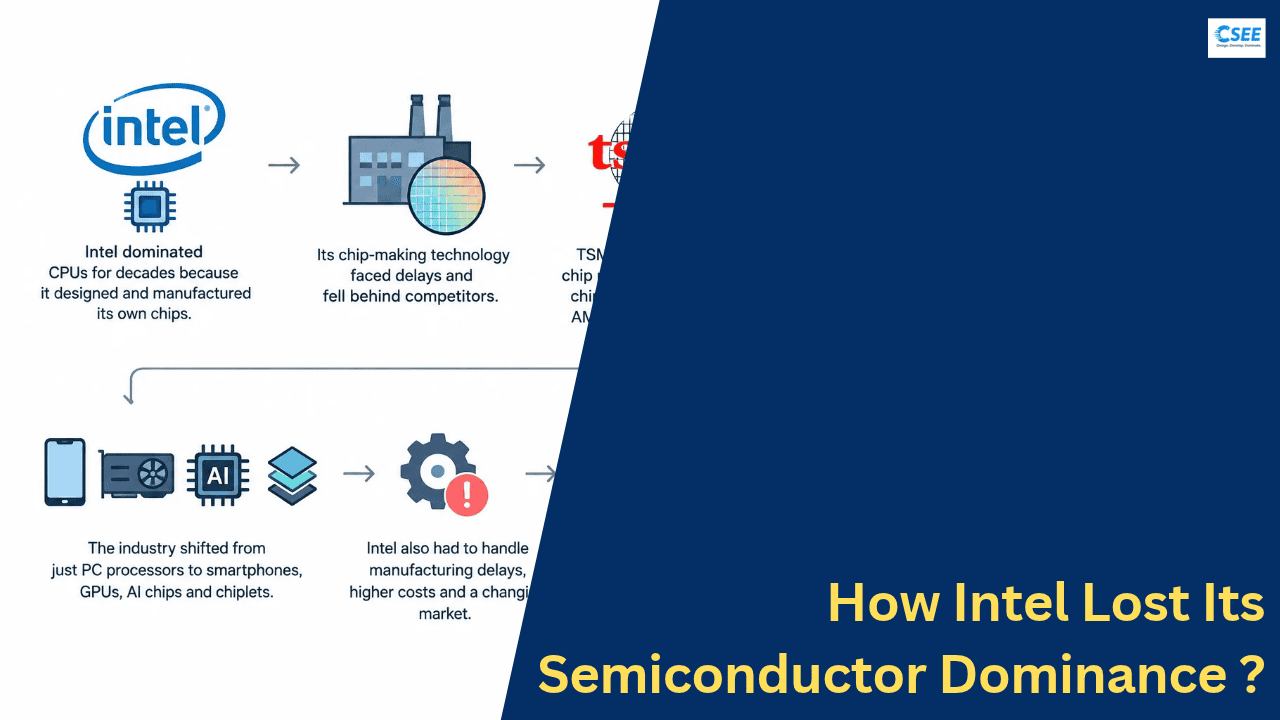
Intel did not lose because it stopped being smart. It lost because several things went wrong together. Its manufacturing, which was its biggest advantage, slipped badly. Rivals found a better division of labour, where one company designs and another manufactures. And the industry’s growth moved from PC processors to phones, graphics chips and AI, areas where Intel was weak.
How Intel became king
Intel was founded in 1968 and made its name first in memory chips, then in microprocessors. The decisive moment came when IBM chose an Intel processor for its Personal Computer in 1981. Because Microsoft’s software ran on it and other makers copied the IBM design, the “x86” architecture became the standard of the PC world. The pairing of Windows and Intel, often called “Wintel,” locked in a huge ecosystem of software and hardware.
Intel then added a second advantage: manufacturing leadership. Under the idea known as Moore’s Law (named for Intel co-founder Gordon Moore), the number of transistors on a chip roughly doubles every couple of years. Intel kept pace with this better than anyone. For decades it was ahead of the rest of the industry in making transistors smaller, and it was an integrated device manufacturer, or IDM. That means it designed its chips and built them in its own factories, which it called fabs.
This worked beautifully. Intel’s chips were faster because its factories were better, and its profits paid for the next generation of factories. Competitors who tried to match it either fell behind or exited the business. By the 2000s Intel supplied the large majority of processors in PCs and servers, and its profit margins were the envy of the industry.
The fabless revolution: TSMC changes the game
In 1987, Morris Chang founded TSMC (Taiwan Semiconductor Manufacturing Company) with a radical idea. TSMC would never design chips of its own. It would only manufacture chips for other companies. This is called the foundry model. Designers who owned no factories, known as “fabless” companies, could now exist. NVIDIA, Qualcomm, AMD (after it spun off its factories), Apple’s chip team and many others took this route.
The effect was powerful. Building a leading-edge factory costs well over ten billion dollars. Intel had to fill its factories with its own products. TSMC could fill its factories with orders from dozens of customers at once, including the largest phone maker in the world. That meant more volume, more practice on each new process, and more money to reinvest. Over two decades, the foundry pooled the industry’s demand while Intel carried its own cost alone.
The manufacturing stumble
Intel’s trouble became visible around its 10nm process. Intel had been shrinking transistors on a steady rhythm, often called “tick-tock,” but 10nm was meant to be a very large jump, relying on aggressive techniques that proved hard to make work at volume. It was originally planned for around 2015. Intel’s first meaningful 10nm chips arrived only years later, and mass production came much later than planned. For several years Intel kept refining its older 14nm process, releasing one similar-looking generation after another.
Meanwhile TSMC kept moving on schedule. By the time Intel’s 10nm was ramping, TSMC was already shipping 7nm and soon 5nm chips in volume. A key part of the story is a technology called EUV (extreme ultraviolet) lithography. TSMC adopted EUV in a staged, careful way and made it work. Intel was slower to commit to EUV, and later admitted its earlier approach to 10nm and 7nm had been too ambitious and too reliant on older methods.
The lesson is that process names stopped being reliable numbers. “7nm” at TSMC and “10nm” at Intel were in several respects comparable. Intel later renamed its processes (Intel 7, Intel 4, Intel 3, 20A and 18A) to match the industry’s naming. But the damage was real: for the first time in decades, the best transistors in volume were not made by Intel.
| Period | Intel | TSMC | What it meant |
|---|---|---|---|
| Before ~2014 | Clear process leader | Follower, a few years behind | Intel’s chips led on both design and manufacturing |
| ~2015 to 2019 | 10nm delayed, 14nm reused | Ramps 10nm then 7nm on time | The lead disappears |
| ~2020 to 2022 | Intel 7 ships, 7nm-class delayed again | 5nm in volume with Apple | TSMC clearly ahead |
| ~2023 to 2025 | Intel 4 and 3 launched, 18A in development | 3nm in volume, 2nm coming | Intel narrows the gap but TSMC still leads in volume |
Why a self-manufacturing company suffers more
When TSMC stumbled on a process, its customers could sometimes adapt. When Intel’s factories stumbled, Intel’s own products stalled with them, because designs were tied to specific processes. A chip planned for a process that is not ready cannot simply be moved elsewhere. Intel’s design teams and fab teams were so tightly coupled that a problem on one side became a delay on the other.
Fabless rivals had a freedom Intel did not. AMD, once it no longer owned factories, could pick the best available manufacturer. After 2018, that meant TSMC. AMD’s designers could focus entirely on architecture. Intel, by contrast, had to make its products work on its own processes even when those processes were behind. That is a meaningful handicap when the factory is the weak link.
| Integrated (Intel) | Fabless (AMD, NVIDIA, Apple) | |
|---|---|---|
| Strength | Design and process tuned together | Can use the best factory available |
| Weakness | Factory delay becomes product delay | Depends on one or two foundries |
| Capital needs | Enormous, borne alone | Much lower |
| Speed of change | Slower, large organisation | Faster, focused on design |
AMD: the rival that came back
By the mid-2010s AMD was widely written off. Its processors lagged, and it was close to financial trouble. Under CEO Lisa Su, who took charge in 2014, the company bet on a new architecture called Zen, launching as Ryzen in 2017. Zen delivered strong performance at competitive prices and gave buyers a real alternative for the first time in years.
AMD’s second masterstroke was the “chiplet” design. Instead of one huge chip, AMD built processors from smaller pieces joined together. Small pieces are easier and cheaper to manufacture with fewer defects, and they could be built on TSMC’s best process. Combined with TSMC’s manufacturing lead, this let AMD’s EPYC server chips take share in data centres, a market where Intel had once held almost everything. Intel’s share of server processors fell noticeably from its peak, though it still held a majority for years afterwards.
Apple and the mobile miss
The biggest strategic mistake may have come earlier. When Apple was developing the first iPhone, it reportedly approached Intel about supplying the processor. Intel’s leadership at the time reportedly declined, judging the volumes and margins unattractive. Instead the iPhone used an Arm-based chip, and the mobile era was built on Arm designs, manufactured eventually by TSMC and Samsung. Intel’s attempt to enter phones with its Atom chips failed, and it exited the market around 2016.
Apple then built its own chips and grew into the world’s most sophisticated chip designer. In 2020 it began moving Mac computers off Intel to its own M-series chips, made by TSMC. This was a double blow: Intel lost a prestigious customer and the Mac proved that Arm-based designs could be both fast and extremely power efficient in laptops, long Intel’s stronghold.
NVIDIA and the AI wave
NVIDIA began as a maker of graphics chips for gaming. A graphics processor, or GPU, does many simple calculations at once. In 2006 NVIDIA released CUDA, a software platform that let developers use GPUs for general computing. That seemed like a niche at the time. But training neural networks turns out to be exactly the kind of work GPUs do well. When deep learning took off in the 2010s, and then exploded with large language models after 2022, NVIDIA was ready with hardware, software and a decade of developer loyalty.
Intel’s own efforts in this area did not succeed. Its “Larrabee” graphics project in the late 2000s was cancelled as a graphics product. It bought AI chip startups, including Nervana and Habana, but its AI accelerators gained limited traction against NVIDIA. NVIDIA’s valuation rose to become one of the largest of any company in the world, far above Intel’s. The central point is that AI data centres now spend heavily on accelerators, and the CPU, Intel’s specialty, became the supporting part rather than the star.
| Company | Model | Core strength | Who makes its chips |
|---|---|---|---|
| Intel | Design and manufacture | x86 CPUs, deep customer base | Mostly itself, some TSMC |
| AMD | Fabless | CPUs and GPUs, chiplets | TSMC |
| NVIDIA | Fabless | AI GPUs and CUDA software | TSMC |
| Apple | Fabless (own use) | Efficient Arm chips | TSMC |
| TSMC | Pure foundry | Leading-edge manufacturing | Itself |
| Samsung | Both | Memory, some foundry work | Itself |
Culture, leadership and money
Several softer causes also mattered. For years Intel’s profits were so high that the company could afford to be comfortable. Critics describe a culture that grew complacent and slow to admit problems, with engineering issues taking too long to rise to decision-makers. Leadership turned over often. Bob Swan, a finance executive, led the company from 2019 to 2021, and many observers felt Intel needed a technologist at the helm.
Intel also spent heavily on share buybacks and dividends during years when it might have invested more in factories and new technology. Over time its cash flow weakened as its products lost ground, which made the necessary investments harder to finance. This is the dark side of the loop shown earlier: when it runs backwards, lower sales mean less money for fabs, which means weaker products.
The turnaround attempt
In February 2021, Pat Gelsinger, a longtime Intel engineer who had left for VMware, returned as CEO. His plan, called IDM 2.0, had three parts: keep building most Intel products in-house, use outside foundries like TSMC where it made sense, and open Intel’s factories to other customers as Intel Foundry. He promised “five nodes in four years,” a rapid sequence of new processes ending with 18A.
Intel started big projects in Arizona, Ohio, Ireland and Germany, helped by the US CHIPS Act, which offered billions of dollars in support. But Intel’s financial results weakened, and costs rose. In late 2024 Gelsinger left, and in March 2025 Lip-Bu Tan, an experienced semiconductor investor and former Cadence CEO, became CEO. He focused on cutting costs, trimming layers of management and sharpening the foundry strategy. In 2025 the US government took an equity stake in Intel, and large investments were reported from SoftBank and from NVIDIA, signs of how strategically important the company had become.
| Pillar of the plan | What it involves | Main risk |
|---|---|---|
| Process catch-up | Intel 3, 20A and 18A, with new transistor and power delivery designs | More delays or low yields |
| Intel Foundry | Making chips for outside customers | Winning trust and large orders from rivals |
| Product recovery | Competitive laptop, desktop and server chips | AMD and Arm gaining share |
| Government and partners | CHIPS Act funds, equity investors | Dependence on outside support |
| Cost discipline | Layoffs, slower building plans | Losing talent and momentum |
The technology bet: 18A
Intel’s most important comeback card is 18A. It introduces two technologies. RibbonFET is Intel’s version of gate-all-around transistors, which control current more precisely than older FinFET designs. PowerVia moves power wiring to the back of the chip, freeing space on the front for signals. Intel pushed to be first to bring backside power delivery to market. If 18A performs as promised, it could bring Intel close to or level with TSMC’s best offerings on some measures. Whether yields and costs are good enough is the critical question, and it can only be answered by high-volume production.
The foundry challenge
Building leading-edge factories is only half the job. A foundry must also win customers, and that requires trust. Chip designers need to know that their secrets are safe, that tools and design kits work smoothly, and that deliveries are on time. TSMC has built that reputation over decades. Intel Foundry must build it from scratch, and it must do so while Intel’s own product group competes with the very customers it hopes to serve.
Intel has taken steps such as separating its foundry business more clearly in its accounts, and it has worked on tools and partnerships with design software companies. Early customers and commitments have been reported, but the big prize, a major order from a company like Apple, NVIDIA or AMD on a leading process, is what would prove the case.
Can Intel lead again?
It depends what “lead” means. Intel is unlikely to return to the all-encompassing dominance of the 1990s and 2000s. The industry is wider now, and NVIDIA, TSMC, Apple and Arm have strong positions. A more realistic aim is to become a credible second source for leading-edge manufacturing, to hold a healthy share of PC and server CPUs, and to find a role in the AI era.
Reasons for optimism
- Intel still has deep manufacturing know-how, a vast installed base, and the biggest x86 software ecosystem.
- Governments in the US and Europe want chip production outside East Asia, which brings funding and political backing.
- Customers are wary of depending on one foundry in one region, so a second option has real value.
- New technologies such as backside power could give a real edge if executed well.
Reasons for caution
- Intel has missed process promises before, and trust is slow to rebuild.
- TSMC is not standing still, and keeps investing at huge scale.
- Foundry profits depend on big external customers who have not yet fully committed.
- Debt, cash flow pressure and executive turnover limit room for mistakes.
| Scenario | What happens | Signals to watch |
|---|---|---|
| Strong comeback | 18A and later nodes ship on time with good yields, and major outside customers sign on | Named flagship foundry customers, rising foundry revenue |
| Slow recovery | Intel stays a solid CPU maker, with a smaller foundry that serves niche and government needs | Modest customer wins, continued losses at foundry |
| Further decline | Process problems repeat, and Intel relies more on TSMC and outside support | More delays, cancelled fabs, falling share |
Key lessons
- Manufacturing is a moving target. A lead of ten years can vanish in three if a major process transition fails.
- Specialisation can beat integration. When rivals split design from manufacturing, each side improved faster.
- Markets shift under your feet. Declining to chase phones and being late to AI left Intel strong in a market that grew slowly.
- Comfort is risky. High profits can hide slow decision-making until a rival exposes it.
Conclusion
Intel’s fall from the top was not caused by a single blunder. It was the compounding of delayed factories, a rival manufacturing model that scaled better, missed opportunities in phones and AI, and an organisation that took too long to change. Its comeback is possible, but it rests on one hard thing above all: delivering leading-edge manufacturing, repeatedly, on schedule, and earning the trust of customers who are also its competitors. Over the next few years, each new process and each new foundry customer will show whether Intel is rebuilding its throne or settling into a different role in a more crowded industry.