For nearly a decade, artificial intelligence conferences around the world have followed a predictable pattern. Companies presented impressive demonstrations, research labs discussed benchmarks, and keynote speakers described a future where machines would transform everything from transportation to medicine. The audience applauded, headlines celebrated technological progress, and then most people returned to lives that looked largely unchanged.
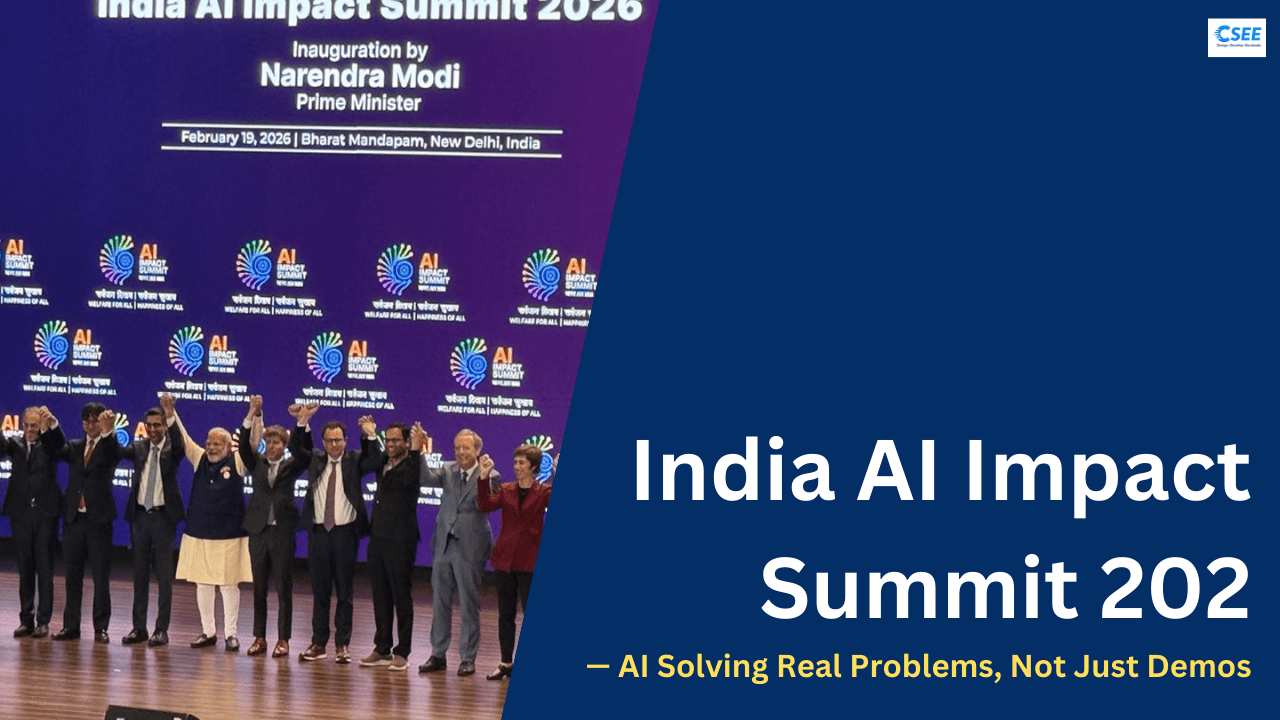
The India AI Impact Summit 2026 represented a noticeable departure from that pattern.
Instead of focusing primarily on what artificial intelligence might achieve someday, the discussions and exhibitions centered on systems already operating in real environments — schools, hospitals, farms, factories, and public offices. The emphasis was not intelligence in abstraction but intelligence embedded into infrastructure. Many solutions were designed for conditions that differ significantly from the environments where most global AI products originate: inconsistent connectivity, dozens of spoken languages, uneven access to trained professionals, and extremely large user populations interacting with government and financial services simultaneously.
The central theme emerging across demonstrations was straightforward: usefulness before sophistication. Several models were intentionally smaller than global frontier systems because they needed to run on low-power devices. Others sacrificed visual polish to ensure reliability in dusty outdoor environments. Some focused less on creative generation and more on structured reasoning and verification. The objective was not novelty but dependable operation under constraints.
This shift also reflected a broader change in how AI development was being measured. Rather than counting parameters or benchmarking leaderboard scores, many teams evaluated success using operational metrics: reduction in waiting time, increased service access, earlier diagnosis, lower training cost, or fewer manual errors. These indicators tied AI progress directly to measurable improvements in daily processes.
The first set of innovations presented at the summit illustrates this philosophy clearly.
1. BharatGen — Multilingual Public Service AI
Organization: Government-supported consortium led by IIT Bombay
One of the most persistent barriers to digital adoption in India has been language. While urban users often interact comfortably with English interfaces, a large majority of citizens prefer regional languages in everyday communication. Traditional translation systems frequently struggle with dialect variations, mixed vocabulary, and context-dependent meaning, leading to confusion in official processes such as applications, banking instructions, or legal notices.
BharatGen was developed specifically to address this structural limitation. Instead of treating translation as a secondary feature layered onto an English-centric model, the system was trained from the beginning on parallel linguistic structures across multiple Indian languages. This allowed it to interpret intent rather than merely substitute words.
In practice, the system functions as a conversational interface for public services. A farmer can ask about subsidy eligibility in a local dialect and receive a step-by-step explanation. A citizen can dictate a grievance verbally and obtain a formatted submission document. Importantly, responses are generated in administrative language aligned with official records, reducing rejection rates caused by formatting errors.
The significance lies less in linguistic novelty and more in administrative accuracy. Early pilots demonstrated that applications prepared through the system required fewer corrections by government clerks, reducing both processing time and travel requirements for applicants.
2. Sarvam AI — Voice-First Digital Interaction
Organization: Sarvam AI
While multilingual text interfaces improve accessibility, literacy and typing familiarity remain obstacles for many users. Sarvam AI approached this challenge by designing a voice-native interaction layer rather than adapting speech recognition to existing graphical interfaces.
The platform interprets natural spoken instructions and converts them into structured actions across multiple services. For example, a user can state a request to update an address in a banking profile, and the system verifies identity, fills digital forms, and confirms completion verbally.
A notable engineering decision was the prioritization of low-bandwidth functionality. The models operate with compressed representations that can function on entry-level smartphones. Partial processing occurs locally on the device, reducing dependency on continuous high-speed internet.
In trials conducted with rural service centers, operators reported that users who had never previously navigated digital menus could complete transactions independently after brief guidance. The improvement was not only technological but behavioral: individuals who depended on intermediaries began interacting directly with services.
3. Gnani.ai — Automated Multilingual Customer Support
Organization: Gnani.ai
Customer support infrastructure in large populations faces scale challenges. Call centers often experience surges in demand during billing cycles, service outages, or policy changes. Hiring and training enough human agents for every language combination becomes operationally expensive and leads to long waiting times.
Gnani.ai developed conversational voice agents capable of handling routine inquiries across multiple languages and accents. Unlike earlier automated menus that relied on rigid option trees, these agents interpret open-ended questions and guide conversations dynamically.
The system integrates with organizational databases, enabling it to retrieve account information, log complaints, schedule technician visits, and provide status updates. Escalation to human agents occurs only when ambiguity or emotional distress is detected.
Deployment in telecom and financial institutions showed a measurable reduction in average call handling time and a decrease in queue length. Human agents were then reassigned to complex cases requiring negotiation or judgment, improving service quality rather than replacing staff entirely.
4. SATHEE — AI Assisted Education Support
Organization: IIT Kanpur
Educational inequality often arises not solely from curriculum availability but from mentorship access. Competitive examinations reward consistent feedback and doubt resolution, something that expensive coaching centers provide but many students cannot afford.
SATHEE functions as a continuous study companion. Students upload questions or describe confusion verbally, and the system explains concepts step by step, adapting explanation depth to prior responses. Instead of giving final answers immediately, it encourages incremental reasoning, mirroring teacher-student interaction.
A distinctive feature is performance tracking across topics. The system identifies recurring mistakes and suggests revision sequences rather than random practice. Teachers in participating schools used it to supplement classroom teaching, assigning targeted exercises based on aggregated class weaknesses.
Early results indicated improved conceptual retention compared to passive video lectures because students engaged in interactive clarification rather than one-directional consumption.
5. Intellihealth Neuro-Diagnostic AI
Organization: Intellihealth
Access to neurological specialists remains limited outside major cities. Conditions such as epilepsy or early cognitive disorders often require repeated observation before confirmation, delaying treatment.
Intellihealth created an AI system that analyzes electroencephalogram recordings to detect abnormal patterns associated with neurological conditions. The goal is not autonomous diagnosis but early screening. Local clinics capture readings, and the system flags anomalies requiring specialist attention.
By filtering normal cases from suspicious ones, the workload of urban specialists decreases, allowing them to focus on patients most likely to need intervention. More importantly, patients in remote areas receive referral recommendations earlier, reducing untreated progression.
The approach demonstrates how AI can extend specialist reach rather than attempting to replace clinical expertise.
6. Wadhwani AI — Population-Scale Decision Support
Organization: Wadhwani AI
Several sectors share a common constraint: decisions must be made frequently by frontline workers who may not have extensive training. Health workers identifying disease symptoms, agricultural officers advising crop management, and local administrators allocating resources all operate under time pressure.
Wadhwani AI built domain-specific decision support tools tailored to these environments. For instance, community health workers can photograph a medical indicator and receive probability-based guidance on whether escalation is necessary. Agricultural advisors receive yield predictions based on localized weather and soil conditions.
The systems emphasize interpretability. Instead of opaque predictions, they provide reasoning summaries explaining which factors influenced recommendations. This transparency increases trust among users who rely on them during fieldwork.
In pilot districts, the tools helped standardize responses across different regions, reducing variability caused by experience gaps.
7. Fractal Analytics — Structured Reasoning for Enterprise Decisions
Organization: Fractal Analytics
Modern organizations collect large volumes of operational data, yet decision-making often still depends on manual analysis and subjective interpretation. Managers interpret dashboards, compare reports, and rely on experience to determine actions. The challenge is not data absence but the difficulty of consistently deriving correct conclusions.
Fractal Analytics introduced a reasoning-oriented AI system designed to evaluate structured business data and recommend actions. Unlike predictive dashboards that display trends, the system produces decision pathways. For example, if sales drop in a region, it traces relationships among supply delays, seasonal demand variation, and pricing changes before suggesting corrective steps.
The reasoning process is explicitly documented so that managers understand why a recommendation exists. This transparency addresses one of the largest barriers to AI adoption in enterprises: reluctance to trust automated suggestions without explanation.
In pilot deployments, organizations reported faster planning cycles because teams spent less time interpreting data and more time evaluating options generated by the system.
8. Zenteiq BrahmAI — Engineering Simulation Acceleration
Organization: Zenteiq
Engineering research frequently relies on simulation models to test designs before manufacturing. However, complex simulations require significant computational time. Testing many variations becomes impractical, forcing engineers to limit exploration and potentially miss optimal solutions.
Zenteiq’s BrahmAI platform applies machine learning to approximate simulation outcomes. After training on a subset of precise simulations, the system predicts results for new design variations in seconds rather than hours. Engineers then perform full simulations only on promising candidates.
This approach reduces development cycles in sectors such as automotive components, electronics cooling systems, and structural materials. Instead of replacing engineering calculations, the AI functions as a filter that narrows the search space.
The impact is subtle but substantial: innovation speed increases because experimentation becomes affordable.
9. Genloop — Offline Small Language Models
Organization: Genloop
Many AI applications assume stable internet access, but numerous industrial and rural environments operate with intermittent connectivity. Cloud dependence can halt operations if networks fail.
Genloop developed compact language models optimized for local execution on edge devices. These models perform tasks such as document classification, safety checklist verification, and local translation without contacting remote servers.
An example deployment involved inspection teams documenting infrastructure conditions. Previously, workers captured photos and notes to upload later for analysis. With on-device AI, reports were categorized immediately, highlighting urgent cases before workers left the site.
Offline capability transforms AI from a convenience to a reliability tool. It ensures functionality under unpredictable network conditions.
10. Shodh AI — Material Discovery Assistance
Organization: Shodh AI
Material science advances often depend on trial-and-error experimentation. Researchers test combinations of chemical compositions and manufacturing processes, recording results and adjusting parameters gradually. The process can take years before a stable improvement emerges.
Shodh AI built a recommendation engine that analyzes experimental outcomes and suggests promising parameter combinations. Instead of randomly exploring possibilities, laboratories prioritize tests predicted to yield useful properties such as improved battery capacity or durability.
The system learns continuously as researchers input results, refining suggestions over time. Rather than replacing scientific judgment, it accelerates iteration by reducing redundant experiments.
Laboratories using the platform reported shorter development cycles and more focused research pathways.
11. Cropin — Predictive Agricultural Intelligence
Organization: Cropin
Agriculture operates under uncertainty: weather variability, soil differences, pest outbreaks, and market fluctuations influence outcomes. Farmers traditionally rely on seasonal experience, which may not reflect changing environmental patterns.
Cropin provides predictive insights by combining satellite imagery, historical weather data, and field observations. The system estimates crop health, yield probability, and irrigation requirements at specific locations.
Advisors and cooperatives use these insights to plan resource allocation and recommend timely interventions. Farmers receive guidance about fertilizer application and harvest timing.
The value lies not in replacing farming knowledge but in updating it with continuously updated environmental context.
12. Niramai — Thermal Imaging Health Screening
Organization: Niramai
Early detection of certain medical conditions can significantly improve outcomes, yet regular screening programs are difficult to implement widely due to equipment cost and specialist requirements.
Niramai developed a non-invasive thermal imaging analysis system that identifies abnormal heat patterns associated with potential health concerns. The technology allows screening camps to operate without large imaging machines or specialized facilities.
Healthcare workers capture thermal images using portable equipment, and the AI highlights cases requiring further medical evaluation. Because the process is quick and comfortable, participation rates increase compared to conventional methods.
The approach demonstrates how AI can enable preventive healthcare by making screening logistically feasible.
13. L&T Smart Traffic AI — Adaptive Urban Mobility
Organization: Larsen & Toubro Smart World & Communication
Urban traffic congestion is often managed through fixed signal timings based on historical assumptions. However, real traffic conditions vary minute by minute due to accidents, weather, or temporary road closures. Static timing leads to inefficient flows and unnecessary waiting.
The adaptive traffic platform developed by Larsen & Toubro processes live camera feeds and sensor data to adjust signal durations dynamically. When a junction begins to accumulate vehicles from a particular direction, the system redistributes green time accordingly.
Unlike traditional centralized control rooms requiring manual adjustments, the AI operates continuously. Traffic officers supervise rather than micromanage the network.
Cities piloting the system reported smoother vehicle movement and reduced idle time, demonstrating how incremental optimization across many intersections significantly improves overall mobility.
14. Staqu — Public Safety Video Analytics
Organization: Staqu Technologies
Monitoring large public areas such as stations, markets, and event venues requires attention across hundreds of video streams simultaneously. Human operators inevitably miss events due to fatigue and cognitive overload.
Staqu developed video analytics software capable of detecting predefined behaviors such as unattended objects, restricted-area entry, or unusual crowd movement patterns. Alerts are generated in real time for security personnel to verify.
The goal is not autonomous enforcement but prioritization of attention. Operators review only flagged situations instead of continuously watching every screen.
In deployments across transport hubs and municipal zones, response time to incidents decreased because staff focused on probable risks rather than scanning uneventful footage.
15. Razorpay Fraud Detection AI — Transaction Risk Analysis
Organization: Razorpay
Digital payments operate at enormous transaction volumes, making manual verification impossible. Fraud detection systems must identify suspicious patterns without blocking legitimate activity.
Razorpay built a machine learning framework analyzing transaction behavior across multiple dimensions such as timing irregularities, device characteristics, and unusual purchase patterns. Each transaction receives a risk score in milliseconds.
High-risk transactions trigger additional verification steps while normal ones proceed uninterrupted. The balance between security and convenience is maintained by continuously learning from confirmed fraud cases.
The system illustrates how AI safeguards infrastructure that users rarely think about but depend on daily.
16. Qure.ai — Radiology Image Interpretation Support
Organization: Qure.ai
Hospitals frequently process large volumes of medical imaging scans. Radiologists must evaluate each image carefully, yet shortages can create delays, particularly in emergency settings.
Qure.ai developed an analysis system that reviews scans immediately after capture and highlights regions likely to contain abnormalities. Radiologists then prioritize those cases first.
This does not replace clinical review; instead, it functions as triage. Critical cases move to the front of the queue, improving response speed in urgent situations such as trauma assessment.
Hospitals using the system reported faster reporting turnaround times and improved allocation of specialist attention.
17. Blue Sky Analytics — Environmental Monitoring Intelligence
Organization: Blue Sky Analytics
Environmental monitoring typically relies on limited physical sensors, providing incomplete coverage across large geographic regions. Predicting air quality or pollution spread requires interpolation that may not capture local variations.
Blue Sky Analytics combined satellite observations with atmospheric models to generate high-resolution environmental indicators. Authorities and organizations use the data to plan outdoor activities, issue health advisories, and manage industrial operations.
The system transforms environmental awareness from retrospective reporting into proactive planning, allowing preventive measures rather than reactive restrictions.
18. Skymet Weather AI — Hyperlocal Forecasting
Organization: Skymet Weather Services
Weather forecasts often operate at regional scale, yet decisions such as irrigation, event scheduling, or logistics require location-specific predictions. Small differences in rainfall timing can alter outcomes significantly.
Skymet’s AI forecasting platform analyzes historical weather patterns, satellite imagery, and ground observations to produce localized predictions. Farmers adjust watering schedules, and event planners adapt arrangements based on expected conditions.
By increasing forecast granularity, the system reduces uncertainty in planning processes dependent on environmental conditions.
Conclusion — From Demonstrations to Dependable Systems
Across eighteen innovations, a consistent narrative emerged. Artificial intelligence was no longer presented primarily as a technological milestone but as an operational instrument. Each system targeted a constraint: language barriers, limited expertise, slow analysis, unpredictable conditions, or coordination complexity.
Another notable feature was restraint. Many developers deliberately avoided building unnecessarily large models when smaller specialized systems performed better in practice. Efficiency and reliability were prioritized over theoretical capability.
The summit therefore marked a transition in perspective. The question was no longer whether AI could achieve human-like performance in isolated tasks, but how it could quietly improve routine processes affecting millions of people. Instead of replacing human effort entirely, most solutions redistributed effort — automating repetitive observation while preserving human judgment where interpretation matters.
In earlier years, discussions about artificial intelligence often revolved around distant possibilities. At this summit, the conversation focused on maintenance schedules, queue lengths, learning gaps, and diagnosis delays. The technology had moved from spectacle toward infrastructure.
That shift may ultimately prove more significant than any single breakthrough model. When intelligence becomes embedded into everyday systems and evaluated by reliability rather than novelty, its influence expands gradually yet persistently. The India AI Impact Summit 2026 illustrated this change clearly: progress measured not by how impressive machines appear, but by how many problems quietly disappear.
Thanks for reading.
Also, read:
- “Mother of All Deals”: How The EU–India Free Trade Agreement Can Reshape India’s Economic Future
- 10 Free ADAS Projects With Source Code And Documentation – Learn & Build Today
- 10 Tips To Maintain Battery For Long Life, Battery Maintainance
- 10 Tips To Save Electricity Bills, Save Money By Saving Electricity
- 100 (AI) Artificial Intelligence Applications In The Automotive Industry
- 100 + Electrical Engineering Projects For Students, Engineers
- 100 GitHub Projects to Level Up Your Embedded Engineering Skills
- 100+ C Programming Projects With Source Code, Coding Projects Ideas