The global auto industry is racing toward a future dominated by electric vehicles, software-defined cars, and sleek, minimalist design. Flush door handles, electronic latches, and sensor-driven entry systems have become symbols of innovation. They look futuristic, improve aerodynamics, and fit perfectly into the “smart car” narrative. But progress often comes with blind spots. In March 2025, a tragic electric vehicle crash in China exposed one such blind spot in the most brutal way possible: when power fails, technology alone may not be enough to save lives.
This single incident triggered nationwide debate, regulatory action, and a fundamental rethink of how safety should be engineered in modern vehicles. By mandating mechanical door releases in all new cars starting 2027, China sent a strong message to automakers worldwide—no matter how advanced a car becomes, basic mechanical safety cannot be optional.
The Incident That Sparked Change
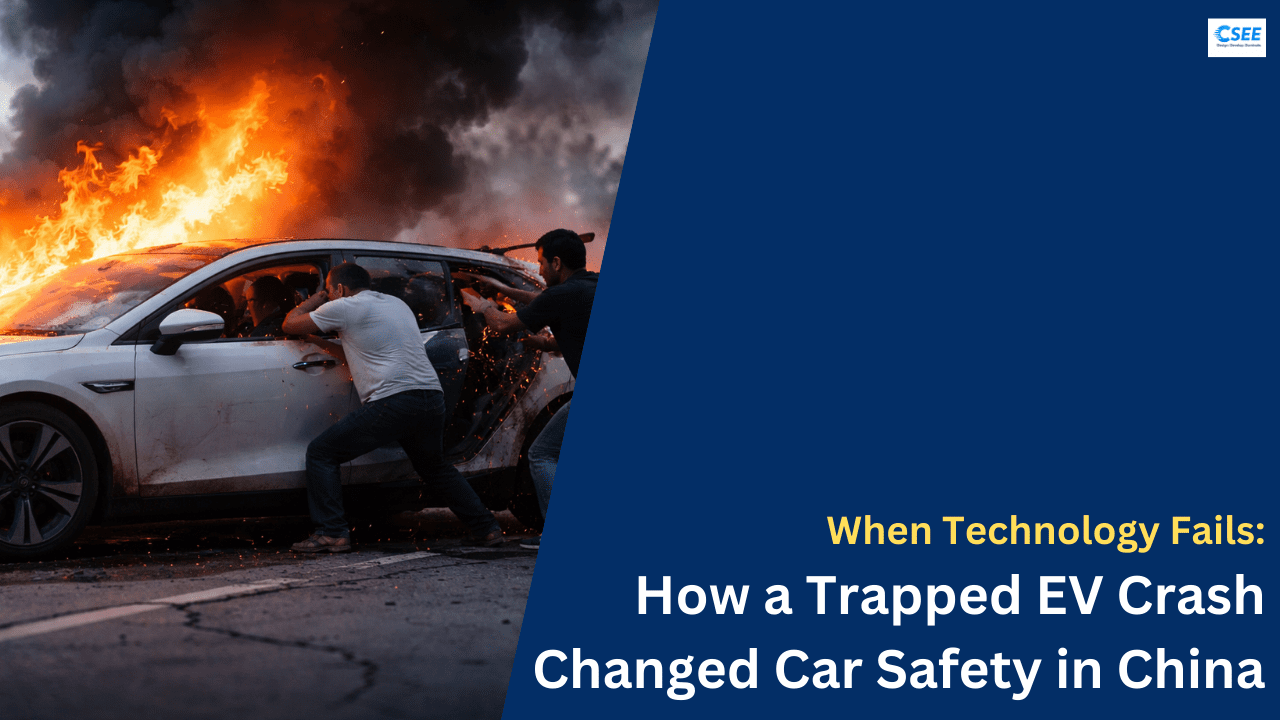
On March 19, 2025, an electric car was involved in a severe crash in China. The impact caused the vehicle to catch fire almost immediately. As flames spread, passengers tried to escape—but the electronic door systems failed. The doors jammed, likely due to power loss or damage to the electronic locking mechanisms.
Bystanders rushed to help and were forced to smash the windows to rescue those inside. Three passengers sitting in the back seats survived. Tragically, the front passenger did not manage to escape in time. According to reports, the inability to open the door quickly played a critical role in the outcome.
The incident was shocking not only because of the loss of life, but because it highlighted a terrifying scenario: a car that looks intact from the outside but becomes a sealed trap the moment electronics stop working.
Why Modern Cars Rely So Much on Electronics
To understand why this happened, it’s important to look at how modern vehicles are designed. Over the past decade, carmakers have steadily replaced mechanical components with electronic ones. Door handles that once relied on simple rods, springs, and cables are now connected to motors, sensors, and control units.
Manufacturers adopted electronic door systems for several reasons:
- Design freedom: Flush handles improve aesthetics and brand identity
- Aerodynamics: Reduced drag helps improve range in electric vehicles
- Smart features: Keyless entry, auto-locking, child safety logic, and theft prevention
- Integration with software: Doors can interact with crash sensors, alarms, and user profiles
In normal conditions, these systems work flawlessly. But in extreme conditions—crashes, fires, battery damage, or complete power loss—electronics can fail instantly. When that happens, a purely electronic door system becomes a single point of failure.
Fire, Power Loss, and the EV Reality
Electric vehicles introduce new safety challenges compared to traditional internal combustion engine cars. While EVs are statistically not more dangerous, the nature of battery fires and electrical systems changes the emergency timeline.
Lithium-ion battery fires can:
- Ignite rapidly after a severe impact
- Produce intense heat and toxic gases
- Cause electrical systems to shut down as a protective measure
In such moments, every second matters. If doors cannot be opened manually, occupants lose precious escape time. Emergency responders and bystanders also lose easy access, forcing them to break windows or cut through metal—actions that take time and increase risk.
Mechanical Backups: Old Technology, Proven Reliability
Mechanical door releases are simple by design. They rely on physical connections—cables, levers, or rods—that directly disengage the door latch. No electricity. No software. No sensors.
For decades, this simplicity saved lives. Even in severe crashes, as long as the door structure wasn’t crushed, occupants could usually force the latch open. The system might feel outdated compared to modern electronic solutions, but it has one unbeatable advantage: it works when everything else fails.
The problem isn’t electronic doors themselves—it’s the absence of a reliable mechanical backup that users can instinctively operate under stress.
The Government Steps In
Following the March 2025 crash and similar concerns raised by safety experts, China’s Ministry of Industry and Information Technology announced a decisive regulatory change.
Starting January 1, 2027, all new cars sold in China must be equipped with:
- Door handles that can be opened from inside and outside
- A mechanical release mechanism that works even if the vehicle has no power
This requirement applies to all vehicles, not just electric cars. The goal is simple: ensure that occupants and rescuers can always open a door using physical force, regardless of the vehicle’s electronic state.
Why This Rule Matters Beyond China
China is the world’s largest automotive market. Any regulation enforced at a national level there has global consequences. Automakers rarely design one version of a car for China and a completely different one for the rest of the world—doing so is expensive and inefficient.
As a result, this rule is likely to:
- Influence global vehicle design standards
- Push international regulators to review their own safety requirements
- Become a de facto global norm over time
History shows this pattern clearly. Seatbelts, airbags, ABS, and electronic stability control all followed similar paths—local regulation first, global adoption later.
Impact on Car Design and Engineering
For automakers, this change is not just about adding a lever. It requires rethinking door architecture, testing procedures, and user education. Engineers must ensure that mechanical releases:
- Are easy to find and use in panic situations
- Do not interfere with electronic systems
- Remain functional after crashes and deformation
- Cannot be accidentally triggered during normal driving
Design teams also face a challenge: how to integrate mechanical safety without compromising the clean, futuristic look that consumers expect. This tension between aesthetics and safety will shape vehicle interiors and exteriors for years to come.
Human Factors: Can Users Find the Release?
Another lesson from this incident is the importance of human-centered design. In several modern cars, mechanical backups already exist—but they are hidden, poorly labeled, or unfamiliar to users.
In an emergency, people don’t have time to think or search. Muscle memory matters. That’s why:
- Mechanical releases must be intuitive
- Instructions must be clear and standardized
- Drivers and passengers should be educated, just like seatbelt use
A safety feature that users don’t understand is almost as dangerous as not having one at all.
Lessons for the Software-Defined Vehicle Era
The auto industry is moving toward software-defined vehicles, where updates, features, and even behavior are controlled by code. This brings incredible flexibility—but also new risks.
The 2025 crash highlights a crucial principle:
Software should enhance safety, not replace physical fail-safes.
In aviation, railways, and industrial systems, redundancy is a core rule. Critical functions always have mechanical or independent backups. Cars, especially as they become more complex, must follow the same philosophy.
A Global Conversation on EV Safety
This incident has fueled discussions worldwide about EV safety standards. Engineers, regulators, and consumers are asking hard questions:
- Should all critical exit systems be mechanically redundant?
- How much automation is too much?
- Are design trends prioritizing looks over survival?
These are uncomfortable but necessary conversations. Progress without safety is not progress—it’s risk disguised as innovation.
What This Means for Consumers
For everyday drivers and passengers, the takeaway is clear:
- Learn how your car doors work
- Understand emergency release mechanisms
- Don’t assume technology will always protect you
As vehicles become smarter, consumers must also become more informed. Safety is a shared responsibility between manufacturers, regulators, and users.
Conclusion: The Value of Simple Solutions
The March 2025 crash was tragic, but its impact may save countless lives in the future. By mandating mechanical door releases, China acknowledged a fundamental truth: the simplest solutions are often the most reliable when everything goes wrong.
In a world obsessed with innovation, this regulation is a reminder that progress should not erase proven safety principles. Smart cars still need simple, physical backups. When fire breaks out, power is lost, and panic sets in, a mechanical handle can be the difference between escape and tragedy.
The future of mobility will be electric, connected, and intelligent—but it must also be human, intuitive, and safe at its core.
Thanks for reading.
Also, read:
- Why Qualcomm Is Entering the Automotive Industry
- The Memory Problem Behind AI Chips
- Why EUV Lithography Took Decades to Develop
- How Intel Lost Its Semiconductor Dominance
- Want To Crack Top Embedded Companies? Build These LLM Projects
- Why The Entire AI Industry Needs ASML
- CPU vs GPU vs NPU: Who Handles What?
- From Beginner to NVIDIA Data Analyst: A 6-Month Roadmap