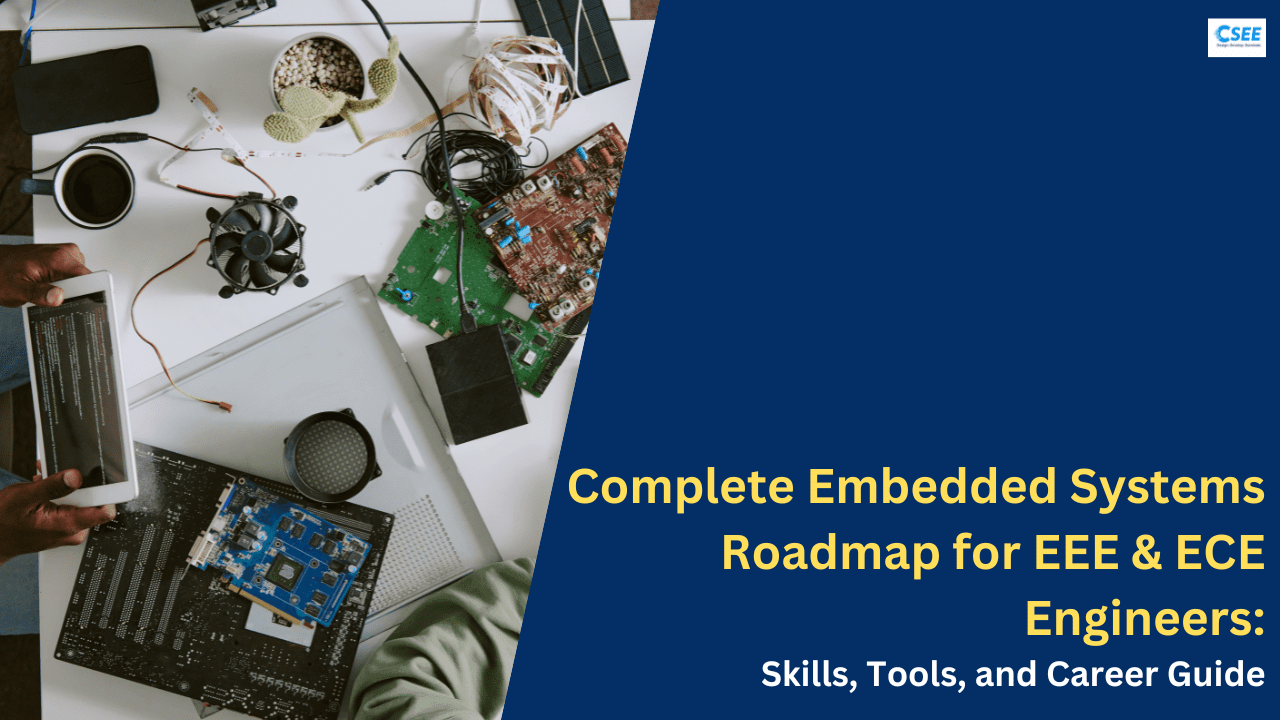
Embedded systems are the invisible backbone of the modern world. From smartphones, electric vehicles, and medical devices to satellites, industrial automation, and smart home appliances, embedded systems power almost everything around us. For students and professionals from Electrical and Electronics Engineering (EEE) and Electronics and Communication Engineering (ECE) backgrounds, embedded systems represent one of the most natural, stable, and high-impact career paths.
However, many EEE and ECE engineers feel confused or even discouraged when trying to enter the embedded domain. The industry demands practical skills, hands-on experience, and tool familiarity—things that traditional college curricula often fail to deliver deeply. This gap creates the illusion that “getting a core embedded job is very hard,” when in reality, it is about learning the right skills in the right order.
This comprehensive roadmap is designed to solve that problem. It provides a step-by-step, industry-aligned guide covering fundamentals, programming, hardware, software, tools, protocols, real-time systems, automotive and AI trends, and career strategies. Whether you are a student, fresher, or working professional, this roadmap will help you build a strong, job-ready embedded systems profile.
1. Understanding Embedded Systems: The Big Picture
Before diving into tools and programming, it is essential to understand what embedded systems actually are.
An embedded system is a combination of hardware and software designed to perform a specific function within a larger system. Unlike general-purpose computers, embedded systems are optimized for reliability, real-time performance, power efficiency, and cost.
Examples include:
- Engine Control Units (ECUs) in cars
- Washing machine controllers
- Pacemakers and medical monitors
- Industrial PLC controllers
- Smart meters and IoT devices
Key Characteristics of Embedded Systems
- Dedicated functionality
- Real-time constraints
- Limited memory and processing power
- High reliability and safety requirements
- Long product life cycles
For EEE and ECE engineers, embedded systems sit at the intersection of electronics, programming, and system-level thinking.
2. Foundation Layer: Core Engineering Fundamentals
Strong fundamentals differentiate average engineers from excellent embedded engineers. Skipping this layer leads to long-term struggles.
2.1 Mathematics for Embedded Engineers
You don’t need advanced mathematics daily, but clarity in basics is crucial.
Important areas:
- Boolean algebra
- Number systems (binary, hexadecimal)
- Basic linear algebra (for control and signal processing)
- Probability basics (useful for communication and AI systems)
2.2 Electrical and Electronics Fundamentals (EEE Focus)
For EEE engineers, this is a strong advantage if used correctly.
Key topics:
- Ohm’s law, Kirchhoff’s laws
- Passive components (resistors, capacitors, inductors)
- Power Electronics Basics
- Transformers and power supplies
- Motors and drives (especially useful in automotive and industrial domains)
Understanding how power flows and how hardware behaves under real conditions is invaluable in embedded design.
2.3 Electronics and Communication Fundamentals (ECE Focus)
ECE engineers bring strength in electronics and signal-level understanding.
Key topics:
- Analog electronics (diodes, BJTs, MOSFETs)
- Digital electronics (logic gates, flip-flops, counters)
- Microprocessors and microcontrollers
- Signals and systems
- Communication basics
A solid grasp of digital electronics directly translates into a better understanding of microcontrollers and SoCs.
3. Programming Fundamentals: The Heart of Embedded Systems
Programming is the most critical skill for modern embedded engineers. Hardware without software is useless.
3.1 C Programming – The King of Embedded Systems
C remains the most dominant language in embedded systems due to its efficiency, predictability, and low-level control.
You must master:
- Data types and memory layout
- Pointers and pointer arithmetic
- Arrays and structures
- Bitwise operators
- Volatile keyword
- Static vs dynamic memory
Embedded-specific C concepts:
- Register-level programming
- Bit manipulation for hardware control
- Interrupt service routines
- Memory-mapped I/O
3.2 C++ in Embedded Systems
Modern embedded systems increasingly use C++ for better abstraction and scalability.
Important concepts:
- Classes and objects
- Encapsulation and inheritance (used carefully)
- Constructors and destructors
- Templates (limited use in embedded)
C++ is especially useful in automotive, robotics, and large embedded software projects.
3.3 Why Not Python?
Python is excellent for scripting, testing, and AI—but not for low-level embedded control due to:
- High memory usage
- Non-deterministic execution
- Dependency on operating systems
However, Python can be used for:
- Automation
- Testing frameworks
- Edge AI model deployment support
4. Microcontrollers and Microprocessors
Understanding processors is non-negotiable in embedded systems.
4.1 Microcontrollers (MCUs)
MCUs integrate CPU, memory, and peripherals on a single chip.
Popular MCU families:
- 8051 (legacy, learning purpose)
- PIC microcontrollers
- AVR (Arduino)
- ARM Cortex-M (industry standard)
Key concepts:
- GPIO
- Timers and counters
- ADC and DAC
- UART, SPI, I2C
- Interrupts
4.2 Microprocessors (MPUs)
MPUs are more powerful and usually run operating systems.
Examples:
- ARM Cortex-A processors
- Raspberry Pi
- BeagleBone
Used in:
- Multimedia systems
- Linux-based embedded devices
- Automotive infotainment
5. Embedded Hardware Design Skills
Many engineers focus only on software and struggle later. Hardware knowledge multiplies your value.
5.1 Schematic Design
Learn to:
- Read datasheets thoroughly
- Design power supply circuits
- Interface sensors and actuators
- Handle pull-up and pull-down resistors
5.2 PCB Design Basics
Tools:
- KiCad
- Altium Designer
- Eagle
Important concepts:
- Component placement
- Ground planes
- Signal integrity
- EMI/EMC considerations
5.3 Debugging Hardware Issues
- Using multimeters
- Oscilloscopes
- Logic analyzers
Hardware debugging is a skill that grows with experience and patience.
6. Communication Protocols: Embedded Systems Language
Embedded systems communicate constantly—with sensors, other controllers, and the cloud.
6.1 On-Board Communication
Must-know protocols:
- UART
- SPI
- I2C
Understand:
- Data frames
- Clocking
- Master-slave architecture
6.2 Automotive and Industrial Protocols
Critical for core jobs:
- CAN
- LIN
- FlexRay
- Modbus
6.3 Networking Protocols
- Ethernet
- TCP/IP basics
- MQTT (IoT)
7. Real-Time Operating Systems (RTOS)
As systems grow complex, bare-metal programming becomes insufficient.
7.1 RTOS Fundamentals
Key concepts:
- Tasks and threads
- Scheduling algorithms
- Semaphores and mutexes
- Queues and event flags
Popular RTOS:
- FreeRTOS
- ThreadX
- VxWorks
RTOS knowledge is mandatory for automotive, aerospace, and medical domains.
8. Embedded Linux
Embedded Linux dominates high-end embedded systems.
8.1 Linux Basics
- Kernel vs user space
- Bootloader (U-Boot)
- Device drivers
8.2 Board Support Package (BSP)
- Kernel configuration
- Device tree
- Root file system
Embedded Linux roles are common in automotive infotainment and consumer electronics.
9. Automotive Embedded Systems
Automotive is one of the biggest employers of embedded engineers.
Key areas:
- ECUs
- AUTOSAR (Classic and Adaptive)
- Functional safety (ISO 26262)
- Diagnostics (UDS)
Tools:
- MATLAB/Simulink
- CANoe, CANalyzer
10. Embedded AI and Edge Computing
The future of embedded systems is intelligent.
Important topics:
- Edge AI concepts
- Model quantization and pruning
- AI accelerators
- TinyML
Used in:
- ADAS
- Predictive maintenance
- Smart cameras
11. Tools Every Embedded Engineer Must Know
Software Tools
- IDEs: STM32CubeIDE, Keil, VS Code
- Debuggers: JTAG, SWD
- Version control: Git
Simulation and Modeling
- MATLAB/Simulink
- Proteus
12. Domain-Wise Career Opportunities
Embedded systems span multiple industries:
- Automotive
- Semiconductor
- Medical devices
- Industrial automation
- Consumer electronics
- Aerospace and defense
Each domain values reliability, safety, and great technical skills.
13. Building Projects and Portfolio
Projects convert knowledge into employability.
Good project ideas:
- RTOS-based sensor system
- CAN-based automotive network
- Linux device driver
- Edge AI object detection
Document your work properly with GitHub and demos.
14. How to Prepare for Embedded Jobs
Technical Preparation
- Strong fundamentals
- Hands-on practice
- Tool familiarity
Interview Preparation
- C programming questions
- Microcontroller concepts
- RTOS scenarios
- Debugging questions
15. Common Mistakes EEE & ECE Engineers Make
- Jumping directly to advanced topics
- Ignoring hardware basics
- Avoiding debugging
- Not building projects
Avoiding these mistakes saves years of struggle.
16. Learning Strategy and Timeline
A realistic roadmap:
- 0–3 months: C, electronics, MCU basics
- 3–6 months: RTOS, protocols, projects
- 6–12 months: Automotive/Linux/AI specialization
Consistency matters more than speed.
17. Future Trends in Embedded Systems
- Software Defined Vehicles
- Edge AI
- Digital twins
- Cybersecurity in embedded systems
Engineers who adapt early will lead tomorrow.
Resource 01: https://github.com/m3y54m/Embedded-Engineering-Roadmap?tab=readme-ov-file
Resource 02: https://github.com/nhivp/Awesome-Embedded
Conclusion: From Confusion to Clarity
For EEE and ECE engineers, embedded systems are not hard—they are structured. Once you follow the right roadmap, build fundamentals, practice consistently, and focus on real-world tools, a strong core embedded career is absolutely achievable.
Embedded systems reward engineers who think deeply, debug patiently, and build reliably. Start small, stay consistent, and grow step by step. The demand for skilled embedded engineers will only increase in the coming years.
This roadmap is not just about learning—it is about transforming yourself into an industry-ready embedded systems professional.
Thank you for reading.
Also, read:
- 10 Free ADAS Projects With Source Code And Documentation – Learn & Build Today
- 100 + Electrical Engineering Projects For Students, Engineers
- 100 GitHub Projects to Level Up Your Embedded Engineering Skills
- 100+ Indian Startups & What They Are Building
- 1000+ Automotive Interview Questions With Answers
- 1000+ Electronics Projects For Engineers, Diploma, MTech Students
- 1000+ MATLAB Simulink Projects For MTech, Engineering Students
- 20 Advanced Coursera Courses for Embedded Engineers That Can Lead to High-Paying Careers