Hello guys, welcome back to my blog! ??
Today, we’re exploring a game-changing topic for automotive engineers and enthusiasts — Adaptive AUTOSAR Service-Oriented Architecture and Real-Life Working Examples. As vehicles become smarter, more connected, and software-driven, understanding how systems communicate and collaborate is more important than ever.
In this article, I’ll break down how Adaptive AUTOSAR’s service-oriented approach is powering next-generation vehicles. We’ll dive into real-world examples like traffic sign recognition, over-the-air updates, ADAS collaboration, V2X communication, battery management, and much more. You’ll learn how providers and consumers exchange data dynamically at runtime, making vehicles more flexible, scalable, and safe.
Whether you’re working on electric vehicles, autonomous systems, or connected mobility solutions, this guide will help you understand the architecture behind the scenes and how it’s transforming the industry. ? By the end, you’ll be equipped with practical insights and the knowledge to implement or work with these systems confidently.
Ask questions if you have any electrical, electronics, or computer science doubts. You can also catch me on Instagram – CS Electrical & Electronics.
- Top Automotive Diagnostic Tools Like DTS Monaco
- How PVA And Liquid Metal Are Revolutionizing PCB Prototyping And E-Waste Management
- Top 30 YouTube Tutorials Every Automotive Engineer Must Watch in 2025
Adaptive AUTOSAR Service-Oriented Architecture
The automotive industry is undergoing a profound transformation. Modern vehicles are no longer just mechanical machines; they are becoming highly software-driven, connected, and intelligent systems. To meet the demands of autonomous driving, over-the-air updates, and advanced driver assistance systems (ADAS), the industry has shifted from rigid, static software architectures toward more flexible and scalable solutions. One of the most important frameworks driving this change is Adaptive AUTOSAR and its Service-Oriented Architecture (SOA).
In this article, we’ll explore in-depth how Adaptive AUTOSAR’s service-oriented approach works, the advantages it offers, and practical examples that demonstrate its real-life application in today’s vehicles.
✅ 1. What is Adaptive AUTOSAR?
AUTOSAR (AUTomotive Open System ARchitecture) is a global development partnership of vehicle manufacturers, suppliers, and tool developers. It provides open standards for automotive software architecture, ensuring interoperability, scalability, and reusability.
Adaptive AUTOSAR is the evolution of this standard designed to meet the needs of modern vehicles, especially for applications that require higher computational power, dynamic updates, and complex algorithms. It complements Classic AUTOSAR, which is focused on real-time, safety-critical applications like braking and powertrain control.
Adaptive AUTOSAR is used in advanced scenarios such as:
- Autonomous driving
- Infotainment systems
- Connected vehicle ecosystems
- Over-the-air (OTA) updates
- Electric vehicle battery management
✅ 2. Why Service-Oriented Architecture?
The increasing complexity of vehicle systems has made traditional software architectures insufficient. Service-Oriented Architecture (SOA) offers the flexibility required to handle the growing requirements. Here’s why it’s a game changer:
? Key Benefits of SOA in Adaptive AUTOSAR:
✔ Loose coupling: Services are independent of each other’s implementation, enabling modularity
✔ Dynamic discovery: Applications find and connect to services at runtime
✔ Scalability: New features can be integrated easily without redesigning the entire system
✔ Security: Authentication, encryption, and permissions are built into service communication
✔ Maintainability: Updates and patches can be deployed without disrupting vehicle operations
✔ Interoperability: Supports components from multiple vendors with standardized interfaces
✔ Future-ready: Designed for connected, electric, and autonomous vehicle ecosystems
✅ 3. How Does Service-Oriented Architecture Work in Adaptive AUTOSAR?
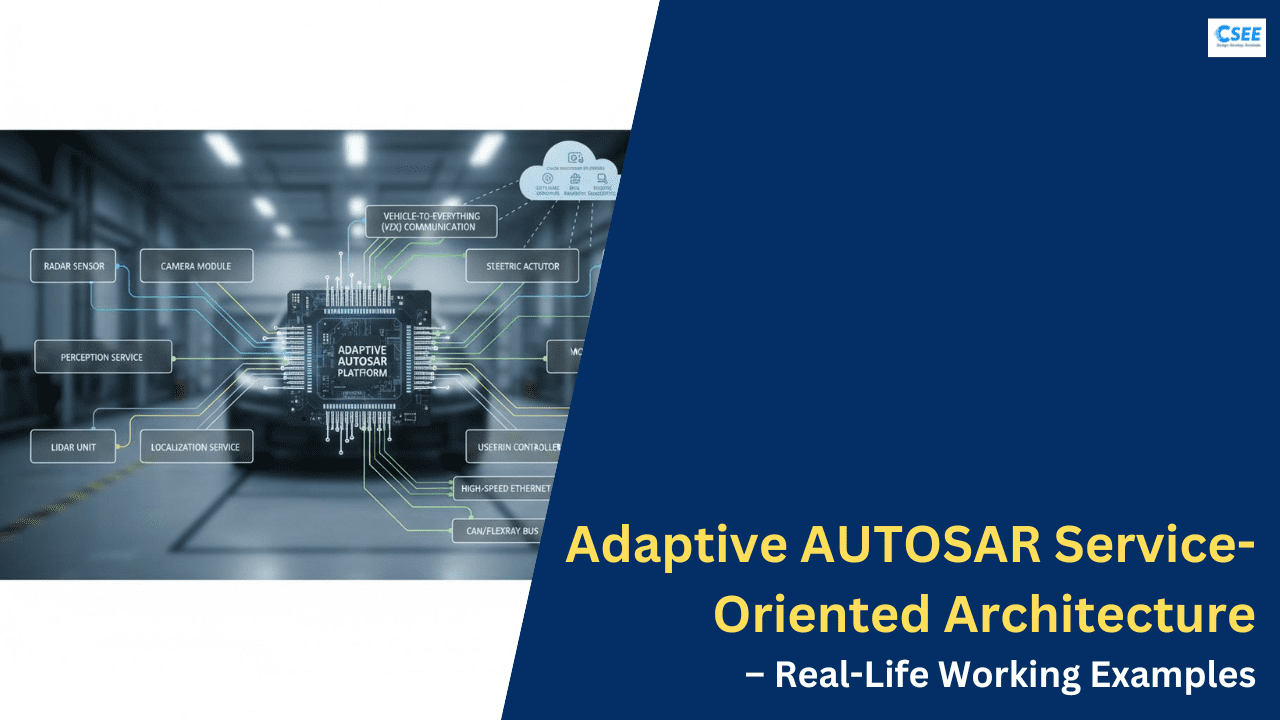
In Adaptive AUTOSAR, the architecture is based on services that are advertised, discovered, and consumed at runtime. The interaction between services follows structured protocols like SOME/IP (Scalable service-Oriented Middleware over IP).
? Core Elements of SOA in Adaptive AUTOSAR:
- Service Interface
Defines what data or functionality is provided or required. - Service Registry and Discovery
Enables services to be advertised and found by consumers at runtime. - Communication Middleware
Supports data exchange using protocols like SOME/IP, ensuring secure and efficient communication. - Service Lifecycle Management
Manages how services are started, monitored, updated, and stopped without affecting other systems. - Security and Permissions
Ensures that only authorized services can communicate, and sensitive data is protected.
✅ 4. Real-Life Working Examples
Let’s explore five real-life scenarios where Adaptive AUTOSAR’s SOA architecture plays a vital role.
? Example 1 – Traffic Sign Recognition and Navigation Integration
✅ Provider:
Traffic Sign Recognition (TSR) Module
✅ Consumer:
Navigation System
? How it Works:
The TSR module processes camera images to detect road signs such as speed limits, stop signs, and warnings. This module registers its service dynamically with the vehicle’s central service registry.
The Navigation system, running on a separate application, discovers the TSR service at runtime and subscribes to traffic updates. When TSR detects a new sign, it sends the information through the middleware to the navigation system, which then adjusts the route or alerts the driver.
? Benefits:
✔ Real-time traffic awareness
✔ Seamless integration with other systems
✔ Dynamic discovery means modules can be updated or replaced easily
✔ No restart required, ensuring uninterrupted driving experience
? Example 2 – Over-the-Air Software Updates
✅ Provider:
OTA Update Manager
✅ Consumer:
Infotainment System
? How it Works:
Modern vehicles require frequent software updates to enhance functionality or fix bugs. The OTA update manager service is responsible for downloading and delivering updates.
Once the service is registered, the infotainment system discovers it and requests available updates. Updates are securely delivered and installed while the vehicle is operational, avoiding the need for long service downtime.
? Benefits:
✔ Reduced maintenance costs
✔ Faster deployment of critical fixes
✔ Enhanced user experience with minimal disruptions
✔ Security patches are handled dynamically without exposing vulnerabilities
? Example 3 – ADAS Collaboration: Lane Keeping and Adaptive Cruise Control
✅ Providers:
Lane Keeping Assist (LKA) and Adaptive Cruise Control (ACC)
✅ Consumers:
Central Driving Controller and Dashboard Display
? How it Works:
ADAS functions often rely on multiple modules working together. LKA helps the vehicle stay within lane boundaries, while ACC adjusts the speed based on traffic conditions.
Both modules register their services with the central controller at runtime. The controller discovers them, binds to the services, and orchestrates data exchange between modules.
The dashboard system subscribes to warning notifications, allowing drivers to receive timely alerts for lane departures or sudden traffic changes.
? Benefits:
✔ Seamless coordination between safety-critical functions
✔ Dynamic binding allows upgrading individual modules without affecting others
✔ Reduces development complexity by standardizing communication
? Example 4 – Vehicle-to-Everything (V2X) Communication
✅ Provider:
V2X Communication Module
✅ Consumers:
Nearby Vehicles, Traffic Signals, Cloud Services
? How it Works:
V2X communication enhances safety by sharing information such as traffic congestion, road hazards, and emergency vehicle alerts.
The V2X module advertises its communication services to nearby vehicles and infrastructure. Other vehicles discover and subscribe to these services to receive warnings instantly.
This interaction happens dynamically, ensuring that newly arriving vehicles or roadside units can participate without manual configuration.
? Benefits:
✔ Real-time hazard awareness
✔ Improved traffic flow management
✔ Emergency vehicles can be given priority
✔ Supports connected vehicle ecosystems across regions
? Example 5 – Battery Management in Electric Vehicles
✅ Provider:
Battery Monitoring System (BMS)
✅ Consumer:
Energy Management System
? How it Works:
Electric vehicles rely heavily on efficient battery management. The BMS tracks parameters such as charge level, temperature, and health status.
The energy management system subscribes to this data through service discovery. It receives real-time updates, helping optimize energy usage and extend driving range.
Alerts for overheating or undercharging are automatically sent, allowing preventive maintenance and enhancing safety.
? Benefits:
✔ Prolongs battery lifespan
✔ Reduces downtime through early fault detection
✔ Enables smart energy management for range extension
✔ Supports seamless integration with charging networks
✅ 5. Key Technologies Supporting SOA in Adaptive AUTOSAR
? SOME/IP Protocol
SOME/IP is the backbone of service communication in Adaptive AUTOSAR. It allows efficient, scalable messaging with features such as:
- Service discovery
- Payload serialization
- Remote procedure calls
- Event notifications
? Security Frameworks
Services use authentication mechanisms and encryption protocols to ensure secure communication. Role-based access control ensures that only authorized services can access sensitive data.
? Service Registry
The registry dynamically tracks available services, allowing applications to discover, bind, and monitor services at runtime without static configuration files.
✅ 6. Differences Between Classic and Adaptive AUTOSAR
| Feature | Classic AUTOSAR | Adaptive AUTOSAR SOA |
|---|---|---|
| Communication style | Static, predefined interfaces | Dynamic, service-based communication |
| Application area | Real-time, safety-critical systems | High-performance, non-real-time applications |
| Flexibility | Low | High |
| Updates | Requires restart | Supports runtime updates |
| Use cases | Powertrain, braking | ADAS, infotainment, V2X |
✅ 7. Challenges and Considerations
While SOA offers immense advantages, implementing it comes with challenges:
✔ Managing the lifecycle of services in distributed systems
✔ Ensuring low-latency communication for time-sensitive functions
✔ Balancing modularity with system reliability
✔ Handling security threats in dynamic environments
✔ Designing efficient discovery and binding protocols
With proper architectural planning and rigorous testing, these challenges can be addressed to build robust, scalable automotive solutions.
✅ 8. The Future of Automotive Software with SOA
As vehicles move toward full autonomy, AI-driven decision-making, and connected ecosystems, Adaptive AUTOSAR’s service-oriented architecture will be indispensable.
Key trends include:
✔ Integration with cloud services for advanced analytics
✔ AI-powered predictive maintenance through dynamic service updates
✔ Real-time coordination between multiple vehicles on the road
✔ Improved safety features through automated, adaptive communication
✔ Cross-industry collaboration using standardized interfaces
✅ Conclusion
Adaptive AUTOSAR’s service-oriented architecture is at the heart of next-generation automotive software systems. By allowing dynamic discovery, secure communication, and modular interaction between vehicle systems, SOA enables smarter, safer, and more efficient vehicles.
Through real-life examples such as traffic sign recognition, OTA updates, ADAS collaboration, V2X communication, and battery management, we can see how this architecture is already transforming modern vehicles. The flexibility, scalability, and security it provides make it a critical foundation for autonomous driving, connected vehicles, and electric mobility.
The future of mobility is service-driven — and Adaptive AUTOSAR is leading the way.
This was about “Adaptive AUTOSAR Service-Oriented Architecture – Real-Life Working Examples“. Thank you for reading.
Also, read:
- 10 Free ADAS Projects With Source Code And Documentation – Learn & Build Today
- 100 + Electrical Engineering Projects For Students, Engineers
- 100 GitHub Projects to Level Up Your Embedded Engineering Skills
- 100+ Indian Startups & What They Are Building
- 1000+ Automotive Interview Questions With Answers
- 1000+ Electronics Projects For Engineers, Diploma, MTech Students
- 1000+ MATLAB Simulink Projects For MTech, Engineering Students
- 20 Advanced Coursera Courses for Embedded Engineers That Can Lead to High-Paying Careers