Hello guys, welcome back to my blog! ?⚡
Today, we’re diving into the technology that makes electric cars powerful, efficient, and smarter than ever — the chips inside them. And when it comes to precision in EVs, one name stands out: Texas Instruments (TI). From smooth acceleration to smarter infotainment, TI’s microcontrollers and processors are the hidden force behind many modern EVs.
In this article, I’ll walk you through how TI’s C2000 real-time controllers keep your EV’s motors and batteries perfectly in sync, delivering precise power flow that saves energy and makes driving seamless. We’ll also explore the Jacinto processors, which bring your digital cockpit and infotainment system to life — powering displays, cameras, and even voice assistants with zero lag.
By the end, you’ll see why Texas Instruments is more than just a chipmaker — it’s a driving force in the EV revolution, ensuring that your electric car runs smoother, cooler, and smarter every single time you hit the road.
Ask questions if you have any electrical, electronics, or computer science doubts. You can also catch me on Instagram – CS Electrical & Electronics
- From Engines to Airbags: How Renesas Chips Power the Future of Mobility
- Different Types of ASIL A, B, C, D Microcontrollers – Complete Guide
- Infineon’s AURIX Microcontrollers And CoolSiC™ MOSFETs: How They Make EVs Charge Faster And Brake Smarter
How Texas Instruments is Driving the Future of EVs
Electric vehicles (EVs) are no longer a futuristic dream — they are today’s reality. From luxury automakers to mass-market brands, almost every car manufacturer is rolling out EV models to meet the growing demand for sustainable mobility. But while EVs promise zero emissions and quiet rides, their success depends on something less visible yet absolutely critical: precise power management.
Unlike traditional internal combustion engine (ICE) cars, electric vehicles rely entirely on batteries, inverters, and electronic control units (ECUs) to deliver power to the wheels. A slight inefficiency in managing this power can result in poor acceleration, wasted energy, overheating, or even safety risks. This is where semiconductors — the tiny chips that act as the brains of EV systems — come into play.
Among the leaders in this space, Texas Instruments (TI) has emerged as a crucial player. TI’s C2000 real-time controllers and Jacinto processors are powering the next generation of EVs by making them more efficient, smarter, and safer. From controlling how electricity flows from the battery to the motor, to ensuring your infotainment screen doesn’t lag while you’re using navigation, TI chips are at the heart of many EV innovations.
The company’s role goes beyond just supplying chips; it solves some of the biggest challenges EVs face today:
- Managing energy waste that reduces driving range.
- Ensuring smooth acceleration without jerks.
- Preventing overheating of electronic systems.
- Delivering lag-free infotainment experiences with AI-enabled processors.
In this article, we’ll dive deep into how Texas Instruments enables EVs to operate more efficiently, explore the role of C2000 controllers and Jacinto processors, and understand how their power and signal chips are shaping the future of electric mobility.
1. The Power Challenge in Electric Vehicles
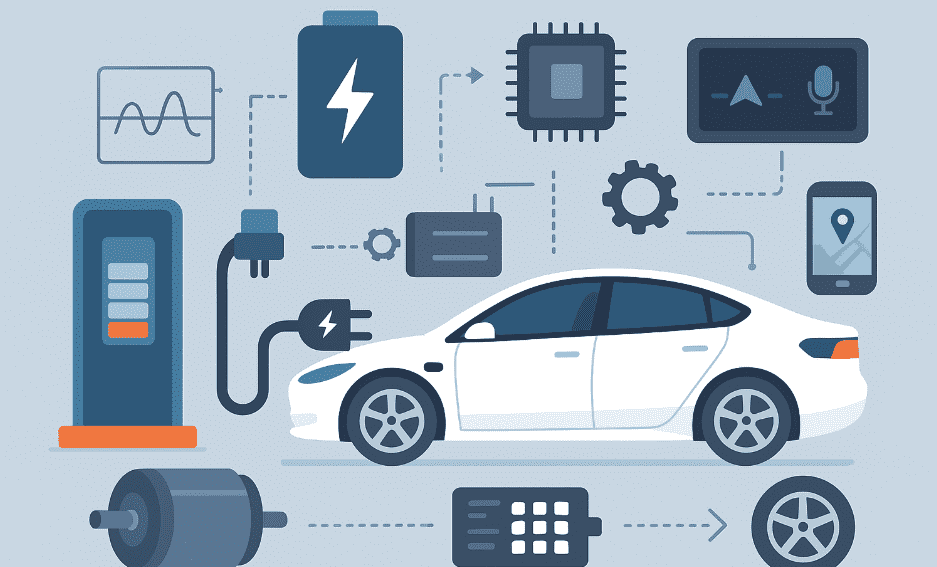
Electric vehicles promise cleaner transportation, but their success depends on solving one critical issue: precise energy management. Unlike traditional cars, where mechanical systems dominate, EVs rely almost entirely on electronic systems to function efficiently.
1.1 Battery Complexity
An EV’s battery pack contains thousands of lithium-ion cells. Keeping them balanced and safe is no small task. If even a few cells become misaligned in voltage or temperature, it can cause:
- Reduced driving range.
- Faster degradation of battery life.
- Safety hazards such as overheating.
This is why Battery Management Systems (BMS) require ultra-fast controllers capable of monitoring hundreds of sensors in real time. TI’s C2000 microcontrollers (MCUs) excel here, processing data in microseconds and ensuring no energy is wasted.
1.2 Power Conversion Efficiency
Electric cars can’t use battery power directly. The inverter must convert the battery’s DC into AC for the motor. Any inefficiency here translates into wasted energy and reduced range.
TI’s C2000 MCUs control pulse-width modulation (PWM) and switching signals with extreme accuracy, ensuring higher inverter efficiency. The result? Less wasted heat, smoother torque, and longer driving range.
1.3 Motor Control Precision
One of the biggest attractions of EVs is their instant torque. Step on the accelerator, and the car should move smoothly and immediately. But this demands real-time control of the motor.
TI’s C2000 MCUs enable field-oriented control (FOC), ensuring motors deliver torque efficiently and without jerks. They also manage regenerative braking — capturing energy when you slow down and feeding it back into the battery.
1.4 Heat Dissipation
High-power electronics generate a lot of heat. Without efficient semiconductors, EVs risk system failures. TI’s power chips, including wide bandgap GaN devices, help reduce energy losses and keep components cooler.
1.5 Infotainment Lag
Modern EVs are rolling computers, packed with infotainment screens, rear-view cameras, and digital assistants. But laggy systems ruin the experience. TI’s Jacinto processors power infotainment and ADAS features with smooth, real-time performance.
2. Texas Instruments’ Role in EVs
Texas Instruments is no stranger to the automotive world. With decades of semiconductor innovation, TI has positioned itself as a key player in enabling EV technologies.
- TI supplies power management ICs, microcontrollers, processors, and signal chips to automakers and Tier-1 suppliers worldwide.
- Unlike general-purpose chipmakers, TI designs solutions specifically optimized for automotive-grade performance.
- TI chips are built to handle high temperatures, reliability standards (AEC-Q100), and functional safety (ISO 26262 ASIL).
2.1 Competitors vs TI
While companies like Infineon, NXP, Renesas, and STMicroelectronics also play a big role, TI differentiates itself by:
- Offering real-time controllers (C2000) focused on precise power electronics.
- Providing Jacinto processors that seamlessly handle infotainment and ADAS workloads.
- Delivering a wide portfolio — covering everything from motor control to signal processing to thermal efficiency.
3. C2000 Microcontrollers – The Brain Behind EV Power
The C2000 family of microcontrollers is one of TI’s flagship products for EVs. These chips are designed for real-time control applications where latency and precision are critical.
3.1 Key Features
- Fast ADCs (Analog-to-Digital Converters): Monitor voltages and currents instantly.
- PWM Generation: Create precise signals for controlling inverters and motors.
- DSP Capabilities: Handle math-heavy tasks like field-oriented motor control.
- Safety Compliance: Built with ISO 26262 functional safety in mind.
3.2 Applications in EVs
- Traction Motor Control
- Enables smooth torque delivery.
- Supports regenerative braking.
- Battery Management Systems (BMS)
- Monitors cell voltages, currents, and temperature.
- Performs real-time balancing for longer battery life.
- Onboard Chargers (OBCs)
- Ensures efficient AC/DC conversion.
- Supports fast charging.
- DC-DC Converters
- Step down high-voltage battery power to 12V for accessories.
3.3 Example Use Case
Imagine pressing the accelerator in your EV. Within microseconds, the C2000 MCU calculates the required torque, adjusts inverter switching, and ensures smooth motor response — all while optimizing energy use. This is real-time precision in action.
4. Jacinto Processors – Smarter Infotainment & ADAS
Beyond power electronics, EVs need intelligence. TI’s Jacinto series of processors handles infotainment, digital cockpit, and ADAS (Advanced Driver Assistance Systems).
4.1 Infotainment
- Controls large, high-resolution displays.
- Manages multiple video inputs (rear-view, 360° cameras).
- Enables lag-free voice assistants and navigation.
4.2 ADAS Applications
- Camera vision for lane detection.
- Object recognition for collision avoidance.
- AI-powered driver monitoring systems.
4.3 Why Jacinto?
Unlike generic processors, Jacinto chips are optimized for automotive workloads, balancing real-time responsiveness with low power consumption.
5. TI’s Power & Signal Chips – Efficiency and Cooling
High-voltage systems in EVs demand chips that can handle stress and heat. TI’s solutions include:
- GaN and MOSFET power devices: Improve switching efficiency in inverters and chargers.
- Signal processing ICs: Enable precise monitoring of voltages and currents.
- Thermal management solutions: Keep systems running cooler, reducing wear and tear.
These solutions directly translate to longer EV range, reduced energy waste, and higher system reliability.
6. Real-World Benefits for EV Drivers
When all these TI technologies come together, the driver benefits:
- ? Smooth Acceleration – No jerks, instant torque.
- ? Longer Range – Efficient power management means fewer charging stops.
- ⚡ Faster Charging – Onboard chargers powered by C2000 make refueling quicker.
- ? Seamless Infotainment – No lag in displays, voice assistants, or cameras.
- ?️ Safer Driving – With ADAS powered by Jacinto processors.
7. The Future of EVs with TI
Texas Instruments isn’t stopping here. The company is actively investing in:
- Wide bandgap semiconductors (GaN, SiC) for even higher efficiency.
- AI-driven processors for autonomous driving features.
- Sustainable designs that reduce carbon footprint in vehicle production.
As EVs evolve toward autonomy and greater adoption, TI will remain at the center of innovation.
8. Business Impact – Automakers & Dealerships
TI’s role extends beyond technology. By making EVs more efficient, reliable, and affordable, TI indirectly boosts automaker competitiveness and dealership sales.
- Lower costs = More affordable EVs for consumers.
- Higher efficiency = Stronger customer trust in EV adoption.
- Better infotainment = Improved driving experience that sells cars faster.
Conclusion
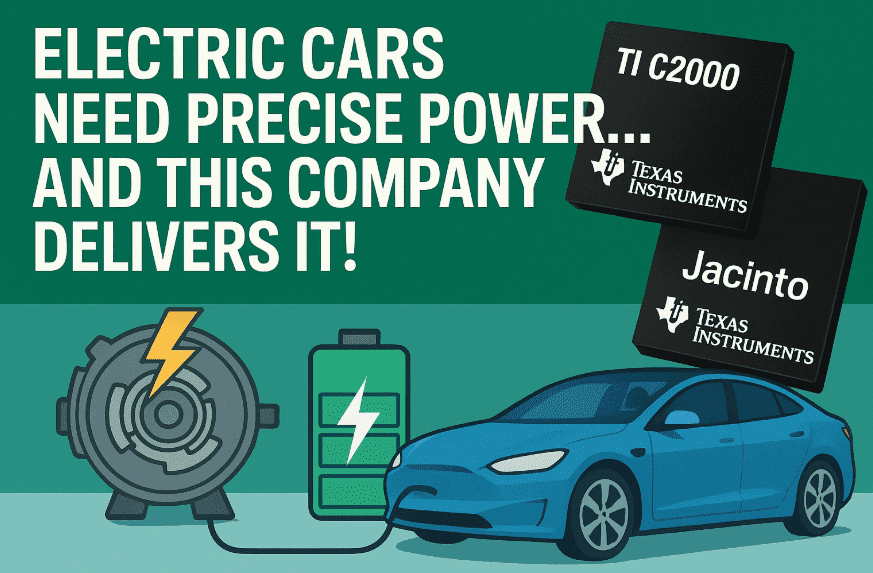
Electric vehicles need more than batteries and motors — they need brains that manage every watt of power and every line of data. Texas Instruments delivers exactly that with its C2000 controllers and Jacinto processors.
From making acceleration smoother to ensuring infotainment systems run without lag, TI chips are the silent heroes behind the EV revolution. Their power and signal devices further ensure everything stays efficient, cool, and reliable.
As we step into the future of electrification and autonomy, TI isn’t just providing chips — it’s providing the foundation of smarter, greener mobility.
This was about “Electric Cars Need Precise Power – How Texas Instruments is Driving the Future of EVs“. Thank you for reading.
Also, read:
- Why Qualcomm Is Entering the Automotive Industry
- The Memory Problem Behind AI Chips
- Why EUV Lithography Took Decades to Develop
- How Intel Lost Its Semiconductor Dominance
- Want To Crack Top Embedded Companies? Build These LLM Projects
- Why The Entire AI Industry Needs ASML
- CPU vs GPU vs NPU: Who Handles What?
- Why Semiconductors Could Change India’s Tech Future