Hello guys, welcome back to my blog! ?⚡
Today, we’re going to explore something that keeps your car running safely, smoothly, and smarter than ever — the chips inside your vehicle. Yes, I’m talking about Renesas microcontrollers (MCUs) and system-on-chips (SoCs), the hidden heroes that control everything from your engine and braking systems to advanced driver assistance and infotainment.
In this article, I’ll walk you through how Renesas’ RH850 MCUs ensure mission-critical safety and performance by handling engines, hybrid systems, and even braking mechanisms with precise timing. We’ll also dive into their R-Car series SoCs, which bring your car’s ADAS features and digital cockpit to life — enabling everything from lane detection to seamless infotainment.
By the end, you’ll understand why Renesas is called the silent guardian of cars — always working behind the scenes to make driving safer, smarter, and more reliable in the age of electrification and autonomy.
Ask questions if you have any electrical, electronics, or computer science doubts. You can also catch me on Instagram – CS Electrical & Electronics
- Different Types of ASIL A, B, C, D Microcontrollers – Complete Guide
- Infineon’s AURIX Microcontrollers And CoolSiC™ MOSFETs: How They Make EVs Charge Faster And Brake Smarter
- How NXP’s S32G and i.MX Processors Power the Software-Defined Vehicle Revolution
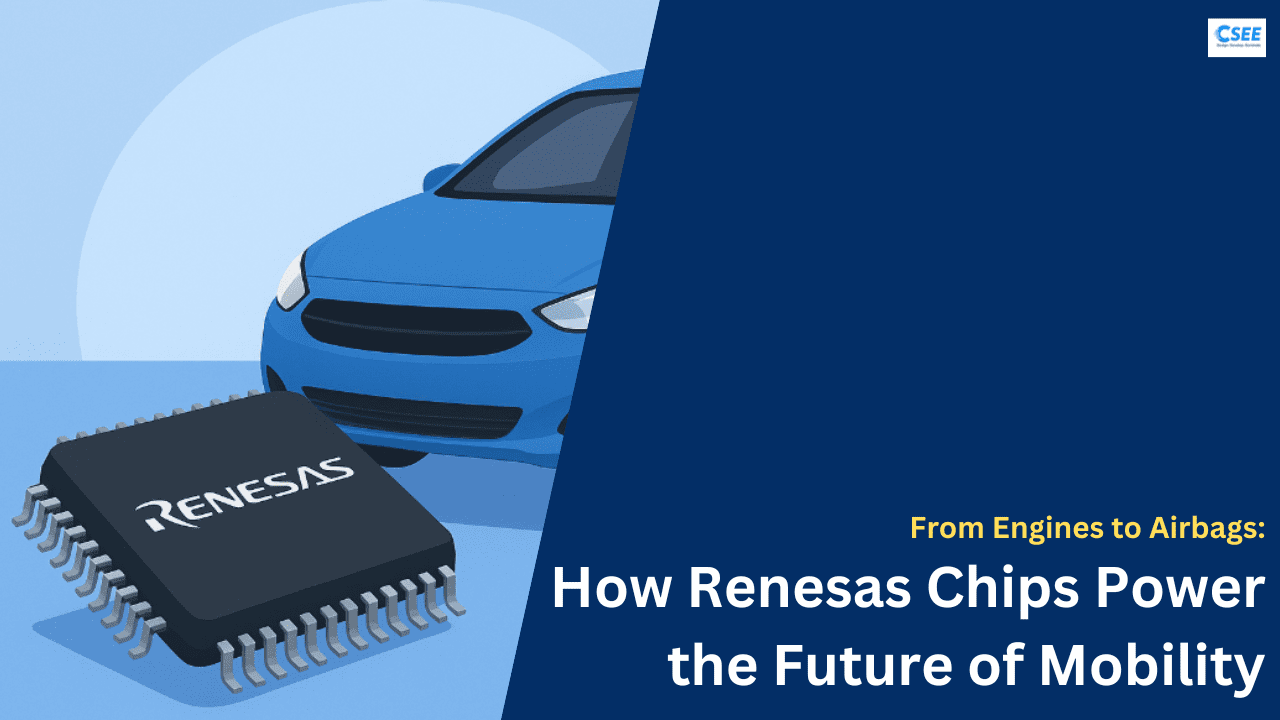
How Renesas Chips Power The Future Of Mobility
If you’ve ever wondered how your car manages to inject the right amount of fuel in milliseconds, deploy airbags instantly in a crash, or show real-time navigation on your dashboard without lag — the answer lies in automotive-grade semiconductors. And one of the companies leading this revolution is Renesas Electronics.
1. Introduction: The Invisible Brains of Modern Vehicles
Cars have come a long way from being purely mechanical machines to becoming rolling computers on wheels. Today’s vehicles are no longer defined only by horsepower, torque, or sleek designs. Instead, they are increasingly measured by the intelligence packed into their electronic control systems. These electronic brains are built around semiconductors—microcontrollers (MCUs), system-on-chips (SoCs), and sensors—that ensure a car’s performance, safety, and comfort.
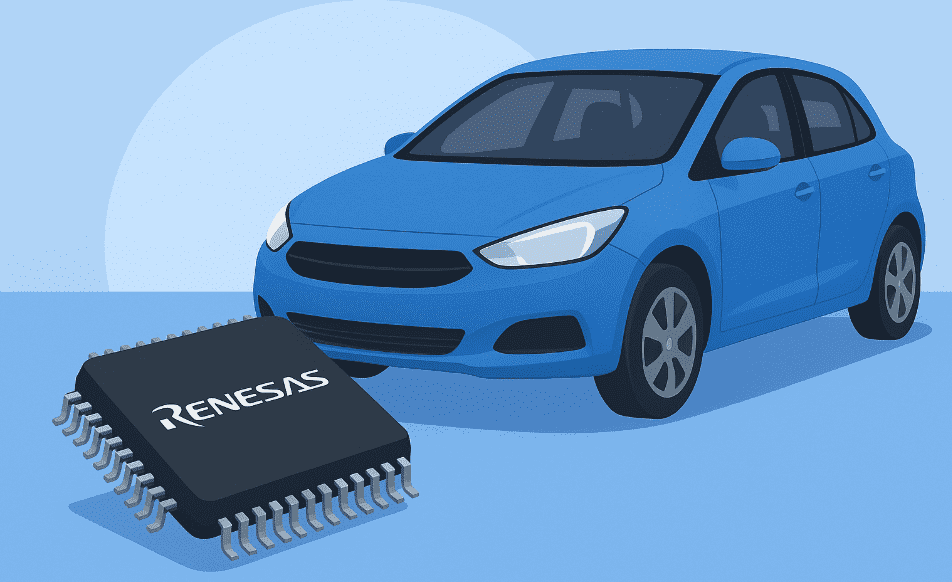
Among the many players in this field, Renesas Electronics Corporation stands out as one of the world’s leading suppliers of automotive-grade semiconductors. Renesas chips power critical systems in millions of vehicles worldwide, managing everything from engine control and battery management to infotainment and advanced driver assistance systems (ADAS).
Renesas has two flagship families of automotive chips that have become the backbone of modern mobility:
- RH850 MCUs – These are designed for precise, real-time control of mission-critical functions like engines, braking, airbags, and hybrid/EV systems.
- R-Car SoCs – These power high-performance functions such as ADAS, infotainment, digital cockpits, and even autonomous driving support.
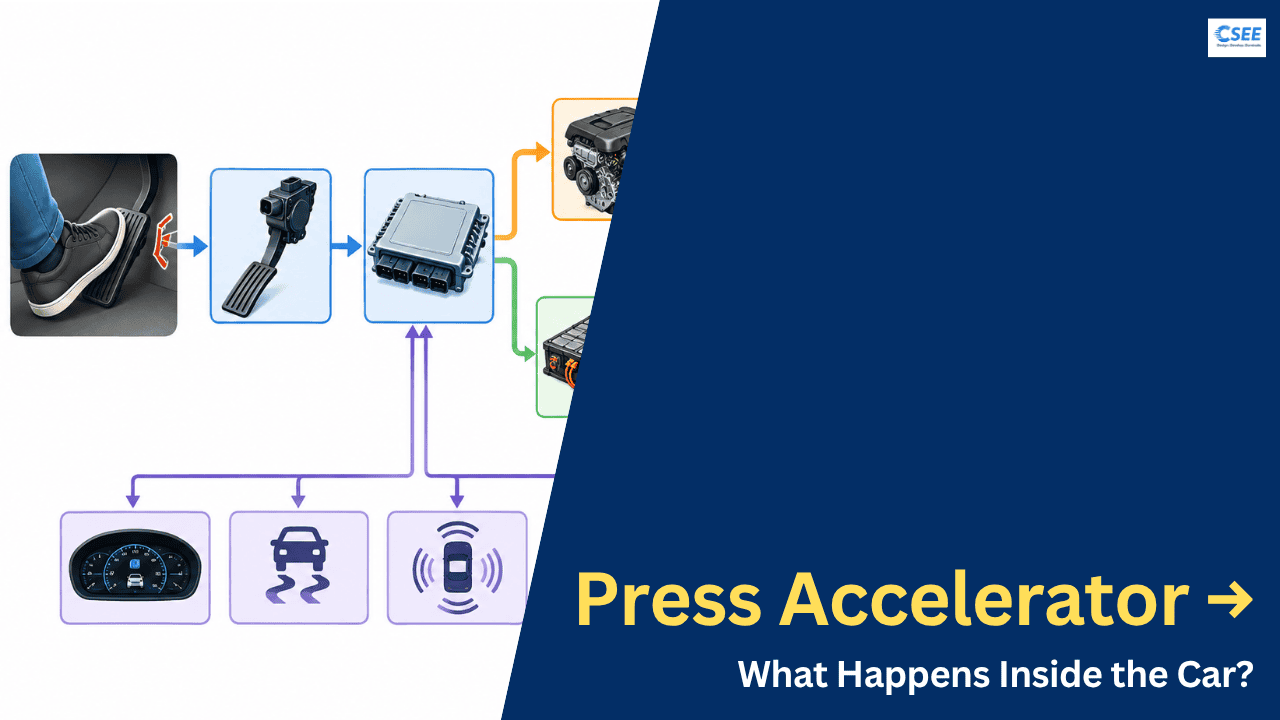
In essence, Renesas is the silent guardian inside your car. When you press the accelerator, the RH850 ensures the fuel injection is precisely timed to milliseconds. When you slam the brakes, the system responds instantly to prevent skidding. If a collision occurs, the airbag control system reacts in less than 30 milliseconds—all thanks to Renesas microcontrollers. Meanwhile, the R-Car SoC processes images from cameras and radar sensors, ensuring the driver gets accurate lane departure warnings or seamless infotainment experiences without delay.
This article takes a deep dive into how Renesas chips have become central to modern vehicles, solving real-time performance challenges and enabling the next generation of safe, efficient, and intelligent mobility.
2. Automotive Electronics Landscape
The automobile has undergone a technological revolution in the last 40 years. In the 1980s, cars relied primarily on mechanical linkages and rudimentary electronics for ignition and fuel injection. Fast forward to today, and a premium car may contain over 100 Electronic Control Units (ECUs), managing everything from basic lighting systems to highly advanced driver-assist features.
At the heart of this transformation are semiconductors. These tiny chips have enabled functionalities that were once unimaginable: adaptive cruise control, lane-keeping assistance, collision avoidance, electric power steering, hybrid drivetrains, and immersive infotainment systems. Without semiconductors, the modern automobile simply wouldn’t exist.
The Rise of Microcontrollers (MCUs)
Microcontrollers like Renesas’ RH850 act as the “nerve centers” for vehicle control. They are optimized for real-time responsiveness, ensuring critical systems like engines, braking, and airbags operate without delay. Unlike consumer electronics chips, automotive MCUs must operate reliably under extreme conditions: wide temperature ranges, high vibration, and exposure to electromagnetic interference.
The Importance of System-on-Chips (SoCs)
While MCUs are great for precise control, modern vehicles also need high-performance computing power. This is where SoCs come in. Renesas’ R-Car series SoCs integrate CPUs, GPUs, and AI accelerators into a single chip, enabling advanced features like camera-based ADAS, digital cockpits, and even autonomous driving capabilities.
Real-Time Constraints in Automotive
Automotive systems face some of the strictest real-time requirements of any industry. For example:
- An airbag must deploy within 30 milliseconds of detecting a crash.
- Anti-lock braking systems (ABS) must adjust braking pressure in real-time to prevent wheel lock.
- Lane-keeping assistance systems must process camera inputs and control steering in under 100 milliseconds.
These time-sensitive operations require chips that are not only powerful but also deterministic. This is why companies like Renesas are trusted partners for automotive manufacturers: their chips are designed with safety, reliability, and timing precision at their core.
3. Renesas RH850 MCUs: The Powerhouse of Control
When it comes to controlling safety-critical systems, Renesas RH850 microcontrollers are industry leaders. Designed specifically for automotive applications, the RH850 family balances performance, low power consumption, and functional safety compliance.
Applications of RH850 MCUs
- Engine Control
- The RH850 manages fuel injection, ignition timing, and throttle control.
- With multi-core processing, it ensures these functions are optimized for efficiency and emissions compliance.
- In hybrid and EVs, it plays a key role in controlling electric drive motors and regenerative braking.
- Hybrid & EV Systems
- Battery management: monitoring cell voltage, temperature, and current to maximize battery life.
- Inverter control: handling the conversion of DC battery power into AC power for electric motors.
- Thermal management: ensuring safe battery and motor operation.
- Braking & Steering Systems
- Anti-lock Braking System (ABS) and Electronic Stability Control (ESC).
- Electric Power Steering (EPS): provides smooth, responsive steering with less mechanical complexity.
- Advanced braking for EVs: blending regenerative and hydraulic braking seamlessly.
- Airbag Deployment Systems
- The RH850 processes crash sensor data instantly.
- Ensures airbags deploy in milliseconds to protect passengers.
Technical Highlights
- Multi-core architecture for handling multiple control tasks simultaneously.
- Ultra-fast interrupt handling, ensuring immediate response in emergencies.
- Low-power modes for efficiency in hybrid and electric systems.
- Built-in hardware safety features, including lockstep CPUs and error correction.
- Compliance with ISO 26262, achieving Automotive Safety Integrity Levels (ASIL-D) for the highest safety-critical applications.
Real-World Example
In a hybrid vehicle, the RH850 may simultaneously:
- Control the gasoline engine ignition and valve timing.
- Manage the electric motor torque delivery.
- Oversee regenerative braking when the driver slows down.
- Communicate with the transmission control system for smooth gear shifts.
This orchestration requires not just speed but deterministic behavior—the RH850 excels at delivering both.
4. R-Car Series SoCs: Driving ADAS and Infotainment
While RH850 MCUs focus on precise control, the R-Car family of SoCs brings high-performance computing to the automotive world. These chips are the “brains” behind advanced driver-assistance systems, digital dashboards, and connected infotainment platforms.
Applications of R-Car SoCs
- ADAS (Advanced Driver Assistance Systems)
- Camera-based lane detection, pedestrian recognition, and traffic sign recognition.
- Radar and lidar data fusion for collision avoidance and adaptive cruise control.
- Real-time decision-making to assist or override driver actions when needed.
- Digital Cockpit
- High-resolution digital instrument clusters.
- Touchscreen infotainment systems with navigation and media.
- Integration of voice assistants and connectivity with smartphones.
- Autonomous Driving Support
- High-performance computing required for Level 2–Level 4 autonomous functions.
- AI-based processing for real-time perception and prediction.
- Integration with cloud-based services and over-the-air (OTA) updates.
Features of R-Car SoCs
- Heterogeneous architecture: CPUs, GPUs, and AI accelerators.
- Real-time image recognition using hardware-accelerated vision processing.
- Scalable lineup: from entry-level infotainment chips to high-end ADAS processors.
- Security features: secure boot, encryption, and intrusion detection.
- Power efficiency, critical for EVs and compact ECUs.
Example in Action
When you drive a car equipped with ADAS, the R-Car SoC may simultaneously:
- Process camera feeds to detect lane markings.
- Fuse radar and camera data to identify vehicles ahead.
- Alert the driver if they are drifting out of the lane.
- Adjust infotainment volume automatically during a warning.
This integration of safety and user experience highlights how central the R-Car is to the driving experience.
5. Safety First: Mission-Critical Timing in Vehicles
Milliseconds matter in the automotive world. If an airbag system is late by even 10 milliseconds, lives could be lost. Renesas chips are built with this level of urgency in mind.
Deterministic Real-Time Response
- RH850 MCUs use ultra-fast interrupt response systems to handle emergencies instantly.
- R-Car SoCs prioritize safety-critical tasks while still running complex infotainment systems.
Built-In Safety Mechanisms
- Lockstep CPUs: Two processors run the same task in parallel and cross-check results.
- Error Correction Codes (ECC): Prevent data corruption.
- Watchdog timers: Reset systems if software hangs.
Cybersecurity in Vehicles
Modern cars are connected, which makes them vulnerable to hacking. Renesas integrates hardware-based security modules to:
- Protect over-the-air updates.
- Encrypt in-vehicle communications.
- Prevent malicious code injection.
6. Renesas and the Automotive Ecosystem
Renesas doesn’t work in isolation. It collaborates closely with OEMs (like Toyota, Nissan, BMW, Daimler) and Tier-1 suppliers (like Bosch, Denso, Continental) to integrate its chips into real-world vehicles.
Software Ecosystem
- Support for AUTOSAR (Automotive Open System Architecture).
- Development tools that shorten time-to-market.
- Partnerships with software companies to enable AI and infotainment platforms.
This ecosystem approach ensures that Renesas chips are not only powerful but also developer-friendly.
7. Future Trends: Where Renesas is Heading
The automotive industry is evolving rapidly, and Renesas is positioning itself at the forefront.
EV and Hybrid Systems
- Chips for battery management, inverters, and charging systems.
- Efficiency improvements to extend EV range.
ADAS to Autonomous Driving
- Scaling R-Car SoCs for Level 4 autonomy.
- AI integration for perception, prediction, and planning.
5G & V2X Communication
- Enabling vehicles to “talk” to each other and to infrastructure.
- Supporting cooperative driving for safer roads.
Sustainability
- Low-power designs to reduce vehicle energy consumption.
- Support for green mobility initiatives worldwide.
8. Conclusion: Renesas, the Silent Guardian of Cars
Renesas may not be a household name for consumers, but in the automotive world, it is indispensable. From controlling engines and braking systems with RH850 MCUs to powering ADAS and infotainment with R-Car SoCs, Renesas chips make vehicles safer, smarter, and more efficient.
Every time you drive, Renesas technology is working silently behind the scenes: ensuring fuel injection happens at the right moment, braking systems respond instantly, airbags deploy in time, and infotainment systems run without lag. As cars continue to evolve into autonomous, connected, and electrified machines, Renesas will remain at the core, shaping the future of mobility.
In short, from engines to airbags, Renesas chips control it all—and they do it with unmatched precision and reliability.
This was about “From Engines to Airbags: How Renesas Chips Power the Future of Mobility“. Thank you for reading.
Also, read:
- Why Qualcomm Is Entering the Automotive Industry
- The Memory Problem Behind AI Chips
- Why EUV Lithography Took Decades to Develop
- How Intel Lost Its Semiconductor Dominance
- Want To Crack Top Embedded Companies? Build These LLM Projects
- Why The Entire AI Industry Needs ASML
- CPU vs GPU vs NPU: Who Handles What?
- Why Semiconductors Could Change India’s Tech Future