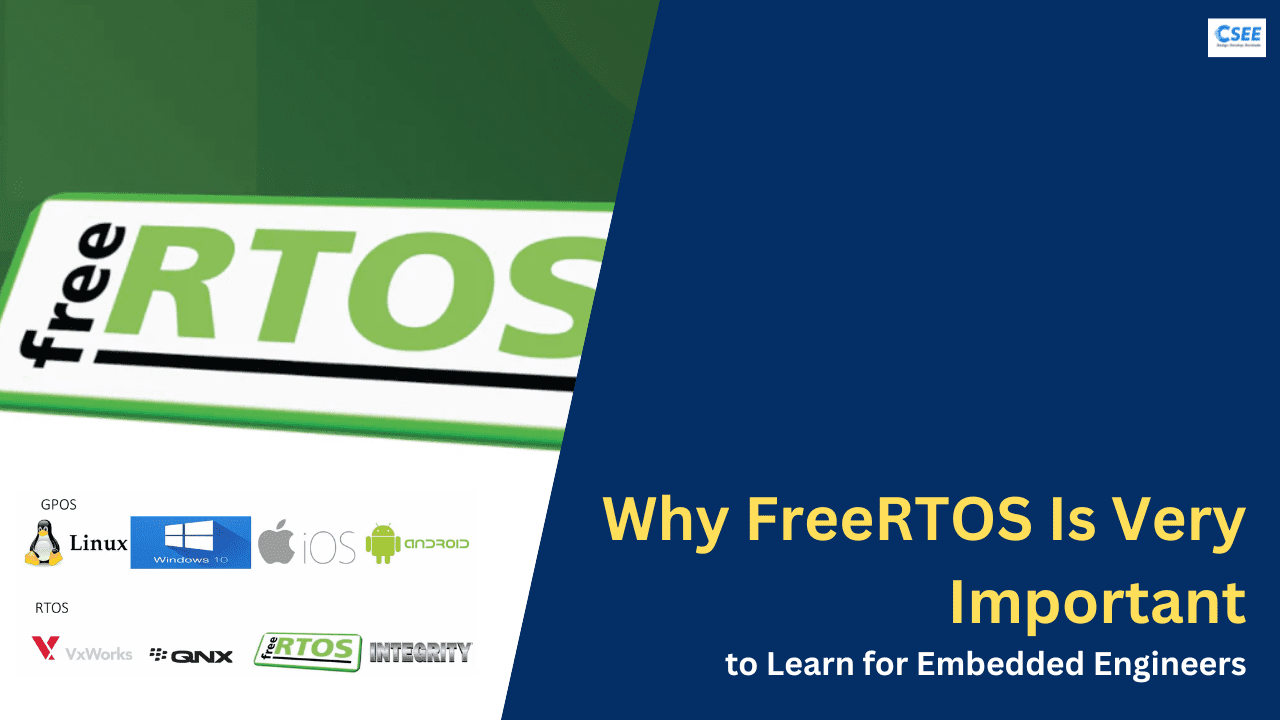
In modern embedded systems, one skill consistently stands out as a major differentiator—FreeRTOS. Whether you are building IoT devices, automotive ECUs, industrial controllers, wearables, drones, or consumer electronics, understanding an RTOS (Real-Time Operating System) has become essential. Most beginners start with bare-metal programming using loops, interrupts, and state machines, but today’s systems are far more complex, demanding structured multitasking, timing accuracy, and clean separation of functionality. This is exactly why FreeRTOS has become one of the most important skills for any embedded engineer.
FreeRTOS is a small, efficient, and open-source real-time operating system kernel designed for microcontrollers. Unlike heavy operating systems, FreeRTOS focuses purely on real-time deterministic behavior, extremely low memory footprint, and clear task management. With the huge rise of connected devices, real-time control systems, and safety-critical electronics, FreeRTOS has become one of the most widely used RTOS platforms globally.
This detailed guide explains why FreeRTOS is so important, what benefits it provides, how it improves embedded development, where it is used, and why companies across industries rely on it. If you want to advance your embedded career, stand out in interviews, or build professional-grade products, this article will give you everything you need to know.
What Exactly Is FreeRTOS?
FreeRTOS is a real-time operating system kernel for microcontrollers. It is not a full OS like Linux; instead, it focuses on providing deterministic scheduling and task management for small embedded systems. It supports hundreds of microcontroller architectures including ARM Cortex-M, PIC32, STM32, ESP32, Renesas, AVR, RISC-V, Raspberry Pi Pico, and more.
Key Characteristics of FreeRTOS
- Very small memory footprint (a few KB)
- Designed for real-time deterministic behavior
- Provides preemptive and cooperative scheduling
- Portable across a huge range of microcontrollers
- Open-source under MIT License
- Backed and maintained by Amazon (AWS)
- Highly configurable and lightweight
FreeRTOS provides the essential building blocks required for multitasking embedded systems.
What FreeRTOS Does Not Do
FreeRTOS is not intended to replace Linux or Android. It does not include:
- A standard file system
- Desktop-like applications
- Heavy middleware by default
- Hardware drivers
It is a minimal and efficient kernel that gives engineers control over task execution and system timing.
Why Embedded Engineers Must Learn FreeRTOS
The demand for RTOS knowledge has grown rapidly across industries. Here are the major reasons why learning FreeRTOS is crucial for embedded engineers.
1. The Embedded Industry Has Become Multitasking-Oriented
Older embedded systems were simple:
- Read a sensor
- Process data
- Control an output
This could easily run inside a single loop.
But modern products require:
- Connectivity (Wi-Fi, BLE, LTE)
- OTA firmware updates
- Cloud data exchange
- UI handling
- Security checks
- Multiple sensors
- Continuous data logging
- Real-time control
Handling all these features inside one loop becomes messy and unreliable. FreeRTOS makes multitasking stable and structured by allowing each function to run as an independent task.
2. Deterministic Timing Is Essential for Real-Time Systems
Real-time systems must respond within very tight timing constraints.
Examples:
- Automotive airbag deployment
- Motor control loops
- HVAC control
- Drone stabilization
- Medical device monitoring
- Industrial closed-loop systems
FreeRTOS ensures precise task timing using:
- Task priorities
- Scheduling algorithms
- Accurate tick control
- No unexpected delays
This improves safety, accuracy, and reliability.
3. It Greatly Improves Code Organization and Maintenance
Bare-metal code becomes difficult to maintain beyond a certain complexity level.
Interrupts, timers, and long loops can create:
- Spaghetti logic
- Hard-to-debug bugs
- Timing conflicts
- Priority issues
FreeRTOS organizes your entire codebase into tasks with clear responsibilities, making your project:
- Easier to manage
- Easier to debug
- Easier to scale
- Easier for teams to collaborate
- Easier to extend in the future
This is a major benefit for long-term commercial projects.
4. It Helps Build Scalable and Flexible Systems
Real products evolve over time. They often need additional:
- Sensors
- Protocols
- Features
- Updates
- Control logic
With FreeRTOS, adding new functionality becomes simple. You just create a new task, set priority, and integrate it with the existing system using queues or semaphores. This modularity makes FreeRTOS ideal for large commercial systems.
5. Demand for FreeRTOS Skills in Job Market Is Rising
Companies in the following domains widely use FreeRTOS:
- Automotive ECUs
- Industrial automation
- IoT and smart home devices
- Medical electronics
- Consumer appliances
- Robotics
- Aerospace
- Drones
Job descriptions frequently mention:
- RTOS experience
- FreeRTOS knowledge
- Task scheduling expertise
- Experience with semaphores, queues, mutexes
Learning FreeRTOS significantly improves job prospects.
6. FreeRTOS Makes You Understand Advanced OS Concepts
FreeRTOS concepts form the foundation for more advanced operating systems like:
- Embedded Linux
- Zephyr
- QNX
- ThreadX
- VxWorks
Key skills you learn:
- Thread scheduling
- Priority inversion
- Concurrency
- Resource locking
- Stack management
- Inter-task communication
These prepare you for senior embedded roles.
FreeRTOS Features Explained Clearly and Simply
FreeRTOS offers many features, but here they are explained in simple terms so any engineer can easily understand them.
1. Tasks
A task is like a mini program running independently.
Instead of putting everything in main(), you divide the system into:
- Sensor task
- Communication task
- Control task
- UI task
Each task gets its own stack and priority.
2. Task Scheduling
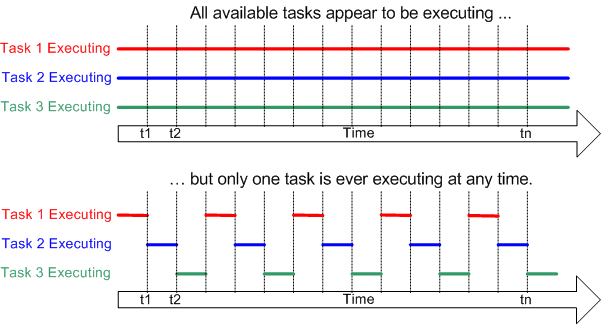
The scheduler decides which task should execute at any moment.
It ensures:
- High priority tasks run first
- Lower priority tasks run when CPU is free
- CPU is never wasted in unnecessary delays
This prevents the entire system from being blocked.
3. Delays and Software Timers
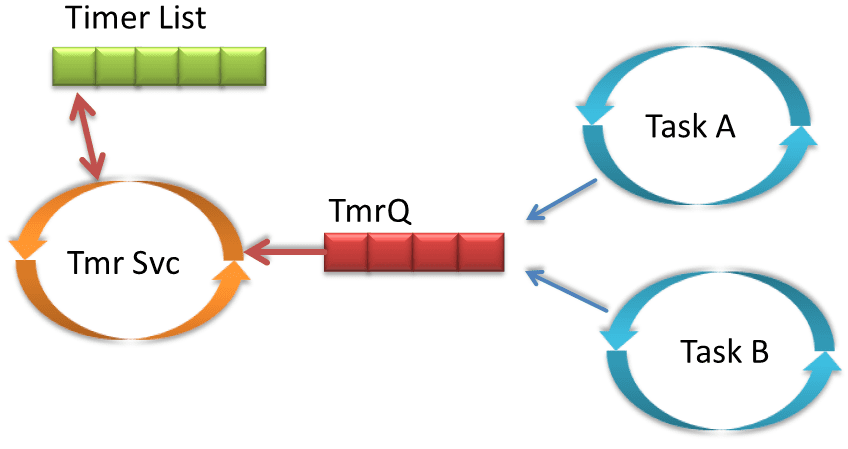
Instead of blocking delays like delay(1000), FreeRTOS provides:
vTaskDelay()xTaskDelayUntil()- Software timers
These delay the task, not the CPU.
4. Queues
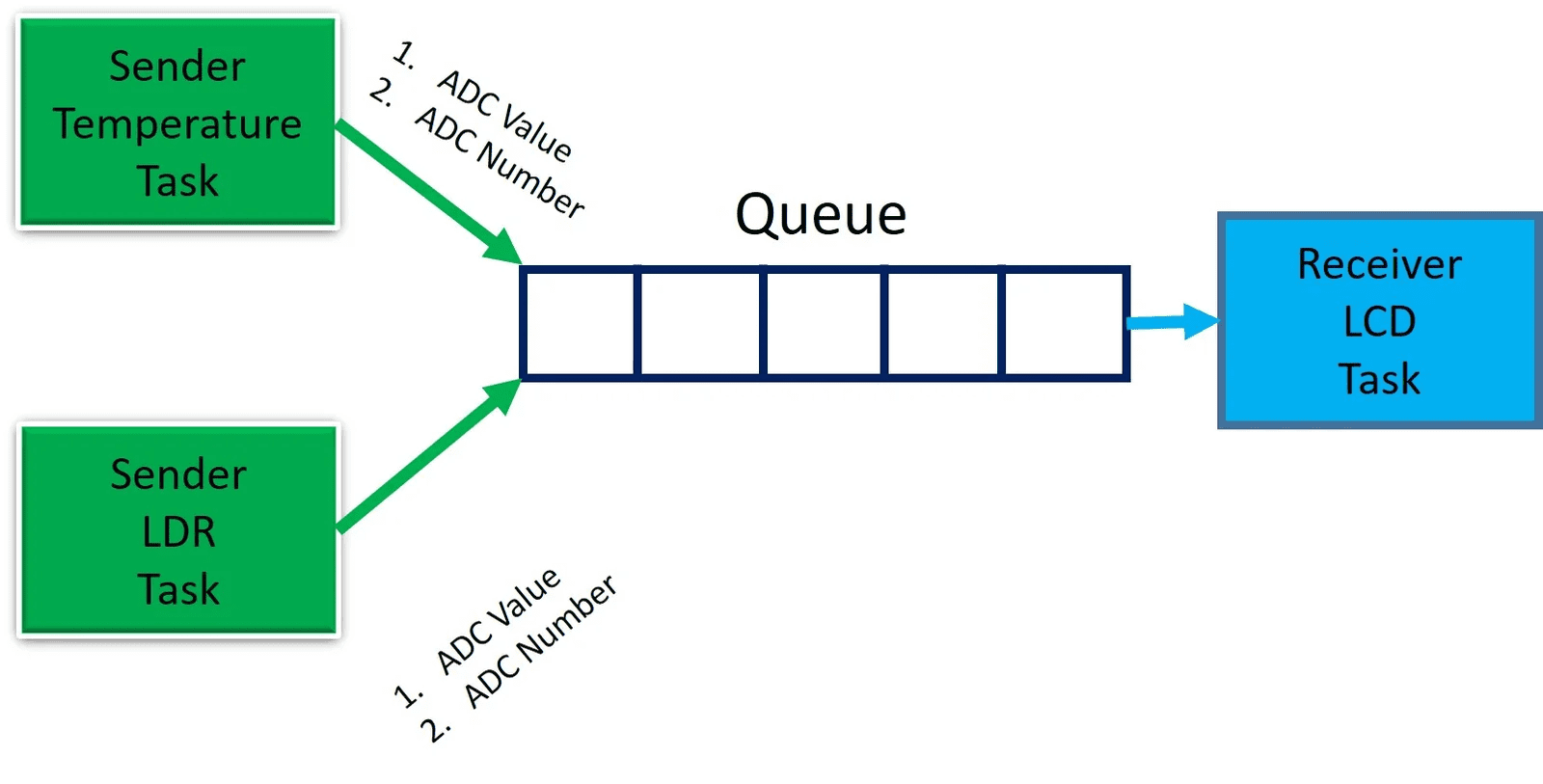
Queues are safe communication channels between tasks.
Example:
- One task reads a sensor
- Another task processes the data
- They exchange information through a queue
Queues prevent data corruption and collisions.
5. Semaphores and Mutexes
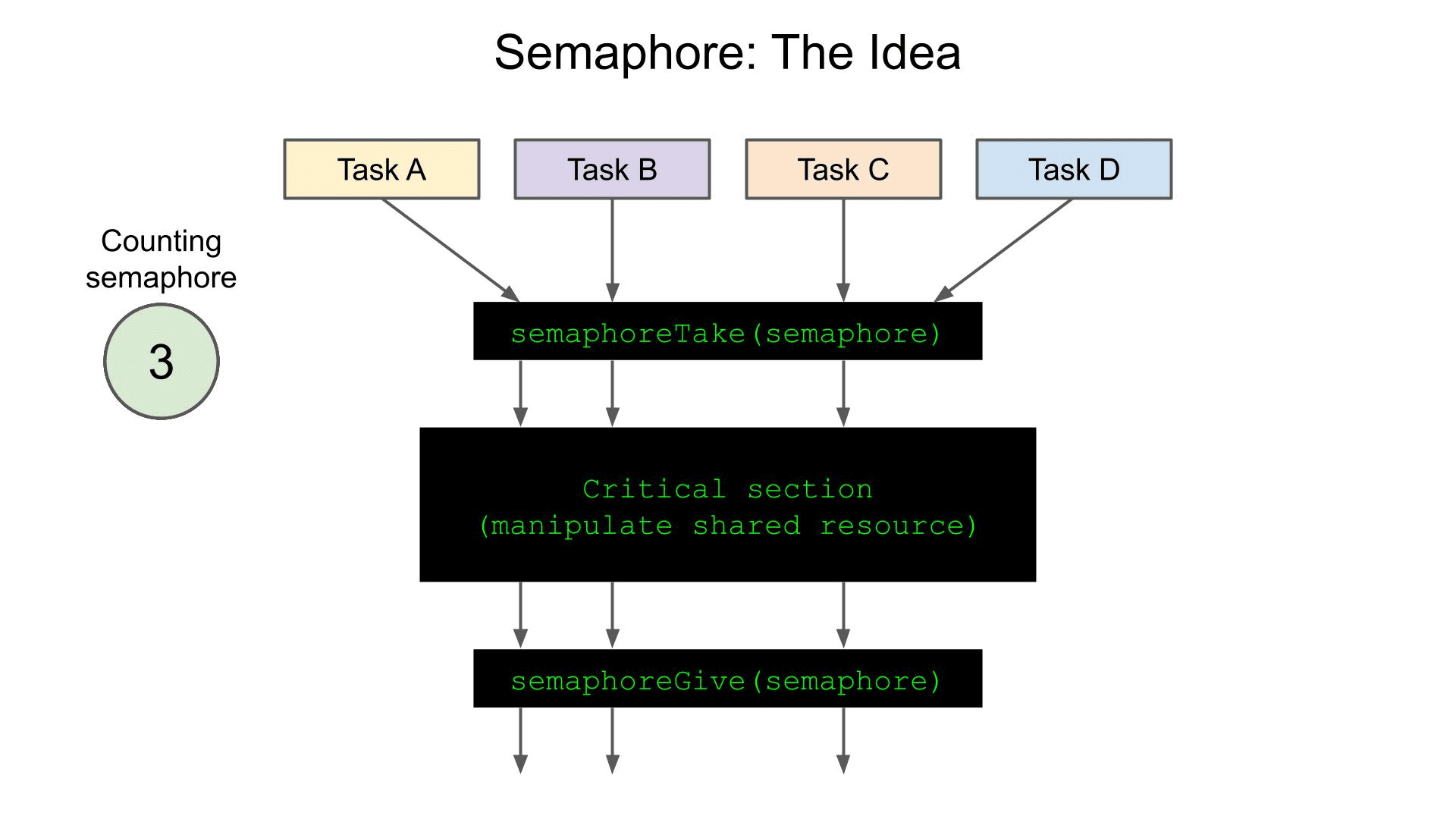
Used for:
- Managing shared resources
- Synchronizing tasks
- Preventing race conditions
- Preventing two tasks from accessing a peripheral at the same time
These features improve stability.
6. Event Groups
Event groups allow multiple tasks to wait for one or more events.
Useful in networking and state-machine-driven systems.
7. Recursive and Counting Semaphores
These provide flexible ways of managing resources with multiple access conditions.
8. Tickless Idle Mode
Ideal for battery-powered devices.
The CPU sleeps when no tasks need to run.
9. Low Memory Consumption
FreeRTOS requires only a few kilobytes of RAM.
Perfect for Cortex-M0/M0+, AVR, PIC, and small MCUs.
10. MPU Support
Memory Protection Unit support is essential for safety-critical applications such as automotive and medical devices.
Why Choose FreeRTOS When Many Other RTOS Options Exist?
There are many RTOS platforms available, but FreeRTOS remains one of the most widely used.
1. Lightweight and Easy to Understand
Other RTOS platforms may be powerful but often large and complex.
FreeRTOS is simple, minimal, and easy for beginners.
2. Massive Global Community
If you face a problem:
- Someone has already solved it
- Documentation exists
- Tutorials exist
- Forums are active
This reduces development time.
3. MIT License (Free for Commercial Use)
FreeRTOS is truly free:
- No royalties
- No legal risks
- No license fees
- Suitable for startups and large companies
This is a huge advantage compared to paid RTOS platforms.
4. Amazon Backing
Since Amazon took over FreeRTOS:
- Quality has improved
- Security features increased
- IoT libraries added
- Long-term support guaranteed
This makes FreeRTOS future-proof.
5. Portability Across MCUs
You can migrate your code from:
- STM32 → ESP32
- PIC32 → RISC-V
- AVR → ARM Cortex-M
The kernel remains the same.
6. Perfect Balance Between Simplicity and Capability
Linux is too heavy for small MCUs.
Some commercial RTOS are too complex.
FreeRTOS hits the sweet spot.
Common Use Cases of FreeRTOS in Real Products
FreeRTOS is used worldwide in countless commercial systems.
1. Internet of Things (IoT)
FreeRTOS is perfect for:
- Smart sensors
- Home automation
- IoT hubs
- Wearables
- Smart meters
It handles networking, real-time control, and power saving.
2. Automotive Systems
Used in:
- Window control
- Door modules
- HVAC
- Lighting systems
- Motor control
- Battery management
- Instrument clusters
Safety and timing accuracy are essential.
3. Industrial Automation
FreeRTOS ensures:
- Deterministic timing
- Fast response
- Reliable operation
Used in PLCs, controllers, and industrial sensors.
4. Medical Devices
Examples:
- Heart-rate monitors
- Infusion pumps
- Ventilators
- Medical wearables
Stability and predictability are critical here.
5. Consumer Electronics
Used in:
- Washing machines
- Refrigerators
- Smart speakers
- Microwave ovens
- Air purifiers
These products rely on multitasking and reliability.
6. Drones and Robotics
Essential for:
- Motor control
- IMU reading
- Flight stabilization
- Communication
- Navigation
FreeRTOS offers fast and predictable control loops.
How Learning FreeRTOS Boosts Your Career
1. Makes You Highly Employable
Companies prefer engineers who understand:
- Multitasking
- Synchronization
- Scheduler behavior
- Real-time systems
FreeRTOS gives you these skills.
2. Helps You Build Real Products
Learning FreeRTOS takes you beyond hobby coding and prepares you for industrial-grade software development.
3. Strengthens Your Fundamentals
Understanding FreeRTOS helps you master:
- Interrupt management
- Timing precision
- Memory constraints
- Stack usage
- Scheduling algorithms
These are essential skills for embedded mastery.
4. Prepares You for Advanced Platforms
If you later switch to Linux, Zephyr, QNX, or ThreadX, the concepts will feel familiar and easy.
Conclusion
FreeRTOS has become one of the most essential skills for embedded engineers around the world. As embedded systems grow more complex, connected, and time-sensitive, the need for structured multitasking has become unavoidable. Bare-metal programming is good for learning, but not enough for real products. FreeRTOS provides predictability, organization, reliability, and scalability—all while being lightweight and easy to adopt.
Its widespread use across IoT, automotive, industrial automation, medical devices, drones, robotics, and consumer electronics makes it a highly valuable skill. It also strengthens your understanding of concurrency, real-time behavior, scheduling, and system architecture, helping you grow into a strong embedded engineer.
If your goal is to build production-ready embedded systems, stand out in job interviews, or work on advanced real-time products, learning FreeRTOS is one of the smartest and most impactful decisions you can make.
Free Tutorial: https://www.youtube.com/playlist?list=PLEB5F4gTNK68zDlrXbcCgJ6NejaP0PvHX
Padi Tutorial: https://www.udemy.com/course/freertos-on-rpi-pico/
This was about “Why FreeRTOS Is Very Important to Learn for Embedded Engineers“. Thank you for reading.
Also, read:
- India’s GaN Chip Breakthrough: Why Gallium Nitride Could Shape the Future of Defense Electronics
- India’s Chip Era Begins: A New Chapter in Semiconductor Manufacturing
- FlexRay Protocol – Deep Visual Technical Guide
- Top 50 AI-Based Projects for Electronics Engineers
- UDS (Unified Diagnostic Services) — Deep Visual Technical Guide
- Automotive Ethernet — Deep Visual Technical Guide
- Controller Area Network (CAN) — Deep Visual Technical Guide
- Top 30 High-Paying Embedded Tools You Must Learn in 2026