Today, we’re diving into one of the most fascinating revolutions shaping the future of technology — the rise of AI Engines that power everything from smart cars to intelligent assistants and industrial robots.
For years, machines operated strictly by predefined logic — doing only what they were programmed to do. But that era is fading fast. Now, systems can learn, adapt, and make decisions on their own, thanks to the growing intelligence embedded deep within their cores — the AI Engine.
From self-driving vehicles and predictive maintenance to voice recognition, image processing, and real-time decision-making, AI Engines are becoming the brains behind modern innovation. They analyze data, detect patterns, and act — all within milliseconds.
This is where the AI Engine takes center stage — the hidden powerhouse that transforms ordinary hardware into intelligent, responsive, and context-aware systems.
But here’s where the story gets even more interesting:
👉 What exactly is an AI Engine, and how does it work?
👉 Why is it becoming essential in automotive, robotics, and edge computing?
👉 And most importantly — how will AI Engines redefine the way machines think, decide, and evolve in the future?
What Is An AI Engine?
The automotive industry is undergoing its biggest transformation in over a century. For decades, vehicles were mechanical marvels — defined by engines, gears, and craftsmanship. But today, the heart of innovation has shifted from mechanics to intelligence. Cars are no longer just machines that move; they are computers on wheels, capable of sensing, learning, and making decisions.
At the center of this revolution lies a powerful concept — the AI Engine.
The AI Engine is not a physical engine made of pistons or valves. Instead, it’s a software-driven brain, the computational core that powers modern intelligent vehicles. It enables cars to see through cameras, interpret data from radar and LiDAR, understand driver behavior, and make real-time decisions on the road.
From Advanced Driver Assistance Systems (ADAS) to fully autonomous driving, and from predictive maintenance to in-cabin personalization — the AI Engine is what makes these smart features possible.
But what exactly is an AI Engine in the automotive world?
How does it work, and what makes it so critical for the future of mobility?
Let’s dive deep and uncover how the AI Engine is reshaping the automotive landscape — turning traditional cars into intelligent, software-defined machines.
1. What Exactly Is an AI Engine in Automotive Systems?
An AI Engine in automotive terms is the central intelligence unit that processes data, interprets surroundings, and supports decision-making for various vehicle functions. It combines machine learning, neural networks, and high-performance computing to analyze inputs from multiple sensors in real time.
Think of it as the brain of a modern vehicle.
Just as the human brain processes signals from the eyes, ears, and skin to make quick decisions, the AI Engine fuses information from cameras, radar, LiDAR, GPS, and ultrasonic sensors to understand the driving environment.
It can:
- Detect objects, lanes, and traffic signs
- Predict movements of pedestrians and vehicles
- Optimize braking, acceleration, and steering
- Monitor driver attention and fatigue
- Personalize infotainment or climate control settings
The AI Engine is what bridges raw sensor data with intelligent vehicle behavior, making it the most critical component in modern automotive electronics.
2. Evolution: From ECUs to Centralized AI Engines
For years, cars relied on hundreds of Electronic Control Units (ECUs) — each responsible for a single function: one for braking, one for lighting, another for airbags, and so on.
But as features grew — with ADAS, infotainment, connectivity, and autonomous functions — the complexity exploded. Managing communication between hundreds of ECUs became inefficient, expensive, and power-hungry.
This led to the rise of domain controllers — powerful processors that handle entire functional domains (e.g., ADAS domain, infotainment domain).
Now, with the era of Software-Defined Vehicles (SDVs), the next leap is the centralized AI Engine — a single or distributed high-performance compute platform that can run multiple intelligent functions simultaneously.
Unlike ECUs that execute fixed code, the AI Engine learns and evolves. It uses neural networks and data-driven algorithms to make context-aware decisions — enabling higher levels of automation and personalization.
Automakers like Tesla, NVIDIA, Qualcomm, and BMW are already using centralized AI compute platforms, such as the NVIDIA DRIVE Orin and Qualcomm Snapdragon Ride, that act as the “brain” of intelligent vehicles.
3. Architecture of an Automotive AI Engine
The AI Engine in a vehicle is designed like a multilayered ecosystem — integrating software, sensors, and compute hardware. Let’s explore its key building blocks:
a) Sensor Fusion Layer
This layer collects inputs from multiple sensors:
- Camera systems (detect lanes, signs, and traffic)
- Radar (measures distance and speed)
- LiDAR (creates 3D maps of the environment)
- Ultrasonic sensors (used for parking and obstacle detection)
- GNSS and IMU (provide position and motion data)
The AI Engine fuses this sensor data into a unified environmental model, enabling the car to “see” and “understand” its surroundings accurately.
b) Perception Layer
Using deep learning models (like convolutional neural networks), the AI Engine identifies:
- Vehicles, pedestrians, and road features
- Traffic lights and signs
- Free drivable space
This is similar to how our brain interprets what we see.
c) Decision-Making Layer
Once the perception layer interprets the scene, this layer makes driving decisions.
It uses reinforcement learning, path-planning algorithms, and probabilistic models to decide:
- When to brake, accelerate, or steer
- How to overtake safely
- When to yield to pedestrians
d) Control Execution Layer
The final layer converts decisions into real-world actions — sending precise control signals to actuators and motors for steering, throttle, and braking.
e) Feedback and Learning
The AI Engine continuously learns from real-world driving experiences.
Data from millions of miles of driving is fed back into training models, which are then updated over-the-air (OTA) to improve accuracy and safety.
4. The Role of Hardware: Compute Platforms Behind the AI Engine
AI Engines rely on high-performance hardware capable of executing complex computations within milliseconds — because every delay could mean the difference between safety and disaster.
Leading automotive compute platforms include:
- NVIDIA DRIVE Orin and Thor: Designed for Level 4–5 autonomous driving with up to 2000+ TOPS (trillions of operations per second).
- Qualcomm Snapdragon Ride: Offers scalable performance from ADAS to full autonomy.
- Tesla Full Self-Driving (FSD) Chip: In-house AI Engine that processes video data from eight cameras in real time.
- AMD and Renesas AI Platforms: Target hybrid automotive workloads, balancing AI inference with traditional control tasks.
These chips use specialized architectures combining CPUs, GPUs, and AI accelerators (NPUs or TPUs) for efficient real-time processing.
Unlike traditional ECUs, these platforms are software-updatable, enabling continuous innovation throughout a car’s life.
5. Software Frameworks and Tools Powering AI Engines
Hardware is only half of the story — the real intelligence lies in the software ecosystem that powers these engines.
Key software frameworks and technologies include:
- AUTOSAR Adaptive Platform: Provides standardized services for AI-enabled automotive systems, supporting POSIX-based environments.
- ROS (Robot Operating System): Commonly used for prototyping and autonomous system development.
- TensorFlow, PyTorch, and ONNX Runtime: Popular frameworks for training and deploying AI models.
- OpenVX, OpenCL, CUDA: For accelerating AI workloads on GPUs and heterogeneous hardware.
- Middleware Layers: Handle communication between AI applications and the vehicle’s hardware abstraction layer.
These tools enable developers to integrate AI-based perception, prediction, and control seamlessly into automotive architectures.
6. Real-World Applications of AI Engines in Vehicles
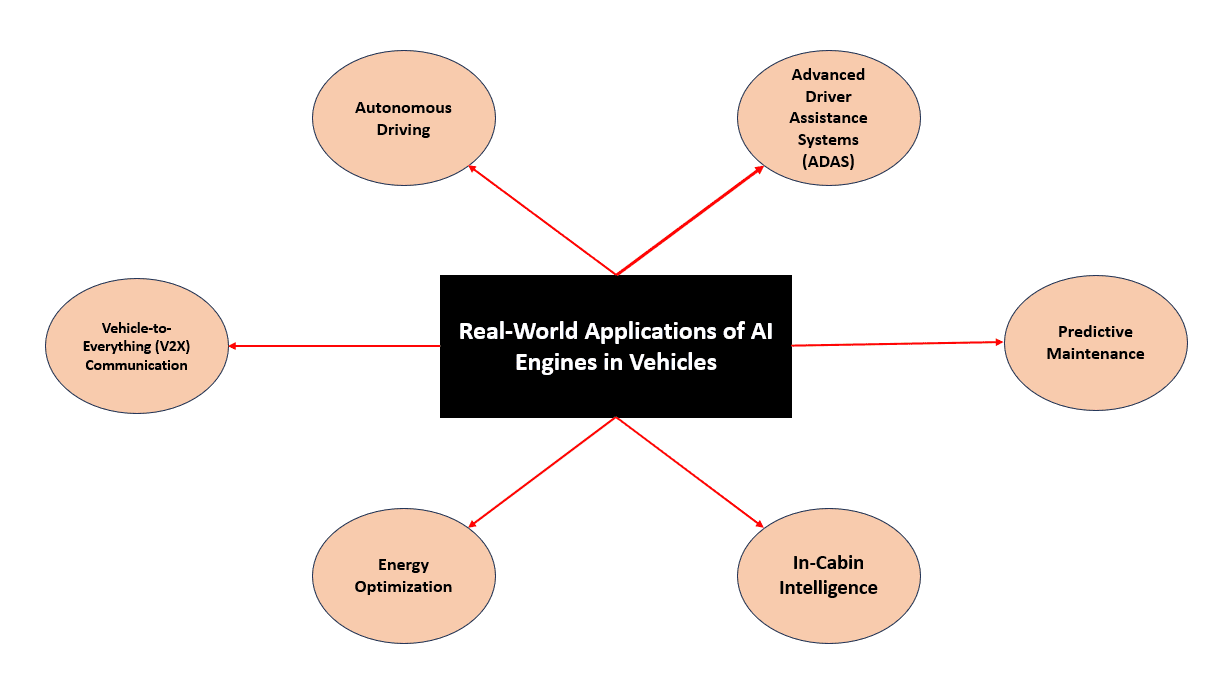
AI Engines have moved from concept to reality. Here’s how they’re already shaping intelligent vehicles:
a) Autonomous Driving
The most advanced use of AI Engines — enabling self-driving capability by processing sensor data and making driving decisions with minimal human input.
b) Advanced Driver Assistance Systems (ADAS)
Features like lane keeping, adaptive cruise control, automatic braking, and blind-spot detection all rely on AI-based perception and decision-making.
c) Predictive Maintenance
AI Engines monitor sensor data to predict failures before they happen — alerting drivers or service centers proactively.
d) In-Cabin Intelligence
From facial recognition to emotion detection and voice assistants, AI Engines personalize the cabin experience — adjusting lighting, temperature, and music based on driver mood.
e) Energy Optimization
Electric vehicles use AI Engines to optimize power distribution, regenerative braking, and charging strategies, extending range and efficiency.
f) Vehicle-to-Everything (V2X) Communication
AI Engines analyze communication data from nearby vehicles and infrastructure, improving safety and traffic flow.
7. Advantages of AI Engines in Automotive Systems
- Enhanced Safety: Faster and more accurate perception reduces accident risk.
- Scalability: A single AI Engine can support multiple functions simultaneously.
- Reduced Hardware Complexity: Centralization reduces ECU count and wiring.
- Continuous Improvement: OTA updates enhance performance over time.
- Personalization: Vehicles adapt to user preferences automatically.
- Data-Driven Insights: Helps OEMs and fleet operators optimize operations.
- Sustainability: Efficient energy management leads to greener mobility.
8. Challenges and Limitations
Despite massive progress, AI Engines face several challenges:
- Data Dependency: Training reliable models requires terabytes of high-quality driving data.
- Compute Demand: Real-time AI workloads require high-performance chips that are costly and power-intensive.
- Safety Certification: Proving that AI-based decisions are safe and predictable under all conditions.
- Explainability: Making AI decisions transparent for engineers and regulators.
- Cybersecurity: AI Engines must be protected against attacks that could manipulate decision-making.
- Edge Constraints: Achieving cloud-level intelligence on embedded automotive hardware.
- Standardization: Ensuring interoperability between platforms, suppliers, and OEMs.
Solving these issues is key to achieving truly autonomous, AI-driven mobility.
9. The Future: AI Engines and the Software-Defined Vehicle Era
As vehicles become software-defined, AI Engines will act as their core operating intelligence — dynamically managing performance, safety, comfort, and personalization.
Future trends include:
- Centralized Vehicle Compute Architecture: Fewer, more powerful AI Engines controlling all domains.
- Edge Learning: Vehicles that learn and adapt locally without cloud dependency.
- Explainable AI (XAI): Transparent, certifiable decision-making for safety-critical systems.
- AI-Enhanced Operating Systems: Integration with automotive OS like QNX, Linux, and Android Automotive.
- Collaboration with Cloud AI: Continuous improvement through federated learning.
- Integration with Digital Twins: Simulated environments for safer AI training and validation.
The AI Engine of tomorrow will not only assist drivers — it will continuously evolve, transforming every car into a self-optimizing, learning entity.
10. Conclusion
The automotive world is standing at the edge of a revolution — one driven not by combustion, but by computation.
The AI Engine is redefining what a car can be — from a machine that obeys commands to one that understands, learns, and acts intelligently. It’s the hidden force behind ADAS, autonomy, electrification, and connected mobility.
In the years ahead, vehicles won’t just transport people — they’ll make decisions, adapt to conditions, and communicate seamlessly with their surroundings.
And at the heart of it all will be one thing — the AI Engine.
It’s not just powering vehicles; it’s powering the future of mobility itself.
This was about “What Is an AI Engine? The Brain Behind Modern Intelligent Vehicles“. Thank you for reading.
Also, read:
- India’s GaN Chip Breakthrough: Why Gallium Nitride Could Shape the Future of Defense Electronics
- India’s Chip Era Begins: A New Chapter in Semiconductor Manufacturing
- FlexRay Protocol – Deep Visual Technical Guide
- Top 50 AI-Based Projects for Electronics Engineers
- India AI Impact Summit 2026: The Shift from AI Hype to AI Utility
- Python Isn’t Running Your AI — C++ and CUDA Are!
- UDS (Unified Diagnostic Services) — Deep Visual Technical Guide
- Automotive Ethernet — Deep Visual Technical Guide