Hello guys, welcome back to my blog! ⚙️🤖💡
Today, we’re diving deep into one of the most fascinating and rapidly evolving technologies shaping the future of artificial intelligence, embedded systems, and edge computing — Field Programmable Gate Arrays (FPGAs).
Whether it’s powering AI acceleration, real-time data processing, autonomous vehicles, or high-performance computing, FPGAs have become the secret weapon for engineers and researchers who need speed, flexibility, and parallelism all packed into one chip.
Unlike traditional CPUs or GPUs, which are fixed in architecture, FPGAs can be reconfigured at the hardware level to handle specific computational workloads — making them incredibly powerful for AI model deployment, signal processing, and deep learning inference at the edge.
From the labs of Xilinx, Intel, and Microchip to the development boards used by startups, researchers, and students worldwide — FPGA boards today come in all shapes and capabilities, each designed for unique use cases like machine learning, computer vision, and embedded robotics.
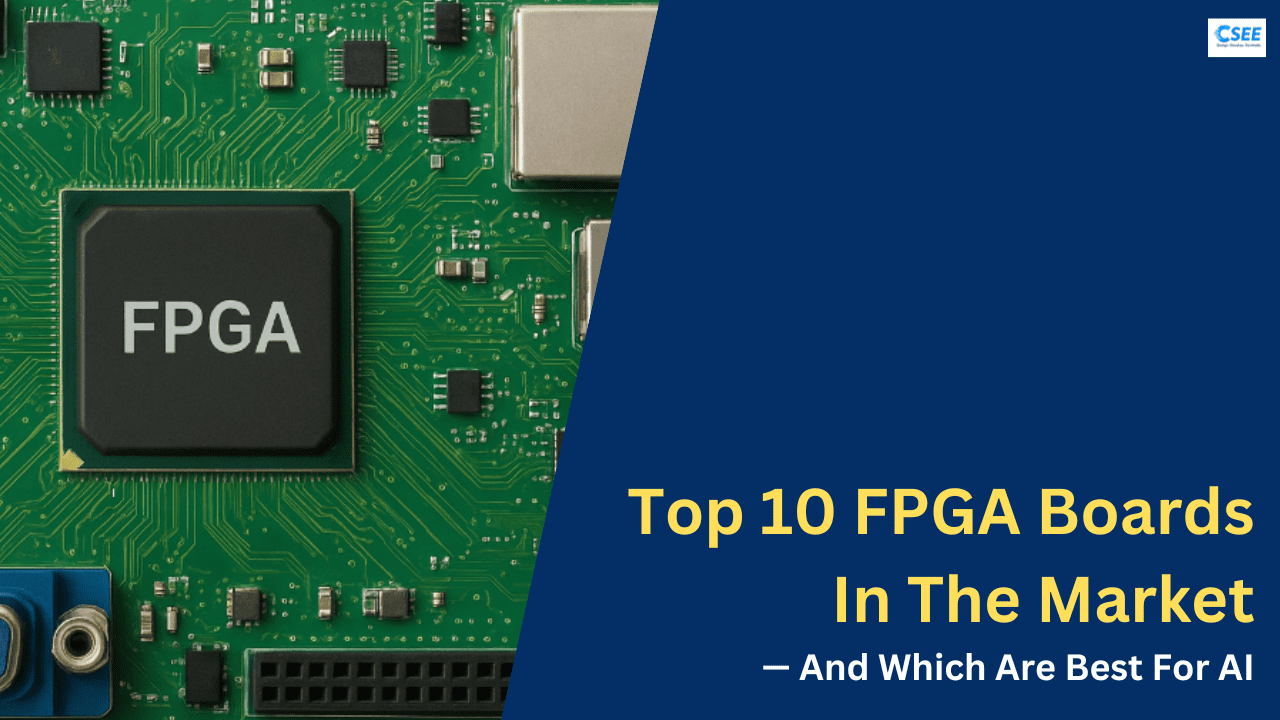
In this article, we’ll explore the Top 10 FPGA Boards in the Market — breaking down their performance, architecture, and best use cases — and finally reveal which FPGA is best suited for AI applications in 2025.
So, whether you’re a hardware enthusiast, AI developer, or automotive engineer, this guide will help you choose the perfect FPGA board for your next project — from low-cost entry-level kits to high-end boards built for serious machine learning workloads.
Ask questions if you have any electrical, electronics, or computer science doubts. You can also catch me on Instagram – CS Electrical & Electronics.
- Top 10 Applications Of FPGA In The Automotive Industry: Driving The Future Of Smart Mobility
- AI Libraries And Models Driving The Future Of Automotive And Semiconductor Industries
- Different Operating Systems Used in Automotive Infotainment (Including Indian OEMs)
Top 10 FPGA Boards In The Market
The world of hardware acceleration is changing fast, and FPGAs are no longer just the playground of hardware engineers or digital logic designers. They’ve become an essential bridge between the flexibility of CPUs and the raw power of GPUs — especially for Artificial Intelligence (AI) workloads.
Whether it’s real-time object detection in autonomous vehicles, low-latency inference in data centers, or efficient edge computing in smart factories, FPGAs are everywhere. But not all FPGA boards are created equal. Each comes with its strengths — some excel in data throughput, others in flexibility, power efficiency, or accessibility for developers.
In this article, we’ll explore the Top 10 FPGA boards currently dominating the market, compare their AI readiness, and help you decide which FPGA board is best suited for your AI projects — from hobbyist-level experimentation to enterprise-grade deployment.
Why FPGAs Matter for AI
Before diving into the top boards, it’s important to understand why FPGAs are becoming so relevant in AI.
Unlike CPUs (which are instruction-driven) or GPUs (optimized for dense parallel operations), FPGAs (Field-Programmable Gate Arrays) offer reconfigurable hardware that can be tailored to match the precise data flow of an AI model.
This flexibility gives FPGAs a few critical advantages:
- Ultra-low latency — great for real-time inference and control loops.
- Power efficiency — only the required logic is active.
- Custom data paths — you can optimize memory bandwidth and processing flow.
- Hardware-level parallelism — tailor-made pipelines instead of shared instruction sets.
In short, an FPGA can be as fast as a GPU for specific models — but far more efficient when optimized well. That’s why automotive, defense, telecom, and industrial AI systems increasingly rely on them.
How We Selected the Top 10
The boards in this list were chosen based on five key factors:
- AI capability — presence of DSPs, tensor engines, or AI accelerators.
- Toolchain support — compatibility with AI frameworks (Vitis AI, OneAPI, etc.).
- Ecosystem maturity — tutorials, libraries, and development community.
- Performance per watt — energy efficiency and bandwidth.
- Accessibility — cost, form factor, and ease of use for developers.
The list covers three major categories:
- Datacenter accelerators for large-scale AI inference
- Embedded/edge boards for real-time and low-latency applications
- Entry-level boards for learning, prototyping, and education
1. AMD/Xilinx Alveo U280 / U55C / U50 Series
These are the heavy hitters of the FPGA world — designed for datacenter-level AI acceleration.
The Alveo series boards are PCIe-based FPGA accelerators with ultra-high bandwidth memory (HBM), making them perfect for large neural network inference and data analytics workloads.
Why it’s great for AI:
- Equipped with HBM2 memory, providing enormous data throughput.
- Supports Vitis AI for deploying TensorFlow and PyTorch models directly.
- Excellent for large-batch inference tasks where GPUs can be bottlenecked by memory access.
Ideal for:
Cloud-based AI inference, data analytics, natural language processing, and recommendation systems.
Verdict:
If you want to bring FPGA acceleration into a server or AI lab setup, Alveo is your best bet.
2. AMD Versal VCK190 / VCK5000 (ACAP Series)
The Versal Adaptive Compute Acceleration Platform (ACAP) represents the next generation of FPGAs — combining CPUs, programmable logic, DSPs, and dedicated AI Engines all on one chip.
Why it’s great for AI:
- Built-in AI Engines provide high performance for CNN and transformer-based models.
- Low-latency, high-throughput performance ideal for telecom, radar, or real-time AI.
- Highly scalable with integrated networking, DDR/HBM, and versatile I/O.
Ideal for:
Telecom base stations, autonomous vehicle vision, and mixed-signal AI workloads.
Verdict:
If you want a hybrid AI platform combining hardware flexibility with dedicated tensor processing, Versal is the future of FPGA-based AI.
3. AMD Kria KV260 Vision AI Starter Kit
The Kria KV260 is one of the most developer-friendly FPGA kits on the market — specifically designed for AI vision applications.
It’s built on a Zynq UltraScale+ MPSoC and includes camera interfaces, Ethernet, and pre-built AI demos out of the box.
Why it’s great for AI:
- Tailored for edge vision — object detection, tracking, gesture recognition, etc.
- Supports pre-optimized AI pipelines for quick prototyping.
- Affordable and accessible even for new developers.
Ideal for:
Smart cameras, drones, robotics, and embedded AI research.
Verdict:
For beginners or startups building edge AI systems, Kria KV260 is arguably the best balance between cost, flexibility, and AI capability.
4. Intel Agilex Development Kits
Intel’s Agilex series is a powerful family of FPGAs known for high-speed I/O, PCIe Gen5, and integrated tensor-like blocks.
These chips are designed for networking, data center, and high-performance computing with AI acceleration in mind.
Why it’s great for AI:
- AI-optimized DSP blocks and massive memory bandwidth.
- Supports Intel’s OneAPI and OpenCL for high-level programming.
- Excellent integration with existing Intel CPU infrastructure.
Ideal for:
AI workloads that involve heavy networking, data flow optimization, or mixed compute operations.
Verdict:
If your team already uses Intel-based acceleration, Agilex provides a seamless path to AI-on-FPGA solutions.
5. Terasic DE10-Nano (Cyclone V SoC)
The DE10-Nano is a legendary board in the FPGA community — affordable, simple, and extremely versatile.
It’s not a monster in raw performance, but it’s a perfect entry point for learning FPGA-based AI.
Why it’s great for AI:
- ARM + FPGA combo for embedded AI.
- Thousands of open-source tutorials and community projects.
- Ideal for lightweight neural networks, audio classification, and small image models.
Ideal for:
Students, hobbyists, and researchers getting started with FPGA-based ML.
Verdict:
A perfect choice if you’re learning FPGA AI basics or want to build a low-cost prototype.
6. Lattice ECP5 and Versa Development Kits
The Lattice ECP5 family stands out for being ultra-low power and open-source friendly.
While not designed for massive AI workloads, these boards are perfect for TinyML and low-energy applications.
Why it’s great for AI:
- Low power consumption and cost-effective.
- Supported by open-source FPGA toolchains like Yosys and nextpnr.
- Ideal for small, quantized neural networks or signal processing AI.
Ideal for:
IoT devices, wearable AI, and ultra-low-power inference systems.
Verdict:
If your project demands energy efficiency and simplicity, ECP5 boards are unbeatable in their class.
7. BittWare and Achronix Accelerator Cards
Companies like BittWare and Achronix build enterprise-grade FPGA accelerator cards often used in data centers and research labs.
They offer customizable configurations and long product lifecycles for industrial deployment.
Why it’s great for AI:
- High-speed PCIe and HBM integration.
- Ready for rack-mount servers and production deployment.
- Strong vendor support for enterprise customers.
Ideal for:
Organizations deploying FPGA AI inference in telecom, banking, or cybersecurity.
Verdict:
If you’re building production-grade FPGA AI solutions, BittWare and Achronix cards are the premium enterprise choice.
8. AMD Zynq UltraScale+ Evaluation Boards
The Zynq UltraScale+ boards are the workhorses of the embedded FPGA world.
They offer multi-core ARM processors, FPGA fabric, and robust connectivity — making them ideal for edge AI and real-time control systems.
Why it’s great for AI:
- Combines CPU and FPGA in one SoC.
- Flexible for robotics, automotive, and industrial AI tasks.
- Supports Vitis AI for model deployment.
Ideal for:
Embedded AI systems, robotics, and advanced control applications.
Verdict:
For engineers who need balanced performance and flexibility, Zynq UltraScale+ boards are a proven and scalable solution.
9. AMD Versal SOMs and Production Modules
System-on-Modules (SOMs) built on Versal and UltraScale+ architectures provide a bridge between prototyping and production.
They include pre-certified modules, memory, and I/O on compact PCBs that can be integrated into end products.
Why it’s great for AI:
- Shorter time to market — ready-to-use modules.
- Compact and power-efficient.
- Easy scalability for volume production.
Ideal for:
Startups or companies ready to move their FPGA AI prototype into a product.
Verdict:
When you’re ready to deploy at scale, Versal SOMs are your fastest path to production.
10. Specialized Tiny/Edge FPGA Boards
A growing segment of the FPGA market focuses on TinyML and edge inference boards — small FPGAs integrated into modules or development kits that can perform simple AI tasks locally.
These are perfect for small devices that need to recognize gestures, sounds, or sensor patterns without sending data to the cloud.
Why it’s great for AI:
- Ultra-low latency, real-time response.
- Ideal for privacy-sensitive applications.
- Supports compact, quantized neural networks.
Ideal for:
IoT sensors, edge cameras, smart locks, and portable AI devices.
Verdict:
These tiny boards are revolutionizing how we think about AI — moving intelligence closer to the data source.
Which FPGA Is Best for AI?
There’s no single answer — it depends on where and how you’re deploying your AI models.
For Data Center AI
Go for AMD Alveo or Versal.
They offer massive bandwidth, HBM memory, and the highest acceleration density available today.
For Edge or Embedded AI
Choose Kria KV260 or Zynq UltraScale+ boards.
They balance cost, flexibility, and performance — ideal for real-time vision or industrial AI.
For Learning and Research
Start with Terasic DE10-Nano or Lattice ECP5.
They’re inexpensive, well-documented, and perfect for building your foundation in FPGA-based AI.
For Production Deployment
Opt for Versal SOMs or BittWare enterprise boards.
These platforms provide long-term support, reliability, and customization options for real products.
The Toolchains That Power FPGA AI
Each FPGA family comes with its ecosystem and AI toolchain:
- AMD/Xilinx Vitis AI: Convert trained models from PyTorch or TensorFlow into FPGA-executable formats.
- Intel OneAPI: Write AI kernels in C++ or OpenCL for Agilex and Stratix FPGAs.
- Open-Source Flows: For Lattice and smaller boards, open-source tools like Yosys and nextpnr enable flexible development.
FPGA toolchains are evolving rapidly, with increasing support for ONNX, quantization, and automated kernel generation — closing the gap between software and hardware.
How to Choose the Right Board
When selecting an FPGA for AI, consider these questions:
- What’s the target environment — data center, embedded device, or edge node?
- What’s the model complexity — small CNN or large transformer?
- How much latency and power can you afford?
- Do you need camera or sensor interfaces?
- How comfortable are you with hardware design tools?
- Do you plan to scale to production?
The key is to align your board’s capabilities with your project’s goals — not just buy the most powerful one.
Future Trends in FPGA AI
- Hybrid AI Engines: Modern FPGAs now include dedicated AI and DSP blocks, combining flexibility with native tensor processing.
- Unified AI Toolchains: Expect better cross-compatibility between frameworks and FPGA compilers.
- Edge AI Acceleration: Smaller, power-efficient FPGAs will dominate industrial and IoT applications.
- AI-Defined Hardware: FPGAs will increasingly configure themselves dynamically based on workload type.
- Partnership Ecosystems: Hardware-software co-design will become a standard approach to AI deployment.
Conclusion
FPGAs have quietly become one of the most powerful tools in the AI hardware landscape.
They combine the customizability of hardware with the flexibility of software, creating a sweet spot for developers who want to optimize performance, reduce power, and enable real-time intelligence.
If you’re building edge AI, go with Kria KV260 or Zynq UltraScale+.
For datacenter acceleration, Alveo and Versal are unmatched.
For learning, DE10-Nano and ECP5 are excellent.
And if you’re heading toward production, explore Versal SOMs or BittWare accelerators.
The future of AI won’t be powered by one chip type alone. It will be a symphony of CPUs, GPUs, and FPGAs — each doing what it does best. And as FPGA toolchains become more accessible, the ability to build hardware-level AI will soon be in the hands of every innovator.
This was about “Top 10 FPGA Boards In The Market“. Thank you for reading.
Also, read:
- 10 Free ADAS Projects With Source Code And Documentation – Learn & Build Today
- 100 + Electrical Engineering Projects For Students, Engineers
- 100+ Indian Startups & What They Are Building
- 1000+ Automotive Interview Questions With Answers
- 1000+ Electronics Projects For Engineers, Diploma, MTech Students
- 1000+ MATLAB Simulink Projects For MTech, Engineering Students
- 2026 Hackathons That Can Change Your Tech Career Forever
- 50 Advanced Level Interview Questions On CAPL Scripting