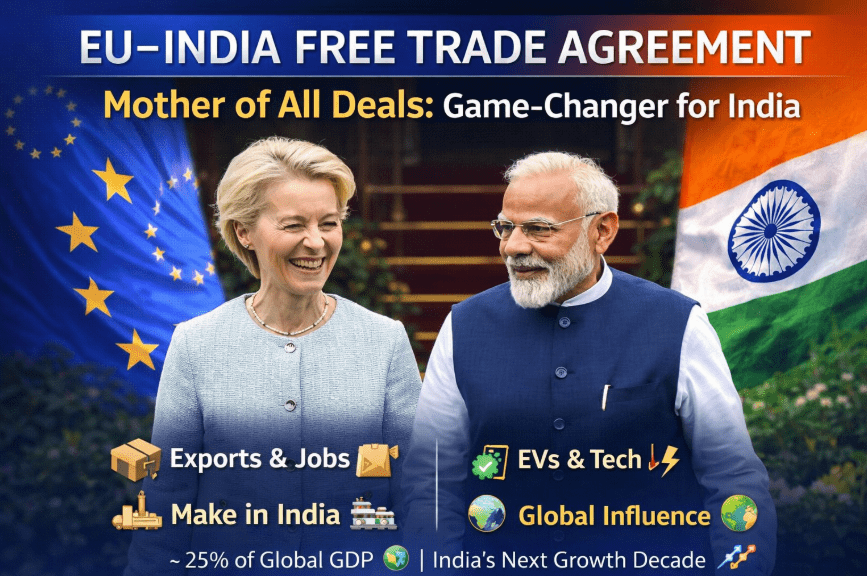
When headlines call the proposed EU–India Free Trade Agreement (FTA) the “Mother of all deals”, it’s not hype for clicks. This agreement, once finalized, will link two of the world’s largest economic blocs — India and the European Union — together in a structured trade partnership covering nearly 25% of global GDP.
In simple terms, this deal has the potential to influence:
- How India manufactures
- Where global companies invest
- How Indian talent works across borders
- And how India positions itself in a rapidly changing global order
This article explains what free trade actually means, why this agreement is strategically important, how India benefits sector by sector, what the EU gains, the challenges involved, and why the long-term impact could define India’s next growth decade.
1. What Does “Free Trade” Really Mean?
At its core, free trade means reducing or removing barriers that make cross-border business expensive or slow.
These barriers usually include:
- Import duties (taxes on goods)
- Complex regulations
- Restrictions on services and professionals
- Rules that discourage foreign investment
A Free Trade Agreement (FTA) does not mean trade becomes “free” overnight. Instead, countries gradually lower tariffs, simplify rules, and agree on common standards over several years.
In simple words:
Free trade means Indian companies can sell more easily in Europe, and European companies can do business in India with fewer obstacles.
2. Why the EU–India FTA Is Uniquely Important
India has signed FTAs before — with ASEAN, Japan, South Korea, and recently with Australia and the UAE. So why is the EU deal different?
Scale and complexity
- The EU is India’s largest trading partner
- 27 countries, one of the world’s richest consumer markets
- Highly regulated, high-quality standards
Economic weight
- EU GDP: ~€16 trillion
- India GDP: Rapidly growing and expected to be the world’s third-largest economy in the coming years
Together, they represent a quarter of the global economy, making this one of the largest FTAs ever negotiated.
3. India’s Big Wins: Sector-by-Sector Breakdown
3.1 IT and Digital Services: India’s Strongest Card
India’s IT and software services sector is globally competitive, but regulatory barriers still limit access in Europe.
FTA benefits include:
- Easier market access for Indian IT firms
- Recognition of professional qualifications
- Improved mobility for skilled professionals
- Growth of Global Capability Centers (GCCs)
This could significantly boost India’s services exports, which already outperform goods exports in value addition.
3.2 Manufacturing: Supercharging “Make in India”
Manufacturing is central to India’s long-term growth vision.
With the FTA:
- Indian-made goods face lower tariffs in Europe
- EU companies are encouraged to manufacture in India
- India becomes an export hub for global markets
Key beneficiary industries:
- Auto components
- Electronics
- Engineering goods
- Chemicals
- Industrial machinery
This aligns directly with India’s ambition to grow manufacturing’s share of GDP.
3.3 MSMEs: From Local to Global
India’s Micro, Small, and Medium Enterprises (MSMEs) employ millions but often struggle to scale globally.
The FTA can help by:
- Reducing export costs
- Improving access to EU buyers
- Integrating MSMEs into European supply chains
For many MSMEs, this deal could mean their first entry into global markets.
3.4 Pharmaceuticals and Healthcare
India is already known as the “pharmacy of the world.”
FTA advantages:
- Easier regulatory pathways
- Lower tariffs on generic drugs
- Stronger collaboration on medical research
- Improved access to EU healthcare markets
This could increase both exports and innovation partnerships.
3.5 Textiles, Apparel, and Leather
These sectors are highly sensitive to tariffs.
Currently, Indian products face higher duties compared to competitors like Bangladesh or Vietnam.
With the FTA:
- Indian textiles become more price-competitive
- Exports increase
- Employment rises, especially for women
This is a direct job-creation engine.
3.6 Automobiles, EVs, and Green Mobility
Europe leads in:
- Electric vehicles
- Battery technology
- Emission standards
India leads in:
- Scale
- Cost efficiency
- Market growth
The FTA encourages:
- Technology transfer
- Joint ventures
- EV manufacturing in India
- Export of components to Europe
This supports India’s clean mobility transition.
4. Technology and Innovation: Moving Up the Value Chain
One of India’s biggest long-term challenges is moving beyond low-cost production.
The EU–India FTA can accelerate:
- Advanced manufacturing
- R&D collaboration
- Semiconductor ecosystems
- AI, robotics, and Industry 4.0 adoption
This is how India shifts from “low-cost” to “high-value” manufacturing.
5. Foreign Direct Investment (FDI): Capital with Confidence
FTAs don’t just boost trade — they build trust.
For European investors, the deal provides:
- Predictable rules
- Investment protection
- Dispute resolution mechanisms
For India, this means:
- Long-term capital inflows
- Stable job creation
- Integration into global production networks
This is especially important in the China+1 strategy, where companies seek alternatives to China.
6. Jobs, Jobs, Jobs: The Human Impact
Trade agreements often sound abstract, but their real impact is measured in employment.
Direct jobs:
- Factory workers
- IT professionals
- Logistics and supply chain roles
Indirect jobs:
- Services
- Infrastructure
- Small vendors and suppliers
The EU–India FTA could support millions of jobs over the next decade, particularly for youth and skilled workers.
7. What India Gains from EU Imports
Free trade is a two-way street.
India benefits from importing:
- Advanced machinery
- Medical devices
- Industrial tools
- Clean energy equipment
These imports:
- Increase productivity
- Lower manufacturing costs
- Improve quality standards
Cheaper and better inputs help Indian firms compete globally.
8. Strategic and Geopolitical Significance
This deal is not just economic — it’s geopolitical.
In a world marked by:
- US–China trade tensions
- Supply-chain disruptions
- Geopolitical uncertainty
The EU–India partnership:
- Diversifies global trade
- Reduces over-dependence on any single country
- Positions India as a trusted global partner
Trade becomes a tool of strategic influence.
9. Why the EU Wants This Deal
From the EU’s perspective:
- India is one of the fastest-growing large economies
- A huge consumer market
- A manufacturing and digital hub
- A democratic, rules-based partner
The EU gains:
- Market access
- Supply-chain resilience
- Participation in India’s infrastructure and green transition
This is a mutual growth story, not a one-sided deal.
10. Challenges and Concerns
No major trade agreement is without friction.
Key challenges include:
- Protecting Indian farmers and sensitive sectors
- Managing competition for domestic industries
- Aligning with EU’s strict environmental and labor standards
- Balancing data protection and digital sovereignty
The success of the FTA depends on careful implementation, not just signing.
11. Long-Term Impact: India’s Next Growth Decade
If executed well, the EU–India FTA could:
- Accelerate GDP growth
- Boost exports sustainably
- Improve productivity
- Create high-quality jobs
- Strengthen India’s global standing
This deal supports India’s transition from:
A large market → a global manufacturing and innovation hub
Conclusion: More Than a Trade Deal
The EU–India Free Trade Agreement is not just about lowering tariffs or increasing exports.
It is about:
- Jobs for millions
- Technology for the future
- Stronger global partnerships
- India’s role in shaping the 21st-century economy
In simple words:
Free trade makes it easier to do business.
This deal makes it easier for India to grow.
If India plays this right, the “Mother of all deals” could truly become the foundation of its next economic leap. 🚀
Thanks for reading.
Also, read:
- India’s GaN Chip Breakthrough: Why Gallium Nitride Could Shape the Future of Defense Electronics
- India’s Chip Era Begins: A New Chapter in Semiconductor Manufacturing
- FlexRay Protocol – Deep Visual Technical Guide
- Top 50 AI-Based Projects for Electronics Engineers
- India AI Impact Summit 2026: The Shift from AI Hype to AI Utility
- Python Isn’t Running Your AI — C++ and CUDA Are!
- UDS (Unified Diagnostic Services) — Deep Visual Technical Guide
- Automotive Ethernet — Deep Visual Technical Guide