Hello guys, welcome back to my blog. In this article, I’m going to dive into how NXP’s S32G processors and i.MX microcontrollers are powering the future of software-defined vehicles. We’ll explore how these chips enable real-time diagnostics, predictive maintenance, secure cloud connectivity, over-the-air updates, and next-gen infotainment systems — making modern cars smarter, safer, and more connected than ever.
Ask questions if you have any electrical, electronics, or computer science doubts. You can also catch me on Instagram – CS Electrical & Electronics
- 10 Free ADAS Projects With Source Code And Documentation – Learn & Build Today
- From Fonts To Steering: How Tesla’s Software-Driven Recalls Are Reshaping Car Safety
- Top 5 AI Tools To Design & Simulate Electronic Circuits In 2025
How NXP’s S32G and i.MX Processors Power the Software-Defined Vehicle Revolution
If you own a car made in the last few years, chances are it’s more like a smartphone on wheels than a purely mechanical machine. You can stream music, receive real-time navigation updates, and even have your vehicle’s software updated without stepping foot in a service center.
But have you ever wondered how your car actually “thinks” and decides when to communicate with the cloud, run a diagnostic check, or play your favorite playlist? A big part of the answer lies in NXP Semiconductors, specifically their S32G processors and i.MX microcontrollers (MCUs).
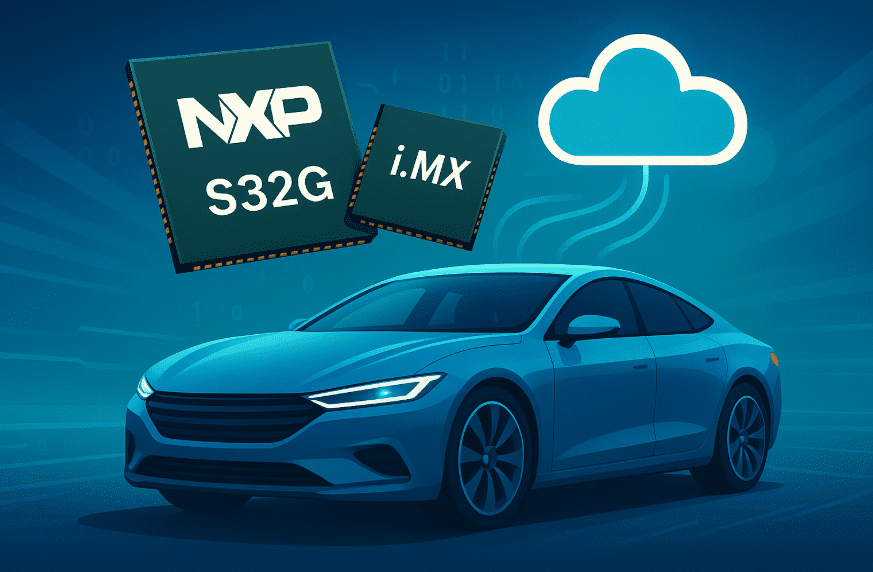
These chips are the digital brains of today’s software-defined vehicles (SDVs) — enabling connectivity, infotainment, predictive maintenance, and cybersecurity.
1. The Rise of Software-Defined Vehicles (SDVs)
Before we dive into NXP’s role, it’s important to understand what a software-defined vehicle is and why it’s shaping the future of mobility.
A software-defined vehicle is one in which much of the car’s core functionality is controlled and improved via software updates rather than physical hardware changes. That means features, performance, and even safety systems can be enhanced after the vehicle leaves the factory.
This transformation is being driven by:
- Connectivity – Cars now communicate constantly with the cloud.
- Data-driven decision making – Sensors feed real-time information to processors.
- Over-the-air updates (OTA) – Cars can receive fixes and upgrades without service visits.
- Enhanced cybersecurity – Protecting against growing digital threats.
- Infotainment integration – Smooth multimedia and navigation experiences.
NXP plays a key role here by providing specialized automotive processors that handle these complex, interconnected tasks.
2. Meet the S32G Processors – The Vehicle’s Data Powerhouse
Think of the S32G processor as the chief operating officer of your car’s data.
These processors:
- Collect data from the car’s various systems — engine, brakes, ADAS sensors, infotainment, and more.
- Process the data in real time for decision-making.
- Securely send data to the cloud for analysis and updates.
- Enable predictive maintenance by spotting issues before they become critical.
2.1 Real-Time Diagnostics
In traditional cars, a fault code would trigger a dashboard warning, and you’d have to visit a mechanic to diagnose the issue. With S32G processors, the vehicle can:
- Identify the problem immediately.
- Send details to the manufacturer or service network.
- Recommend action before a breakdown occurs.
This is predictive maintenance in action — reducing downtime and saving money for both drivers and fleet operators.
3. Over-the-Air Updates – Your Car Learns Without a Wrench
Gone are the days when every update required a trip to the dealership.
With NXP S32G, cars can receive OTA software updates — similar to how your smartphone updates overnight.
These updates can:
- Fix software bugs.
- Improve fuel efficiency.
- Enhance safety features.
- Add entirely new capabilities.
This means your car actually gets better with age instead of becoming outdated.
4. i.MX Microcontrollers – The Infotainment Masters
While S32G processors focus on vehicle networking and safety-critical data, NXP’s i.MX microcontrollers run the systems you interact with daily inside the cabin.
They power:
- Navigation systems – Smooth, real-time GPS mapping.
- Music & multimedia – High-quality audio playback and streaming.
- Voice control – Seamless voice commands for hands-free operation.
- Touchscreens – Responsive and fluid interactions.
A clunky infotainment system can frustrate drivers — but with i.MX MCUs, performance is fast, reliable, and visually appealing.
5. Cybersecurity – Keeping Vehicles Safe in the Digital Age
With connectivity comes vulnerability. A connected car is potentially at risk from cyber threats — from unauthorized access to malicious software injection.
NXP tackles this with:
- Secure boot processes – Ensuring only trusted software runs.
- Hardware security modules (HSMs) – Protecting encryption keys and authentication.
- Intrusion detection systems – Monitoring for abnormal behavior in real time.
The S32G processors integrate security at the hardware level, making hacking far more difficult.
6. Why NXP’s Role is Critical for the Future
Without companies like NXP, the dream of truly connected, software-defined, and secure vehicles would be years away. Their processors are essentially enabling:
- Faster innovation cycles – Automakers can roll out features quickly.
- Cost savings – OTA updates replace costly recalls for software bugs.
- Better driver experience – From predictive maintenance to smart infotainment.
- Longevity of vehicles – Cars remain relevant with continuous software enhancements.
7. Real-World Applications and Case Studies
Let’s look at some real-world scenarios where NXP’s technology is already making an impact:
- Fleet management – Commercial vehicles using S32G processors can send continuous health reports to fleet managers, reducing downtime.
- EV optimization – Electric cars can receive software updates that improve battery efficiency or charging speed.
- ADAS integration – Data from multiple sensors can be processed quickly for lane-keeping, adaptive cruise control, and collision avoidance.
- Connected infotainment – Premium vehicles offer buttery-smooth touchscreen performance thanks to i.MX MCUs.
8. The Road Ahead – Towards Fully Autonomous and Smart Mobility
NXP’s innovations are paving the way for:
- Level 4 and Level 5 autonomy – Where vehicles operate without human intervention.
- V2X communication – Cars talking to each other and to infrastructure for safer roads.
- Personalized in-car experiences – The car adjusting settings automatically based on who’s driving.
- Integration with smart cities – Vehicles becoming part of a larger connected ecosystem.
Conclusion: Building the Smarter Car of Tomorrow
NXP’s S32G processors and i.MX microcontrollers are quietly transforming the way we interact with vehicles. From real-time diagnostics and predictive maintenance to infotainment and cybersecurity, their chips enable the very concept of a software-defined vehicle.
As cars become more connected, autonomous, and personalized, the technology powering them will be just as important as the engines that drive them. With NXP at the heart of this transformation, the future of mobility looks not just smarter — but truly intelligent.
This was about “How NXP’s S32G and i.MX Processors Power the Software-Defined Vehicle Revolution“. Thank you for reading.
Also, read:
- 10 Free ADAS Projects With Source Code And Documentation – Learn & Build Today
- 100 + Electrical Engineering Projects For Students, Engineers
- 100+ Indian Startups & What They Are Building
- 1000+ Automotive Interview Questions With Answers
- 1000+ Electronics Projects For Engineers, Diploma, MTech Students
- 1000+ MATLAB Simulink Projects For MTech, Engineering Students
- 2026 Hackathons That Can Change Your Tech Career Forever
- 50 Advanced Level Interview Questions On CAPL Scripting