For decades, Indian engineers—especially those from Electrical and Electronics Engineering (EEE) and Electronics and Communication Engineering (ECE)—have been told the same story:
“Core jobs are limited in India.”
“Real semiconductor work happens abroad.”
“Most ECE graduates end up in IT.”
Budget 2026 changes this story.
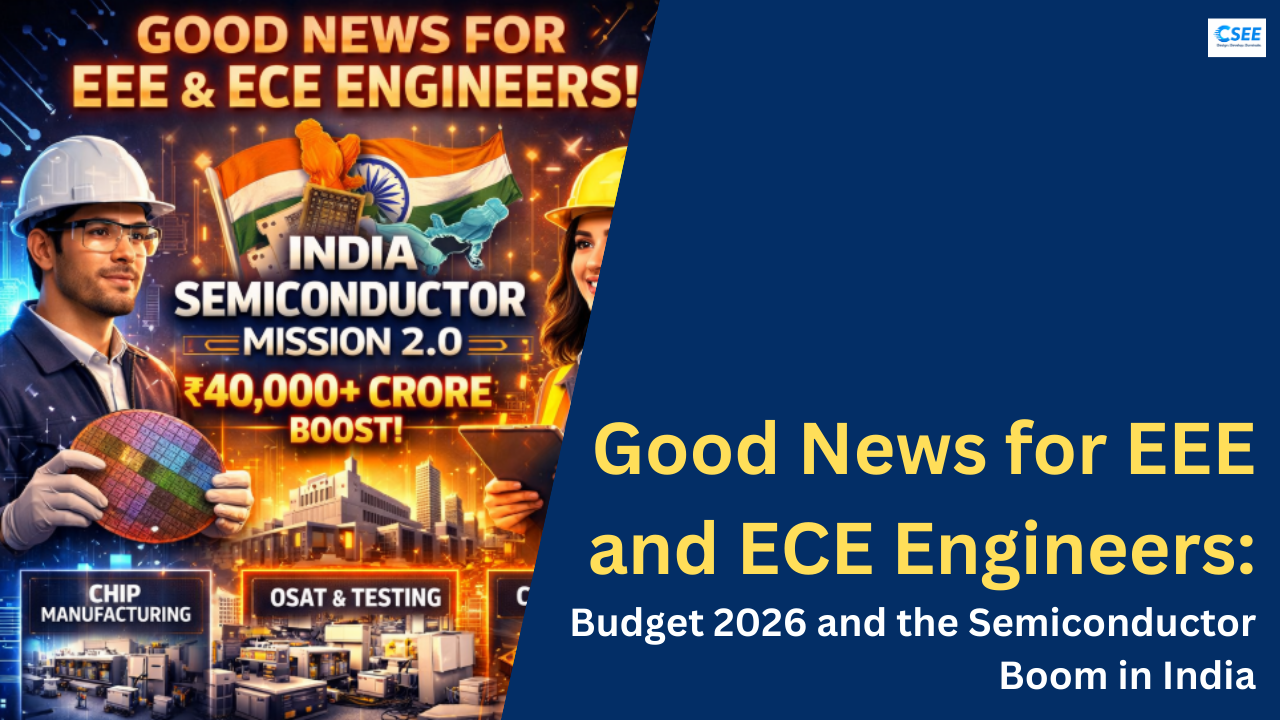
With ₹40,000+ crore allocated under India Semiconductor Mission (ISM) 2.0, the Indian government has made one thing very clear:
Semiconductors are a national priority, and engineers are at the center of this mission.
This is not just a policy announcement. This is job creation, industry building, and long-term career security—especially for EEE and ECE engineers.
The simple message is powerful:
Semiconductors are the future, and EEE & ECE engineers will benefit the most. 🚀
Why Semiconductors Matter (In Simple Terms)
Semiconductors are not just “chips.”
They are the brains and nervous system of the modern world.
Every device you use depends on them:
- Smartphones 📱
- Laptops 💻
- Electric vehicles 🚗
- Solar inverters ☀️
- Power grids ⚡
- Medical equipment 🏥
- Defence systems 🛡️
- AI servers 🤖
- 5G and 6G networks 📡
If semiconductors stop, the world stops.
That’s why countries like the USA, China, Taiwan, South Korea, and Japan invest billions every year in chip manufacturing and design.
India has decided:
“We cannot depend on imports anymore.”
And that decision opens massive opportunities for engineers.
What Is India Semiconductor Mission 2.0?
India Semiconductor Mission (ISM) 2.0 is the next phase of India’s semiconductor strategy.
The goals are clear:
- Manufacture chips in India
- Test and package chips in India
- Design chips in India
- Build a complete semiconductor ecosystem
- Create high-quality engineering jobs
The ₹40,000+ crore allocation in Budget 2026 is meant to accelerate all of this.
This is not one factory.
This is an entire industry being built from scratch.
Three Big Pillars of the Semiconductor Push
1. Chip Manufacturing (Semiconductor Fabs)
Chip manufacturing plants (called fabs) are where silicon wafers are turned into integrated circuits.
These facilities require:
- Ultra-clean environments
- Precision power systems
- Advanced automation
- Complex process control
This is where EEE and ECE engineers are critical.
Engineers Needed in Chip Fabs:
- Process Engineers
- Equipment Engineers
- Electrical Systems Engineers
- Yield Engineers
- Reliability Engineers
- Maintenance & Automation Engineers
Each fab directly employs thousands of engineers and indirectly supports many more jobs.
2. OSAT Units (Outsourced Semiconductor Assembly and Test)
Let’s keep this simple.
After a chip is manufactured:
- It must be cut
- Packaged
- Tested
- Qualified
This work is done in OSAT units.
India is heavily promoting OSAT because:
- Lower cost compared to fabs
- Faster setup
- Huge job potential
Jobs Created in OSAT Units:
- Test Engineers
- Validation Engineers
- Packaging Engineers
- Hardware Engineers
- Failure Analysis Engineers
- Production & Quality Engineers
This area is perfect for freshers and mid-level ECE/EEE engineers.
3. Chip Design Ecosystem
Chip design is where India already has some strength—but now it’s expanding fast.
Design includes:
- Digital design
- Analog design
- Mixed-signal design
- Physical design
- Verification
- DFT (Design for Test)
Companies Hiring:
- Global semiconductor giants
- Indian startups
- Automotive chip companies
- AI chip startups
- Defence electronics firms
This means high-paying core jobs without leaving India.
Why Budget 2026 Is a Game Changer
Earlier semiconductor announcements raised hopes.
Budget 2026 makes it real.
Here’s why:
1. Big Money = Serious Intent
₹40,000+ crore is not symbolic.
It funds:
- Infrastructure
- Subsidies
- Power and water support
- R&D
- Skill development
2. Long-Term Vision
Semiconductor plants run for 20–30 years.
This means career stability, not short-term hiring.
3. Global Confidence
Global companies invest only where governments are committed.
This budget tells the world:
“India is serious about semiconductors.”
What This Means for EEE Engineers
EEE engineers often ask:
“Where are the core electrical jobs?”
Here is your answer.
High-Demand Roles for EEE Engineers
- Power Systems Engineers
- High-voltage Equipment Engineers
- Industrial Electrical Engineers
- Automation & Control Engineers
- Energy Management Engineers
- Reliability Engineers
Semiconductor fabs consume massive power and require:
- Zero downtime
- Stable supply
- Advanced power electronics
EEE engineers are mission-critical here.
What This Means for ECE Engineers
ECE engineers are the backbone of the semiconductor industry.
High-Demand Roles for ECE Engineers
- VLSI Design Engineers
- Embedded Engineers
- Test & Validation Engineers
- Process Engineers
- Packaging Engineers
- RF & Communication Engineers
Whether it’s design, testing, or manufacturing, ECE engineers dominate this space.
Job Creation: How Big Is the Opportunity?
Let’s talk numbers—conservatively.
Direct Jobs
- Each fab: 1,500–3,000 engineers
- Each OSAT unit: 1,000–2,000 engineers
- Design centers: hundreds per company
Indirect Jobs
- Equipment suppliers
- Automation vendors
- Power & infrastructure firms
- Logistics & materials
- Software tools and EDA
Total impact: Lakhs of jobs over the next decade.
Salary Growth and Pay Benefits
Core semiconductor jobs pay significantly better than many IT roles over time.
Why?
- Specialized skills
- High responsibility
- Global standards
- Limited talent supply
As the ecosystem matures:
- Entry-level salaries rise
- Mid-career engineers see sharp growth
- Senior engineers earn global-level pay
Global Exposure Without Leaving India
One major benefit often overlooked:
You can work on global technology while staying in India.
Engineers will collaborate with:
- US fabs
- European automotive companies
- Japanese equipment makers
- Korean and Taiwanese chip leaders
This brings:
- International standards
- Cutting-edge learning
- Strong global resumes
Startup Boom in Semiconductors
Where big industries grow, startups follow.
Expected startup areas:
- Chip design IP
- Embedded systems
- AI accelerators
- Power electronics
- EV electronics
- Testing tools
- Semiconductor software
This is huge for:
- Young engineers
- Founders
- Researchers
- Product builders
Long-Term Career Stability
Unlike hype-driven tech trends, semiconductors are:
- Infrastructure-level
- Long-cycle
- Mission-critical
Once you enter this field:
- Skills remain relevant for decades
- Experience compounds
- Career paths are stable
This is not a short-term bubble.
What Students and Freshers Should Do Now
If you are:
- An EEE student
- An ECE student
- A recent graduate
Start Focusing On:
- VLSI fundamentals
- Semiconductor basics
- Embedded systems
- Power electronics
- Testing and validation
- Python, MATLAB, automation basics
The industry is growing, but skills still matter.
What Working Engineers Should Do
If you already work in:
- IT
- Embedded
- Electronics
- Automotive
- Power sector
This is a great time to:
- Upskill
- Transition into semiconductor roles
- Move closer to core engineering
India’s Strategic Advantage
India offers:
- Large engineering talent pool
- Cost advantage
- Strong government support
- Growing domestic market
This makes India a long-term semiconductor hub, not a temporary one.
Challenges (And Why They’re Solvable)
Yes, challenges exist:
- Skill gaps
- Long setup timelines
- High initial costs
But with:
- Government funding
- Industry partnerships
- Academic collaboration
These challenges are already being addressed.
The Bigger Picture: National Impact
Semiconductors are not just about jobs.
They impact:
- National security
- Economic independence
- Technological leadership
- Manufacturing strength
Engineers are now nation builders, not just employees.
Final Message to EEE & ECE Engineers
Let’s keep it simple:
- Semiconductors are the future
- Budget 2026 makes it real
- EEE & ECE engineers are the biggest winners
- Jobs, pay, growth, and stability are coming
- This is a once-in-a-generation opportunity
India is building its semiconductor ecosystem.
And engineers will build their careers with it. 🚀
Thanks for reading.
Also, read:
- India’s GaN Chip Breakthrough: Why Gallium Nitride Could Shape the Future of Defense Electronics
- India’s Chip Era Begins: A New Chapter in Semiconductor Manufacturing
- FlexRay Protocol – Deep Visual Technical Guide
- Top 50 AI-Based Projects for Electronics Engineers
- India AI Impact Summit 2026: The Shift from AI Hype to AI Utility
- Python Isn’t Running Your AI — C++ and CUDA Are!
- UDS (Unified Diagnostic Services) — Deep Visual Technical Guide
- Automotive Ethernet — Deep Visual Technical Guide