Hello guys, welcome back to my blog! ⚡?
Today, we’re diving into one of the most fascinating applications of Artificial Intelligence — power plants — and how AI is transforming the way we generate and manage energy. From fully autonomous facilities in Japan to predictive maintenance systems in South Korea, AI is taking over some of the toughest challenges in the energy sector.
In this article, I’ll walk you through how AI is being used to run power plants with minimal human intervention, detect problems before they cause breakdowns, deploy smart robots for hydropower inspections, and even optimize fuel efficiency in thermal stations. Each example comes straight from real-world projects already making a difference today.
By the end, you’ll see why AI in power plants isn’t just a futuristic idea — it’s already here, helping us save fuel, cut emissions, improve safety, and make energy systems smarter. ⚡ Whether you’re an engineer, a tech enthusiast, or just curious about how AI is reshaping the world’s infrastructure, this blog will give you a front-row seat to one of the biggest revolutions in energy.
Ask questions if you have any electrical, electronics, or computer science doubts. You can also catch me on Instagram – CS Electrical & Electronics.
- How Diffusion Models Can Help In The Automotive Industry
- ADAS Technologies Explained: Complete Guide To Advanced Driver Assistance Systems (2025)
- Electric Cars Need Precise Power – How Texas Instruments is Driving the Future of EVs
Case Studies Of AI In Power Plants Worldwide
Energy is the backbone of modern civilization. Every light switch we turn on, every train we board, and every device we charge is powered by massive systems working silently in the background. Power plants have been at the center of this system for more than a century, producing the electricity that drives economies and improves lives. But with growing demand, stricter environmental regulations, and the urgent push toward cleaner, more efficient energy, traditional ways of operating these plants are no longer enough.
Enter Artificial Intelligence (AI).
AI is already transforming industries like healthcare, finance, and transportation—but one of its most powerful applications is in the energy sector. Imagine a power plant that can monitor itself, predict problems before they happen, optimize how fuel is used, and even run without constant human intervention. That’s not science fiction—it’s happening today.
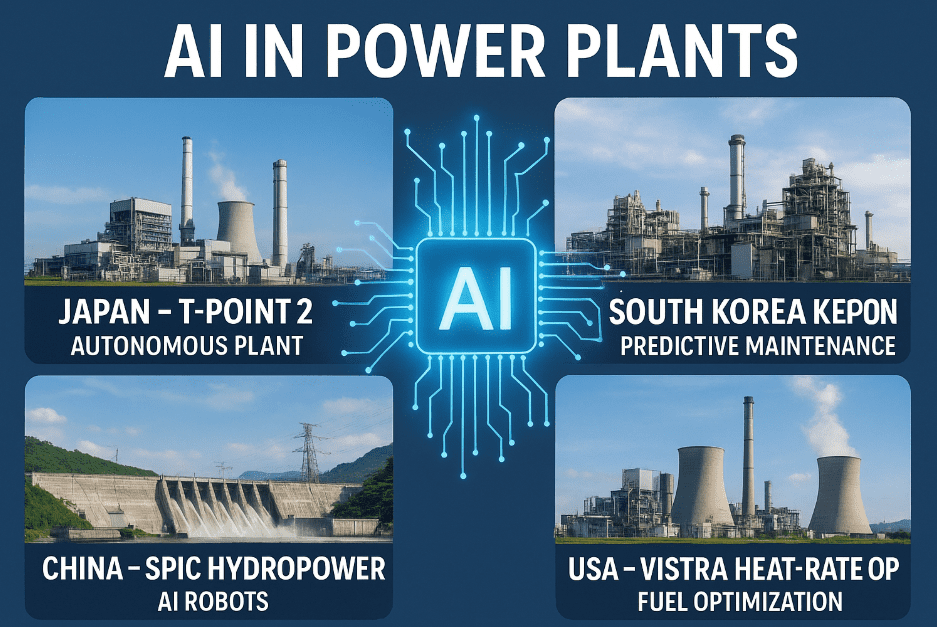
Around the world, some of the most advanced energy companies are already experimenting with, and in some cases fully deploying, AI in their facilities. Japan has created the world’s first fully autonomous power plant. South Korea is using AI to process mountains of sensor data for predictive maintenance. In China, AI-powered robots inspect and maintain hydropower stations, keeping workers safe and plants more reliable. And in the United States, AI is being used to optimize fuel use, saving money and reducing emissions at scale.
These are not small pilot projects—they are real, operational systems shaping the future of how we generate and manage electricity. Each case provides valuable lessons about the potential of AI in energy: improving efficiency, reducing costs, enhancing safety, and pushing us toward more sustainable operations.
In this article, we’ll take a detailed look at these four real-world examples, understand how AI is applied, explore the benefits achieved, and discuss the challenges and opportunities that lie ahead. By the end, you’ll see why AI is not just a tool—it’s becoming the brain of modern power plants.
? AI in Power Plants – The Big Picture
To understand why AI is so important in energy, let’s first look at how traditional power plants operate.
A typical thermal power plant runs on coal, natural gas, or oil. It has boilers, turbines, pumps, and a maze of sensors and control systems. Operators are constantly monitoring pressure, temperature, fuel mix, and output to keep the plant stable. Hydropower plants, on the other hand, rely on massive dams, tunnels, and turbines powered by flowing water. These also need continuous inspections and precise adjustments to maintain safe and reliable output.
For decades, plant operation has depended heavily on human expertise. Experienced engineers could read sensor data, detect problems, and make adjustments. But as plants have grown more complex and demand for efficiency has skyrocketed, relying only on human judgment is no longer enough. There are simply too many signals, too much data, and too many variables to process in real time.
This is where AI comes in.
AI can process massive streams of data in seconds, something impossible for human teams. It can detect tiny patterns or anomalies that indicate a problem—like a slight increase in vibration that might signal a turbine fault. It can optimize fuel combustion far better than human operators, continuously adjusting parameters to squeeze out maximum efficiency. And with robotics and machine learning, AI can even take over routine inspections and maintenance, reducing human risk.
The benefits are clear:
- Efficiency gains: AI ensures plants use less fuel or water while producing the same output.
- Cost reduction: By predicting failures and avoiding downtime, AI saves millions in repairs.
- Safety improvements: Robots and predictive systems protect human workers from dangerous environments.
- Sustainability: Smarter operations mean lower emissions and cleaner energy production.
Globally, power companies are realizing that AI is not just a nice-to-have, but a must-have for the future. With stricter emission regulations, rising energy demand, and pressure to integrate renewables, AI offers the intelligence needed to balance reliability, cost, and sustainability.
Now, let’s explore four major real-world examples that show how AI is already reshaping the power sector.
? Case Study 1: Japan – Mitsubishi T-Point 2
In 2020, Mitsubishi Hitachi Power Systems (MHPS) made history with the launch of T-Point 2, the world’s first fully autonomous power plant. Located in Takasago, Japan, this facility is a groundbreaking example of how AI can control every aspect of plant operation.
At the core of T-Point 2 is Mitsubishi’s TOMONI AI suite. Unlike traditional control systems, which mainly monitor and alert, TOMONI actively controls boilers, turbines, and auxiliary systems. It can predict operational changes before they happen and automatically adjust plant settings to maintain stability.
For example, if demand suddenly spikes, TOMONI adjusts the turbine output instantly. If a sensor shows unusual heat levels, the system runs predictive models to decide whether it’s a normal fluctuation or a sign of trouble. All of this happens without waiting for human intervention.
The benefits are huge:
- Stability: Continuous AI monitoring keeps output steady even in changing conditions.
- Efficiency: By fine-tuning combustion and turbine speed, TOMONI improves fuel use.
- Reduced downtime: Predictive features cut unplanned outages.
What makes T-Point 2 especially important is that it’s not just a pilot project. It’s a real operational plant, running on commercial power, proving that autonomous power plants are possible today. For Japan, a country with limited natural resources and a need for energy efficiency, this model offers a glimpse into the future of power generation.
? Case Study 2: South Korea – KEPCO’s IDPP
South Korea’s KEPCO (Korea Electric Power Corporation) has taken a different but equally powerful approach with its Intelligent Digital Power Plant (IDPP) initiative. Instead of going fully autonomous, KEPCO focused on predictive maintenance and operational insights.
Modern power plants generate mountains of sensor data every second. Pressure levels, vibrations, chemical readings, temperatures, and more are constantly tracked. For human engineers, analyzing all this data in real time is nearly impossible. But for AI, it’s second nature.
KEPCO’s IDPP platform ingests this data, processes it with machine learning, and looks for anomalies. For example, if a turbine bearing begins to vibrate at a slightly unusual frequency, the AI detects it before it becomes a bigger problem. It then recommends an inspection or adjustment.
This has several advantages:
- Early fault detection: Problems are caught before they cause failures.
- Lower maintenance costs: Repairs are done proactively, not reactively.
- Higher uptime: Plants experience fewer outages.
One real-world case saw KEPCO reduce maintenance downtime significantly by using AI predictions to schedule inspections at the right time. Instead of waiting for a breakdown or following a fixed schedule, maintenance is now optimized, saving both time and money.
This approach is especially valuable for South Korea, which relies heavily on imported fuel. By reducing waste and maximizing uptime, KEPCO’s AI systems help keep energy costs manageable while ensuring reliability.
? Case Study 3: China – SPIC Hydropower
China is home to some of the world’s largest hydropower projects, and maintaining them is no small task. Massive dams, long tunnels, and giant turbines require constant inspection. Traditionally, this meant sending workers into potentially dangerous environments—a slow, costly, and risky process.
Enter AI-powered robots at SPIC (State Power Investment Corporation) hydropower stations. These robots are equipped with cameras, sensors, and AI algorithms that allow them to crawl through tunnels, scan equipment, and report findings in real time.
The AI analyzes the data and highlights issues that need immediate attention. For example, if a crack is forming in a tunnel wall, the AI detects it early and alerts engineers. If a turbine blade shows wear, maintenance can be scheduled before failure.
Benefits include:
- Worker safety: Humans no longer need to enter hazardous areas as often.
- Efficiency: Inspections that once took weeks can now be completed in hours.
- Reliability: Continuous monitoring keeps stations running longer without shutdowns.
For a country like China, where hydropower is a critical part of the renewable energy mix, AI-driven maintenance ensures these facilities operate at peak performance. It also sets the stage for global adoption of AI robotics in energy infrastructure.
? Case Study 4: USA – Vistra Heat-Rate Optimizer
In the United States, Vistra Corp, one of the largest power producers, has embraced AI to tackle one of the biggest challenges in thermal plants: fuel efficiency.
Vistra developed an AI-based Heat-Rate Optimizer. The “heat rate” measures how much fuel is needed to produce one unit of electricity. Lowering the heat rate means burning less fuel for the same output—saving money and reducing emissions.
Traditionally, operators adjusted fuel mix and combustion settings based on experience. But AI does this much better. It continuously monitors plant performance, runs predictive models, and fine-tunes operations in real time.
The results have been impressive:
- Fuel savings: Significant cost reductions across multiple plants.
- Cleaner operations: Lower greenhouse gas emissions.
- Scalability: The optimizer has been rolled out across plants in different regions.
For the U.S., where balancing economic growth and environmental responsibility is a constant challenge, this use of AI offers a practical solution—cut costs, cut emissions, and keep power reliable.
? Challenges & Risks of AI in Power Plants
While these examples show the potential of AI, there are still challenges to overcome.
- Cybersecurity: Power plants are critical infrastructure. If AI systems are hacked or manipulated, the consequences could be severe.
- Data quality: AI is only as good as the data it receives. Incomplete or faulty sensor data can lead to wrong decisions.
- Cost of adoption: Retrofitting older plants with AI systems requires a major investment.
- Human factor: Engineers may resist relying too much on AI, especially in safety-critical environments.
- Regulation: Governments will need to set standards to ensure AI in power plants is safe and reliable.
These risks are not insurmountable, but they require careful planning and robust systems to ensure AI delivers on its promises.
? Future of AI in Energy
The four examples we’ve seen are just the beginning. The future of AI in energy is even more exciting.
- AI in renewables: Solar and wind farms are already using AI to forecast weather and optimize output.
- Digital twins: Entire power plants can be simulated in AI-powered digital models to test scenarios before applying them in real life.
- AI-powered grids: Smart grids will use AI to balance supply and demand in real time, reducing blackouts and improving reliability.
- Hydrogen and new technologies: As new energy sources emerge, AI will play a key role in making them viable at scale.
Ultimately, the vision is of a world where AI manages the entire energy chain—from generation to transmission to consumption—making energy systems cleaner, safer, and more resilient.
? Conclusion
From Japan’s autonomous T-Point 2 to South Korea’s predictive IDPP, from China’s AI robots in hydropower to the USA’s Heat-Rate Optimizer, AI is proving its worth in real-world energy applications.
These aren’t experiments—they’re working systems that save money, improve efficiency, and protect both people and the planet.
AI is no longer just about robots or self-driving cars. It is quietly becoming the brain of our energy infrastructure. The question is not whether AI will power the future of energy, but how quickly every country will embrace it.
This isn’t the future—it’s already happening today. ?⚡
This was about “Case Studies Of AI In Power Plants Worldwide“. Thank you for reading.
Also, read:
- 100 (AI) Artificial Intelligence Applications In The Automotive Industry
- 1000+ Automotive Interview Questions With Answers
- 2024 Is About To End, Let’s Recall Electric Vehicles Launched In 2024
- 2026 Hackathons That Can Change Your Tech Career Forever
- 6G Technology: What To Expect Beyond 5G
- 7 Ways EV Batteries Stay Safe From Thermal Runaway
- 8 Reasons Why EVs Can’t Fully Replace ICE Vehicles in India
- 90% Of The World’s Most Advanced Chips Come from One Place — Why TSMC Quietly Runs the Modern World