The automotive world is undergoing one of the biggest transformations since the invention of the internal combustion engine. Vehicles are no longer just mechanical machines; they are evolving into powerful, intelligent computing platforms on wheels. This shift toward software-defined vehicles is reshaping how automotive systems are designed, developed, tested, and deployed. As software becomes the heart of the vehicle, the industry needs development methods that are faster, safer, more scalable, and resilient to complexity. This is where model-based design becomes an essential pillar for the next generation of automotive engineering.
Software-defined vehicles are characterized by centralized computing, high-performance electronic control units, cloud connectivity, Ethernet-based communication, flexible over-the-air updates, and large, highly integrated software stacks. All of these require engineering teams to follow a drastically different development approach than traditional automotive engineering. Historically, vehicle software was scattered across dozens of ECUs, each with its own firmware, tools, and development teams. Today, automotive OEMs and suppliers want unified platforms with common architectures, shared software layers, and the ability to update features even after the vehicle has been sold.
This huge transition introduces challenges in software quality, system integration, verification, validation, cybersecurity, functional safety, and long-term maintainability. Adding advanced driver-assistance systems, autonomous perception pipelines, vehicle-to-everything communication, and cloud-connected services increases the complexity exponentially. Traditional spreadsheets, document-heavy processes, and manually written code simply cannot keep up with the demands of software-defined mobility.
Model-based design solves these challenges by moving the engineering process into an environment where the system is represented as a set of executable models. These models behave like the real system long before hardware exists, which drastically accelerates development. Model-based design captures requirements visually, allows simulation at every stage, generates production-grade code automatically, and provides end-to-end traceability from concept to deployment.
To understand how model-based design empowers software-defined vehicle development, it is important to explore the demands of modern automotive software, the limitations of traditional workflows, and the transformative nature of high-fidelity modeling and automated code generation.
The Rise of Software-Defined Vehicles
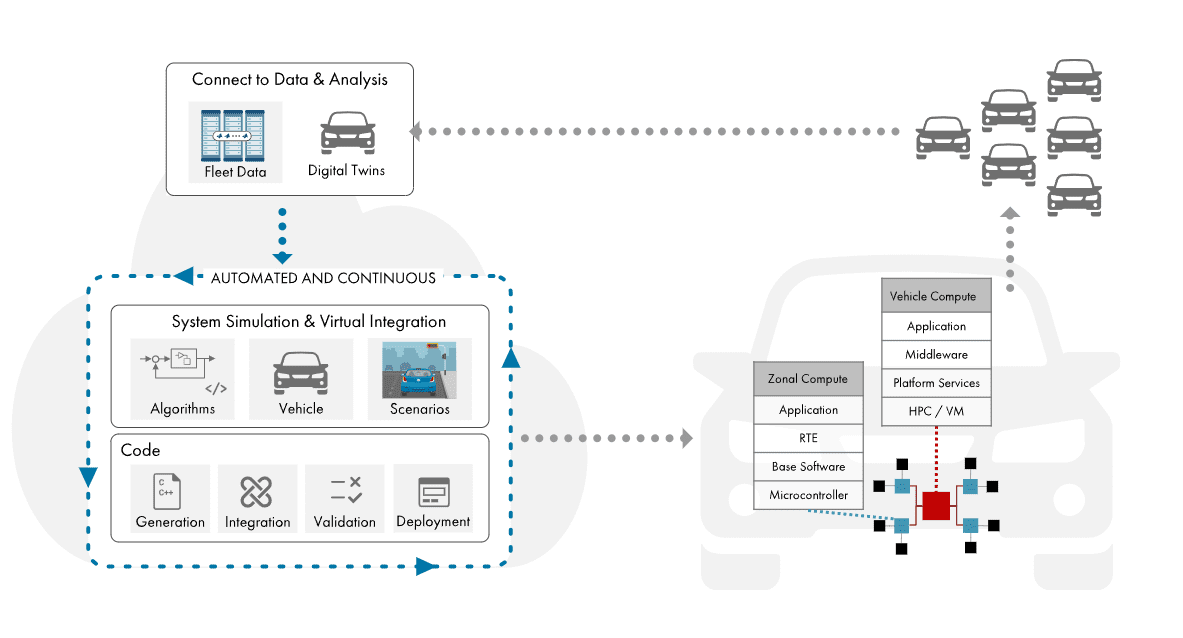
A software-defined vehicle is one whose functionality is largely controlled, enhanced, and updated by software rather than mechanical or hardware changes. Everything from cockpit interfaces to power management, thermal systems, domain controllers, ADAS algorithms, and full vehicle motion control increasingly depends on sophisticated embedded software.
Modern vehicles already contain more lines of code than an aircraft or a smartphone operating system. With the introduction of centralized high-performance computing nodes, zonal architectures, and cloud-driven intelligence, the amount of automotive software is expected to triple over the next decade.
The key characteristics of software-defined vehicles include:
● centralized or zonal compute architectures
● scalable hardware and software platforms
● high-bandwidth communication backbones
● unified operating systems and middleware layers
● virtualization and containerization for automotive systems
● remote diagnostics and predictive maintenance
● over-the-air (OTA) software updates
● continuous improvement of vehicle features
● extensive software reuse across vehicle models
All these capabilities elevate software from a supporting component to the core of the value chain. Today, automakers differentiate through software quality, user experience, connectivity, and automation—not just powertrain or styling. Because of this, the entire development pipeline must be optimized around software creation, testing, verification, and lifecycle management.
However, software-defined vehicles demand development methods capable of handling complexity that traditional methods simply were not designed for.
Why Traditional Development Is Too Slow for SDVs
Conventional automotive software development is linear and document-driven. Requirements are written in natural language, verified manually, and passed through multiple teams. Code is handwritten, unit tested after development, and validated on hardware prototypes late in the cycle. This is slow and error-prone, especially when requirements evolve or need to be validated early.
Traditional workflows struggle with:
● long development cycles and high cost of late changes
● poor visibility into system behavior before integration
● difficulty maintaining consistency across documentation, models, and code
● heavy dependence on physical prototypes
● high effort in debugging integration issues
● challenges in verifying safety or cybersecurity requirements early
● risks associated with manual coding errors
● difficulty scaling software to centralized or zonal architectures
In software-defined vehicles, where new features are expected to be added rapidly and vehicles must be updated frequently, this traditional approach becomes a bottleneck.
Model-based design addresses these issues by providing an executable digital representation of the system from concept to deployment.
How Model-Based Design Accelerates SDV Development
Model-based design is a development methodology where engineers build models that represent system behavior. These models are simulated, tested, refined, and reused throughout the design lifecycle. Instead of writing textual specifications, engineers create visual, mathematical, or logical representations of how the system should behave.
Key pillars of model-based design include:
● system-level modeling and simulation
● multi-domain integration across mechanical, electrical, control, and software systems
● simulation-based verification instead of document-based reviews
● automatic code generation from validated models
● rapid prototyping on hardware-in-the-loop and software-in-the-loop setups
● continuous validation through digital twins
● traceability from requirements to implementation
● ability to generate embedded code and test harnesses automatically
In software-defined vehicles, these capabilities accelerate almost every part of development. Since systems are validated through simulation early, issues are caught long before hardware creation. This dramatically reduces rework, integration failures, and the cost of change.
Model-based design speeds up feature creation, optimizes algorithms, ensures software reliability, and improves collaboration across multidisciplinary teams. It also supports safety-critical standards such as ISO 26262, which are essential for automotive businesses.
Modeling as the Foundation of SDV Architecture
At the core of model-based design lies the ability to capture system architecture using hierarchical, component-based models. Software-defined vehicles require complex architecture modeling across:
● powertrain and energy management
● braking and steering systems
● thermal systems
● battery management
● perception and sensor fusion
● control algorithms
● infotainment and user experience
● connectivity and networking
● zonal compute nodes and domain controllers
Instead of writing thousands of lines of code to define architecture, engineers use models which visually lay out data flows, state transitions, control logic, plant models, and physical system behavior. This shifts the entire development process from coding-first to architecture-first.
Architecture models help to:
● simulate interactions between systems early
● verify communication structures
● test timing constraints
● ensure that safety analysis is complete and traceable
● identify resource bottlenecks
● optimize partitioning between hardware and software
● ensure that functions are portable across computing platforms
For highly integrated SDV platforms, this makes architectural exploration far more efficient. Model-based design helps OEMs choose the correct partitioning between centralized domain controllers and zonal compute units, something that is nearly impossible using traditional document-based processes.
Executable Specifications Replace Ambiguous Documents
Natural language specifications often lead to misunderstandings. A requirement written in text may be interpreted differently by each team, resulting in inconsistencies between design, code, and validation tests.
Model-based design solves this through executable specifications, where:
● requirements are represented as behavioral models
● the model itself becomes the reference, removing ambiguity
● simulation confirms correctness before implementation
● every change can be instantly tested
● the specification never diverges from the implementation
Because of this, stakeholders have a single source of truth. Designers, software engineers, verification teams, and functional safety auditors all work from the same model. This drastically reduces integration issues and accelerates alignment across teams.
In software-defined vehicles — where subsystems are deeply interconnected — executable specifications are essential to prevent architectural mismatches and requirement drift.
Simulation Becomes the New Testing Ground
One of the greatest accelerators of model-based design is simulation. With system models available early, engineers perform extensive simulation long before hardware exists.
Types of simulations include:
● behavioral simulation
● multi-domain physical simulation
● Monte-Carlo-based scenario testing
● closed-loop simulation for control and perception systems
● software-in-the-loop testing
● processor-in-the-loop testing
● hardware-in-the-loop validation
Simulation enables developers to explore thousands of scenarios rapidly, test corner cases, and verify safety-critical behavior that would be expensive or impossible to test physically.
For software-defined vehicles, simulations are invaluable for validating:
● ADAS algorithms
● perception pipelines
● sensor fusion accuracy
● energy management strategies
● thermal and battery management
● braking and steering control loops
● communication timing behavior
● cyber-attack resilience
● autonomous driving behavior across environmental conditions
Simulation drastically reduces reliance on physical prototypes. Instead of building expensive test vehicles for each iteration, companies evaluate system behavior using digital twins and scenario-based simulation environments. This speeds up development cycles while improving system reliability and safety.
Rapid Prototyping for Real-Time Automotive Applications

Software-defined vehicles require fast, iterative development of sophisticated algorithms such as:
● path planning
● torque vectoring
● adaptive cruise control
● lane-keeping
● perception pipelines
● battery state estimation
● motor control
● energy optimization strategies
● in-vehicle infotainment interfaces
With model-based design, these algorithms can be deployed to prototype hardware directly from the models. Engineers bypass manual coding entirely and instead focus on refining the algorithm logic.
Rapid prototyping enables:
● real-time testing with actual sensors
● faster evaluation of control loops
● immediate tuning of parameters
● early user-experience testing
● validation under real driving conditions
● seamless transition from prototype to production code
This reduces the time required to go from concept to a road-testable algorithm. Since automotive development cycles are extremely time-sensitive, rapid prototyping significantly improves time-to-market.
Automatic Code Generation for Production Software
One of the most powerful aspects of model-based design is the ability to automatically generate production-grade code from validated models. Automatic code generation eliminates many of the issues associated with manual coding, such as:
● human errors
● inconsistent coding styles
● incomplete requirement implementation
● untested or unreachable code
● difficulty tracing requirements to code
● long debugging cycles
Generated code is:
● optimized for embedded hardware
● deterministic and predictable
● traceable to the original model
● compliant with safety standards
● easier to audit and maintain
This is especially beneficial for software-defined vehicles, because code must be portable across different compute nodes, reused across vehicle models, and updated frequently through OTA pipelines. Model-based design creates code that is consistent across platforms and automatically aligned with system models.
Automatic code generation removes bottlenecks in the development process, enabling automotive companies to release features faster while maintaining high reliability.
Integration with Hardware-in-the-Loop (HIL) and Software-in-the-Loop (SIL) Testing
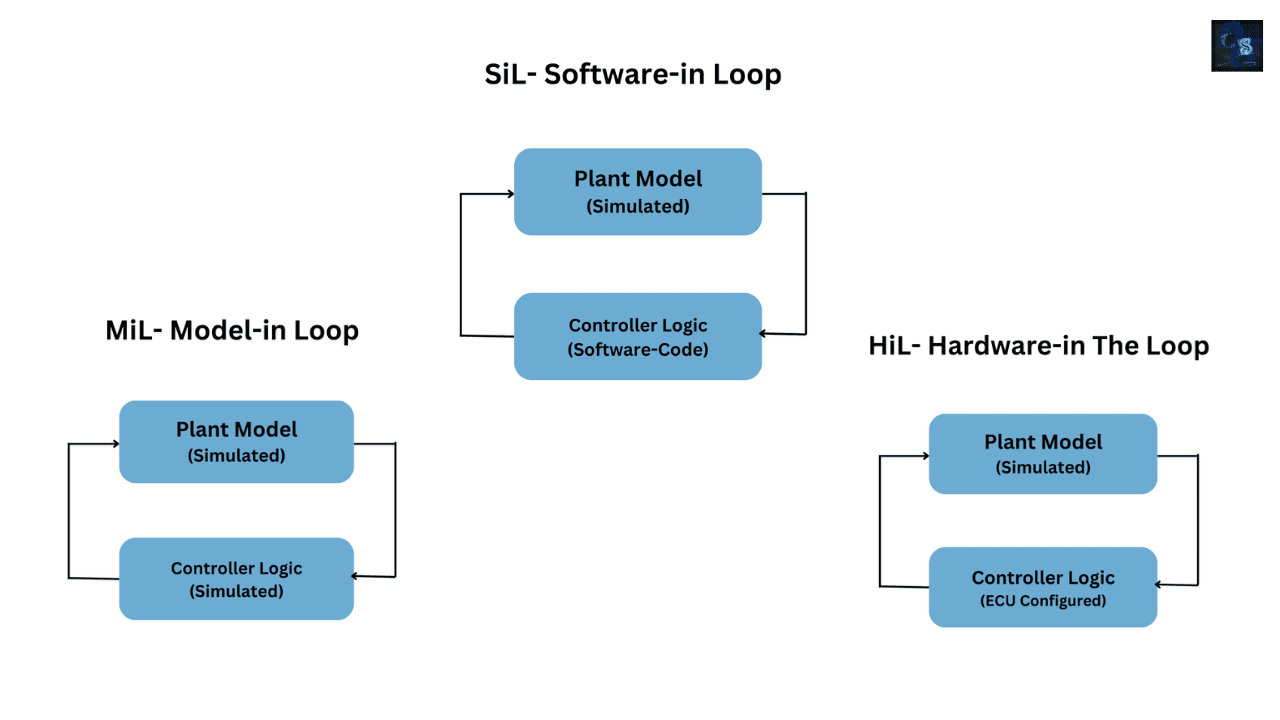
Testing automotive software on real hardware is expensive and slow. Model-based design solves this using SIL and HIL environments.
In SIL testing:
● the generated code runs inside a simulated environment
● plant models simulate sensors, actuators, and physical conditions
● developers find errors early, before hardware integration
In HIL testing:
● real ECUs run the generated software
● simulations drive sensor and vehicle dynamics interfaces
● engineers validate timing, reliability, and safety
● faults and edge cases can be tested safely
For software-defined vehicles, which have centralized ECUs and high computation loads, SIL and HIL are essential tools. They ensure that software performs reliably before integration with actual vehicle hardware.
Model-Based Design Enhances Functional Safety and Cybersecurity
Safety and security are the two pillars of any automotive system, especially in software-defined vehicles. These vehicles rely heavily on software, making them vulnerable to failures and cyber-attacks.
Model-based design supports safety in several ways:
● traceability from requirements to implementation
● formal verification of safety-critical logic
● systematic failure mode and effect simulation
● validation against ISO 26262 processes
● consistent, audited code through automatic generation
On the cybersecurity side, model-based design helps:
● simulate potential attack vectors
● validate secure communication protocols
● test responses to cyber-intrusion attempts
● verify robustness of over-the-air update pipelines
By bringing safety and security verification into early design phases, model-based design prevents costly recalls and ensures compliance with global regulations.
Supporting Over-the-Air Updates and Continuous Deployment
Software-defined vehicles depend heavily on over-the-air updates for:
● bug fixes
● performance improvements
● new features
● battery and energy optimization
● infotainment upgrades
● autonomy improvements
● safety enhancements
To support OTA pipelines, code must be modular, portable, and easy to validate. Model-based design provides:
● reusable function libraries
● well-structured, model-driven software components
● consistent and automatically generated code
● improved maintainability
● easy regression testing using simulation
This ensures that OTA updates can be developed and verified quickly, minimizing risk and maximizing vehicle uptime.
Cross-Domain Collaboration Made Easier
Automotive systems are multidisciplinary. Electrical engineers, mechanical engineers, control system designers, software developers, machine learning experts, cloud architects, and cybersecurity teams all need to collaborate seamlessly.
Traditional document-based workflows cause:
● miscommunication
● duplicated work
● inconsistent assumptions
● schedule delays
Model-based design solves these issues by providing a unified modeling environment where:
● all teams use a shared representation of the system
● data flows are visually defined and understood
● simulations validate assumptions quickly
● requirements are linked directly to model components
● design reviews become interactive and more productive
This breaks down silos and accelerates communication across teams, which is essential for the rapid release cycles of software-defined vehicles.
Digital Twins and Lifecycle Management
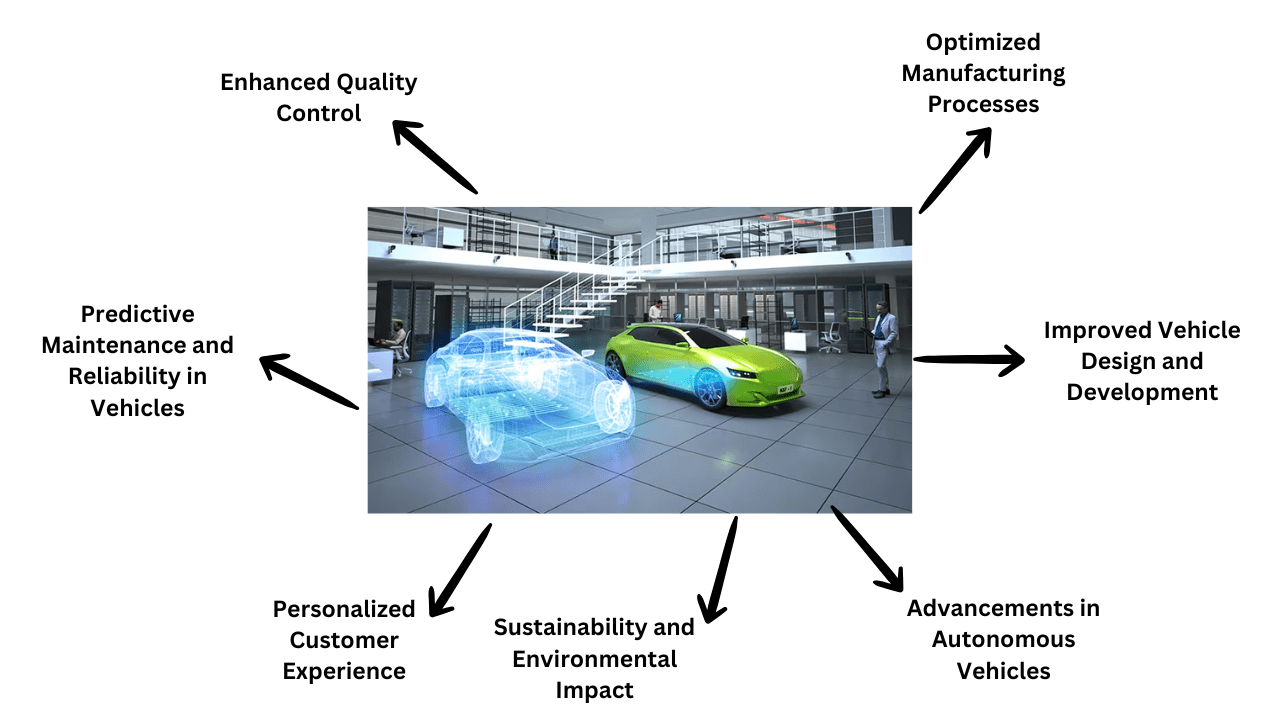
Digital twins — virtual representations of physical systems — play a major role in software-defined vehicles. Model-based design is the foundation for creating accurate digital twins of:
● batteries
● motors
● sensors
● powertrains
● thermal systems
● ADAS systems
● entire vehicle architectures
With these digital twins, engineers can:
● predict failures
● optimize energy usage
● analyze driving behavior
● evaluate updates safely before deployment
● support predictive maintenance
● improve OTA reliability
● continually improve vehicle software throughout its lifecycle
Model-based design ensures that digital twins are consistent with production software and hardware, allowing OEMs to manage vehicles throughout their lifespan.
Scaling Development for Zonal and Centralized Architectures
The shift toward zonal and centralized computing is one of the defining features of software-defined vehicles. In these architectures:
● sensors connect to zonal controllers
● zonal controllers feed data to high-performance central computers
● software layers are decoupled from hardware layers
● functions can be deployed flexibly across zones
Model-based design helps automotive companies transition to these architectures by enabling:
● flexible software partitioning
● automated mapping of functions to computing hardware
● simulation of communication loads
● verification of real-time constraints
● optimization of processor and memory usage
Because software-defined vehicles require scalable architectures, model-based design becomes a key enabler for achieving long-term flexibility and sustainability in system design.
Machine Learning and AI Integrated with MBD
Modern vehicles rely on machine learning and AI for perception, decision-making, driver monitoring, anomaly detection, and predictive maintenance.
Model-based design environments increasingly support:
● integration of trained neural networks
● validation of AI behavior inside control systems
● simulation of perception algorithms
● testing AI robustness under diverse scenarios
● automatic code generation for AI inference engines
This ensures that machine learning models behave safely and predictably when integrated into automotive systems.
In software-defined vehicles, where AI is central to user experience and autonomy, this integration is essential.
Reducing Cost and Time-to-Market
The automotive industry faces immense competitive pressure. Software-driven features must be released faster, updates must be delivered continually, and vehicles must remain reliable for years.
Model-based design reduces development cost by:
● reducing prototype iterations
● minimizing integration rework
● lowering testing cost through simulation
● reducing dependency on manual coding labor
● improving reuse of models and components
● reducing field failures and warranty costs
Time-to-market is accelerated because:
● system behavior is evaluated early
● requirements ambiguities are eliminated
● simulation replaces slow physical testing
● code is generated automatically from validated models
● teams collaborate more effectively
● updates can be developed and verified rapidly
For software-defined vehicles, which depend on fast iteration cycles, these savings are critical for business sustainability.
The Future of SDVs with Model-Based Design
As vehicle electronics become more centralized and software becomes more modular, model-based design will become the backbone of automotive engineering. Its ability to unify modeling, simulation, code generation, verification, safety analysis, and lifecycle management makes it the ideal approach for building the vehicle architectures of tomorrow.
Emerging trends that align with model-based design include:
● AI-driven design automation
● automotive cloud simulation platforms
● virtual homologation and certification
● seamless OTA pipelines integrated with simulation
● end-to-end digital engineering ecosystems
● hardware-agnostic software layers
● full-vehicle digital twin deployments
● unified platforms for ADAS, autonomy, and infotainment
These trends will further amplify the importance of models as the central source of truth for system behavior.
Model-based design is not just a tool; it is a methodology that enables the development of safer, smarter, more resilient, and rapidly evolving software-defined vehicles.
Final Thoughts
Software-defined vehicles represent the most significant transformation in automotive engineering. They demand rapid feature development, long-term software updates, and deep system integration across mechanical, electrical, and software domains. Traditional document-heavy processes cannot keep up with the complexity or pace required.
Model-based design provides the solution. It shifts development into a simulation-driven, architecture-focused, algorithm-centric workflow. It ensures consistency, accelerates development, reduces cost, supports safety and cybersecurity, and enables continuous innovation.
As the automotive industry moves toward fully connected, intelligent, and autonomous vehicles, model-based design will be the central enabler that accelerates every stage of development — from concept to deployment to long-term lifecycle management.
In the era of software-defined mobility, model-based design is not optional. It is the foundation for building the intelligent vehicles of the future.
This was about “Accelerating Software-Defined Vehicles with Model-Based Design“. Thank you for reading.
Also, read:
- “Mother of All Deals”: How The EU–India Free Trade Agreement Can Reshape India’s Economic Future
- 10 Free ADAS Projects With Source Code And Documentation – Learn & Build Today
- 100 (AI) Artificial Intelligence Applications In The Automotive Industry
- 1000+ Automotive Interview Questions With Answers
- 2024 Is About To End, Let’s Recall Electric Vehicles Launched In 2024
- 2026 Hackathons That Can Change Your Tech Career Forever
- 50 Advanced Level Interview Questions On CAPL Scripting
- 7 Ways EV Batteries Stay Safe From Thermal Runaway