Why Is Everyone Talking About AI Agents? 🤖
Because AI is moving from simply answering questions to actually getting things done. This guide explains what agents are, how they work, where they are used, and the question that matters most: how autonomous should they be?
1. The big shift: from answers to actions
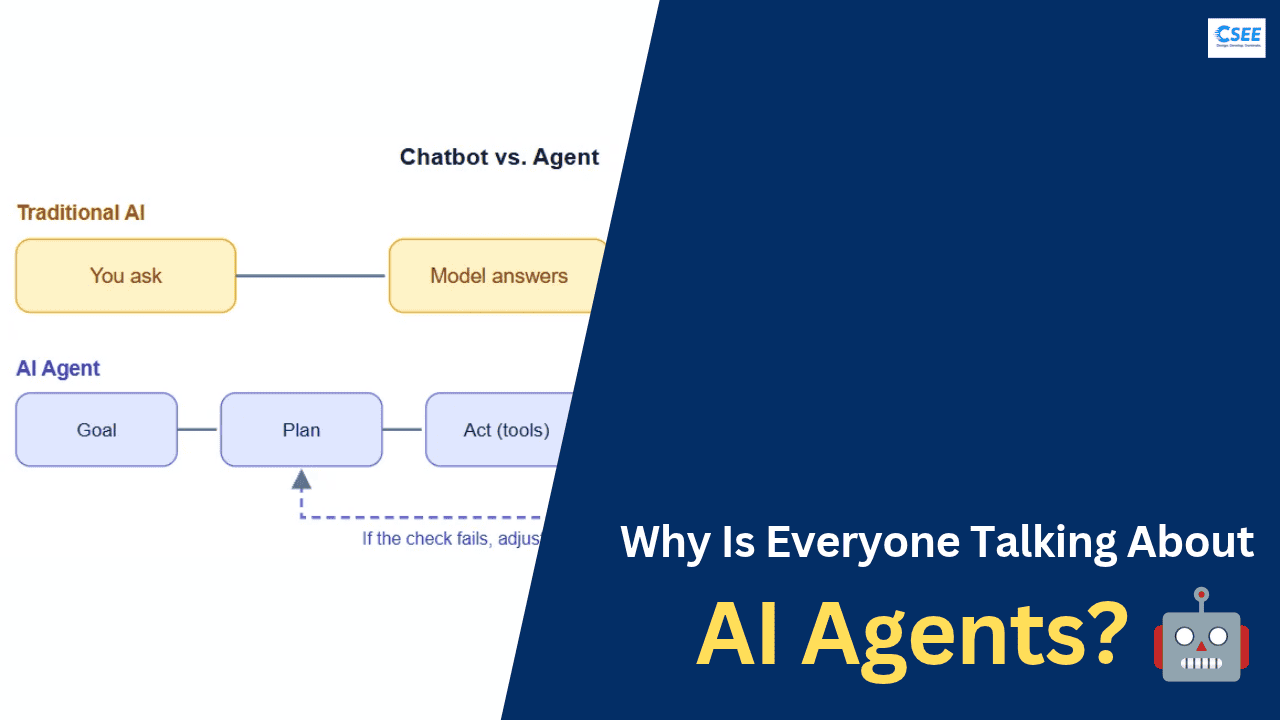
Traditional AI waits for your prompt. You ask a question, it generates an answer, and the interaction ends. What happens next is up to you: you copy the text, open the tools, click the buttons, and do the work.
An AI Agent is different. It can understand a goal, break it into smaller tasks, decide which actions are needed, use tools or APIs, access data, execute steps, check the results, and adjust when something goes wrong. The human describes the outcome; the agent works out the path.
Side-by-side comparison
| Aspect | Chatbot / Traditional AI | AI Agent |
|---|---|---|
| Starting point | A single prompt | A goal or objective |
| Output | Text, code, or an image | Completed actions and outcomes |
| Tools | Usually none | APIs, databases, browsers, code runners |
| Memory | Current conversation only | Short-term state plus long-term memory |
| Error handling | User notices and re-prompts | Agent checks results and retries |
| Human role | Does the work | Sets goals, approves, supervises |
2. A concrete example: booking a flight
Ask a chatbot to “find the best flight” and you get general advice. An agent treats it as a project:
- Understand your requirements: dates, budget, airline preferences, baggage.
- Search available flights through airline or travel APIs.
- Compare prices, durations, layovers and timings.
- Check your calendar for meetings or conflicts.
- Prepare options with a clear recommendation and reasons.
- Ask for approval, then potentially complete the booking.
3. Anatomy of an AI Agent
Technically, an agent combines a large language model (LLM) with a set of supporting components. The LLM is the “brain”, but on its own it can only produce text. Everything else turns that text into action.
4. The agent loop: how work actually happens
Most agents run a repeating cycle, often described as observe → think → act → evaluate. Each pass moves closer to the goal, or triggers a change of approach.
What “adjusting when something goes wrong” looks like
| Situation | Weak automation | Agent behavior |
|---|---|---|
| API returns an error | Script crashes | Reads the error, fixes the parameters, retries |
| Flight sold out | Stops or shows stale data | Searches alternatives and updates the options |
| Test fails after a code change | Reports “failed” | Reads the log, proposes a patch, re-runs the test |
| Ambiguous request | Guesses | Asks a clarifying question before acting |
5. Where AI Agents are being applied
| Industry | What an agent can potentially do |
|---|---|
| Software development | Read a ticket, write code, run tests, open a pull request, respond to review comments |
| Automotive | Analyze requirements, generate code, inspect logs, identify test failures, produce reports |
| Cybersecurity | Triage alerts, correlate events, gather context, draft incident summaries |
| Finance | Reconcile records, flag anomalies, prepare compliance reports, summarize filings |
| Customer support | Resolve common issues end to end, look up orders, issue refunds within limits |
| Robotics | Turn high-level instructions into task sequences using perception and control tools |
Automotive deep dive
Automotive engineering is a strong example because it is full of structured artifacts: requirements, code, logs, test reports, and traceability matrices. An agent connected to engineering tools could work through a pipeline like this:
In safety-critical domains such as automotive and embedded systems, the agent’s output is best treated as a proposal that engineers verify, especially where standards and certification apply.
6. Chatbot, assistant, agent: a spectrum
“Agent” is not a yes-or-no label. Systems sit along a spectrum of capability and independence.
| Level | Name | Description | Example |
|---|---|---|---|
| 0 | Chatbot | Answers questions, no tools | FAQ bot |
| 1 | Assistant | Uses one or two tools when asked | Chat with web search |
| 2 | Workflow agent | Follows a fixed sequence with AI at steps | Invoice processing pipeline |
| 3 | Autonomous agent | Plans its own steps and chooses tools | Coding agent fixing a bug |
| 4 | Multi-agent system | Several specialized agents collaborate | Planner, coder and reviewer agents |
7. The key question: how autonomous should agents be?
More autonomy means more speed and less human effort, but also more risk when the agent is wrong. A wrong answer from a chatbot wastes a minute. A wrong action from an agent can send an email, delete a file, or spend money.
A practical way to decide
| Action type | Reversible? | Cost of error | Suggested autonomy |
|---|---|---|---|
| Reading, searching, summarizing | Yes | Low | Fully autonomous |
| Drafting emails or documents | Yes | Low | Autonomous, human sends |
| Changing code in a branch | Yes | Medium | Autonomous with review |
| Spending money, sending messages | Hard | High | Explicit approval |
| Deleting data, production changes | Often no | Very high | Approval plus safeguards |
| Safety-critical control | No | Severe | Human decision, agent assists |
8. Risks and how to manage them
9. Why now?
Agents have been an idea for decades. Several ingredients have recently come together: language models that can follow multi-step instructions, standardized ways to call tools and APIs, larger context for holding information, and growing enterprise data that can be reached programmatically. The result is that “software that acts on your behalf” is finally practical in many everyday tasks.
10. Conclusion
The big shift is simple: AI is not just generating information anymore. It is increasingly designed to take actions toward a goal. Moving from chatbot to digital worker across multiple systems will change software development, automotive engineering, cybersecurity, finance, support, robotics and more.
The technology is advancing quickly, but the decision that matters most is a human one: how much autonomy should we grant, for which tasks, and with which safeguards?