Engineering Tutorial · Automotive Systems
Digital Twins in the Automotive Industry
A ground-up, visually explained guide to how a living virtual replica of a vehicle is built, connected, simulated and used across design, manufacturing, driving and service.
What exactly is a digital twin?
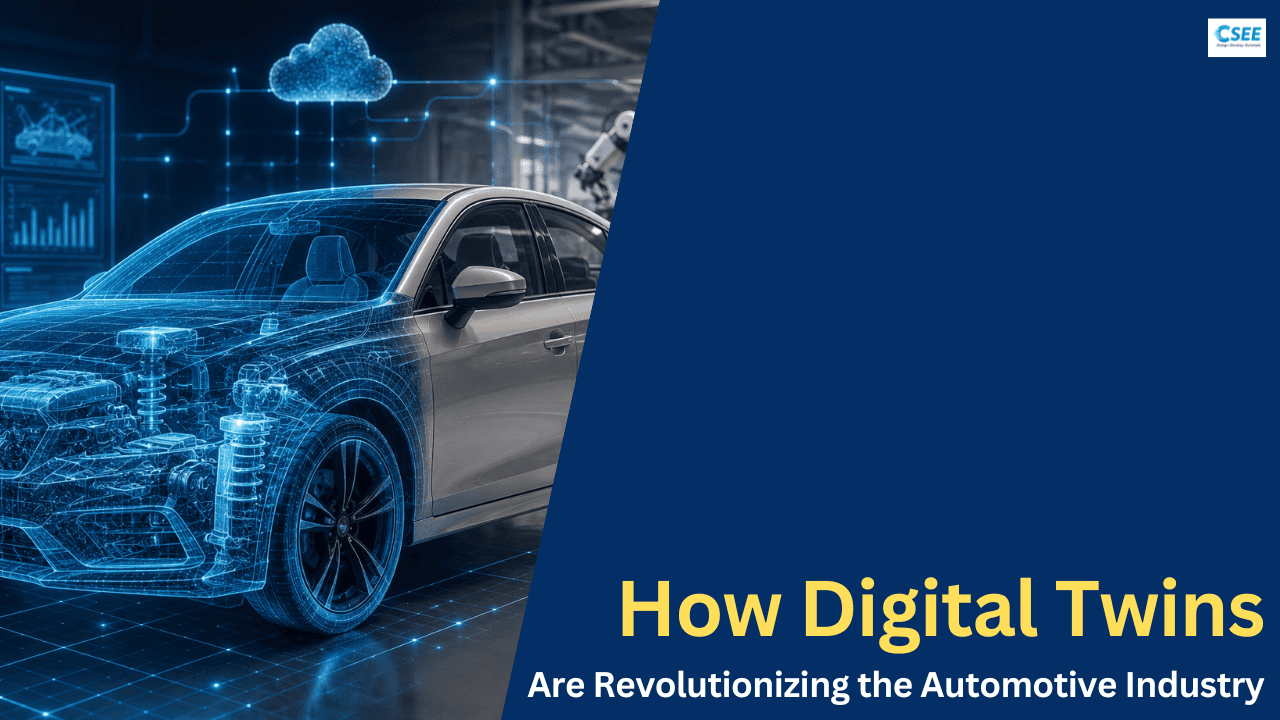
A digital twin is a living, data-fed virtual model of a real physical thing — a part, a full vehicle, a factory line, or an entire fleet — that stays synchronized with its physical counterpart throughout its life.
The word “twin” is doing a lot of work in that sentence, so it is worth slowing down. A three-dimensional CAD model of an engine is not a digital twin. A one-off crash simulation is not a digital twin either. What separates a true digital twin from an ordinary model is a persistent, two-way connection to a real object that exists right now in the physical world. Sensors on the physical object stream measurements into the model, the model updates itself to reflect the real object’s current condition, and insights flow back out to influence how the real object is operated, maintained or redesigned.
Put simply, a digital twin has three inseparable ingredients: a physical entity in the real world, a virtual entity in software, and the flow of data and information that keeps the two in step. Remove any one of these three and you no longer have a twin — you have a drawing, a spreadsheet, or a simulation.
Digital model vs. digital shadow vs. digital twin
These three terms are often used loosely, but engineers distinguish them by how the data flows. Understanding the difference is the fastest way to know whether a system is genuinely a twin or just marketing.
| Concept | Physical → Virtual | Virtual → Physical | Example in a car |
|---|---|---|---|
| Digital Model | Manual | Manual | A CAD file of a brake caliper used in design review. |
| Digital Shadow | Automatic | Manual | A dashboard that mirrors live battery temperature but takes no action. |
| Digital Twin | Automatic | Automatic | A battery twin that reads live cell data and automatically adjusts charging limits. |
If data flows automatically into the model but a human must act on it, you have a digital shadow. Only when insight also flows automatically back to the physical object do you have a full digital twin. Most real automotive deployments live somewhere on this ladder and climb it over time.
A short history, and why cars are the perfect fit
The concept did not begin with cars. Its roots reach back to the Apollo program, where NASA maintained physical duplicate spacecraft on the ground so engineers could rehearse fixes for vehicles hundreds of thousands of kilometres away. The idea of a paired “mirror” system that could be studied while the real one flew was the seed. The term digital twin itself was coined in the early 2000s in the context of product lifecycle management, describing a virtual counterpart that would accompany a product from cradle to grave.
What turned the idea from theory into everyday engineering was the collision of several maturing technologies: cheap and abundant sensors, ubiquitous wireless connectivity, elastic cloud computing, and machine-learning methods able to turn oceans of raw telemetry into usable predictions. A modern vehicle happens to sit at the intersection of all of these.
Automotive is arguably the ideal home for digital twins for a handful of structural reasons:
- Cars are already rolling sensor networks. A contemporary vehicle carries dozens to hundreds of sensors and many electronic control units, generating a continuous stream of data during every trip.
- They have long, multi-stage lifecycles. A vehicle is designed, engineered, manufactured, sold, driven for a decade or more, serviced repeatedly, and eventually recycled. A twin can add value at every stage.
- The stakes are high. Safety, regulatory compliance, warranty cost and brand reputation all reward the ability to predict failures before they happen.
- Electrification and autonomy raise the complexity. Battery chemistry, thermal behaviour and software-defined driving are extremely hard to reason about with intuition alone, and they benefit enormously from a synchronized virtual model.
The four levels of digital twin
Digital twins are not one-size-fits-all. Engineers usually describe them as a hierarchy that scales from a single component up to a whole connected process. Each level nests inside the next, and a mature manufacturer runs twins at several levels simultaneously.
| Level | Twin type | What it models | Automotive example | Primary value |
|---|---|---|---|---|
| 01 | Component / Part | A single physical element | One lithium-ion cell; a single gear or bearing | Deep failure analysis |
| 02 | Asset / Unit | Components working together | Full battery pack; a complete engine assembly | Condition monitoring |
| 03 | System | Assets forming a functioning whole | The complete vehicle and its powertrain | Performance optimization |
| 04 | Process | Many systems interacting over time | An assembly line; an entire vehicle fleet | Throughput & logistics |
Anatomy of an automotive digital twin
Under the hood, every automotive digital twin is assembled from the same stack of layers. Data is captured on the vehicle, transported over a network, ingested and stored, fused into a model, analyzed for insight, visualized for humans, and finally looped back as action. Think of it as a pipeline that begins with a physical sensor and ends with a decision.
Walking through each layer
Layer 1 — Physical layer
This is the real vehicle: chassis, powertrain, battery, brakes, and every embedded sensor and actuator. Sensors measure things — temperature, vibration, current, wheel speed, steering angle, GPS position — while actuators are the parts the twin can eventually influence, such as a charging controller or an adaptive damper. The richness of a twin is fundamentally limited by what the physical layer can sense.
Layer 2 — Connectivity
Data has to travel from a moving car to a data centre. This layer covers the telematics control unit, cellular links (increasingly 5G for low latency and high bandwidth), and vehicle-to-everything (V2X) communication that lets cars exchange information with infrastructure and each other. Reliability, latency and cost trade-offs here shape what is possible: safety-critical loops may run on the edge, while heavier analytics run in the cloud.
Layer 3 — Data platform
Raw telemetry is noisy, high-volume and heterogeneous. The data platform ingests it, cleans and timestamps it, and stores it in a form that models can consume. A crucial architectural decision is the split between edge processing (on or near the vehicle, for fast reactions) and cloud processing (centralized, for heavy computation and fleet-wide learning).
Layer 4 — Modeling & simulation
This is the heart of the twin. Two modeling philosophies are usually blended here. Physics-based models encode known engineering laws — thermodynamics, structural mechanics, electrochemistry — and are trustworthy and explainable. Data-driven models learn patterns directly from telemetry and can capture messy real-world behaviour that equations miss. Combining them produces a hybrid model that is both grounded and adaptive.
Layer 5 — Analytics & AI
On top of the model sit the questions we actually want answered: Is this component about to fail? Is this driving behaviour unusual? What is the remaining useful life of this battery? Machine-learning methods for prediction, classification and anomaly detection live here.
Layer 6 — Visualization & HMI
Insight is useless if nobody can see it. This layer renders the twin for humans — interactive 3D representations for engineers, simplified dashboards for fleet operators, and plain-language alerts for drivers.
Layer 7 — Feedback & control
Finally, the loop closes. Insight becomes action: an over-the-air software update, a recalibrated charging limit, a maintenance work order, or a design change fed back into the next model year. This layer is what elevates the system from a shadow to a true twin.
| Layer | Core job | Representative technologies | Failure if weak |
|---|---|---|---|
| 1 · Physical | Sense & act | MEMS sensors, ECUs, actuators | Blind spots in the model |
| 2 · Connectivity | Move data | 5G, V2X, telematics | Stale or laggy twin |
| 3 · Data platform | Store & clean | Edge nodes, cloud data lakes | Garbage-in, garbage-out |
| 4 · Modeling | Represent reality | CAE, physics engines, surrogates | Inaccurate predictions |
| 5 · Analytics | Extract insight | ML, anomaly detection | No actionable output |
| 6 · Visualization | Explain to humans | 3D render, dashboards | Insight ignored |
| 7 · Feedback | Close the loop | OTA, control APIs | Shadow, not twin |
How data actually moves through the loop
It helps to trace a single measurement on its full round trip. Imagine a temperature sensor deep inside an electric vehicle’s battery pack. Following that one number from cell to decision reveals how all the layers cooperate in practice.
Notice that the value of the twin comes from step 4 onward. Steps 1 to 3 are plumbing — necessary but not sufficient. The magic is in step 4, where the model interprets the reading in context (this cell is running warm relative to its neighbours and its own history), and step 6, where that interpretation changes the physical world. A system that stops at step 3 is a telemetry dashboard, not a twin.
Digital twins across the vehicle lifecycle
The single most important thing to understand about automotive digital twins is that their value compounds across the vehicle’s entire life. The same conceptual twin — enriched with different data at each stage — supports design engineers, factory managers, drivers and service technicians in turn. This continuous thread of information following the product is often called the digital thread, and the twin is what makes it usable.
6.1 · Design & engineering
Long before a physical prototype exists, engineers build a virtual twin to run thousands of simulations: crash tests, aerodynamics, thermal management, structural stress, noise and vibration. This slashes the number of expensive physical prototypes needed and lets teams explore designs that would be impractical to build one at a time. When physical prototypes finally arrive, their real test data is fed back to calibrate and validate the twin, tightening the match between virtual and real.
6.2 · Manufacturing & the factory twin
The same philosophy scales up to the plant. A factory twin models the assembly line — robots, conveyors, stations, buffers — so engineers can simulate layout changes, balance the line, and predict bottlenecks before touching real steel. During production, the twin monitors equipment health, catches quality drift early, and enables the flexibility needed to build multiple variants on one line. Each individual vehicle also gets its own as-built twin recording exactly which parts and software versions went into it.
6.3 · Testing & validation
Autonomous-driving software is the clearest example of validation by twin. It is neither safe nor feasible to expose experimental self-driving code to every rare hazard on public roads. Instead, engineers replay and generate millions of scenarios — a child stepping out between parked cars, sudden fog, a blown tire ahead — inside a high-fidelity virtual world. The twin lets the software accumulate the equivalent of many lifetimes of driving experience safely and cheaply.
6.4 · Operation, predictive maintenance & the connected car
Once the vehicle is on the road, its twin becomes a live health monitor. This is where predictive maintenance shines: rather than servicing parts on a fixed schedule or waiting for them to break, the twin estimates the actual remaining useful life of each component from real usage and warns before failure. It can also personalize the vehicle — adapting range estimates to a specific driver’s habits, or optimizing charging for a specific battery’s measured condition.
6.5 · Service, aftersales & end of life
At the service centre, a technician armed with the vehicle’s twin can see its complete as-built and as-operated history, reproduce an intermittent fault virtually, and confirm a fix before the customer leaves. At end of life, the accumulated lifetime data informs recycling and — crucially — flows back to designers so the next generation is better. The loop that began in design closes years later, richer for the journey.
6.6 · Fleets, mobility and the aggregate twin
Everything above concerns a single vehicle, but some of the largest returns appear when thousands of individual twins are aggregated. A logistics company running a fleet of delivery vans does not care much about any one van in isolation; it cares about total uptime, fuel or energy cost, and delivery reliability across the whole fleet. A fleet-level twin rolls up the health and usage of every vehicle into one operational picture, so that maintenance can be scheduled to minimize disruption, routes can be planned around each vehicle’s real range and condition, and a systemic problem — say, a brake component wearing faster than expected across a whole model year — can be spotted from a statistical signal long before it becomes a safety recall.
This aggregation also unlocks a powerful learning effect. When one vehicle in a fleet encounters a rare fault, the pattern that preceded it can be learned and then watched for across every other vehicle. In effect, the entire fleet learns from the experience of each member. This is why connected-fleet twins tend to get smarter the larger they grow: more vehicles means more examples of both normal and abnormal behaviour, which sharpens every prediction the twin makes.
6.7 · A closer look at ADAS and autonomy
Advanced driver-assistance systems and self-driving stacks deserve special mention because they invert the usual relationship between the physical and the virtual. For most components, the physical object comes first and the twin follows. For autonomous driving, the virtual world often comes first: the driving software is trained and validated primarily inside simulation, and only a comparatively small amount of its experience comes from physical roads. The twin here is not just a mirror of one car but a synthetic reality — a configurable world in which weather, lighting, pedestrians, other vehicles and road geometry can all be dialed to create precisely the rare, dangerous situations that are hardest to collect on real roads and most important to get right.
Crucially, this virtual testing is only trustworthy if the simulated world behaves like the real one. That is where the twin discipline pays off: sensor models must reproduce how a real camera, radar or lidar would actually perceive a scene, including their imperfections, and vehicle-dynamics models must reproduce how the real car would actually move. Real road data continuously calibrates these models, and any surprising behaviour observed on the road is reproduced in simulation to understand and fix it. The physical and virtual worlds refine each other in a tight loop, which is the essence of a digital twin taken to its logical extreme.
| Stage | What the twin does | Key benefit | Who benefits |
|---|---|---|---|
| Design | Virtual simulation & testing | Fewer prototypes, faster iteration | R&D engineers |
| Manufacturing | Line simulation & monitoring | Higher throughput, less downtime | Plant operations |
| Validation | Scenario simulation at scale | Safe testing of edge cases | Safety & software teams |
| Operation | Live health & predictive maintenance | Fewer breakdowns, lower cost | Owners & fleets |
| Service | Full history & virtual diagnosis | Faster, first-time-right repairs | Dealers & technicians |
| End of life | Data feedback & recycling insight | Better next-gen design | Designers & planet |
Deep dive: the electric-vehicle battery twin
No component demonstrates the payoff of digital twins better than the traction battery of an electric vehicle. The battery is the most expensive part of an EV, the biggest determinant of range and safety, and the hardest to reason about intuitively because its behaviour depends on chemistry, temperature, age and how it is used. A battery twin turns this opaque black box into a transparent, predictable, manageable system.
With these outputs, the vehicle can do things that would otherwise be impossible. It can give a range estimate tuned to this battery’s real, aged capacity rather than a factory default. It can protect the pack by throttling fast-charging when the twin predicts harmful heat build-up. It can warn of a thermal runaway risk before it becomes dangerous. And at fleet scale, manufacturers can spot a bad batch of cells across thousands of vehicles long before warranty claims spike.
State of Charge answers “how far can I go right now?” State of Health answers “how much has this battery aged?” Remaining Useful Life answers “when should it be serviced or replaced?” A good battery twin keeps all three accurate for a decade of unpredictable real-world use — something no fixed formula can do.
A second deep dive: the factory twin
The battery twin is a system twin; the factory twin is a process twin, and it is worth walking through because it shows how the same principles scale from one object to an entire production environment. A vehicle assembly plant is a choreography of hundreds of robots, conveyors, welding stations, paint booths and human operators, all of which must stay in balance for the line to flow. A tiny disturbance at one station — a robot running a few seconds slow, a buffer filling up — can ripple downstream and stall the whole line, and every stalled minute is expensive.
A factory twin models this choreography in software. Before a new vehicle variant is introduced, engineers can simulate how it will move through the existing line, where it will create bottlenecks, and how to rebalance stations to absorb it — all without stopping real production to experiment. During production, the same twin ingests live signals from the equipment: cycle times, vibration on motors, temperatures, energy draw. It compares what is happening to what should be happening, flags stations that are drifting out of tolerance, and predicts equipment failures so maintenance can be scheduled into planned downtime rather than forced by a breakdown. The result is a line that runs closer to its theoretical maximum with fewer nasty surprises.
The factory twin also connects to the product twins it produces. As each vehicle is built, its individual as-built record — the exact components, torque values, software versions and test results that went into that specific car — is captured and attached to that car’s own twin. Years later, if a fault appears in the field, this as-built record lets engineers trace whether it correlates with a particular supplier batch, a particular shift, or a particular station. The factory twin and the vehicle twin are two ends of the same digital thread.
Predictive maintenance, step by step
Because predictive maintenance is the benefit most people associate with digital twins, it is worth spelling out exactly how the twin produces a maintenance decision, using a wheel bearing as a simple example. First, vibration and temperature sensors near the bearing stream their readings into the twin. Second, the twin compares the current vibration signature against the bearing’s own healthy baseline and against the patterns that have historically preceded bearing failures across the fleet. Third, if the signature begins to drift toward a known failure pattern, the twin estimates how quickly it is degrading and projects when it will cross the threshold of unacceptable risk. Fourth, that projection becomes a concrete recommendation with a time window — service this bearing within the next few thousand kilometres — rather than a vague warning light. Finally, the recommendation flows into the maintenance system as a work order, and after the repair, the outcome is fed back to sharpen the next prediction.
The contrast with traditional maintenance is stark. A fixed-schedule approach replaces the bearing whether it needs it or not, wasting good parts. A run-to-failure approach waits for the breakdown, risking a roadside failure and collateral damage. The twin threads the needle: it acts on the real, measured condition of that specific bearing, replacing it late enough to use its full life but early enough to avoid failure.
The enabling technologies
A digital twin is a system-of-systems, and it only became practical because several independent technology curves crossed a threshold at roughly the same time. Understanding each helps clarify why twins are exploding in automotive now rather than twenty years ago.
IoT sensors
Cheap, tiny, reliable sensors make it affordable to instrument nearly everything, feeding the twin with rich state data.
5G & V2X
High bandwidth and low latency let vehicles stream data and receive control decisions fast enough for real-time use.
Cloud & edge
Elastic cloud handles heavy fleet-wide analytics; edge computing handles fast, local, safety-critical reactions.
AI & machine learning
Turns raw telemetry into predictions — remaining life, anomalies, and behaviour the equations alone would miss.
Physics simulation (CAE)
Decades-old engineering simulation gives the twin a trustworthy, explainable backbone grounded in real laws.
Over-the-air updates
OTA is the return path that lets insight become action remotely, closing the loop without a workshop visit.
Physics-based vs. data-driven vs. hybrid models
Because modeling sits at the core, it is worth understanding the three modeling styles and why hybrids dominate serious deployments.
| Approach | How it works | Strengths | Weaknesses |
|---|---|---|---|
| Physics-based | Encodes known engineering equations | Explainable, trustworthy, works with little data | Slow to compute; misses unmodeled effects |
| Data-driven | Learns patterns from telemetry | Captures messy reality; fast once trained | Needs lots of data; can be a black box |
| Hybrid | Blends physics with learned corrections | Accurate and grounded; best of both | More complex to build and maintain |
Benefits, costs and honest challenges
Digital twins are powerful but not free. A balanced view weighs the very real benefits against equally real obstacles, so that expectations stay grounded.
The upside
- Fewer physical prototypes. Simulating designs virtually cuts the time and money spent building and destroying real prototypes.
- Predictive rather than reactive maintenance. Fixing components just before they fail avoids both premature replacement and unexpected breakdowns.
- Faster time to market. Parallel virtual testing compresses development cycles that used to run sequentially.
- Safer autonomous development. Rare and dangerous scenarios can be tested millions of times without risk.
- Continuous improvement. Field data flowing back to design makes each generation measurably better.
- Personalization at scale. Every vehicle can be tuned to its own condition and its owner’s habits.
The honest challenges
- Data quality and volume. A twin is only as good as its data; noisy, missing or biased inputs quietly corrupt predictions.
- Integration complexity. Stitching together sensors, networks, cloud platforms and legacy engineering tools is genuinely hard.
- Cost and skills. Building and staffing twin programs requires significant upfront investment and rare cross-disciplinary talent.
- Cybersecurity. A two-way link into a vehicle is also a potential attack surface that must be rigorously secured.
- Privacy. Detailed telemetry about how, when and where a car is driven is sensitive personal data that demands careful governance.
- Model trust and validation. Convincing engineers and regulators that a virtual result can be trusted like a physical test takes rigour and time.
| Benefit | Obstacle to realizing it | Typical mitigation |
|---|---|---|
| Predictive maintenance | Poor or sparse sensor data | Better instrumentation + data cleaning |
| Faster development | Slow, siloed engineering tools | Integrated digital-thread platforms |
| Personalization | Privacy & consent concerns | Data governance, anonymization |
| Remote updates (OTA) | Cybersecurity exposure | Encryption, secure boot, monitoring |
| Trusted virtual testing | Regulatory skepticism | Rigorous validation against real tests |
How an organization actually adopts twins
Companies rarely leap straight to a fully autonomous, closed-loop twin. Adoption is a maturity journey, and skipping steps usually ends badly. A pragmatic roadmap climbs the ladder from simple mirroring to autonomous optimization.
- Level 1 — Monitor. Start by simply mirroring live data (a digital shadow). Get instrumentation, connectivity and storage working reliably first.
- Level 2 — Model. Add a model that can explain and simulate behaviour, letting engineers ask “what if” questions.
- Level 3 — Predict. Layer in analytics that forecast failures and estimate remaining life, turning hindsight into foresight.
- Level 4 — Autonomous. Close the loop so the twin can optimize and act on its own within safe bounds — the full digital twin.
A sensible first project is narrow and high-value: pick one painful, well-instrumented component (batteries and brakes are common choices), prove the loop end-to-end, and expand from there. Trying to twin an entire vehicle on day one is the classic way to fail.
Where this is heading
Several trends are converging to make digital twins more capable and more central to how vehicles are built and run.
The rise of the software-defined vehicle — where much of a car’s behaviour is defined by updatable software rather than fixed hardware — makes the feedback loop far more powerful, because insight from the twin can be turned into new capability with an over-the-air update rather than a physical recall. As cars become more like smartphones on wheels, the twin becomes the control room from which that software fleet is understood and steered.
Twins are also expanding beyond individual vehicles into connected ecosystems: fleet-level twins that optimize logistics and charging across thousands of vehicles, and even city-scale twins where vehicle twins interact with traffic-system and infrastructure twins to reduce congestion and emissions. Generative and foundation-model AI is beginning to make twins easier to build and query in natural language, lowering the expertise barrier. And the same electrochemical battery twins that protect a pack in service are increasingly used to certify batteries for a profitable second life in stationary storage once they retire from the road.
The through-line is consistent: the boundary between the physical vehicle and its virtual counterpart keeps getting thinner. As sensing, connectivity and modeling improve, the twin tracks reality ever more closely and acts on it ever more autonomously — until, for practical purposes, understanding the car and understanding its twin become the same activity.
Common questions, answered plainly
Is a digital twin just a fancy simulation?
No, and this is the most common misconception. A simulation is typically a one-off experiment run to answer a specific design question — you set it up, run it, read the result, and move on. A digital twin is a persistent system that stays alive alongside a specific real object and keeps updating itself with that object’s live data throughout its life. A simulation might tell you how a brake design should behave; a twin tells you how this particular brake, on this particular car, is behaving right now and will behave next month. Simulation is a tool the twin uses, not the twin itself.
Does every car on the road already have a digital twin?
Not fully. Many modern connected vehicles feed telemetry back to the manufacturer and so support at least a digital shadow, and specific subsystems like the battery are increasingly given proper twins. But a complete, closed-loop twin of an entire vehicle — one that models every subsystem and can autonomously act on all of them — is still an aspiration that the industry is climbing toward rather than a universal reality. Most deployments are partial and focused on the highest-value subsystems first.
Where is the data actually stored, in the car or the cloud?
Both, deliberately. Time-critical processing that must happen in milliseconds — a safety reaction, a charging cutoff — runs at the edge, on or near the vehicle, because a round trip to a distant data centre would be too slow and too dependent on connectivity. Heavier analysis that benefits from comparing across many vehicles, or from large computing resources, runs in the cloud. Designing this split well is one of the central engineering challenges of any twin.
What happens if the connection drops?
A well-designed twin degrades gracefully. The vehicle continues to operate safely on its own onboard logic, buffering its data locally, and synchronizes with its cloud counterpart when the connection returns. The twin should enhance the vehicle, never become a single point of failure that the vehicle depends on to function.
Glossary of key terms
| Term | Plain-language meaning |
|---|---|
| Digital Twin | A live virtual replica of a physical object, kept in sync by two-way data flow. |
| Digital Shadow | A model that mirrors a real object automatically but does not act back on it. |
| Digital Thread | The continuous record of data that follows a product across its whole lifecycle. |
| Telemetry | Sensor measurements streamed from the physical object to the model. |
| Edge computing | Processing done on or near the vehicle for fast, local reactions. |
| OTA update | Over-the-air software delivered remotely, without a workshop visit. |
| V2X | Vehicle-to-everything communication with other cars and infrastructure. |
| CAE | Computer-aided engineering — physics simulation of designs. |
| Surrogate model | A fast, learned approximation that stands in for a slow physics simulation. |
| State of Charge (SoC) | How much usable energy a battery holds right now. |
| State of Health (SoH) | How much a battery has aged relative to when it was new. |
| Remaining Useful Life | An estimate of how long a component will keep working before service. |
| Predictive maintenance | Servicing a part based on its predicted condition, not a fixed schedule. |
| Software-defined vehicle | A car whose behaviour is largely determined by updatable software. |
The one-paragraph summary
A digital twin in automotive is a living virtual counterpart of a real vehicle or its parts, connected by a continuous two-way flow of data. It is built from a layered stack — sensing, connectivity, storage, modeling, analytics, visualization and feedback — and it delivers compounding value across the entire lifecycle, from simulating a design before any metal is cut, to running a factory, to predicting a battery’s remaining life on the road, to feeding hard-won field data back into the next generation. Its power grows as sensing, connectivity, AI and modeling improve, steadily thinning the line between the physical car and its digital reflection.