Where AI Will Live Next
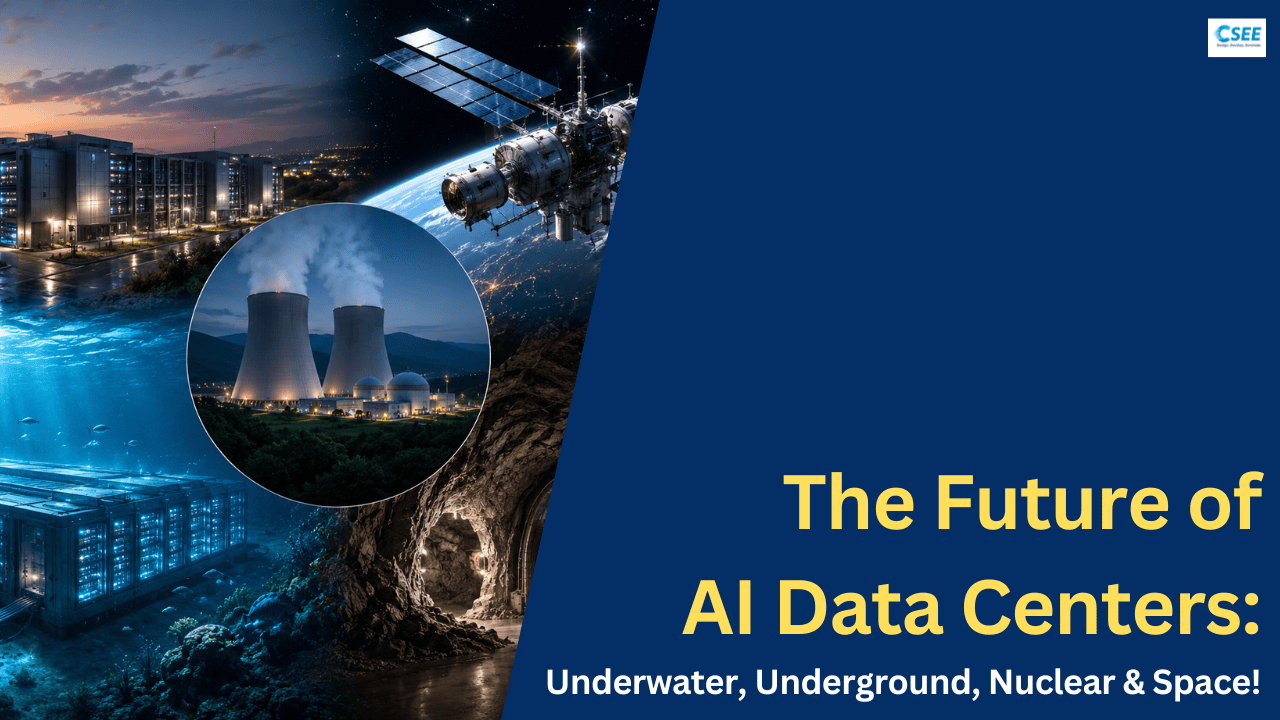
Today’s data centers sit on flat land near a power line. The next ones may sit on the seafloor, inside a mountain, beside a reactor, or in orbit. This is the case for each — and the case against.
Every answer an AI model gives you begins in a building. Not a metaphorical one — an actual warehouse with a roof, a concrete floor, a fence, and a substation humming outside it. Inside are rows of racks, and inside those racks are accelerators drawing more power per square meter than almost any structure humans have built for non-industrial purposes. The intelligence feels weightless. The infrastructure behind it weighs thousands of tonnes and drinks electricity by the gigawatt-hour.
For thirty years, the rules for where to put that building were boring and stable. Find cheap land. Find cheap, reliable power. Find fiber. Stay close enough to users that latency stays low. Stay out of floodplains. Repeat. The result is the familiar map of digital geography: Northern Virginia, Dublin, Singapore, Frankfurt, Mumbai, Oregon, Bengaluru, Sao Paulo. Suburban campuses with anonymous facades, ringed by transformers.
That formula is now under real strain. AI training and inference have changed the load profile of computing in three specific ways, and each one attacks a different assumption in the old siting equation.
First, density. A conventional enterprise rack drew something like 5 to 10 kilowatts. An air-cooled rack of modern accelerators pushes 40 to 60. Liquid-cooled AI racks are being designed at 120 kilowatts and above, with roadmaps talking about 250 to 600 kilowatts per rack in the second half of this decade. That is a step change, not a trend line. Air can no longer carry the heat away at those densities. Once you accept liquid cooling, the entire physical logic of the building changes — and so does the logic of where the building can go.
Second, scale of power draw. Individual campuses are now being planned at hundreds of megawatts, with multi-site clusters discussed in gigawatts. A gigawatt is roughly the output of a large nuclear reactor. When a single tenant asks a utility for a gigawatt, the utility does not simply add a line item — it starts talking about new generation, new transmission corridors, and interconnection queues that run five to seven years long. Power, not land, has become the binding constraint.
Third, latency tolerance has split in two. Not all computing is equal anymore. Serving a chatbot response to a user in Bengaluru needs to happen in tens of milliseconds, close by. Training a frontier model for eleven weeks does not care whether the racks are 50 kilometers away or 5,000. That split is the crucial insight. It means a large and growing share of the world’s compute has been quietly released from the requirement to sit near people.
And those three questions have some genuinely strange answers. Cold seawater is free cooling. Deep rock is free thermal mass and free physical security. A dedicated reactor is firm, carbon-free power that never asks the grid’s permission. Sunlight in orbit never sets, never clouds over, and arrives at roughly a third more intensity than at sea level. None of these are jokes. All of them have engineering programs, funded prototypes, or filed permits behind them.
What follows is a full tour of the four frontier siting concepts — underwater, underground, nuclear-anchored, and orbital — plus the honest, unglamorous reality that most of the world’s compute will keep living in ordinary buildings for a long time yet. The goal is not hype. The goal is to give you a mental model precise enough that you can judge new announcements yourself.
01The three constraints that decide everything
Before comparing locations, it helps to be precise about what a data center actually needs. Strip away the marketing and there are three hard inputs and one soft one.
Power
Electricity is the dominant operating cost and the dominant siting constraint. Two properties matter: the price per megawatt-hour, and the availability of firm capacity — power that is there at 3 a.m. in February whether or not the wind is blowing. AI training clusters run near 100% utilization for months, so they need firm power, not average power. This is why intermittent renewables alone cannot anchor a training campus without enormous storage, and why nuclear has re-entered the conversation so forcefully.
Cooling
Essentially all electricity entering a data center leaves as heat. A 100 MW facility is a 100 MW heater. You must move that heat somewhere colder. The efficiency of doing so is captured by PUE — power usage effectiveness — the ratio of total facility power to IT power. A PUE of 1.5 means half again as much energy is spent on cooling and overhead as on actual computing. Best-in-class land facilities reach 1.1 to 1.2. Free-cooling environments can go lower.
Connectivity
Fiber capacity and round-trip latency. Terrestrial fiber moves data at roughly two-thirds the speed of light in vacuum, adding about 5 milliseconds per 1,000 kilometers each way. A user in Bengaluru talking to a server in Virginia eats around 180 to 220 milliseconds of round trip before any computing happens. Fine for a batch job. Unpleasant for a voice assistant.
And the soft one: permission
Land use approval, water rights, grid interconnection, environmental review, and community consent. This is increasingly the slowest step. Several of the exotic siting ideas are, quietly, attempts to route around it.
The one number to remember
Every megawatt of compute needs roughly 0.1 to 0.5 megawatts of cooling overhead on land, near zero in a well-designed seabed pod, and a radiator area problem in space. Cooling is the axis on which these four ideas most differ.
| Environment | Primary problem solved | Problem it creates | Maturity |
|---|---|---|---|
| Land (today) | Access, servicing, supply chain | Power queues, water use, local opposition | Commercial, mature |
| Underwater | Cooling energy and water consumption | Zero physical access; marine engineering | Prototypes proven, early commercial |
| Underground | Security, thermal stability, land conflict | Excavation cost, ventilation, egress | Operating today at modest scale |
| Nuclear-anchored | Firm carbon-free power at gigawatt scale | Licensing timelines, public trust, fuel supply | Restarts and PPAs signed; SMRs pending |
| Orbital | Unlimited continuous solar, no land at all | Heat rejection, radiation, launch cost, repair | Experimental; small demos flying |
02Underwater: letting the ocean do the work
The underwater data center is the most intuitively appealing of the four ideas, because the physics is so obviously on its side. Water carries heat roughly 3,500 times better by volume than air. The deep ocean is a nearly infinite reservoir sitting at a stable 4 to 12 °C. If your problem is getting rid of heat, and you place your machine inside the world’s largest heat sink, you have solved your problem in the most direct way available.
The concept was validated publicly by Microsoft’s Project Natick, which ran a sealed cylinder of 864 servers on the seabed off Orkney, Scotland, for two years and retrieved it in 2020. The headline result was not the cooling — that was expected — but the reliability. The submerged servers failed at roughly one-eighth the rate of an identical control group on land. That is a counterintuitive and important result, and the explanation is instructive.
Why sealed vessels are more reliable
- No oxygen. The vessel is filled with dry nitrogen. Oxidation and corrosion of connectors and solder joints essentially stop.
- No humidity swings. A stable dry atmosphere eliminates condensation risk and the expansion-contraction cycling that fatigues joints.
- No dust. No filters to clog, no particulate accumulation on heatsinks.
- No people. A meaningful share of data center incidents are caused by humans bumping, unplugging, or mis-cabling things. Nobody bumps into anything on the seabed.
- No vibration or thermal shock. The sea is a mechanically and thermally quiet place.
The design consequence is that you stop treating servers as field-replaceable units and start treating the whole vessel as one. You over-provision hardware, accept that failed nodes stay dead, and plan a retrieval every five years or so. The vessel is a consumable, not a building.
The honest drawbacks
Underwater is not free of trouble. The objections are real and mostly practical rather than theoretical.
You cannot fix anything. A retrieval operation needs a vessel, favorable weather, and days of work. If a power conversion module fails in month four of a five-year deployment, that capacity is gone. This forces expensive redundancy and hardware refresh cycles that clash with the AI industry’s brutal 3-to-4-year accelerator upgrade cadence. Putting a fleet of chips somewhere you cannot upgrade them is a bet that they will still be economically useful when you finally open the can.
Biofouling. Anything left in productive coastal water gets colonized — barnacles, algae, tubeworms. A fouled heat exchanger loses efficiency. Countermeasures exist (coatings, sacrificial surfaces, periodic cleaning by remotely operated vehicles) but they add cost and complexity.
Thermal discharge and permitting. Dumping tens of megawatts of heat into a coastal ecosystem requires environmental review. In practice this is manageable at pod scale — the plume mixes quickly and warms surrounding water by a fraction of a degree within meters — but it scales unfavorably. A gigawatt of seabed compute is a genuinely large thermal input to a local marine environment, and regulators will treat it that way.
Grid connection still applies. This is the point most often missed in enthusiastic coverage. An underwater data center does not generate power. It still needs a cable from shore, and that shore connection faces the same interconnection queue as any other project. Underwater solves cooling. It does not solve the actual bottleneck, which is power.
| Dimension | Land, air-cooled | Land, liquid + free cooling | Seabed pod |
|---|---|---|---|
| Typical PUE | 1.4 – 1.6 | 1.1 – 1.2 | 1.02 – 1.10 |
| Water consumed | High if evaporative | Low to moderate | Effectively zero |
| Land footprint | Large | Large | Near zero |
| Hardware servicing | Any time | Any time | Only at retrieval |
| Observed failure rate | Baseline | Baseline | Roughly 1/8 of baseline |
| Deploy time per unit | 18 – 36 months | 18 – 36 months | Weeks once fabricated |
| Upgrade flexibility | High | High | Very low |
| Best fit workload | Everything | AI training and inference | Stable inference, edge, CDN |
03Underground: rock as armor and as flywheel
Underground data centers are the least speculative item on this list, because they already exist and have for years. Decommissioned mines, limestone caverns, and Cold War bunkers in Scandinavia, Switzerland, and the United States host commercial facilities today. The Lefdal Mine in Norway and the Pionen facility in Stockholm are well-known examples. What is new is the ambition: not a boutique bunker for high-security hosting, but excavated halls sized for AI clusters.
What rock gives you
Thermal stability. Below roughly 15 meters, ground temperature stops tracking the seasons and settles near the local annual mean — often 8 to 15 °C in temperate and northern latitudes. That is a permanently available cold sink, and it never has a heatwave. Facilities in this class routinely run free cooling for most or all of the year, sometimes coupled to nearby cold water for the final heat rejection stage.
Physical security by geology. Tens of meters of rock is proof against essentially every threat category that keeps infrastructure operators awake: severe weather, wildfire, blast, ballistic attack, small drones, and electromagnetic pulse. For sovereign, financial, and defense workloads, that is not a nice-to-have. It is the product.
Land-use peace. A large share of the friction now facing data center projects is local: noise from chillers, visual impact, traffic, and competition for water. An underground facility is essentially invisible from the surface. It occupies land that has no alternative use and generates none of the visual objections. In dense or protected regions, this can be the difference between a permit and a rejection.
Reuse of existing voids. Excavation is expensive — but a mine that has already been dug is a sunk cost someone else paid. Norway, Finland, and Sweden have thousands of kilometers of accessible worked-out mine galleries near cheap hydropower and cold fjord water. That combination is close to ideal.
Where it gets hard
Excavating new caverns is slow and expensive — figures of several hundred to a couple of thousand dollars per cubic meter are common, depending on rock quality. Ventilation and life safety in an occupied underground space are heavily regulated: you need redundant egress, smoke control, and fire suppression designs that satisfy mining as well as building codes. Getting a 40-tonne transformer down a spiral ramp is a real engineering exercise. Humidity and groundwater ingress require permanent management. And expansion is not as simple as pouring another slab next door; you have to dig again.
The realistic conclusion is that underground scales well where voids already exist or where rock is cheap to work and power is cheap and clean. It does not scale everywhere. But as a home for sovereign, regulated, and security-critical AI workloads, it is arguably the most immediately practical of the four ideas.
04Nuclear: solving the constraint that actually binds
Of everything in this article, nuclear co-location is the one already reshaping real balance sheets. The reason is simple: it is the only option on the list that addresses power rather than cooling.
The arithmetic driving this is stark. A one-gigawatt AI campus consumes roughly the annual electricity of a mid-sized city, at a near-constant load. Grid interconnection queues in major markets run five to seven years. Utilities cannot add that much firm capacity quickly, and adding it with gas conflicts with the emissions commitments these same companies have published. Wind and solar are cheap but variable; matching a flat 24/7 load with them requires either huge storage or grid imports that reintroduce the queue problem.
Nuclear fits the load shape almost perfectly. It is firm, dense, carbon-free at the point of generation, and it runs at capacity factors above 90%. And a data center is an unusually good customer for a reactor: a flat, predictable, creditworthy, decades-long offtake. The match is so natural that the industry moved fast once it noticed.
Three routes to nuclear-powered compute
- Buy output from existing plants. The fastest path. Long-term power purchase agreements with operating reactors, sometimes with the data center built adjacent to the plant to avoid transmission entirely. This is available now.
- Restart retired reactors. Several units shut for economic reasons in the 2010s remain physically intact. With a committed multi-decade buyer, restarting them becomes financeable. This is genuinely novel — an industry that had only ever gone one direction reversing course because of computing demand.
- Build small modular reactors (SMRs). Factory-built units in the 50 to 350 MW range, designed for passive safety and serial production. Conceptually ideal: you could place one at each campus and sidestep the transmission grid. In practice, first units are unlikely before the early 2030s, and first-of-a-kind costs are historically brutal.
The objections
The most serious criticism of behind-the-meter nuclear is not technical but distributional. If a large customer contracts directly with an existing reactor, that reactor’s output leaves the public grid. The grid must replace it — often with gas — and the cost of the replacement is spread across ordinary ratepayers. Regulators in several jurisdictions have flagged this as a fairness problem. The counter-argument is that these deals fund restarts, uprates, and new build that would not otherwise happen, adding net capacity over time. Both points have merit and the outcome will be decided case by case.
Beyond that: licensing is slow by design and should be; SMR economics remain unproven until several units have actually been built; fuel supply chains for advanced designs need development; and public acceptance varies enormously by country. Nuclear is not a shortcut. It is a long road that happens to lead somewhere the industry now urgently wants to go.
Why this one matters most
Cooling innovations change operating cost by tens of percent. Power availability determines whether a project exists at all. That asymmetry is why nuclear co-location has moved from concept to signed contracts faster than any other idea here.
05Orbit: the idea that sounds silliest and is hardest to dismiss
Space-based data centers sound like a joke until you look at the energy numbers, at which point they become uncomfortable.
In a sun-synchronous orbit, a solar array can be illuminated continuously — no night, no clouds, no seasons, no atmospheric attenuation. Solar flux in space is about 1,361 watts per square meter, versus a typical peak of 1,000 at the surface and a real-world average far below that after weather, latitude, and darkness. A given panel in orbit produces on the order of five to eight times the annual energy of the same panel on the ground. No land is required. No water is required. No neighbors object. No interconnection queue exists.
That is a genuinely extraordinary set of advantages, and it explains why serious proposals now exist and why small demonstration payloads carrying accelerators have already flown.
The problem nobody can hand-wave: heat
Every environment discussed so far offered a fluid to dump heat into — air, water, rock. Space offers nothing. A vacuum has no convection and no conduction. The only mechanism available is thermal radiation, governed by the Stefan–Boltzmann law: radiated power scales with the fourth power of absolute temperature and linearly with area.
Fourth-power scaling sounds generous but is unhelpful in this range, because the radiator must stay cool enough to actually absorb heat from electronics running at modest temperatures. Practical radiator temperatures land around 300 to 350 kelvin, which yields roughly 300 to 800 watts of rejection per square meter after accounting for view factors, absorbed sunlight, and earthshine. Rejecting 100 megawatts therefore needs somewhere in the range of 150,000 to 300,000 square meters of double-sided radiator — a structure measured in tens of hectares, that must be launched, deployed, kept pointed away from the sun and the Earth, and protected from debris.
The rest of the difficulties, briefly
- Radiation. Charged particles cause bit flips and cumulative damage to silicon. Radiation-hardened parts lag commercial performance by many years — exactly the wrong tradeoff for AI. Alternatives (shielding mass, aggressive error correction, redundant voting, frequent reboots) all cost performance, mass, or both.
- No repair. Underwater is hard to service; orbit is effectively impossible at current costs. A failed node stays failed for the mission life.
- Bandwidth to the ground. Optical downlinks offer high capacity but are blocked by cloud, requiring a diverse network of ground stations. Radio links are weather-tolerant but far lower capacity. Either way, moving petabytes down is a real constraint on what workloads make sense.
- Launch mass and cost. Even with dramatic reductions in launch price, a full system’s mass — compute, power, radiators, structure, propulsion, shielding — is large. Costs fall with reuse but do not vanish.
- Debris and end of life. Very large structures in low orbit raise collision and debris concerns, and deorbit planning becomes a design requirement rather than an afterthought.
The plausible near-term version of orbital computing is therefore not “the cloud, in space.” It is inference performed where the data already is: satellites that process their own imagery on board and downlink conclusions instead of raw pixels. That is a real, valuable, and much smaller problem — and it is already being flown. Whether that scales into general-purpose orbital compute over the following decades is exactly the open question.
| Factor | Land | Underwater | Underground | Nuclear-anchored | Orbital |
|---|---|---|---|---|---|
| Cooling source | Air / water / chillers | Seawater | Rock + cold water | Same as land | Radiation only |
| Cooling difficulty | Moderate | Very low | Low | Moderate | Extreme |
| Power access | Grid queue | Grid via cable | Grid, often hydro | On site, firm | Continuous solar |
| Land use | High | Minimal | Minimal surface | Moderate | None |
| Water use | Can be high | None consumed | Low | Plant-dependent | None |
| Serviceability | Excellent | Poor | Good | Excellent | None |
| Latency to users | Low | Low (coastal) | Low to moderate | Moderate | High and variable |
| Security posture | Fences and guards | Concealment | Geological | Regulated site | Remote but exposed |
| Capital cost | Baseline | Comparable per MW | Higher up front | Much higher | Far higher |
| Time to first watt | 2 – 4 years | Months once built | 3 – 5 years | 5 – 12 years | Decade+ at scale |
| Realistic 2035 share | Large majority | Small niche | Meaningful niche | Large and growing | Very small |
06The decision framework
Rather than asking which location wins, ask which workload goes where. Compute is not one thing, and the four frontier environments each fit a distinct slice of demand.
| Workload | Latency need | Power profile | Best home |
|---|---|---|---|
| Frontier model training | None | Flat, enormous, months long | Nuclear-anchored remote campus |
| Batch inference and analytics | Low | Flat, schedulable | Underground or remote hydro |
| Interactive chat and voice | Very high | Spiky, diurnal | Metro land facilities, near users |
| Coastal city edge serving | High | Moderate, steady | Seabed pods offshore |
| Sovereign and defense | Moderate | Steady | Underground, hardened |
| Long-term archival | None | Very low | Underground cold storage |
| Satellite imagery processing | On-board | Low, solar | Orbital edge nodes |
07The things that will actually decide this
Underneath the engineering, a handful of forces will determine which of these visions becomes ordinary and which stays a demonstration.
Heat as a product, not a waste
The most efficient thing to do with a data center’s heat is to sell it. District heating networks in Denmark, Finland, and Sweden already take warm water from data centers and pipe it to homes. This inverts the entire cost model: heat stops being a disposal problem and becomes revenue, and the ideal site becomes one near people in a cold climate rather than far from everyone. That is a direct counterargument to the remoteness thesis, and it is being built today.
Chip efficiency versus Jevons
Performance per watt improves every generation. If demand were fixed, energy use would fall. Demand is not fixed. Historically, cheaper compute has expanded usage faster than efficiency reduced it — the Jevons paradox. Efficiency gains buy time; they have not, so far, reduced total consumption.
Regulation and sovereignty
Data residency rules push compute inside national borders. Export controls shape where the most capable chips may be installed. Local moratoria on new data centers — already enacted in several jurisdictions facing grid or water stress — push projects toward remote and unconventional sites. Politics is a siting force at least as strong as physics.
Water
Evaporative cooling consumes freshwater, and in water-stressed regions this has become the single most effective argument against new projects. Closed-loop liquid cooling, seawater cooling, and underground rejection all sidestep it. Expect water scarcity to be a stronger driver of exotic siting over the next decade than either carbon or cost.
The upgrade treadmill
This is the quiet killer of hard-to-reach sites. Accelerators are replaced every three to four years because the newer generation is dramatically more efficient per unit of work. Any location where retrieving and replacing hardware is expensive fights against that cycle. It is the strongest structural argument in favor of boring, accessible buildings — and the reason seabed and orbital concepts will likely stay specialized rather than general.
08A grounded forecast
Putting it together, here is a defensible picture of the next decade, stated with the uncertainty it deserves.
Land keeps the overwhelming majority. Not because it is elegant, but because it is fast, serviceable, financeable, and close to users. The most likely change is not location but form: liquid cooling everywhere, closed loops, higher rack densities, more heat reuse, and campuses sited by power availability rather than by proximity to a metro area.
Nuclear becomes normal. This is the highest-confidence prediction here. Co-located and contracted nuclear power for AI campuses is already commercially real, and the pipeline of restarts, uprates, and SMR projects will keep growing because nothing else matches a flat gigawatt load without emissions.
Underground grows into a solid niche. Especially in the Nordics, the Alps, and anywhere with existing voids, cheap clean power, and sovereignty requirements. Not a majority. A durable and meaningful share.
Underwater stays specialized. The physics works and the reliability data is genuinely impressive, but the servicing constraint and the upgrade cadence limit it. Expect coastal edge deployments, island and offshore-platform installations, and modular pods for places with no land — not a wholesale migration.
Orbital remains early but does not disappear. On-board processing for space-generated data is real and growing now. Large orbital compute platforms depend on radiator technology, launch cost, and radiation tolerance improving together. That is possible over fifteen to twenty-five years. It is not a 2030 story.
The synthesis
The future is not one winning location. It is a stratified system: latency-sensitive serving stays near people, heavy training migrates to wherever firm clean power is abundant, hardened and sovereign work goes into rock, coastal edge cases go into water, and space handles the data that was born in space. The map gets more diverse, not more uniform.
09What the shift really means
Step back and something larger is visible. For most of computing history, where machines lived was an operational detail with no consequence beyond a facilities budget. That is no longer true. Compute siting is now an energy policy question, a water policy question, an industrial policy question, and increasingly a national security question. When a company’s choice of campus location determines whether a utility builds a new transmission line or restarts a reactor, computing has stopped being a tenant of the physical economy and become a shaper of it.
The strange proposals — pods on the seabed, halls inside mountains, reactors behind the meter, radiator fields in orbit — are best read not as futurism but as pressure readings. Each one is an attempt to escape a specific constraint that has become binding: cooling energy, land conflict, grid queues, or the fundamental limits of a planet’s surface. The more exotic the proposal, the harder the constraint it is trying to escape.
Which means the interesting question is not “will there be data centers in space?” It is “which constraint will bite hardest first?” If it is power, the answer is nuclear and it is already happening. If it is water and land, the answer is underground and underwater. If it is the surface of the Earth itself — which is a real limit, just a distant one — then eventually, yes, the answer points upward.
Most likely, all of them bite, in different places, at different times. The world will not pick one home for its intelligence. It will build many, each shaped by the specific thing that was scarcest where it stood.
Which location do you think will dominate?
Ocean floor, deep rock, a reactor next door, or orbit — and what makes you confident? If you think the whole premise is wrong and ordinary buildings simply win on cost and serviceability, say that too. Comment below.