MISRA Guidelines: A Complete Visual Tutorial
How the world’s most widely adopted coding standard turns the C and C++ languages into a disciplined, analyzable, safety-ready subset — explained end to end with diagrams, rules, tooling, and workflow.
What MISRA Is, and the Problem It Solves
MISRA stands for the Motor Industry Software Reliability Association. It began in the United Kingdom in the early 1990s as a collaboration between vehicle manufacturers, component suppliers, and engineering consultancies who shared a single uncomfortable realisation: cars were becoming computers on wheels, those computers were increasingly written in the C programming language, and the C language — for all its speed and portability — is dangerously permissive. A brake controller, an airbag deployment unit, or an engine management module cannot afford the kind of silent, unpredictable failure that C happily allows a careless programmer to write. MISRA was created to close that gap.
At its core, MISRA is not a tool, a compiler, or a library. It is a set of guidelines — a carefully engineered subset of the C (and later C++) language, together with the process discipline needed to prove that a codebase actually stays inside that subset. The guidelines describe constructs to avoid, patterns to prefer, and documentation to keep, all with one overriding goal: to make software behaviour predictable. When behaviour is predictable, it can be reviewed, tested, and reasoned about; and when it can be reasoned about, it can be trusted in a system where a defect might injure or kill someone.
The reason a coding standard is even necessary comes down to a property of the C language that surprises many newcomers. The C standard deliberately leaves large areas of behaviour unspecified, implementation-defined, or outright undefined. These are not bugs in the language; they are trade-offs that let C compile to fast machine code on wildly different hardware. But they are landmines for safety.
| Behaviour class | What the C standard says | Concrete example | Why it is dangerous |
|---|---|---|---|
| Undefined behaviour | Anything at all may happen; the program has no defined meaning. | Signed integer overflow; dereferencing a null or dangling pointer; reading an uninitialised variable. | The compiler may delete code, “prove” impossible branches, or produce a working debug build that fails catastrophically when optimised. |
| Unspecified behaviour | The standard offers several legal choices but does not require documentation of which is used. | Order of evaluation of function arguments; order of side effects between sequence points. | Code that “works” on one compiler silently changes meaning on another, or between two versions of the same compiler. |
| Implementation-defined | The choice is up to the compiler, but it must be documented. | Whether char is signed; the number of bits in an int; bitfield layout. |
Portability assumptions break silently when the code is retargeted to a new microcontroller. |
MISRA’s guidelines systematically forbid, constrain, or require documentation around every one of these traps. A large fraction of the rules exist precisely to keep a program away from undefined and unspecified behaviour, and to make any reliance on implementation-defined behaviour explicit and reviewed rather than accidental. The remaining rules target a second class of problem: constructs that are perfectly well defined by the standard but are so error-prone, so easily misread by a human reviewer, or so likely to hide a mistake, that a safety-focused project is better off avoiding them entirely. The classic example is the assignment operator inside a conditional — if (x = y) — which is legal C, means something precise, and is almost always a typo for ==.
There is a second, quieter reason coding standards exist, and it is about people rather than compilers. Software in safety-critical systems is read far more often than it is written — reviewed by peers, audited by assessors, maintained years later by engineers who never met the original author. A construct that a compiler handles flawlessly can still be a hazard if a human reviewer routinely misreads it. C is full of such constructs: deeply nested ternary expressions, assignments buried inside conditions, macros that expand in surprising ways, fall-through switch cases, and operator-precedence combinations that even experienced programmers get wrong. MISRA treats reviewer comprehension as a first-class concern, banning or constraining constructs precisely because they are easy for a human to misunderstand, independent of whether the machine understands them perfectly.
This matters because the ultimate deliverable in a safety project is not just working software but a safety argument — a documented, defensible chain of reasoning that convinces an independent assessor the system will not behave dangerously. Every unpredictable construct is a hole in that argument. If a variable might be read before initialisation, the argument that “this value is always valid” collapses. If pointer arithmetic might stray out of bounds, the argument that “memory is never corrupted” collapses. MISRA’s guidelines exist to close these holes one by one, so that the properties a safety case depends on can actually be established rather than merely hoped for. Predictable code is not a stylistic preference here; it is the raw material from which trust is built.
It is worth stressing what MISRA is not. It is not a promise that compliant code is bug-free — a program can honour every guideline and still compute the wrong answer because the logic is wrong. It is not a substitute for testing, requirements engineering, or architectural safety analysis. And it does not target a single compiler or processor; its rules are deliberately portable, aiming to produce code whose meaning survives being moved to a new toolchain or a new microcontroller. What MISRA does guarantee, when applied properly, is that a large class of insidious, hard-to-test, compiler-dependent failure modes is designed out of the code before testing even begins.
Thirty Years of Evolution
MISRA did not arrive fully formed. It grew in response to changes in the C and C++ languages, in the automotive industry, and in the broader world of functional safety. Understanding the lineage matters in practice, because real projects run on many different editions at once — a legacy engine controller may still be certified against MISRA C:2004, while a new advanced-driver-assistance module targets MISRA C:2025. Knowing which document governs which codebase is the first act of compliance.
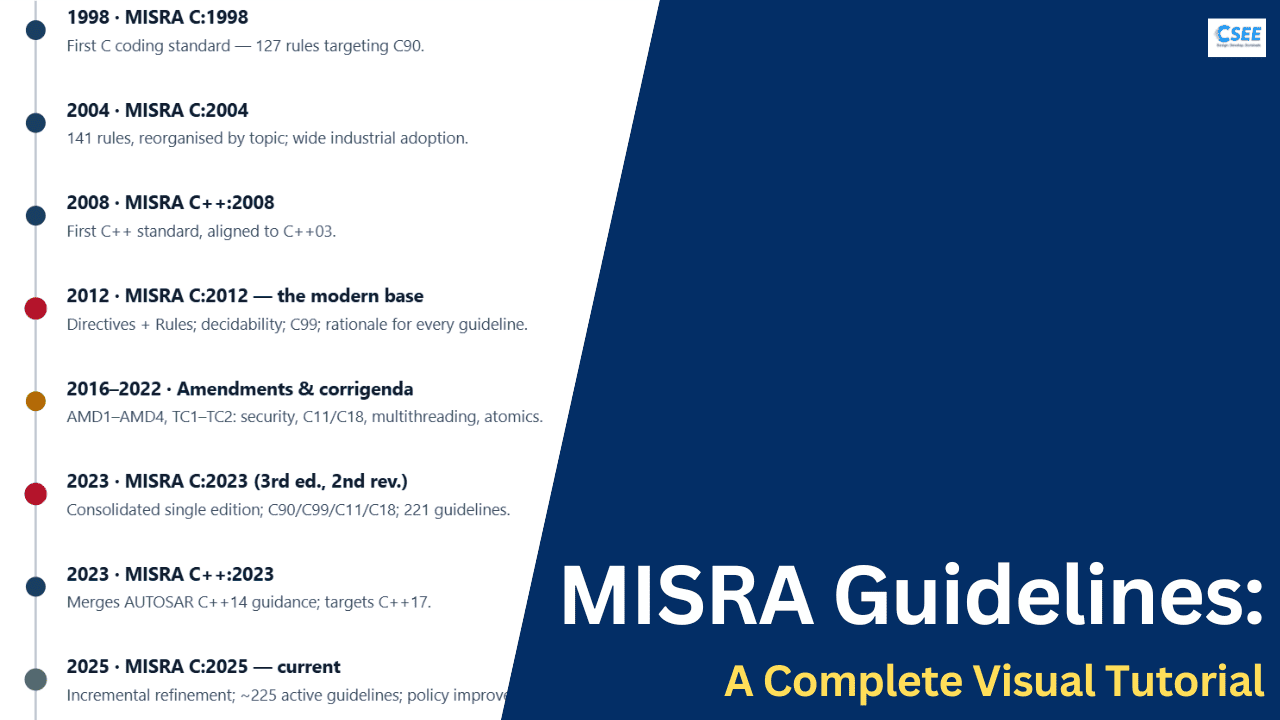
The story starts with the 1994 report Development Guidelines for Vehicle Based Software, a broad process document rather than a coding standard. The first true coding standard, MISRA C:1998, defined 127 rules and immediately found an audience far beyond cars. MISRA C:2004 reorganised those rules into 141 items grouped by topic and became the version many engineers still remember. MISRA C:2012 was the great leap: it introduced the directive versus rule distinction, added formal decidability information for tooling, expanded to cover C99, and grew through a series of amendments and technical corrigenda over the following decade.
Those amendments were eventually consolidated. MISRA C:2023 rolled up every amendment and corrigendum — including the multithreading and atomics guidance of Amendment 4 — into a single third edition, second revision, covering C90, C99, C11 and C18. Two years later, MISRA C:2025 refined the collection further with policy changes and additional guidelines. On the C++ side, MISRA C++:2008 served C++03, and MISRA C++:2023 merged the separate AUTOSAR C++14 guidelines into a single modern standard targeting C++17.
The MISRA Document Family
Newcomers often assume “MISRA” is one book. In reality it is a small library of interlocking documents, and knowing how they fit together is essential, because you cannot legitimately claim compliance from the coding guidelines alone. The guidelines tell you what good code looks like; a separate compliance document tells you how to prove your project met them; and further documents adapt the rules to specialised situations such as automatically generated code.
The family has four functional layers. At the centre sit the language guideline documents — MISRA C and MISRA C++ — which contain the directives and rules themselves. Surrounding them is the compliance framework, principally MISRA Compliance:2020, which defines the artifacts and process required to demonstrate conformance and which became mandatory from MISRA C:2023 onward. A third layer, the Autocode (AC) documents, adapts the guidelines for model-based development and code generators such as Simulink and TargetLink. A fourth layer of addenda and mappings ties MISRA to security taxonomies such as CERT C and CWE, showing that a standard born for safety is equally valuable for security.
Directives, Rules, Categories, and Decidability
Every MISRA guideline is classified along several independent axes. These classifications are not bureaucratic decoration — they determine how a guideline is enforced, whether a tool can check it automatically, and how much freedom a project has to deviate from it. Master these four axes and the entire standard becomes navigable.
Axis 1 — Directive vs Rule
A guideline is the umbrella term. It splits into two kinds. A directive is a guideline whose full compliance cannot be judged from the source code alone; judging it needs additional information such as design intent, documentation, or process evidence. “All code shall be traceable to documented requirements” is a directive — no analyser can read your requirements database. A rule, by contrast, is a guideline that is completely defined by the source code, so its meaning is unambiguous and — at least in principle — checkable by a tool. “The goto statement shall not be used” is a rule.
Directives are written as Dir n.m (for example, Dir 4.1) and rules as Rule n.m (for example, Rule 15.1). The first number is the chapter; the second is the position within it.
Axis 2 — Category: Mandatory, Required, Advisory
Each guideline carries one of three enforcement categories, and this is the single most important attribute to internalise because it dictates whether you are allowed to deviate.
| Category | Chip | Deviation allowed? | Meaning in practice |
|---|---|---|---|
| Mandatory | Mandatory | No. Never. | Compliant code must always satisfy these. There is no legitimate mechanism to deviate. A single violation breaks compliance outright. |
| Required | Required | Only via a formal, authorised deviation. | The default expectation is full compliance, but a documented and signed-off deviation record may justify a specific exception. |
| Advisory | Advisory | Yes, with lighter documentation. | Recommendations. Non-compliance should still be recorded for consistency, but the bar is lower. A project may choose to reclassify advisory items as required. |
For automatically generated code, some editions add a fourth situational category, readability, and allow certain rules to change category — recognising that a machine, not a human, is writing the code, so rules that exist purely to aid human review may relax while rules guarding runtime behaviour stay firm.
Axis 3 — Decidability: Decidable vs Undecidable
This axis speaks directly to what tools can promise. A rule is decidable if an algorithm can always answer “does this code comply?” with a definite yes or no. A rule is undecidable if, in the general case, no algorithm can always give a correct yes/no answer — usually because it depends on runtime values or on information that is provably impossible to compute statically (this is a deep consequence of computability theory, related to the halting problem). Undecidable rules force analysers to be conservative: they must either over-report (flag safe code, producing false positives) or under-report (miss real violations, producing false negatives).
Axis 4 — Scope: Single Translation Unit vs System
A single translation unit rule can be checked by looking at one preprocessed source file in isolation. A system rule requires visibility across the whole program — every translation unit linked together — because it concerns things like consistent declarations of the same object across files, or the uniqueness of external identifiers. System-scope rules are why serious MISRA tooling analyses the entire build, not just individual files.
Put together, a single guideline reads like a specification. For instance, Rule 17.7 (“The value returned by a function having non-void return type shall be used”) is a Required rule, decidable, single-translation-unit in scope. That compact profile tells a team everything they need: they must comply unless they raise a deviation, a tool can reliably flag it, and it can be checked file by file.
The anatomy of a single guideline entry
Inside the official documents, each guideline follows a consistent template, and knowing that template helps you read the standard efficiently and settle arguments about what a rule really requires. A typical entry opens with the guideline’s headline — the one-sentence statement, such as “The goto statement shall not be used.” Beneath it sit the classification tags discussed above (category, decidability, scope, and the applicable language versions). Then comes the substantive body, which usually contains several distinct parts.
The amplification pins down the precise meaning of the headline, resolving the ambiguity that plain English always carries — it states exactly which constructs are in scope and which are not. The rationale explains why the guideline exists: the specific hazard, defect pattern, or portability problem it prevents. This section is the one most worth reading, because it turns a rule from an arbitrary prohibition into an understandable engineering decision, and it is often what you cite when justifying a deviation. Where relevant, an exception clause lists narrowly defined situations in which the construct is permitted despite the headline — these are official carve-outs, not deviations, and code using them is fully compliant. Finally, most entries provide examples, typically paired non-compliant and compliant snippets that make the boundary concrete.
Reading a guideline in this structured way prevents two common mistakes. The first is over-applying a rule beyond its amplified scope — flagging code the standard never intended to catch. The second is treating a permitted exception as though it needed a deviation, which wastes effort and clutters the deviation log. When a team disagrees about whether some code violates a rule, the amplification and exception clauses, not the one-line headline, are the authority.
How the Rules Are Organised by Chapter
The rules are grouped into numbered chapters, each covering a coherent area of the language. The chapter number is the first digit of every rule identifier, so once you know the map you can guess roughly where any rule lives. A rule beginning with Rule 10. concerns the essential type model; one beginning Rule 21. concerns the standard library. The directives occupy their own short set of chapters (Dir 1 through Dir 4) covering the build environment, code design, documentation, and general design principles.
| Ch. | Topic area | Representative concern |
|---|---|---|
| 1 | A standard C environment | Program must use a documented, conforming implementation; no language extensions without justification. |
| 2 | Unused code | No unreachable code, dead code, unused variables, labels, parameters, or tags. |
| 3 | Comments | No nested /* */; no line-splicing that hides code inside comments. |
| 4 | Character sets and lexical conventions | Restrictions on escape sequences and non-portable characters in identifiers. |
| 5 | Identifiers | Uniqueness and length constraints so distinct identifiers never collide across linkers or scopes. |
| 6 | Types | Bit-field types constrained; no reliance on plain int bit-field sign. |
| 7 | Literals and constants | Octal constants banned; unsigned literals suffixed; string literals not modified. |
| 8 | Declarations and definitions | Consistent, complete declarations; one definition; explicit linkage; no implicit types. |
| 9 | Initialization | Objects initialised before use; aggregate initialisers well-formed; no partial overlap. |
| 10 | The essential type model | Controls implicit conversions between “essential” type classes — the heart of MISRA. |
| 11 | Pointer type conversions | Tight limits on casting between pointer types and between pointers and integers. |
| 12 | Expressions | Parenthesisation, operator precedence clarity, sizeof and comma operator restrictions. |
| 13 | Side effects | No undefined evaluation order; no assignment inside larger expressions where it confuses. |
| 14 | Control statement expressions | Loop counters and controlling expressions must be well-behaved; no invariant conditions. |
| 15 | Control flow | Single point of exit guidance; goto restricted; every if/else if chain terminated. |
| 16 | Switch statements | Well-formed switch; every clause ends in break; a default is present. |
| 17 | Functions | No recursion (by default); prototypes required; return values used; va_* restricted. |
| 18 | Pointers and arrays | Pointer arithmetic bounded to arrays; no out-of-bounds; flexible array member limits. |
| 19 | Overlapping storage | Restrictions on unions and overlapping objects that alias the same memory. |
| 20 | Preprocessing directives | Macro hygiene: parenthesised macro parameters, #include discipline, no #undef abuse. |
| 21 | Standard libraries | Bans or restricts risky library facilities: setjmp, system, dynamic memory, unbounded string functions. |
| 22 | Resources | Files, streams, and other resources acquired and released correctly; no use-after-close. |
| 23 | Generic selections (C11) | _Generic usage constrained for predictability. |
Two chapters deserve special attention because they generate the most day-to-day findings and the most confusion: chapter 10, the essential type model, and chapter 21, the standard library restrictions. The next section unpacks the essential type model in depth, and a later section walks through concrete rules from several chapters with compliant and non-compliant code side by side.
Rule 15.5 = chapter 15 (control flow), fifth rule → “A function should have a single point of exit at its end.” Dir 4.12 = directive chapter 4 (design principles), twelfth directive → “Dynamic memory allocation shall not be used.” The grammar is always chapter.position.
The Essential Type Model, Explained Slowly
If you learn only one deep idea from MISRA, make it this one. The essential type model is MISRA’s answer to the single most treacherous feature of C: implicit conversions. In ordinary C, arithmetic silently promotes and converts operands according to the “usual arithmetic conversions” and integer promotion rules. A char becomes an int; a signed value meeting an unsigned value quietly becomes unsigned; a narrow type widens; a wide value assigned to a narrow variable is truncated without a peep. Each of these is a documented, standard-conforming behaviour, and each is a classic source of security holes and safety defects.
MISRA cannot simply ban implicit conversion — that would make C unusable. Instead it defines a parallel, stricter type system layered on top of the language’s own, and it constrains how values may move between the classes of that stricter system. This parallel system is built from essential types.
From declared type to essential type
Every expression in C has a declared type according to the language. MISRA maps that declared type onto an essential type category, which is one of a small set of families. The mapping deliberately ignores accidental width and focuses on the value’s true nature: is this a boolean, a character, a signed number, an unsigned number, an enumeration constant, or a floating-point number?
| Essential type category | Declared C types that map to it | Intended meaning |
|---|---|---|
| Essentially Boolean | bool / _Bool, or a project-defined boolean type | A truth value — only ever true or false. |
| Essentially character | plain char | A printable/text character, not a small integer for arithmetic. |
| Essentially signed | signed char, short, int, long, long long | A number that may be negative. |
| Essentially unsigned | unsigned char/short/int/long/long long | A non-negative number, often a bit pattern or count. |
| Essentially enum | a named enum type | A member of a specific enumeration — not interchangeable with raw ints. |
| Essentially floating | float, double, long double | A real number with fractional precision. |
With the categories defined, the chapter-10 rules enforce a simple philosophy: a value should not silently change category. You may not use a signed value where an unsigned one is expected without an explicit conversion; you may not treat a plain char as a number; you may not assign a wider essential type into a narrower object where information could be lost; and boolean context must receive genuinely boolean values. When a conversion is truly needed, MISRA wants it written out as an explicit cast so a human reviewer sees the intent and a tool can confirm the cast is safe.
A worked example
/* Non-compliant: signed/unsigned mixing and implicit narrowing */
void bad(void)
{
    int            s  = -1;
    unsigned int   u  = 1u;
    unsigned char  b;

    if (s < u)          /* Rule 10.4: signed vs unsigned in same expression  */
    {
        /* On most targets s converts to a huge unsigned value → branch NOT taken. Surprise. */
    }

    b = u + 300u;       /* Rule 10.3: value 301 truncated into unsigned char */
}

/* Compliant: intentions made explicit, categories respected */
void good(void)
{
    int            s = -1;
    unsigned int   u = 1u;
    unsigned char  b;

    if (s < (int)u)                    /* both operands essentially signed */
    {
        /* now the comparison behaves as a human expects */
    }

    b = (unsigned char)((u + 44u) & 0xFFu);  /* explicit, bounded, reviewed */
}
Composite expressions and the width trap
The model has a subtle refinement that trips people up: the essential type of a composite expression — one built from operators like +, *, or << — is determined by MISRA’s own rules, not simply by C’s promotion. Two unsigned char operands added together have a declared type of int in C (because of integer promotion), but MISRA still treats the essential type of the sum as unsigned, matching the programmer’s intent. This lets the model catch cases where a value’s true nature and its promoted type disagree, which is exactly where silent defects hide. It also means the model is deliberately width-agnostic: it does not care whether a number is stored in 8, 16, 32, or 64 bits nearly as much as it cares whether the number is signed, unsigned, a character, or a float. Width matters only when a conversion could lose information, at which point the narrowing rules step in.
A related consequence is that plain char occupies its own category, distinct from both signed and unsigned integers. This is intentional. Whether plain char is signed or unsigned is implementation-defined — it varies by compiler and target — so any code that performs arithmetic on a plain char and relies on its sign is silently non-portable. By quarantining char as “essentially character”, the model forces you to convert explicitly to signed char or unsigned char the moment you want to do arithmetic, making the portability assumption visible and reviewed rather than accidental.
The practical payoff of the whole model is that a reviewer, or a tool, can look at any expression and immediately see whether values are crossing category boundaries. Where they cross, an explicit cast documents that the author knew and intended the conversion. Where they do not, the expression is transparently type-safe in MISRA’s stricter sense. This is why chapter 10 generates so many findings on codebases new to MISRA: ordinary, “working” C is riddled with implicit category crossings that no one ever noticed, each a small latent risk that the model drags into the light.
s < u comparison above is a genuine, shipping-in-the-wild bug pattern. Because -1 converts to UINT_MAX, a check meant to catch negative values silently fails. The essential type model exists to make exactly this class of mistake impossible to write by accident.
A Guided Tour of High-Impact Rules
Reading rule numbers is one thing; recognising them in your own code is another. This section walks through a representative selection of rules and directives drawn from across the chapters, each shown as a guideline card with the intent, the category, and — where useful — non-compliant and compliant code. These are the rules that safety teams see violated most often, so they repay careful study.
A directive, because judging it needs design evidence, not just source. It asks the team to actively design against run-time faults — division by zero, out-of-range array access, arithmetic overflow, invalid pointer use — rather than hope they never occur. Compliance is demonstrated through defensive coding, static analysis of value ranges, and documented reasoning, not a single code pattern.
One of the most consequential directives for embedded design. malloc, calloc, realloc, and free introduce fragmentation, non-deterministic timing, and a whole family of use-after-free and leak defects that are extremely hard to bound in a safety argument. Safety-critical firmware therefore favours static allocation, fixed-size pools, and stack discipline. Where a heap truly cannot be avoided, a deviation with a bounded, deterministic custom allocator is the usual route.
The controlling expression of if, while, for, and the ternary operator must have essentially Boolean type — you may not lean on C’s habit of treating “non-zero means true”.
if (ptr) { ... }         /* non-compliant: ptr is a pointer, not Boolean */
while (count) { ... }    /* non-compliant: count is an integer          */

if (ptr != NULL) { ... } /* compliant: comparison yields Boolean         */
while (count != 0u) { ... }Advisory, and genuinely debated. A single return at the end can make control flow easier to reason about and easier to instrument, which is why it is recommended; but many modern teams deviate in favour of early-return “guard clauses” that reduce nesting. Because it is advisory, a project may adopt either stance provided the choice is recorded and applied consistently.
Every if, else, for, and while body must be wrapped in braces, even for a single statement. This eliminates the infamous “goto fail” class of bug, where an unbraced body silently excludes a following line from the intended branch.
if (secure) do_a();      /* non-compliant: no braces */
    do_b();              /* runs unconditionally — easy to misread */

if (secure)
{
    do_a();
    do_b();
}Chapter 16 collectively demands disciplined switch statements: every clause other than the last terminates with an unconditional break (no accidental fall-through), a default clause is always present, and the switch expression is not essentially Boolean. Together these stop the most common switch defects — forgotten breaks and unhandled cases — cold.
Recursion makes stack usage a function of runtime data, which is unacceptable when you must prove a hard upper bound on stack depth for a safety case. MISRA therefore bans recursion by default. Algorithms that are naturally recursive are rewritten iteratively with an explicit, bounded work stack.
Ignoring a return value often means ignoring an error code. If a function returns a status you genuinely intend to discard, you must say so explicitly by casting to void, which documents that the discard was deliberate and reviewed.
memcpy(dst, src, n);          /* non-compliant: return value dropped */
(void)memcpy(dst, src, n); /* compliant: discard is explicit */The concrete rule that backs the anti-heap directive. Chapter 21 is full of similar library restrictions: setjmp/longjmp are banned for their unpredictable control flow, system and getenv are restricted for security, and unbounded string functions are discouraged in favour of length-limited alternatives.
Function-like macros are notorious for precedence surprises. Wrapping each parameter — and the whole expansion — in parentheses prevents the expanded text from binding in unexpected ways.
#define SQ(x)  x * x        /* SQ(a+b) expands to a + b * a + b  */
#define SQ(x) ((x) * (x)) /* now SQ(a+b) is ((a+b) * (a+b)) */A system-scope rule. When a function is meant to be shared across translation units, its prototype belongs in a header that both the definition and every caller include. This guarantees the compiler sees one consistent signature everywhere, catching the classic bug where a caller and a definition silently disagree about argument types.
/* widget.h — the single source of truth */
extern int widget_init(unsigned id);

/* widget.c */
int widget_init(unsigned id) { /* ... */ return 0; }
/* both the caller and this file include widget.h → declarations must match */Reinterpreting one object type as another through a pointer cast can break alignment requirements and violate the compiler’s aliasing assumptions, producing undefined behaviour. Chapter 11 tightly constrains pointer conversions; where a genuine reinterpretation is unavoidable — as in some hardware-register or serialization code — it is exactly the kind of place a carefully justified deviation belongs.
float f = 3.14f;
unsigned int *p = (unsigned int *)&f;  /* non-compliant: type-punning via cast */

/* Compliant alternative: copy the bytes explicitly */
float f = 3.14f;
unsigned int u;
(void)memcpy(&u, &f, sizeof u);Pointer arithmetic that wanders outside the bounds of the array it started in is undefined behaviour and a frequent root cause of memory-corruption defects and security vulnerabilities. This rule keeps every pointer computation anchored to a real array, which is also what makes bounds checkable by analysis. It is closely related to the broader chapter-18 goal of eliminating out-of-bounds access entirely.
The logical && and || operators short-circuit: the right operand may or may not be evaluated depending on the left. If that right operand changes state — increments a counter, writes a variable, calls a function with effects — then whether the effect happens becomes non-obvious and depends on values, making the code hard to read and reason about. Keeping side effects out of short-circuit operands removes the surprise.
These cards are a sampler, not the full catalogue — the standard contains well over two hundred guidelines. But they illustrate the recurring MISRA design philosophy: prefer the explicit over the implicit, prefer the bounded over the unbounded, and prefer constructs a human reviewer and a static analyser can both understand without heroics.
Deviations and the Compliance Process
Real codebases cannot always obey every guideline. A hardware register might have to be accessed through a pointer cast that a rule forbids; a certified third-party library might contain constructs your project would never write itself; a performance-critical routine might justify a specific, well-understood exception. MISRA anticipates this and provides a disciplined escape hatch: the deviation. The rule is simple and strict — you may deviate from Required and Advisory guidelines through a formal process, but never from Mandatory ones.
The governing document, MISRA Compliance:2020, turns “we mostly follow MISRA” into something an auditor can verify. It defines a handful of concrete artifacts that together form the evidence of compliance. These are worth memorising by name, because a safety assessor will ask for each of them.
| Artifact | Abbrev. | Purpose |
|---|---|---|
| Guideline Enforcement Plan | GEP | Declares, for every guideline, how compliance will be checked — which tool, which manual review, or which analysis. It is the plan you agree before writing code. |
| Guideline Compliance Summary | GCS | The headline results table: for each guideline, its category and its final compliance status (compliant, deviations, or violations). This is the top-level scorecard. |
| Deviation Record | — | A documented, justified, authorised exception to a specific guideline in specific code, with rationale and any compensating measures. |
| Deviation Permit | — | A pre-authorisation, often from a supplier or standards body, allowing a class of deviations under stated conditions across a project. |
The compliance process itself is a loop, not a one-time gate. It runs continuously through development: the code is analysed, findings are triaged, each finding is either fixed or turned into an authorised deviation, and the compliance summary is kept current. The following diagram shows the flow a single finding travels.
How Enforcement Actually Works: Static Analysis
Because most MISRA rules are defined by the source code, they can be checked by machine — and in practice they must be, since no human team can manually verify two hundred rules across a large firmware codebase on every commit. The workhorse technology is the static analyser, a tool that reasons about a program’s structure and possible behaviour without running it. Understanding what happens inside such a tool demystifies both its power and its limits.
A MISRA-capable analyser mirrors the front half of a compiler and then keeps going. It preprocesses the code (expanding macros and includes exactly as the real build would), lexes and parses it into an abstract syntax tree, and builds semantic models — a symbol table, type information, a control-flow graph, and a call graph. On top of that it layers analyses the compiler never bothers with: data-flow analysis to track how values move, and for the deepest checks, techniques such as abstract interpretation that compute a safe over-approximation of every value a variable could hold at every point in the program. Rule checkers then walk these models looking for the patterns each MISRA guideline forbids.
This is also where decidability from section 04 becomes concrete. For a decidable rule such as “no goto“, the checker gives a definite answer. For an undecidable rule such as “this pointer is never null when dereferenced”, the tool must approximate. A sound tool errs toward over-reporting: it will never miss a real violation, but it produces false positives that engineers must review and dismiss. A tool tuned for low noise may instead miss some real issues. Choosing and configuring a tool is largely about managing this trade-off, and it is why deviations and manual review remain part of the picture even with excellent tooling.
Two formal properties describe how a tool handles this trade-off, and safety teams should know both. A tool is sound (for a given rule) if it never misses a real violation — every true problem is reported, at the cost of possibly reporting some non-problems. A tool is complete if it never reports a false positive — everything it flags is a genuine violation, at the cost of possibly missing some real ones. Because of undecidability, no tool can be both perfectly sound and perfectly complete for every undecidable rule at once; something has to give. Safety-oriented tools generally favour soundness, because in a safety context a missed defect is far more dangerous than an extra false alarm. That choice is precisely why triaging false positives is an unavoidable, budgeted part of the workflow rather than a sign that the tool is broken.
There are also hard limits worth stating plainly. Static analysis cannot judge the directives, which by definition need information outside the source. It cannot confirm that your requirements are correct, only that code traces to them if you supply the links. It cannot fully verify undecidable properties, only approximate them. And it says nothing about whether the software does the right thing functionally. For all these reasons, tooling is one instrument in an ensemble that also includes manual code review, unit and integration testing, structural coverage measurement, and independent assessment. The analyser removes the tedious, mechanical, high-volume work so that scarce human attention can focus where machines cannot help — on design intent, on the directives, and on the parts of the safety argument that genuinely require judgement.
Tools Used to Enforce MISRA
A healthy MISRA practice combines several categories of tool. The star is the dedicated static analyser, but it works alongside compilers (which can be configured to reject some non-conformances outright), unit-test and coverage frameworks (which support the directives about testing and requirements traceability), and configuration-management systems (which store the deviation records and compliance summaries as controlled documents). The table below surveys the widely used static analysers and checkers; most support several MISRA editions and can be configured to the specific subset a project has agreed in its enforcement plan.
| Tool | Origin / vendor family | Notable characteristics |
|---|---|---|
| Helix QAC | Perforce (formerly PRQA QA·C) | Long-established, certification-focused C/C++ analyser with deep MISRA coverage and compliance reporting; common in automotive and aerospace. |
| LDRA tool suite | LDRA | Combines MISRA checking with requirements traceability, structural coverage, and unit testing; LDRA staff sit on MISRA working groups. |
| Polyspace | MathWorks (Bug Finder & Code Prover) | Uses abstract interpretation to prove absence of certain run-time errors; integrates with Simulink model-based workflows and MISRA AC. |
| Coverity | Black Duck / Synopsys lineage | Scalable deep static analysis with strong defect and security coverage plus MISRA rule sets; popular in large codebases. |
| Klocwork | Perforce | Developer-desktop and CI static analysis with incremental, on-the-fly checking and MISRA support. |
| Parasoft C/C++test | Parasoft | Static analysis plus unit testing, coverage, and reporting bundled for safety compliance workflows. |
| PC-lint Plus | Gimpel | Veteran, highly configurable command-line linter with extensive MISRA rule support and a modest footprint. |
| Astrée | AbsInt | Sound static analyser based on abstract interpretation, aimed at proving the absence of run-time errors and data races; also checks MISRA rules. |
| IAR C-STAT | IAR | Static analysis integrated into the IAR embedded toolchain, checking MISRA C/C++ alongside CWE and CERT rules. |
| Cppcheck | open source (with commercial add-on) | Free static analyser; the commercial Cppcheck Premium adds fuller MISRA C/C++ coverage and reporting. |
| ECLAIR | BUGSENG | Analyser with formal-methods heritage and thorough MISRA classification metadata; contributors sit on MISRA groups. |
Alongside these dedicated products, mainstream compilers play a supporting role. GCC and Clang expose many warning flags (for implicit conversions, uninitialised use, unreachable code, and more) that overlap with MISRA rules, and turning warnings into errors is a cheap first line of defence. Clang-Tidy ships some MISRA-adjacent checks. But compiler warnings alone never constitute MISRA compliance — they cover only a fraction of the guidelines and offer none of the compliance reporting that Compliance:2020 requires.
Integrating MISRA Into the Development Workflow
MISRA fails as a “big bang at the end” activity. A team that writes a year of code and only then runs the analyser will drown in thousands of findings, many of them requiring architectural change to fix. The teams that succeed treat conformance as continuous — every developer sees findings as they type, every commit is gated, and the compliance summary is always current. This is the “shift left” principle applied to coding standards: catch issues at the earliest, cheapest moment.
A mature setup layers enforcement at four points in the lifecycle, each catching what the previous layer missed and each progressively harder to bypass.
Two practical techniques make continuous enforcement bearable on real projects. The first is baselining: when adopting MISRA on an existing codebase, you record the current set of findings as an accepted baseline and configure the gate to fail only on new findings. This lets a team stop the bleeding immediately while paying down the legacy debt on a planned schedule, rather than freezing all work until a mountain of historical issues is cleared. The second is incremental analysis, where the tool re-checks only the files affected by a change, keeping the commit and pull-request gates fast enough that developers do not route around them.
Directives, remember, cannot be closed by the analyser alone. The workflow must therefore also weave in the human and process evidence they demand: requirements traceability links (for the directive that all code trace to requirements), documented coding-standard sign-off, and review records. Tools such as the LDRA suite and Parasoft explicitly bridge static analysis and this traceability evidence, which is why full “tool suites” are attractive to teams pursuing formal certification.
MISRA C++ and the AUTOSAR Merger
C++ brings enormous expressive power to embedded systems — classes, templates, RAII, the standard library — and with it a correspondingly larger surface of ways to go wrong. MISRA addressed C++ separately from C because the languages, despite shared syntax, raise different hazards. MISRA C++:2008 targeted C++03 and constrained features such as multiple inheritance, exceptions, and template complexity that complicate a safety argument.
The landscape then fragmented. As the automotive industry adopted modern C++, the AUTOSAR consortium published its own Guidelines for the use of the C++14 language in critical and safety-related systems, because MISRA C++:2008 had aged relative to C++11 and C++14. For a period, teams faced two overlapping standards. That duplication was resolved in MISRA C++:2023, which merged the AUTOSAR C++14 guidance into MISRA and updated the whole to target C++17. The result is a single, current “go to” subset for safety-related C++, ending the awkward AUTOSAR-versus-MISRA split.
| Edition | Language | Status & note |
|---|---|---|
| MISRA C++:2008 | C++03 | The original C++ standard; now dated relative to modern C++. |
| AUTOSAR C++14 | C++14 | Filled the modern-C++ gap for automotive; merged into and superseded by MISRA C++:2023. |
| MISRA C++:2023 | C++17 | Current edition; consolidates AUTOSAR guidance; the recommended target for new C++ safety work. |
Conceptually, everything you learned about MISRA C carries over: directives and rules, the three categories, decidability, deviations, and the Compliance:2020 framework all apply. What changes is the content of the rules, which now cover C++-specific concerns — object lifetime and ownership, exception usage, template instantiation, virtual dispatch, the pitfalls of implicit conversions among class types, and modern additions such as constraints on structured bindings and range-based for loops that can create dangerous temporaries.
Where MISRA Sits Among Functional-Safety Standards
MISRA does not exist in a vacuum. It is one ingredient in a larger recipe for building software that regulators and safety assessors will trust. The umbrella discipline is functional safety, and each industry has its own governing standard. Those standards rarely name MISRA outright, but they require the use of a suitable coding standard that enforces a safe language subset — and MISRA is the near-universal way teams satisfy that requirement.
| Standard | Domain | Relationship to MISRA |
|---|---|---|
| ISO 26262 | Automotive | The automotive functional-safety standard. It calls for enforcing a language subset and coding guidelines; MISRA C/C++ is the industry-default way to meet that expectation across ASIL levels. |
| IEC 61508 | Industrial / general E/E/PE | The parent functional-safety standard for programmable electronic systems. It recommends coding standards and language subsets that MISRA directly provides. |
| DO-178C | Aerospace (airborne software) | Governs software in civil aircraft. Coding standards are an expected artifact; MISRA is frequently adopted or adapted, sometimes alongside domain rule sets. |
| IEC 62304 | Medical device software | Defines the software lifecycle for medical devices; a coding standard supporting risk control is expected, and MISRA is a common choice. |
| EN 50128 / EN 50657 | Railway | Rail software safety standards that likewise expect a coding standard and language subset, for which MISRA is widely used. |
| CERT C / CWE | Security | Not safety standards but security taxonomies; MISRA publishes addenda mapping its guidelines onto CERT C and CWE, showing strong overlap between safe and secure coding. |
The relationship is best understood as layered. At the top sits the domain safety standard (say ISO 26262), which sets the overall process and integrity levels. It delegates “use a safe coding style” to a coding standard, and MISRA fills that slot. MISRA in turn delegates “prove you followed it” to Compliance:2020, and delegates “check it automatically” to the static-analysis tools. Each layer hands a well-defined job to the next, and the whole stack together forms the safety argument an assessor evaluates.
Two further concepts connect MISRA to the surrounding safety machinery. The first is the notion of integrity levels. Safety standards grade how much rigor a given piece of software demands based on how badly it could hurt someone if it failed — automotive uses ASIL A through D under ISO 26262, industrial systems use SIL 1 through 4 under IEC 61508, and aerospace uses design assurance levels under DO-178C. Higher integrity levels demand stronger evidence, and that often translates into a stricter MISRA subset: a project might treat many advisory guidelines as required, or elevate its expectations for how thoroughly deviations are reviewed, as the integrity level rises. MISRA gives you the dial; the integrity level tells you how far to turn it.
The second concept is tool qualification. If you rely on a static analyser to demonstrate that your code conforms — and therefore to support a safety claim — an assessor will reasonably ask how you know the tool itself is trustworthy. Could a bug in the analyser cause it to miss a real violation and let a defect through? Safety standards address this through tool qualification (ISO 26262 speaks of a tool confidence level; DO-178C uses tool qualification levels), a process that establishes appropriate confidence in the tools used to develop or verify safety-critical software. This is one practical reason teams gravitate toward established commercial analysers with qualification support and documented evidence, rather than assembling an ad-hoc chain of unqualified utilities: the tool’s own credibility becomes part of the safety argument.
Misconceptions, Costs, and Best Practices
MISRA has a reputation — some of it earned, much of it based on outdated impressions or partial adoption. Separating the real trade-offs from the myths helps a team adopt it with clear eyes.
Common misconceptions
- “MISRA just bans useful features to annoy developers.” Nearly every rule traces to a documented failure mode. The standard publishes a rationale for each guideline; where a rule is genuinely controversial it is usually classified advisory precisely so teams can debate and deviate.
- “A clean analyser report equals compliance.” As covered above, compliance also requires the enforcement plan, the compliance summary, authorised deviations, and evidence for the directives — none of which a tool produces on its own.
- “MISRA makes code slower.” The subset it defines is about predictability, not performance. Avoiding recursion or dynamic allocation often improves determinism and worst-case timing, which is what real-time systems care about.
- “MISRA is only for cars.” Born in automotive, yes, but now used across aerospace, rail, medical, industrial, and security-sensitive software. The CERT/CWE mappings underline its relevance well beyond safety.
- “You can retrofit MISRA to a finished product in a sprint.” Retrofitting is the hardest path. Baselining makes it survivable, but genuine conformance on a large legacy codebase is a sustained program, not a task.
The honest costs
Adopting MISRA is not free. Expect an upfront investment in tooling and licences, training for the team, and time spent triaging false positives on undecidable rules. There is friction in writing explicit casts and braces that felt unnecessary before, and there is ongoing effort in maintaining deviation records. On legacy code the cost can be substantial. These costs are real and should be planned for — but they are dwarfed by the cost of a field failure in a safety-critical product, which is exactly the calculation the standard is designed around.
Best practices that consistently pay off
- Adopt early. Turn on enforcement at project inception. Staying clean is cheap; becoming clean is expensive.
- Agree the subset up front. Write the Guideline Enforcement Plan before serious coding. Decide which advisory rules you will treat as required, and how each guideline will be checked.
- Baseline legacy code. Freeze existing findings, gate on new ones, and schedule debt paydown.
- Automate the gate. Put analysis in CI and make new findings block merges. Manual discipline erodes; automated gates do not.
- Treat deviations as first-class engineering. Justify, authorise, scope, and review each one. Watch the deviation count as a health metric.
- Tune for signal. Configure the tool to your agreed subset so developers see relevant findings, not noise they learn to ignore.
- Keep the compliance summary live. Regenerate it continuously so a release audit is a formality, not a scramble.
- Do not skip the directives. The process and documentation directives are where partial adopters most often fall short of real compliance.
A Practical Adoption Roadmap
For a team standing at the starting line, here is a pragmatic sequence that turns the theory in this manual into a working practice. It assumes a mix of new and existing code, which is the usual reality.
Phase one — decide. Choose the edition (MISRA C:2025 or C++:2023 for greenfield), select a tool that emits the compliance evidence you need, and draft the enforcement plan that records how each guideline will be met and which advisory rules you elevate to required. Phase two — baseline. Run the tool across the existing codebase and accept the current findings as a documented starting point so you are not blocked by history. Phase three — gate. Wire analysis into CI, fail builds on new findings, and train the team on the rules they will hit most and on how to raise a deviation properly. Phase four — sustain. Keep the compliance summary current, review deviations regularly, and burn down the baseline on a planned schedule so the legacy debt shrinks release over release.
Glossary of MISRA Terms
| Term | Meaning |
|---|---|
| Guideline | The umbrella term for any single MISRA item; it is either a directive or a rule. |
| Directive (Dir n.m) | A guideline whose full compliance cannot be judged from source code alone; needs design or process evidence. |
| Rule (Rule n.m) | A guideline fully defined by the source code and therefore, in principle, tool-checkable. |
| Mandatory | A category that permits no deviation whatsoever. |
| Required | A category that permits deviation only via a formal, authorised deviation record. |
| Advisory | A recommendation; deviation is permitted with lighter documentation. |
| Decidable rule | A rule for which an algorithm can always give a definite compliant/non-compliant answer. |
| Undecidable rule | A rule that cannot be decided by any algorithm in the general case; tools must approximate. |
| Single translation unit | A rule checkable by examining one preprocessed source file alone. |
| System rule | A rule that requires visibility across the whole linked program. |
| Essential type | MISRA’s stricter classification of an expression (Boolean, character, signed, unsigned, enum, floating). |
| Essential type model | The chapter-10 system that constrains implicit conversions across essential type categories. |
| Deviation | A documented, authorised, justified exception to a required or advisory guideline. |
| Deviation permit | A pre-authorisation allowing a class of deviations under stated conditions. |
| GEP | Guideline Enforcement Plan — declares how each guideline will be checked. |
| GCS | Guideline Compliance Summary — the per-guideline status scorecard. |
| Static analysis | Reasoning about a program’s properties without executing it; the main MISRA enforcement technology. |
| Abstract interpretation | A sound static-analysis technique that computes safe over-approximations of program values. |
| Baselining | Recording current findings as accepted so the gate fails only on new ones. |
| Undefined behaviour | C behaviour with no defined meaning; the primary hazard MISRA guards against. |
| AUTOSAR C++14 | A separate C++14 safety guideline set, now merged into MISRA C++:2023. |
Bringing It All Together
MISRA can look, from the outside, like a thick book of prohibitions. Seen properly, it is something more coherent: a disciplined answer to a genuine engineering problem. The C and C++ languages give embedded developers enormous power and, in the same breath, enormous freedom to write code whose behaviour no one can fully predict. In a spreadsheet or a game, that unpredictability is a bug. In a brake controller, an infusion pump, or a flight-control computer, it is a hazard to human life. MISRA exists to convert those languages into a subset that is still powerful but is now predictable, reviewable, and provable.
The pieces all fit together. The guidelines — directives and rules, each tagged by category, decidability, and scope — define the safe subset. The essential type model tames C’s most dangerous habit, implicit conversion. The compliance framework turns “we follow MISRA” into auditable evidence through enforcement plans, compliance summaries, and authorised deviations. Static analysis tools automate the checking, honestly bounded by what is decidable. A continuous workflow shifts enforcement left so problems are caught cheaply. And the whole edifice slots into the larger world of functional-safety standards as the coding-level pillar of a much taller safety argument.
If you remember only a handful of things from this manual, let them be these: compliance is more than a clean tool report; deviations are controlled engineering decisions, never loopholes; mandatory means mandatory; the essential type model is the conceptual heart; and adopting MISRA early and continuously is vastly easier than retrofitting it late. Hold onto those, and the two-hundred-plus guidelines stop being a wall of rules and become what they were always meant to be — a well-worn path to software you can actually trust.