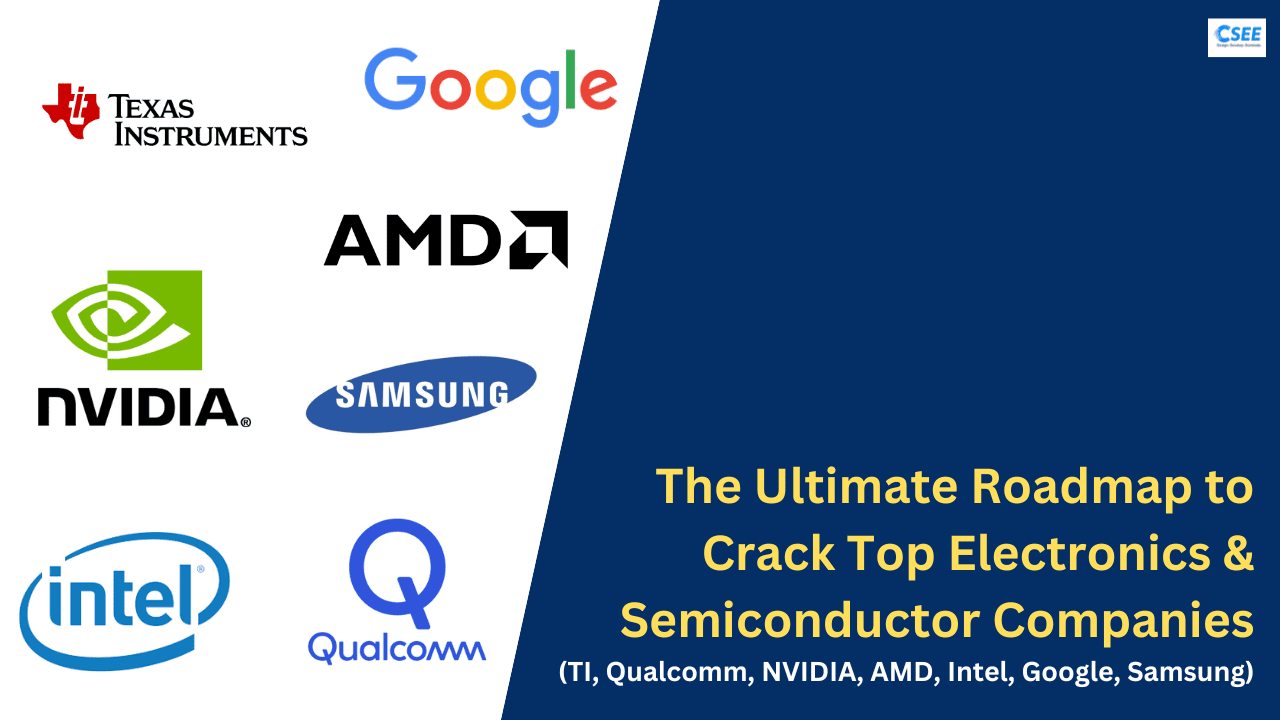
For almost every electronics engineer, the ultimate dream is to work at world‑class companies like Texas Instruments, Qualcomm, NVIDIA, AMD, Intel, Google, and Samsung. These organizations design the chips, systems, and technologies that power smartphones, electric vehicles, AI data centers, satellites, consumer electronics, and the future of computing itself. Getting into these companies is not easy—but it is absolutely possible with the right roadmap, mindset, and preparation strategy.
This article is written as a complete, practical, no‑nonsense guide for ECE, EEE, and related engineers who want to crack these top tech giants. It covers:
- Skills you must master
- How interviews actually work
- What separates selected candidates from rejected ones
- How to plan your preparation from college to working professionals
This is not theory. This is a battle‑tested roadmap.
1. Understanding What These Companies Really Look For
Before preparing, you must understand one thing clearly: top electronics companies do not hire based on tools alone. They hire based on thinking ability + fundamentals + problem‑solving mindset.
Core Traits They Look For
- Strong fundamentals in electronics
- Ability to explain concepts clearly
- Logical problem solving
- Curiosity and a learning attitude
- Hands‑on experience (projects)
- Ability to debug and think step‑by‑step
Brand names, certifications, and courses help—but they are never enough by themselves.
2. Strong Fundamentals: The Non‑Negotiable Foundation
No matter which role you target—embedded, VLSI, validation, firmware, or systems—core electronics fundamentals are mandatory.
Must‑Know Subjects
2.1 Analog Electronics
- Diodes, BJTs, MOSFETs
- Amplifiers (CE, CS, differential)
- Op‑amps (ideal & practical)
- Feedback, stability, bandwidth
- Noise basics
These are heavily tested in TI, Analog Devices, Qualcomm, and Samsung.
2.2 Digital Electronics
- Logic gates, Boolean algebra
- Combinational & sequential circuits
- FSMs
- Timing analysis
- Basics of digital IC design
2.3 Network Theory
- KCL, KVL
- Thevenin & Norton
- Transient response
- Frequency response
2.4 Signals & Systems
- Time & frequency domain
- Laplace & Fourier transforms
- Convolution
- Sampling basics
2.5 Control Systems (Selective)
- Transfer functions
- Stability concepts
- Root locus, Bode plots
You don’t need to be perfect in everything—but you must be conceptually clear.
3. Programming Skills: Your Second Language
Electronics engineers who cannot code are at a huge disadvantage.
Mandatory Languages
- C (must) – pointers, memory, bitwise operations
- C++ (good to have) – OOP concepts
- Python (optional but powerful) – scripting, automation
What Interviewers Check
- How memory works
- Stack vs heap
- Pointers and arrays
- Bit manipulation
- Writing clean, logical code
In embedded and firmware roles, C programming can make or break your interview.
4. Embedded Systems Roadmap
Embedded roles are among the most popular entry points into these companies.
Key Topics
- Microcontrollers (ARM, AVR basics)
- GPIO, UART, SPI, I2C
- Timers & interrupts
- RTOS basics (tasks, scheduling)
- Boot process
What Projects Should Show
- Sensor interfacing
- Communication protocols
- Debugging skills
- Power optimization basics
A simple but well‑explained project beats a complex but poorly understood one.
5. VLSI & Semiconductor Design Path
For core semiconductor roles, depth matters more than breadth.
Core Subjects
- CMOS fundamentals
- Digital IC design
- Timing analysis
- Static & dynamic power
- Verilog / SystemVerilog basics
Tools Awareness
- Cadence
- Synopsys
- Mentor Graphics
You are not expected to be an expert—but you must understand design flow clearly.
6. Validation, Testing & Silicon Roles
Not everyone starts in design—and that’s okay.
Skills Required
- Digital fundamentals
- Scripting (Python / Perl basics)
- Understanding specs
- Debugging mindset
Many engineers grow from validation → design → architect roles.
7. Projects: Your Biggest Differentiator
Projects show what marksheets cannot.
What Makes a Project Strong
- Clear problem statement
- Your role explained clearly
- Design choices justified
- Challenges & debugging steps
Examples
- Embedded automation system
- Power electronics converter
- Image processing on MCU
- Protocol analyzer
Be ready to defend every line of your project.
8. Internships & Experience
Internships matter—but learning matters more.
- Focus on what you learned
- Understand systems, not just tasks
- Ask questions and document learning
A good internship can directly convert into a full‑time role.
9. Resume That Actually Works
Resume Rules
- One page
- No unnecessary graphics
- Focus on skills & projects
- Quantify impact where possible
Your resume should make the interviewer say:
“This candidate understands fundamentals.”
10. Interview Process Breakdown
Typical Rounds
- Online test (aptitude + technical)
- Technical interview(s)
- Managerial / HR round
Interview Style
- Deep questioning
- Scenario‑based problems
- Debugging questions
If you don’t know an answer, think out loud.
11. How to Study Smart (Not Hard)
- Revise fundamentals regularly
- Teach concepts to others
- Practice explaining
- Solve problems on paper
Consistency beats intensity.
12. Common Mistakes to Avoid
- Ignoring fundamentals
- Blindly collecting certificates
- Overloading tools without basics
- Memorizing instead of understanding
13. Roadmap for Students
1st–2nd Year
- Build fundamentals
- Learn C programming
3rd Year
- Projects & internships
- Core subject depth
Final Year
- Interview preparation
- Resume & applications
14. Roadmap for Working Professionals
- Identify skill gaps
- Strengthen fundamentals
- Build targeted projects
- Switch strategically
15. Interview Questions
Breaking into top semiconductor and electronics companies is a dream for many electronics and embedded engineers. While job roles may differ—firmware, BSP, drivers, validation, SoC bring-up, or embedded Linux—the interview foundations remain extremely strong in embedded systems fundamentals.
This article compiles 350+ real-world, role-relevant embedded interview questions, grouped company-wise, to help you prepare strategically.
🔵 Texas Instruments (TI) – Embedded / Firmware / Applications Engineer
TI interviews heavily focus on microcontroller fundamentals, peripherals, real-time systems, and debugging depth.
50 Interview Questions – Texas Instruments
- Explain the ARM Cortex-M architecture.
- Difference between Harvard and Von Neumann architecture.
- How does an interrupt work internally?
- What happens from reset vector to
main()? - Explain linker script and memory mapping.
- Difference between stack and heap in embedded systems.
- How do timers work in microcontrollers?
- Explain PWM generation and applications.
- What is clock tree and PLL?
- How does ADC work internally?
- Explain DMA and when to use it.
- SPI vs I2C vs UART – internal working differences.
- What causes jitter in PWM signals?
- How do you debounce a mechanical switch?
- Explain watchdog timer and failure cases.
- How does low-power mode work in MCUs?
- What is ISR latency and how to reduce it?
- How do you debug a hard fault?
- Explain volatile keyword usage.
- Difference between
static,const, andvolatile. - What is race condition?
- How do you protect shared resources?
- Explain RTOS task scheduling.
- Difference between mutex and semaphore.
- Priority inversion problem.
- How does FreeRTOS work internally?
- Explain bootloader functionality.
- Firmware upgrade strategies.
- How does flash memory work?
- Difference between NOR and NAND flash.
- Explain memory alignment issues.
- What is endianess?
- How to optimize code for speed vs memory?
- Explain bit-banding.
- What is peripheral clock gating?
- How do you test embedded firmware?
- What is boundary scan / JTAG?
- Explain I/O pin multiplexing.
- What happens if stack overflows?
- Difference between polling and interrupt-driven design.
- How do you measure execution time?
- What is power-on reset?
- Explain brown-out detection.
- What is EMI/EMC and how firmware affects it?
- Explain CRC and its use.
- What is fault tolerance?
- How do you design fail-safe systems?
- Explain watchdog reset vs power reset.
- What is real-time constraint?
- Explain worst-case execution time (WCET).
🔵 Qualcomm – Embedded / BSP / Modem / Automotive Roles
Qualcomm interviews focus on SoC-level understanding, embedded Linux, drivers, memory, and performance.
50 Interview Questions – Qualcomm
- Explain SoC architecture.
- Difference between MCU and MPU.
- Explain ARM Cortex-A vs Cortex-M.
- How Linux boots on embedded devices?
- Explain U-Boot and kernel handoff.
- What is device tree?
- How interrupts are handled in Linux?
- Difference between process and thread.
- Explain virtual memory.
- What is MMU and TLB?
- Explain page fault.
- How does DMA work in Linux?
- Explain Linux driver model.
- Character vs block drivers.
- What is sysfs?
- Explain IOMMU.
- What is cache coherency?
- Explain L1, L2 cache.
- What is cache line?
- How does ARM cache work?
- What is SMP?
- Explain spinlock vs mutex.
- What is preemption?
- Explain scheduler in Linux.
- What is real-time Linux?
- Difference between softirq and tasklet.
- Explain kernel panic.
- How to debug kernel crash?
- What is memory leak?
- How do you detect memory corruption?
- Explain power management in Linux.
- What is DVFS?
- Explain thermal throttling.
- What is TrustZone?
- Explain secure boot.
- What is IPC?
- Explain shared memory.
- How do you handle concurrency?
- What is race condition in kernel?
- Explain RCU.
- What is modem firmware?
- Explain BSP role.
- What is cross-compilation?
- Explain Yocto.
- What is buildroot?
- What is Android HAL?
- Difference between kernel space and user space.
- What is latency vs throughput?
- Explain performance profiling.
- How do you optimize boot time?
🔵 NVIDIA – Embedded / Jetson / GPU / Autonomous Systems
NVIDIA focuses on embedded Linux, CUDA awareness, performance, and real-time systems.
50 Interview Questions – NVIDIA
- Explain NVIDIA Jetson architecture.
- CPU vs GPU differences.
- What is CUDA?
- What is parallel processing?
- Explain SIMD vs SIMT.
- What is GPU memory hierarchy?
- Unified memory concept.
- Explain DMA between CPU and GPU.
- What is zero-copy memory?
- How does Linux boot on Jetson?
- Explain device tree for Jetson.
- What is BSP in NVIDIA?
- Explain real-time constraints.
- Difference between hard and soft real-time.
- How interrupts affect latency?
- Explain PREEMPT_RT.
- What is ROS?
- Explain sensor interfaces (CSI, SPI, I2C).
- Camera pipeline in embedded systems.
- Explain GStreamer.
- What is OpenCV pipeline?
- How do you optimize latency?
- Explain cache coherency.
- What is NUMA?
- Explain shared memory.
- How does multi-core scheduling work?
- What is power budgeting?
- Explain thermal management.
- What is DVFS?
- Explain watchdog usage.
- How to debug kernel crash?
- Explain kernel modules.
- What is cross-compiling?
- Explain Yocto.
- What is real-time clock?
- How do you profile performance?
- Explain system tracing.
- What is Nsight?
- Explain memory bandwidth issues.
- What is zero latency pipeline?
- Explain inter-process communication.
- What is shared buffer?
- How do you handle sensor fusion?
- Explain CAN protocol.
- Automotive safety concepts (ASIL).
- What is fail-safe?
- Explain redundancy.
- What is watchdog supervision?
- Explain system bring-up.
- How do you validate embedded platforms?
🔵 AMD – Firmware / SoC / Platform Roles
AMD interviews emphasize low-level firmware, boot flow, memory, and performance.
50 Interview Questions – AMD
- Explain x86 vs ARM.
- What is BIOS/UEFI?
- Explain boot flow.
- What is AGESA?
- Explain SoC bring-up.
- What happens during reset?
- Explain cache hierarchy.
- What is speculative execution?
- What is pipeline stall?
- Explain branch prediction.
- What is microcode?
- Explain firmware update.
- What is SPI flash?
- Explain DDR initialization.
- What is memory training?
- Explain ECC memory.
- What is power gating?
- Clock gating vs power gating.
- Explain thermal management.
- What is SMU?
- Explain interrupt handling.
- What is APIC?
- What is ACPI?
- Explain PCIe.
- How enumeration works?
- Explain DMA.
- What is IOMMU?
- Explain virtualization.
- What is hypervisor?
- What is SMM?
- Explain secure boot.
- What is TPM?
- Explain debug interfaces.
- What is JTAG?
- Explain firmware logging.
- What is ring buffer?
- How do you debug early boot?
- What is watchdog?
- Explain firmware testing.
- What is fault injection?
- Explain performance counters.
- What is latency vs throughput?
- Explain multi-core synchronization.
- What is spinlock?
- Explain memory barriers.
- What is cache flush?
- Explain coherency protocol.
- What is MESI?
- Explain power-on self-test.
- How do you validate platforms?
🔵 Intel – Embedded / Firmware / Validation
Intel focuses on architecture, low-level software, memory, and debugging.
50 Interview Questions – Intel
- Explain Intel architecture.
- What is microarchitecture?
- Explain instruction pipeline.
- What is out-of-order execution?
- What is cache coherence?
- Explain MESI protocol.
- What is TLB?
- Explain MMU.
- What is virtualization?
- Explain VT-x.
- What is BIOS vs UEFI?
- Explain boot flow.
- What is firmware?
- Explain power management.
- What is C-state and P-state?
- Explain ACPI.
- What is thermal throttling?
- Explain interrupt handling.
- What is MSI/MSI-X?
- Explain PCIe.
- What is memory ordering?
- Explain memory barriers.
- What is atomic operation?
- Explain multithreading.
- What is Hyper-Threading?
- Explain spinlock.
- What is deadlock?
- Explain race condition.
- What is watchdog?
- Explain firmware validation.
- What is fault injection?
- Explain JTAG.
- What is boundary scan?
- Explain debug tools.
- What is logic analyzer?
- Explain performance profiling.
- What is latency?
- Throughput vs bandwidth.
- Explain cache miss.
- What is prefetching?
- Explain NUMA.
- What is system agent?
- Explain power-on reset.
- What is firmware update?
- Explain secure boot.
- What is TPM?
- Explain hardware bring-up.
- What is early silicon debugging?
- Explain errata.
- How do you handle hardware bugs?
🔵 Samsung – Embedded / SoC / Consumer Electronics
Samsung interviews combine embedded fundamentals, Linux, and consumer electronics understanding.
50 Interview Questions – Samsung
- Explain SoC architecture.
- Difference between MCU and SoC.
- Explain ARM architecture.
- What is Exynos?
- Explain bootloader stages.
- What is secure boot?
- Explain TrustZone.
- What is embedded Linux?
- How kernel boots?
- What is device tree?
- Explain interrupts.
- What is DMA?
- Explain memory hierarchy.
- What is cache?
- Explain cache coherency.
- What is multi-core scheduling?
- Explain power management.
- What is DVFS?
- Explain thermal management.
- What is PMIC?
- Explain display pipeline.
- What is MIPI?
- Explain camera interface.
- What is ISP?
- Explain audio pipeline.
- What is I2S?
- Explain Bluetooth stack.
- What is Wi-Fi driver?
- Explain kernel modules.
- What is cross-compilation?
- Explain Yocto.
- What is buildroot?
- Explain debugging methods.
- What is JTAG?
- Explain log analysis.
- What is watchdog?
- Explain fault recovery.
- What is validation testing?
- Explain regression testing.
- What is stress testing?
- Explain memory leak.
- How to detect race condition?
- Explain mutex vs semaphore.
- What is priority inversion?
- Explain real-time constraints.
- What is latency?
- Explain power optimization.
- What is system bring-up?
- Explain field issue debugging.
- How do you improve product reliability?
16. Final Advice
Cracking Texas Instruments, Qualcomm, NVIDIA, AMD, Intel, Google, or Samsung is not about being extraordinary—it’s about being clear, consistent, and prepared. Thousands of engineers get rejected not because they are bad, but because they lack direction.
With the right roadmap, disciplined preparation, and strong fundamentals, this dream is achievable.
If this article helped you, share it with fellow electronics engineers—and remember:
Prepare smart. Think deep. Build fundamentals. 🚀
Thank you for reading.
Also, read:
- 10 Free ADAS Projects With Source Code And Documentation – Learn & Build Today
- 100 + Electrical Engineering Projects For Students, Engineers
- 100 GitHub Projects to Level Up Your Embedded Engineering Skills
- 100+ Indian Startups & What They Are Building
- 1000+ Automotive Interview Questions With Answers
- 1000+ Electronics Projects For Engineers, Diploma, MTech Students
- 1000+ MATLAB Simulink Projects For MTech, Engineering Students
- 20 Advanced Coursera Courses for Embedded Engineers That Can Lead to High-Paying Careers