Edge AI has moved from being an emerging technology to becoming a core pillar of modern automotive systems and semiconductor innovation. As vehicles evolve into intelligent, software-driven machines and chips become more specialized, the ability to process AI workloads locally is no longer optional—it is essential.
Edge AI enables machines to sense, decide, and act in real time, without relying on constant cloud connectivity. This capability is redefining safety, performance, energy efficiency, and scalability across both the automotive and semiconductor industries.
What Edge AI Really Means
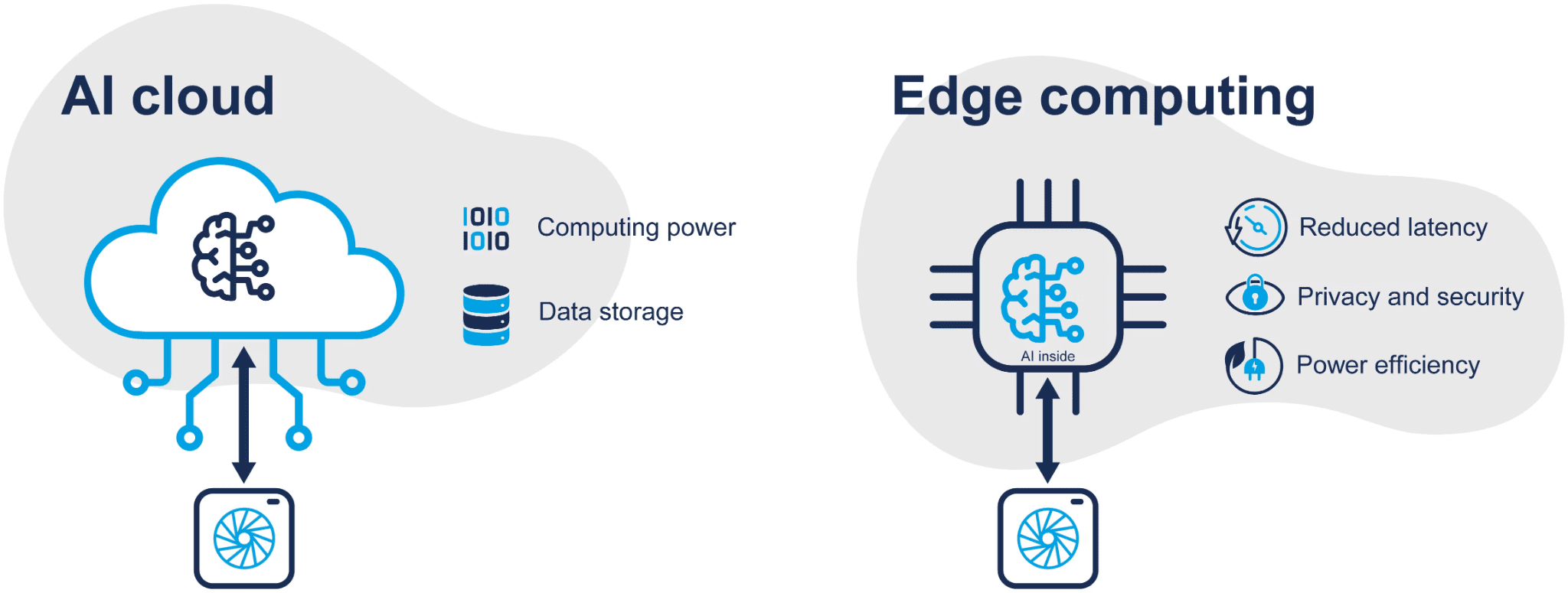
Edge AI refers to running artificial intelligence algorithms directly on local hardware rather than in centralized cloud servers. In automotive and embedded systems, the “edge” can include:
- Electronic Control Units (ECUs)
- Automotive SoCs and domain controllers
- Cameras, radars, and LiDAR modules
- Battery management and motor control units
- Infotainment and cockpit controllers
Instead of sending raw data to the cloud, Edge AI processes information where it is generated, enabling faster responses and greater system reliability.
Why Cloud AI Alone Is Not Enough for Automotive
Cloud-based AI works well for data analytics and model training, but it fails to meet the real-world demands of automotive systems.
Key Limitations of Cloud-Only AI
- Latency risks
Safety-critical decisions must happen in milliseconds. Even small delays can cause accidents. - Unreliable connectivity
Vehicles operate in tunnels, remote highways, rural regions, and underground parking where network access is limited or unavailable. - Privacy concerns
Transmitting camera feeds, driver data, and location information to the cloud raises serious security and compliance issues. - High bandwidth costs
Modern vehicles generate terabytes of sensor data daily, making continuous cloud transmission impractical.
Edge AI overcomes these challenges by enabling local intelligence, ensuring systems remain functional, secure, and responsive at all times.
Edge AI as the Backbone of Modern Automotive Systems
The automotive industry is transitioning from mechanical engineering dominance to AI-driven system design. Vehicles today are intelligent platforms, not just modes of transport.
Edge AI enables this shift by powering perception, decision-making, and control directly inside the vehicle.
Edge AI in ADAS: Real-Time Safety Intelligence
Advanced Driver Assistance Systems (ADAS) are one of the most visible and impactful applications of Edge AI.
Edge AI enables ADAS functions such as:
- Lane departure warning
- Automatic emergency braking
- Adaptive cruise control
- Pedestrian and cyclist detection
- Traffic sign recognition
- Blind-spot monitoring
These systems rely on real-time sensor fusion, combining data from cameras, radar, ultrasonic sensors, and sometimes LiDAR.
Without Edge AI:
- Real-time perception would not be possible
- Safety certifications would be harder to achieve
- Driving assistance would be unreliable
Edge AI directly contributes to reducing accidents and saving lives.
Autonomous Driving and Edge AI
Autonomous driving represents the most demanding Edge AI use case ever deployed.
An autonomous vehicle must continuously:
- Perceive its surroundings
- Predict the behavior of other road users
- Plan safe driving trajectories
- Control steering, braking, and acceleration
Why Edge AI Is Mandatory for Autonomy
- Sensor data volumes are too large for cloud processing
- Decisions must be deterministic and real time
- Systems must remain operational without internet access
- Safety standards require predictable system behavior
Semiconductor companies are now designing AI-first automotive SoCs specifically to support autonomous workloads at the edge.
Driver Monitoring and Cabin Intelligence
Edge AI is transforming vehicle interiors into intelligent, adaptive environments.
Driver and Cabin Monitoring Use Cases
- Drowsiness and distraction detection
- Driver identification and personalization
- Gesture and voice control
- Occupant detection and seatbelt monitoring
- Child presence detection
Processing camera and audio data locally ensures:
- Low latency responses
- Strong data privacy
- Reliable operation in all conditions
Edge AI allows vehicles to understand both the road and the people inside the car.
Edge AI in Electric Vehicles (EVs)
Electric vehicles introduce new challenges where Edge AI delivers significant value.
Battery Management Systems (BMS)
Edge AI improves:
- State of Charge (SoC) estimation
- State of Health (SoH) prediction
- Thermal optimization
- Early fault detection
- Battery lifespan extension
Traditional algorithms struggle with complex battery chemistry, while AI models continuously adapt to real-world usage.
Motor Control and Power Electronics
Edge AI enables:
- Efficiency optimization
- Predictive maintenance
- Noise and vibration reduction
- Improved driving range
These improvements directly enhance EV performance and customer satisfaction.
Predictive Maintenance and Vehicle Health Monitoring
Edge AI allows vehicles to detect issues before failures occur.
By analyzing sensor data locally, AI models can identify:
- Abnormal vibration patterns
- Overheating components
- Electrical faults
- Mechanical wear
Benefits include:
- Reduced breakdowns
- Lower warranty costs
- Fewer recalls
- Improved fleet reliability
For commercial fleets, Edge AI-driven predictive maintenance is a major competitive advantage.
Software-Defined Vehicles and Edge AI
Software-Defined Vehicles (SDVs) are reshaping automotive architectures.
In SDVs:
- Features are defined by software rather than hardware
- Vehicles improve over time via OTA updates
- AI models evolve throughout the vehicle lifecycle
Edge AI acts as the intelligence layer that makes SDVs practical and scalable.
Key Benefits of Edge AI in SDVs
- Continuous feature enhancement
- Personalized driving experiences
- Faster innovation cycles
- Reduced hardware redundancy
Why Edge AI Is Transforming the Semiconductor Industry
Edge AI is not only changing vehicles—it is redefining semiconductor design itself.
Shift Toward AI-Specific Silicon
Traditional automotive chips focused on control and signal processing. Edge AI demands far more.
Modern Edge AI chips integrate:
- CPUs for control logic
- GPUs for parallel processing
- NPUs for AI inference
- Dedicated safety and security blocks
This shift has created massive demand for automotive-grade AI SoCs.
Power Efficiency as a Key Differentiator
Unlike data centers, vehicles operate under tight power and thermal constraints.
Edge AI pushes semiconductor innovation in:
- Low-power inference engines
- Efficient memory architectures
- Hardware acceleration
- Advanced fabrication nodes
Energy-efficient AI processing is now a competitive advantage.
Automotive Safety and Reliability Requirements
Edge AI chips must meet strict standards:
- ISO 26262 functional safety
- ASIL compliance
- Long product lifecycles (10–15 years)
- Operation under extreme temperatures
These requirements raise the barrier to entry and favor semiconductor companies with deep automotive expertise.
TinyML and Ultra-Low-Power Edge AI
Not all Edge AI requires high-performance SoCs. Many use cases rely on TinyML running on microcontrollers.
TinyML Automotive Applications
- Tire pressure monitoring
- Sensor anomaly detection
- Environmental sensing
- Always-on voice activation
- Low-power predictive maintenance
TinyML expands Edge AI into cost-sensitive, high-volume systems.
Edge AI Inside Semiconductor Manufacturing
Edge AI is also transforming how chips are manufactured.
In semiconductor fabs, Edge AI is used for:
- Equipment health monitoring
- Yield optimization
- Defect detection
- Process control
- Predictive maintenance
This creates a feedback loop where AI-powered chips are built using AI-driven manufacturing.
Business Impact of Edge AI
For automakers:
- Higher safety ratings
- Premium feature differentiation
- Faster time-to-market
For semiconductor companies:
- Higher-margin products
- Long-term software ecosystems
- Strategic relevance in AI-driven markets
Edge AI has become a business enabler, not just a technical feature.
Challenges in Edge AI Adoption
Despite its benefits, Edge AI presents challenges.
Key Challenges
- Model optimization under tight resource constraints
- Complex software toolchains
- Hardware-software co-design requirements
- Shortage of skilled engineers across AI and embedded domains
Techniques like quantization, pruning, and hardware-aware training are essential to overcome these barriers.
The Road Ahead for Edge AI
Edge AI will continue to gain importance as vehicles become more autonomous and connected.
Future trends include:
- Centralized vehicle computing
- AI-first chip architectures
- Edge-to-cloud collaboration
- Self-learning automotive systems
- Personalized in-vehicle AI experiences
Final Perspective
Edge AI is not an incremental upgrade—it is a foundational shift.
- For automotive, it enables safety, autonomy, electrification, and software-defined innovation.
- For semiconductors, it drives architectural reinvention, higher-value silicon, and long-term growth.
As mobility and computing converge, Edge AI will define who leads and who follows in the automotive and semiconductor industries.
Thank you for reading.
Also, read:
- 10 Free ADAS Projects With Source Code And Documentation – Learn & Build Today
- 100 + Electrical Engineering Projects For Students, Engineers
- 100 GitHub Projects to Level Up Your Embedded Engineering Skills
- 100+ Indian Startups & What They Are Building
- 1000+ Automotive Interview Questions With Answers
- 1000+ Electronics Projects For Engineers, Diploma, MTech Students
- 1000+ MATLAB Simulink Projects For MTech, Engineering Students
- 20 Advanced Coursera Courses for Embedded Engineers That Can Lead to High-Paying Careers