Hello guys, Welcome back to my blog. In this article, I will discuss active vs passive ADAS, which one is driving the future of automotive safety, industry trends and future scope.
Ask questions if you have any electrical, electronics, or computer science doubts. You can also catch me on Instagram – CS Electrical & Electronics
- Will AI Replace Automotive Engineering Jobs? Deep Dive Into MBD, HiL, Diagnostics, Software Testing & Beyond
- Why There Is No Competitor For MATLAB Simulink In The Automotive Industry
- The Ultimate Roadmap To Become A Part of the Software-Defined Vehicle (SDV) Revolution
Active vs Passive ADAS
The future of mobility is increasingly dependent on smart technologies, and ADAS (Advanced Driver Assistance Systems) stand at the heart of this transformation. ADAS technologies have become integral in improving vehicle safety, enhancing driver comfort, and laying the foundation for autonomous driving. These systems are typically categorized into two broad types: Active ADAS and Passive ADAS.
While both serve the overarching purpose of enhancing road safety and driving efficiency, they differ significantly in how they operate, respond to stimuli, and interact with the vehicle and driver. This article aims to present a detailed, over-4000-word comparison of Active vs Passive ADAS, highlighting their definitions, functionalities, architectures, real-world applications, advantages, limitations, and the direction in which the automotive industry is headed with these technologies.
ADAS stands for Advanced Driver Assistance Systems—a suite of electronic technologies that assist drivers in driving and parking functions. Using input from multiple data sources (sensors, cameras, radar, LIDAR), ADAS can monitor the vehicle’s surroundings and aid the driver in making decisions or directly take action when necessary.
01. Understanding Active ADAS
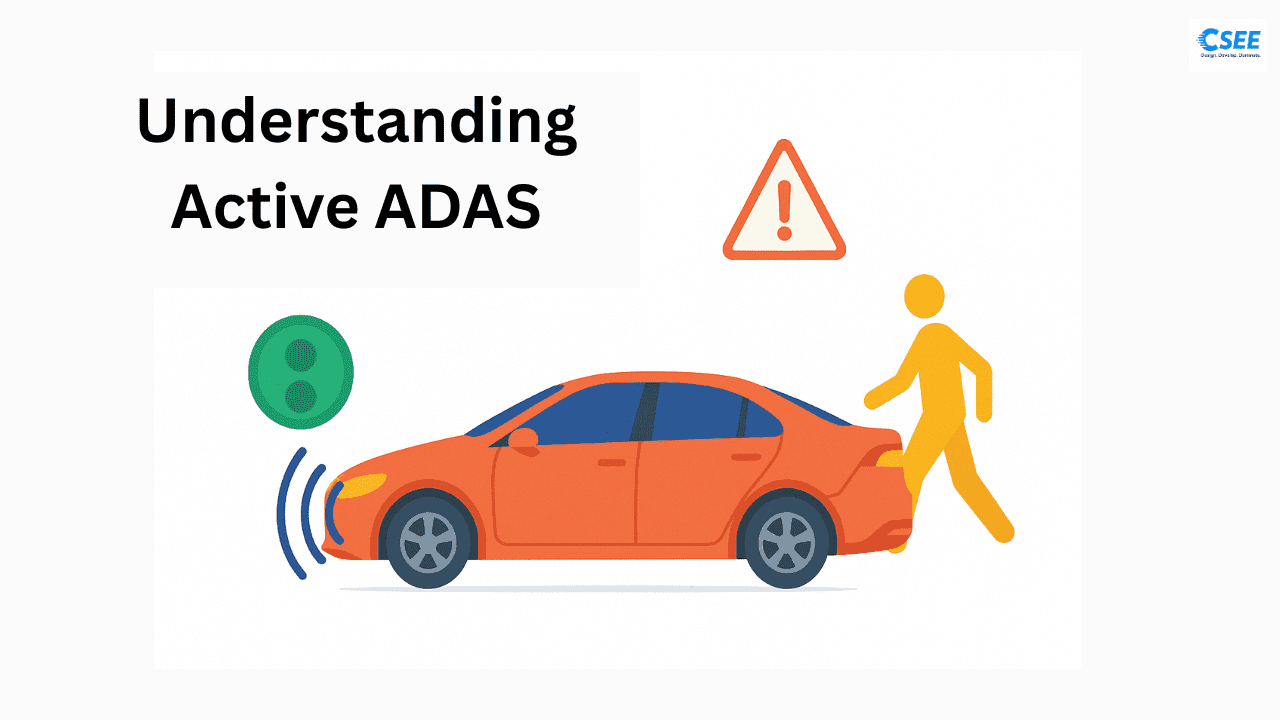
Active ADAS refers to systems that monitor the environment and automatically take corrective actions without requiring the driver’s input. These systems are designed to intervene proactively to avoid or mitigate accidents.
How It Works
Active ADAS systems constantly process sensor data in real-time. When the system detects a potential hazard or unsafe situation (such as a vehicle too close or the car drifting from its lane), it intervenes by:
- Applying brakes
- Controlling steering
- Adjusting throttle
- Providing haptic feedback
Examples of Active ADAS
- Autonomous Emergency Braking (AEB)
- Lane Keeping Assist (LKA)
- Adaptive Cruise Control (ACC)
- Automatic Parking Assist
- Traffic Jam Assist
- Collision Avoidance Systems
- Active Blind Spot Detection
02. Understanding Passive ADAS

Passive ADAS systems, in contrast, are designed to alert or inform the driver of potential dangers but do not take control of the vehicle or perform any corrective action. They rely on the driver’s judgment to act upon the alert.
How It Works
Passive ADAS systems analyze the environment using similar sensors as active systems but only generate visual, auditory, or haptic alerts. They serve as a digital co-pilot, providing information and warnings but never controlling the vehicle.
Examples of Passive ADAS
- Rear Cross Traffic Alert
- Forward Collision Warning (FCW)
- Blind Spot Monitoring (BSM)
- Driver Drowsiness Detection
- Traffic Sign Recognition
- Speed Limit Alert
- Lane Departure Warning (LDW)
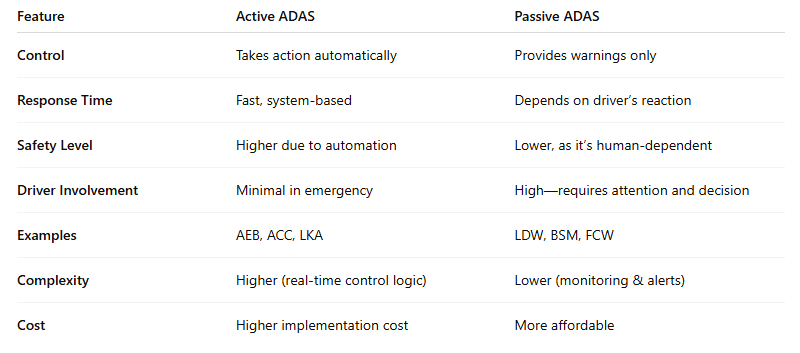
03. Key Differences Between Active and Passive ADAS
04. Sensor Technologies Used
Active ADAS Sensors
- Radar: Used in Adaptive Cruise Control and AEB
- LIDAR: Used for precise 3D mapping and object detection
- Ultrasonic: For automatic parking and low-speed maneuvers
- Cameras: Used in Lane Keeping, pedestrian detection, traffic sign recognition
Passive ADAS Sensors
- Camera-only systems: Lane departure warnings
- Radar + Camera fusion: Blind spot monitoring
- In-cabin sensors: Drowsiness detection, seatbelt alerts
05. Detailed Comparison by Feature
Collision Prevention
- Active ADAS: Automatically brakes or steers to avoid collision (AEB)
- Passive ADAS: Provides collision warnings (FCW)
Lane Management
- Active: Automatically keeps the vehicle in the lane (LKA)
- Passive: Warns when crossing lanes without signaling (LDW)
Speed and Distance Control
- Active: Maintains speed and distance with the vehicle ahead (ACC)
- Passive: Alerts when approaching too fast (Speed alerts, FCW)
Parking Assistance
- Active: Fully automated parallel or perpendicular parking
- Passive: Beep alerts for proximity to objects
06. System Architecture
Active ADAS Architecture
- Sensor Fusion Engine
- AI and Machine Learning for Predictive Control
- Actuators Control (Brake, Steering, Throttle)
- Redundant Power Supply and Fail-Safe Systems
- CAN/FlexRay/Ethernet for Data Communication
Passive ADAS Architecture
- Sensor Signal Processing
- Warning Interface Systems (Auditory/Visual/Haptic)
- Simple Microcontroller Units (MCUs)
- Lower bandwidth data exchange
07. Detailed Comparison by Feature
Collision Prevention
- Active ADAS: Automatically brakes or steers to avoid collision (AEB)
- Passive ADAS: Provides collision warnings (FCW)
Lane Management
- Active: Automatically keeps the vehicle in the lane (LKA)
- Passive: Warns when crossing lanes without signaling (LDW)
Speed and Distance Control
- Active: Maintains speed and distance with the vehicle ahead (ACC)
- Passive: Alerts when approaching too fast (Speed alerts, FCW)
Parking Assistance
- Active: Fully automated parallel or perpendicular parking
- Passive: Beep alerts for proximity to objects
08. System Architecture
Active ADAS Architecture
- Sensor Fusion Engine
- AI and Machine Learning for Predictive Control
- Actuators Control (Brake, Steering, Throttle)
- Redundant Power Supply and Fail-Safe Systems
- CAN/FlexRay/Ethernet for Data Communication
Passive ADAS Architecture
- Sensor Signal Processing
- Warning Interface Systems (Auditory/Visual/Haptic)
- Simple Microcontroller Units (MCUs)
- Lower bandwidth data exchange
10. Cost Comparison
Active ADAS:
- Costlier due to the need for high-performance ECUs, actuators, safety compliance (ISO 26262)
- Average cost addition: $1,500–$5,000 per vehicle
Passive ADAS:
- Less complex; relies mainly on monitoring and interface systems
- Average cost addition: $500–$1,200 per vehicle
11. Real-World Applications
In Mass-Market Vehicles
- Passive ADAS is widely used in entry-level and mid-range vehicles.
- Active ADAS is slowly becoming common in top-end variants.
In Premium and EVs
- Tesla, Mercedes-Benz, BMW, Volvo, and Audi have integrated Active ADAS like Autopilot, Drive Pilot, and Pilot Assist.
Fleet and Commercial Vehicles
- Use both systems extensively for driver behavior monitoring and accident prevention.
12. Benefits of Active ADAS
- Reduced Human Error: Takes control in emergency scenarios.
- Lower Accident Rates: Immediate reaction time prevents collisions.
- Driver Comfort: Reduces driving stress, especially in traffic.
- Foundation for Autonomous Driving: Essential for Levels 2-5 of autonomy.
13. Benefits of Passive ADAS
- Low Cost: Affordable and easy to implement.
- No Override: Keeps driver in full control.
- Great for Awareness: Encourages safe driving habits.
- Energy Efficient: Less power consumption than active systems.
14. Limitations of Active ADAS
- Over-Reliance by Drivers
- False Positives/Negatives
- Higher Maintenance and Calibration Costs
- Legal and Regulatory Hurdles
15. Limitations of Passive ADAS
- No Action in Emergencies
- Alert Fatigue: Drivers may ignore frequent warnings
- Dependent on Human Reaction
- Limited Assistance in Complex Scenarios
16. Integration with Other Technologies
Active ADAS with V2X
Vehicle-to-Everything (V2X) communication allows Active ADAS to react not just to nearby cars, but to intersections, pedestrians, and infrastructure alerts.
Passive ADAS with Driver Monitoring Systems (DMS)
Combining Passive ADAS with DMS helps assess whether the driver is alert enough to respond to warnings.
18. Global Regulations Impact
- EU Regulations (2022 onward): Mandate several ADAS functions like AEB, lane assist, and DMS.
- US NHTSA Guidelines: Encouraging OEMs to integrate AEB, FCW, and LDW.
- India’s AIS-189 Guidelines (2025 roadmap): Will make LDW and DMS compulsory in stages.
19. Industry Trends and Future Scope
Shift Towards Active ADAS: OEMs are moving toward active systems with better autonomy, especially in electric and premium vehicles.
Sensor Fusion & AI: Integrating camera, radar, and LIDAR for better accuracy. AI enables learning from driver behavior for smarter interventions.
OTA Updates for ADAS: OEMs like Tesla, Rivian, and Lucid update ADAS algorithms and capabilities remotely.
AI-based Predictive ADAS: Next-gen systems will anticipate accidents before they happen using real-time data, machine learning, and behavioral analytics.
20. Which One Is Better?
It depends on the use case, driver preference, regulatory landscape, and budget. A blend of both systems is ideal:
- Urban Driving: Active ADAS shines with adaptive cruise, lane assist, and AEB
- Highway Cruising: Active systems provide significant comfort
- Entry-level Cars: Passive ADAS is better for budget-conscious safety
- Fleets: Combination of passive for alerts and active for preventive actions
21. Conclusion
The evolution from passive warning systems to active intervention technologies marks a major shift in vehicle safety paradigms. While Passive ADAS helps by acting as an extra pair of eyes, Active ADAS serves as an extra pair of hands.
As we move toward fully autonomous vehicles, Active ADAS will dominate, but Passive ADAS will still hold relevance in budget vehicles and driver training. Understanding the distinction between the two is crucial for engineers, vehicle buyers, safety regulators, and automotive enthusiasts alike.
By balancing cost, complexity, and safety, OEMs are tailoring ADAS solutions for diverse markets. The future lies not in choosing between Active or Passive, but in integrating both intelligently for a safer, smarter, and more sustainable mobility experience.
This was about “Active vs Passive ADAS“. Thank you for reading.
Also, read:
- “Mother of All Deals”: How The EU–India Free Trade Agreement Can Reshape India’s Economic Future
- 10 Free ADAS Projects With Source Code And Documentation – Learn & Build Today
- 100 (AI) Artificial Intelligence Applications In The Automotive Industry
- 100 GitHub Projects to Level Up Your Embedded Engineering Skills
- 1000+ Automotive Interview Questions With Answers
- 20 Advanced Coursera Courses for Embedded Engineers That Can Lead to High-Paying Careers
- 2000+ Embedded Systems Interview Question Bank
- 2024 Is About To End, Let’s Recall Electric Vehicles Launched In 2024