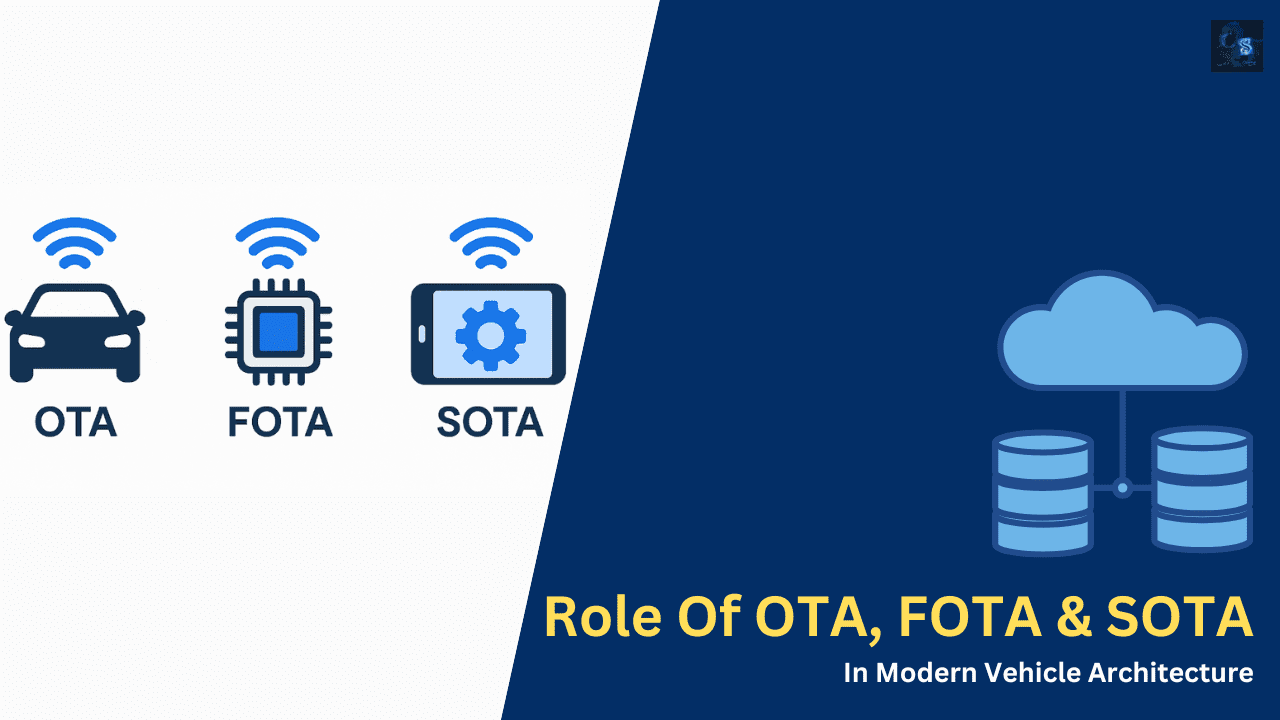
Hello, everyone. Welcome back to our blog. In this article, I will discuss the roles of OTA, FOTA, and SOTA in modern vehicle architecture, with some real-world automotive examples and challenges.
Ask questions if you have any electrical, electronics, or computer science doubts. You can also catch me on Instagram – CS Electrical & Electronics
- Kalman Filter Applications in ADAS (Advanced Driver Assistance Systems)
- Top 10 Software-Defined Vehicle (SDV) Project Ideas To Build In 2025
- The Future Of Battery Management Systems In The Era Of Software Defined Vehicles
Role Of OTA, FOTA & SOTA In Modern Vehicle
The automotive landscape is undergoing a revolutionary shift, where software is becoming as vital as the hardware components of a vehicle. Traditionally, once a vehicle left the factory, updating or fixing any issue required a physical visit to the service center. This model is no longer viable in a world dominated by software-driven features, autonomous capabilities, and the growing need for security and convenience.
Enter Over-the-Air (OTA) updates, a powerful innovation enabling manufacturers to remotely deliver software enhancements, feature upgrades, bug fixes, and security patches directly to vehicles via wireless communication. OTA updates not only reduce the dependency on dealerships but also enhance customer experience, reduce operational costs, and allow for continuous product evolution.
Within this OTA ecosystem, two essential subcategories exist: FOTA (Firmware Over-the-Air) and SOTA (Software Over-the-Air). While they are often used interchangeably, they serve distinct purposes and target different layers of the vehicle’s architecture.
In this article, we’ll explore the technical differences, real-world applications, benefits, and challenges of OTA, FOTA, and SOTA. We’ll also discuss the implications for the future of automotive, especially in the context of Software-Defined Vehicles (SDVs).
What is Over-the-Air (OTA) in Automotive?
Over-the-Air (OTA) refers to the wireless method of delivering data updates and software upgrades to vehicles, using mobile networks (3G/4G/5G), Wi-Fi, or satellite systems. The data is transmitted from a cloud-based server to the vehicle’s onboard systems — typically the Telematics Control Unit (TCU), which then distributes the update to relevant Electronic Control Units (ECUs).
OTA is not a single technology but an umbrella that includes:
- Firmware updates
- Software patches
- Configuration changes
- Map data or navigation updates
- Security patches
Why OTA Matters in Automotive
Vehicles today are no longer static mechanical machines. They are evolving platforms packed with sensors, microcontrollers, processors, and increasingly complex software. A modern vehicle may have 100+ ECUs, and the software code running them can exceed 100 million lines — more than some commercial aircraft.
OTA updates offer a dynamic solution to this growing complexity by:
- Enhancing functionality post-purchase.
- Improving user satisfaction through new features.
- Enabling fast and scalable deployment of safety patches.
- Supporting business models based on software subscriptions and upgrades.
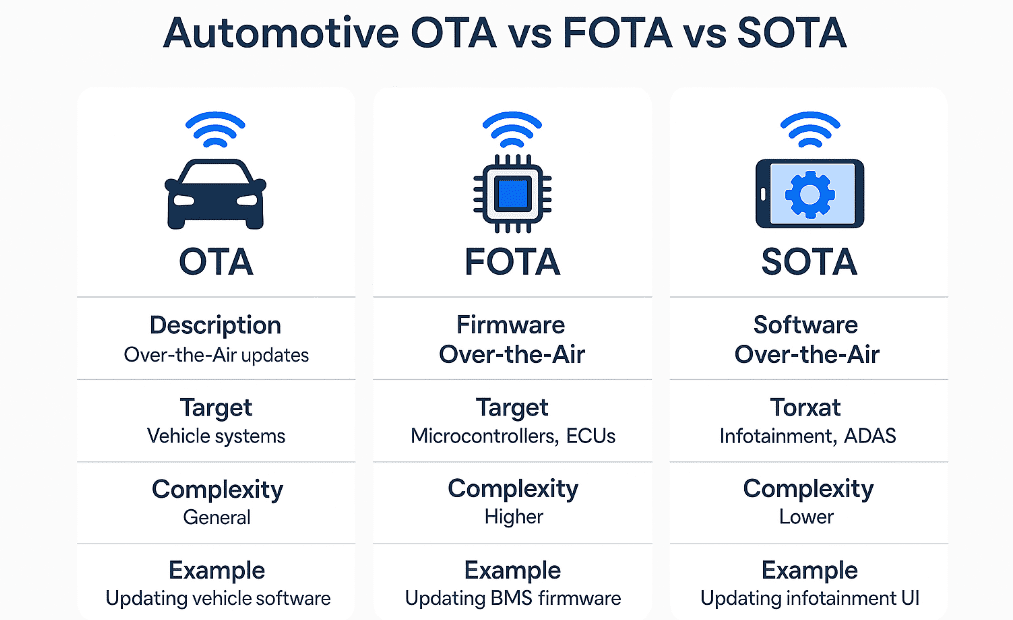
FOTA vs SOTA: Understanding the Differences
Though both FOTA and SOTA are subsets of OTA, they serve different layers of a vehicle’s software stack.
| Feature | FOTA (Firmware OTA) | SOTA (Software OTA) |
| Definition | Updates the low-level firmware that controls hardware | Updates higher-level application software |
| Primary Target | ECUs like Engine Control Unit, Battery Management | Infotainment systems, Navigation, ADAS features |
| Risk Level | High — errors can disable vehicle function | Low — errors are easier to recover from |
| Rollback Capability | Must be fail-safe (dual-bank memory) | Usually has built-in rollback or restore features |
| Update Size | Smaller files but highly sensitive | Larger files (e.g., UI assets, maps) |
| Tools Used | UDS, ODX, Secure Flash Bootloaders | Linux/Android platforms, containerized apps |
In simpler terms:
- FOTA is like updating the BIOS or firmware of your computer — risky but necessary for fundamental performance.
- SOTA is like updating your apps or operating system UI — less risky, more user-facing, often done in the background.
FOTA (Firmware Over-the-Air): Deep Dive
What is Firmware?
Firmware is low-level software embedded directly into the microcontroller of a device. In vehicles, firmware runs critical systems like braking, powertrain, airbags, battery charging, and more. It is not frequently updated, but when it is, the update must be flawless.
How FOTA Works
- The update is created and validated in the OEM’s secure environment.
- It is encrypted and uploaded to a secure cloud platform.
- The TCU in the vehicle receives the firmware, often in chunks.
- The update is verified, written into a backup memory area (dual-bank).
- On reboot, the vehicle switches to the new firmware if checks pass.
Common FOTA Update Examples
- Engine ECU updates for emission compliance
- Battery Management System (BMS) calibration
- Fixing known issues in ADAS ECUs
- Improving transmission response in electric vehicles
Risks and Challenges
- Bricking the ECU if the update is interrupted (e.g., power failure)
- Requires robust validation, rollback, and watchdog systems
- Strong encryption and digital signatures are mandatory
- FOTA is crucial for long-term vehicle safety, performance, and regulation compliance.
SOTA (Software Over-the-Air): Deep Dive
What is Software in a Vehicle?
Beyond firmware, vehicles now include embedded operating systems (e.g., QNX, Linux, Android Automotive) that support applications like:
- Infotainment systems
- Voice recognition
- Driver profiles
- Mobile connectivity
- Navigation and ADAS visualization
These can be updated frequently to add new features, enhance security, or simply improve user experience.
How SOTA Works
- The OEM pushes new software from the cloud.
- The TCU downloads it to the vehicle’s gateway or infotainment head unit.
- Update validation checks are performed.
- Updated software is deployed — often while the vehicle is idle or charging.
Common SOTA Update Examples
- New UI design or features for infotainment systems
- Updated maps or navigation engine
- App store additions (e.g., Spotify, YouTube)
- OTA-based personalization features (seats, mirrors, temperature profiles)
Benefits of SOTA
- Easy, frequent updates
- Safe rollback if update fails
- Provides opportunity for feature monetization
Communication & Diagnostic Protocols in OTA
Communication is key in OTA systems. Common protocols used include:
- UDS (ISO 14229): Unified Diagnostic Services, used for secure flashing and diagnostics.
- DoIP: Diagnostics over IP for high-speed Ethernet-based communication.
- TLS/SSL: Encrypts data during transmission to prevent tampering.
- CAN / FlexRay / LIN: Traditional in-vehicle communication buses.
- SOME/IP: Used in AUTOSAR-based systems for service-oriented communication.
OTA Security: A Critical Layer
Why Security is Crucial
As vehicles become connected, they also become vulnerable. A malicious or compromised OTA update can result in:
- Loss of control over vehicle functions
- Theft of user data
- Privacy breaches
- Physical accidents due to malfunction
Key Security Mechanisms
- Secure Boot: Ensures only authenticated firmware is executed
- Code Signing: Prevents tampering of update packages
- Encryption: All update payloads are encrypted end-to-end
- Access Control: Role-based authentication for each step
- Audit Logging: Tracks update history for forensic analysis
Real-World Automotive Examples
Tesla
- Pioneered over-the-air updates for autonomous driving, battery management, and performance improvements.
- Delivers both SOTA (e.g., UI/UX changes) and FOTA (e.g., drive unit efficiency updates).
Mercedes-Benz
- Offers remote software updates through the Mercedes me app.
- SOTA for MBUX infotainment; FOTA for drive assistance systems.
Volkswagen Group
- VW ID. series supports full OTA updates.
- Includes energy management and battery optimization updates (FOTA).
Advantages of OTA, FOTA, and SOTA
For OEMs:
- Lower recall and service costs
- Faster time-to-market for new features
- Fleet-wide issue resolution
For Customers:
- Immediate access to improvements
- Enhanced safety and features over time
- Reduced service center visits
For Dealerships:
- Less manual labor
- Focus on value-added services instead of recalls
Deployment Challenges
Despite the benefits, several hurdles exist:
| Challenge | Description |
| Vehicle Downtime | Updates must not interfere with vehicle operation |
| Heterogeneous ECUs | Different suppliers, software stacks |
| Regulatory Compliance | Regional laws may mandate update transparency |
| User Consent | Informed user approval is required |
| Network Bandwidth | Rural or poor-coverage areas hinder OTA delivery |
Testing OTA Updates
Before OTA updates are deployed, they undergo a series of stringent validation phases:
- Model-in-the-loop (MiL) and Software-in-the-loop (SiL)
- Hardware-in-the-loop (HiL) simulations
- Automated Test Benches for long-term stress tests
- Security Penetration Testing
- Field Trials in controlled environments
Failing to test thoroughly can lead to vehicle failure or recall, undermining consumer trust.
Regulatory and Compliance Standards
Governments and industry groups are introducing regulations to standardize OTA practices:
- ISO 24089 (in progress): Guidelines for secure automotive updates.
- UN R156: Requirements for safe and auditable software updates.
- ISO/SAE 21434: Cybersecurity engineering standards.
- UNECE WP.29: Mandates OEMs to provide software version tracking and update audit logs.
OTA and the Rise of Software-Defined Vehicles (SDVs)
In SDVs, software defines the vehicle’s capabilities — and OTA becomes a strategic enabler. Updates can be:
- Event-triggered (bug fix)
- Feature-triggered (new driver modes)
- Revenue-triggered (subscription upgrades like heated seats or performance boosts)
As zonal architecture and centralized computing become common, the entire vehicle can be reconfigured from the cloud — making OTA the central nervous system of next-gen vehicles.
Future of OTA, FOTA, and SOTA
The road ahead is promising, and OTA technologies will become smarter and more integrated:
- Delta Updates: Only send changed bits rather than full files.
- Intelligent Scheduling: AI determines the best time to deploy updates.
- Blockchain-based Validation: Tamper-proof update verification.
- Predictive Maintenance OTA: Updates triggered by AI-driven diagnostics.
In the near future, vehicles may be updated as often as smartphones — with users barely noticing the transition.
Conclusion
Over-the-Air technology is reshaping the automotive landscape. By enabling remote, safe, and efficient updates to software and firmware, OTA — along with its branches FOTA and SOTA — provides the agility needed in the modern era of mobility.
As automotive shifts toward electrification, autonomy, and SDVs, OTA is not just a convenience — it’s a foundational requirement for survival and success.
Manufacturers must invest in robust OTA platforms, secure communication channels, and continuous validation frameworks to ensure they meet consumer expectations and regulatory standards. In doing so, they unlock a future where vehicles improve with time, not age.
This was about “Role Of OTA, FOTA & SOTA In Modern Vehicle“. Thank you for reading.
Also, read:
- “Mother of All Deals”: How The EU–India Free Trade Agreement Can Reshape India’s Economic Future
- 10 Free ADAS Projects With Source Code And Documentation – Learn & Build Today
- 100 (AI) Artificial Intelligence Applications In The Automotive Industry
- 100 GitHub Projects to Level Up Your Embedded Engineering Skills
- 1000+ Automotive Interview Questions With Answers
- 20 Advanced Coursera Courses for Embedded Engineers That Can Lead to High-Paying Careers
- 2000+ Embedded Systems Interview Question Bank
- 2024 Is About To End, Let’s Recall Electric Vehicles Launched In 2024