In 2021, Tesla made a decision that went against the entire autonomous driving industry. While other companies were adding more sensors—radar, LiDAR, ultrasonic sensors, and high-definition maps—Tesla removed radar from its vehicles, completely rejected LiDAR, and committed to a camera-only approach for Autopilot and Full Self-Driving (FSD). This approach is known as Tesla Vision.
This move surprised engineers, analysts, regulators, and customers alike. For years, the belief was simple: more sensors mean more safety. Tesla challenged that belief and argued the opposite—that too many sensors can actually make autonomy worse.
This article explains, in detail, why Tesla took this path, the technical reasoning behind it, the limitations of radar and LiDAR, how camera-only autonomy works, and what this decision means for the future of self-driving cars.
1. Tesla’s Core Belief: The World Is Built for Vision
Tesla’s autonomy strategy starts with a fundamental idea:
The real world is designed for human eyes.
Everything on the road is visual:
- Lane markings
- Traffic lights
- Road signs
- Speed limit boards
- Brake lights
- Turn indicators
- Pedestrians and cyclists
- Hand gestures from traffic police
- Construction cones and barricades
Humans drive using:
- Two eyes (vision)
- A brain (intelligence)
- Experience (learning over time)
Tesla believes that true autonomy must replicate this model. Instead of depending on artificial sensors like radar and lasers, Tesla wants cars to see, understand, and reason about the environment just like humans do.
2. The Traditional Autonomous Driving Approach
Before Tesla Vision, most companies followed a sensor fusion approach.
Common Sensors Used:
- Cameras – Visual understanding
- Radar – Distance and speed
- LiDAR – 3D object detection
- Ultrasonic sensors – Short-range detection
- HD maps – Predefined road knowledge
Companies like Waymo, Cruise, Zoox, and Baidu use all of these together.
Tesla initially also used:
- Cameras
- Forward-facing radar
- Ultrasonic sensors
But Tesla never used LiDAR, even in early versions.
3. The Radar Problem: Why Tesla Removed It
Radar sounds useful, but Tesla discovered serious limitations.
3.1 Radar Sees the World Very Poorly
Radar does not “see” like a camera. It:
- Detects large metallic objects
- Has very low resolution
- Cannot identify object type clearly
- Struggles with stationary objects
Radar cannot tell:
- A stopped car vs a metal sign
- A bridge overhead vs an obstacle ahead
- A plastic cone vs a metal object
3.2 Sensor Conflict Is Dangerous
One of Tesla’s biggest discoveries was this:
When radar and cameras disagree, the system becomes unreliable.
Example:
- Camera sees a clear road
- Radar detects a strong reflection
- System becomes unsure
- Result: sudden braking (phantom braking)
Tesla observed that false positives increased when radar data conflicted with camera perception.
3.3 Phantom Braking Became a Major Issue
Radar caused:
- Sudden braking on highways
- Braking under bridges
- Braking near trucks
- Braking due to road signs
This reduced driver trust and comfort.
Tesla concluded that bad data is worse than no data.
3.4 Radar Resolution Is Too Low for Urban Driving
Modern autonomous driving requires:
- Understanding complex intersections
- Tracking pedestrians
- Handling cyclists
- Predicting intent
Radar cannot provide:
- Shape details
- Lane context
- Object classification
Tesla realized radar was holding back AI progress.
4. Why Tesla Rejected LiDAR Completely
LiDAR is popular in autonomous research, but Tesla strongly disagrees with its necessity.
4.1 LiDAR Does Not Understand Meaning
LiDAR creates a 3D point cloud. It shows:
- Object position
- Object size
But it does NOT show:
- Traffic light color
- Road signs text
- Hand signals
- Brake lights
- Turn indicators
Autonomy is not just about detecting objects—it’s about understanding intent.
4.2 LiDAR Is Expensive and Hard to Scale
Problems with LiDAR:
- Very high cost
- Complex hardware
- Moving parts (in many systems)
- Difficult mass production
Tesla wants autonomy for millions of consumer cars, not limited fleets.
4.3 LiDAR Depends Heavily on HD Maps
Most LiDAR-based systems:
- Work only in mapped cities
- Fail in new areas
- Struggle with road changes
Tesla wants:
- No dependency on maps
- Ability to drive anywhere
- Adaptation to changing roads
4.4 LiDAR Is Not Weather-Proof
LiDAR struggles with:
- Heavy rain
- Fog
- Snow
- Dust
- Direct sunlight interference
It is not a perfect sensor.
5. 2021: Birth of Tesla Vision
In 2021, Tesla officially announced:
- Radar removal from Model 3 and Model Y
- Camera-only Autopilot
- Radar disabled even if hardware existed
- Neural networks retrained for vision-only
This was a clean break from sensor fusion.
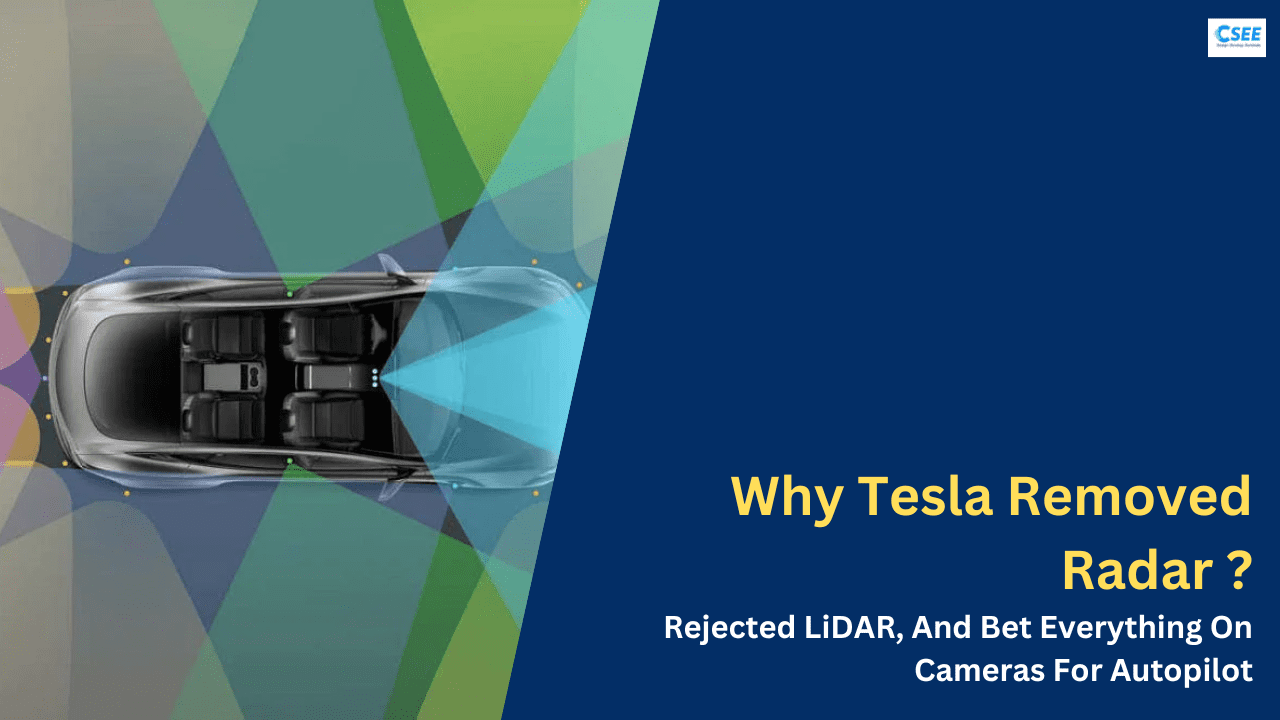
6. Tesla’s Camera Hardware Setup
Tesla uses multiple cameras:
- Front narrow
- Front main
- Front wide
- Side repeaters
- Rear camera
Benefits:
- 360° coverage
- Overlapping fields of view
- Redundancy through vision
- Depth perception through motion
7. How Cameras Replace Radar and LiDAR
7.1 Depth Estimation Using Vision
Cameras estimate depth using:
- Perspective
- Relative object size
- Motion over time
- Stereo vision
- Neural network predictions
This is similar to how humans judge distance.
7.2 Velocity Estimation
Instead of Doppler radar, Tesla uses:
- Frame-to-frame object tracking
- Optical flow
- Temporal consistency
Neural networks learn speed visually.
7.3 4D Perception
Tesla processes:
- 3D space
- Over time (4th dimension)
This allows:
- Better object prediction
- Understanding motion
- Intent estimation
8. Neural Networks, Not Handwritten Rules
Traditional ADAS systems rely on:
- Hard-coded rules
- Thresholds
- Manual tuning
Tesla uses:
- End-to-end neural networks
- Trained on real-world data
- Improved continuously
This allows the system to learn, not just follow rules.
9. Tesla’s Biggest Advantage: Data
Tesla has:
- Millions of cars on roads
- Billions of miles of driving data
- Edge cases from all conditions
Every Tesla contributes:
- Camera footage
- Rare scenarios
- Failure cases
This data feeds Tesla’s AI training.
10. Why Vision Scales Better Than Sensor Fusion
Sensor Fusion Problems:
- Complex system integration
- Difficult debugging
- Conflicting data
- Higher costs
Vision-Only Advantages:
- Simpler architecture
- Faster AI improvement
- Software-driven progress
- Lower hardware dependency
Tesla believes simplicity enables reliability.
11. Addressing Safety Concerns
11.1 Weather Conditions
Critics argue cameras fail in fog and rain. Tesla responds:
- Humans also rely on vision
- Cameras see headlights and reflectors
- Neural networks adapt over time
Radar does not solve all weather problems either.
11.2 Redundancy Without Multiple Sensors
Tesla uses:
- Multiple cameras
- Overlapping views
- Software redundancy
- Model cross-validation
Redundancy is achieved through vision diversity, not sensor diversity.
12. Initial Challenges After Radar Removal
After 2021:
- Speed limits were restricted
- Following distances increased
- Some features were limited
This was temporary.
Over time:
- Vision-only performance improved
- Phantom braking reduced
- Driving smoothness increased
13. Industry Reaction
Supporters:
- Vision aligns with human driving
- Data-driven AI will win
- Hardware independence matters
Critics:
- Radar provides redundancy
- LiDAR increases certainty
- Tesla is taking risks
The debate continues.
14. Regulatory Perspective
Tesla’s approach shifts focus to:
- Software validation
- AI training quality
- Continuous improvement
Regulators are cautious but watching closely.
15. Long-Term Goal: Full Autonomy
Tesla’s end vision:
- No steering wheel
- No pedals
- Robotaxis
- Global scalability
This requires:
- Understanding the world
- Not just detecting obstacles
Vision-based intelligence is key.
16. Lessons for Automotive Engineers
Key takeaways:
- More sensors ≠ better autonomy
- Data quality matters more than hardware
- Software-defined vehicles are the future
- AI is the real differentiator
Conclusion: A High-Risk, High-Reward Strategy
Tesla’s decision to remove radar and reject LiDAR in 2021 was not a shortcut or cost-cutting move. It was a deeply technical and philosophical choice.
Tesla believes:
- Vision is the foundation of intelligence
- AI improves faster than hardware
- The real world is visual
- Autonomy is a learning problem
Whether Tesla’s vision-only approach becomes the global standard or remains a unique path, one thing is clear:
Tesla permanently changed how the world thinks about self-driving technology.
Thanks for reading.
Also, read:
- India’s GaN Chip Breakthrough: Why Gallium Nitride Could Shape the Future of Defense Electronics
- India’s Chip Era Begins: A New Chapter in Semiconductor Manufacturing
- FlexRay Protocol – Deep Visual Technical Guide
- Top 50 AI-Based Projects for Electronics Engineers
- India AI Impact Summit 2026: The Shift from AI Hype to AI Utility
- Python Isn’t Running Your AI — C++ and CUDA Are!
- UDS (Unified Diagnostic Services) — Deep Visual Technical Guide
- Automotive Ethernet — Deep Visual Technical Guide